Transcript
Chapter 1: Arrival at the museum
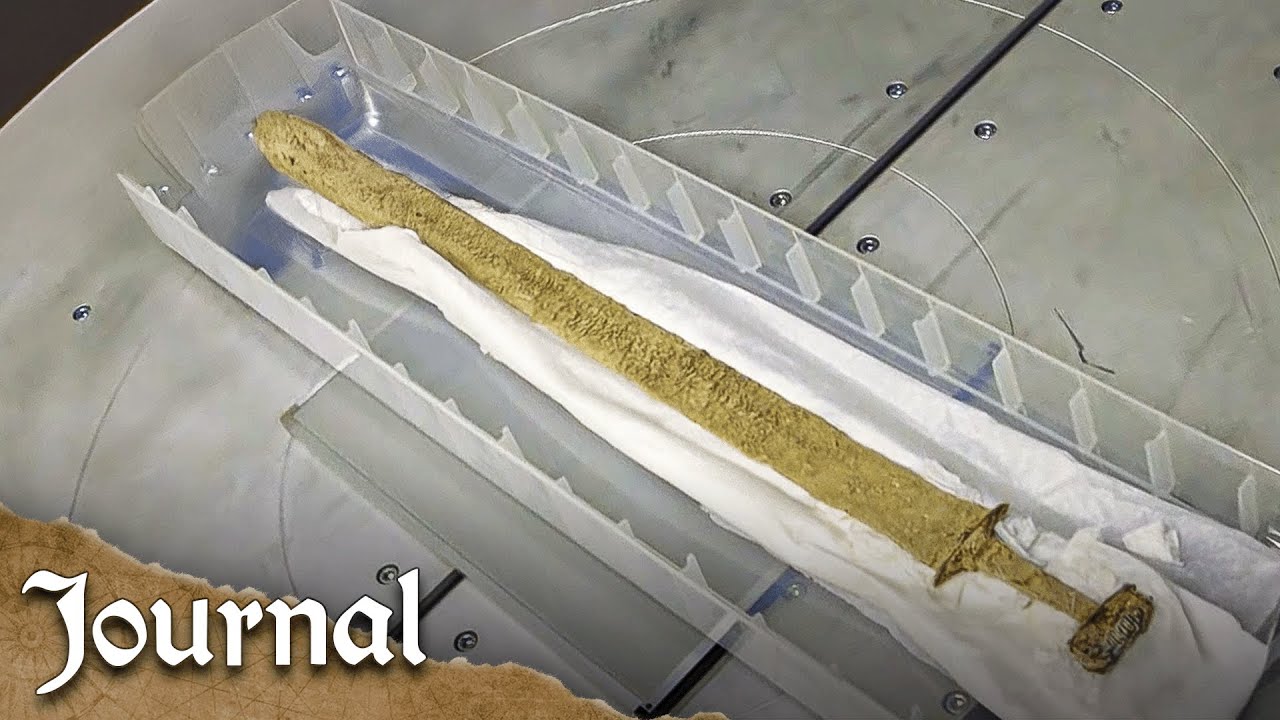
In central London, a very special object has arrived at the British Museum. It’s so rare and the historical information it holds potentially so valuable that the fines liaison officer who recorded it in Kent, Joe Armit, is personally escorting it to the museum. I have something in this I was never expecting to uh see in my entire career. And now I’m off to conservation to uh get it properly looked after. There’s a bit of a bump there, Joe. Watch it. Conservator Haley Bullock has been tasked with uncovering the object’s secrets. Oh, wow. That’s quite exciting. It needs to go to be x-rayed first and then we see what we’ve got. Four floors deep beneath the museum is a cutting-edge X-ray imaging lab which radiologist Daniel O. Flynn uses to examine anything from Roman sculptures to mummified Egyptian crocodiles. Yes, I can’t wait to see what the X-ray shows has done. But today, Haley needs him to investigate the rare artifact Joe’s brought from Kent.
Chapter 2: X-ray imaging analysis
This sword that they suspect is more than 1,500 years old. Daniel is initially looking to see if it contains precious metal. If it’s 10% gold or silver, it is potential treasure and must be reported to the local coroner. We can see very well preserved dense metal. And we can also see these dark regions which are regions of corrosion. This metal is probably iron or maybe steel. And this is something much more dense. So, for example, silver. They’re also looking for clues that might indicate the exact period of history it’s from. If I turn the contrast up, oh, look, we can just about see the hint of some decoration there and also some arches on the pommel itself. Moving down to the blade, we can see there’s a herringbone pattern, like a zigzag, and that strongly implies that there was pattern welding. The pattern welding helps identify the sword as Anglo-Saxon as this was a manufacturing technique used by metal workers in the early Middle Ages. To do that, they would have twisted square cut pieces of rod in alternate directions, welded them together, and that would give you this pattern.
Chapter 3: Conservation ethics
Back in conservation, Haley and Joe get a closer look at the sword under the microscope. Joe, this sword is fabulous. We don’t normally get to see them so complete. I was utterly gobsmacked when I saw this. The Kent sword was found in what is believed to be an unmarked Anglo-Saxon grave. And such discoveries can raise ethical questions around the wishes of the deceased. Graves are always going to be a very emotive subject. We’re always working to protect them. Unless we have no choice, we do not want to disturb them. Corrosion to the sword’s blade has happened slowly over time, but its recovery from the soil has now put it under greater threat. This kind of object that really needs care and attention really quickly. As soon as it hits the air, it’s all of that damage that’s been done in the ground begins accelerating. We now have a duty of care for this object. We have a duty of care for the person that was in the grave. Haley hopes to stabilize its condition whilst also uncovering the intricate decoration which could reveal more about the person the sword was found with. But it requires a deft touch. It’s quite delicate. It’s quite fragile. It’s been buried for hundreds of years. It’s not as robust as it looks. So, we have to be careful with it.
Chapter 4: Discovery of the bowl burial
But there’s another Anglo-Saxon discovery recently made that could prove even more significant than Joe’s swChapter 5: Investigating Ned’s graveord from Kent. And detectorist Sue Washington is the woman who made it. There’s lots of tin foil. Today, Sue is on a club dig near Marlo in Buckinghamshire. But as her husband Mick can attest, this was never meant to be her hobby. For my 55th birthday, Sue bought me a detector and we went detecting together. And it was after the first time I was hooked. Hooked, weren’t you? If it were just I detecting, there’s no way in the world I would be allowed out from 8:00 in the morning till 6:00 in the evening. Quite right. It’s far worse than golfing. Oh, that’s a good signal at last. The couple are members of the Maidenhead Search Society, and it was on a club dig in 2018, not far from here, that Sue made the find of a lifetime.
Suddenly, we’ve got these rims of two vessels in the ground. Few of the other members came over and they helped us dig. And people with much more experience than I’ve got saying, “Actually, this could be good. This could be really interesting.” Sue immediately contacted the Buckingham Sheriff Fines liaison officer, Arwin Wood, who identified the bowls as sixth century. Today, after 2 years of painstaking conservation work, Arwin’s invited Sue to Discover Bucks Museum to see the bowls for the first time since their excavation. Wow. Unbelievable. Fantastic. I cannot believe they look great, don’t they? Oh my god. I actually cannot believe it. How on earth have they got those together? I know. They’re beautiful. They’re amazing. I love them. The copper alloy bowls are similar to silver ones recovered at Sutton Hoo, which are now a key part of the exhibit at the British Museum.
Chapter 5: Investigating Ned’s grave
What do you remember, guys? Yeah, somewhere. Somewhere over there. Over there. Somewhere just along there. But bronze bowls weren’t the only thing unearthed that day. A toe bone confirmed that Sue had stumbled upon an ancient grave. We had mixed feelings about finding a grave. It’s lovely to find, but then he’s there. Do you? He should be staying there really with all his goods. We gave him a name, didn’t we, sir? Yeah, we did. Gave him a name, Ned.
Archaeologists began the investigation into Ned’s burial ground. But it wasn’t until the summer of 2020 that funds were raised by the University of Reading to carry out a full excavation.
Sue was invited to join the dig where Ned was revealed in the same position he laid in for 1,500 years. The skeleton was pretty much intact. He was laid perfectly in this grave and he had his hands clasping his sword. That was very emotional to see that spears were laid out down by his feet and then there were the shears that were by his head and the tweezers were around there. So I think probably pruned himself a little bit liked the way he looked. Typical man. Back at Discover Bucks Museum, the restored bowls are allowing Arwin to piece together a picture of who Ned was. And it’s looking increasingly likely that he was a man of very high status. These are valuable objects, and it would have been easy for the family to keep the objects, but they felt it was important to place them in the grave. Sue’s bowls not only reveal Ned’s standing in his community, but his continental connections, too. They’re sixth century, so it’s early in the period. They’re either made on the continent or copying objects made on the continent, which shows that he had links with the continent or he was a first or second generation immigrant. Fantastic. I mean, I had no idea the importance of it. It would be interesting now to find out a little bit more about him. Yes, definitely. The skeletal remains have been undergoing research at the University of Reading and experts are almost ready to share their findings so Sue can finally get a better sense of who Ned really was.
Chapter 6: Revealing sword secrets
An individual would have been buried with his most precious items, but swords are not that common, which is why we know this one would have been quite high status. The handle is really small. So to grip that, you’d have to have a really dainty small hand. One hell of a grip as well, ‘cause that’s not a small sword. You’d have to be pretty strong. The blade reveals clues as to how this powerful man may have wielded the sword. We’ve got two cutting edges either side. So, it would have been used for more of a slashing motion than a thrusting motion. It will be really interesting to see once you’ve done your conservation if we can see any nicks along that blade to see if it has been used for slashing people.
X-rays and initial cleaning have shown there could be highly decorative precious metal under dirt and corrosion. The pommel is absolutely beautiful. It looks like silver, but it’ll be interesting to reveal some more. It’s going to take a long while, Joe. Haley has been using tiny swabs dipped in deionized water to gently wipe the mud from the surface, but at times the sword needs to go under the knife itself. There’s a bit of copper corrosion on that, which won’t come off with a swab. So, I’m just going to use a scalpel blade. You have to be really careful because my stainless steel blade is very hard and I am cleaning a very delicate soft metal, silver. So, you can do some damage to an object if you don’t have a steady hand. Cautiously, Haley scrapes away the rust and dirt to unveil trademark Anglo-Saxon decoration. I’ve just revealed a little area here and it does look zoomorphic. It looks like a little eye just there. Animals such as birds and serpents were significant in Anglo-Saxon culture and metal workers used them as decoration perhaps to offer protection from evil forces. We can see the pure skill and all that kind of beautiful zoomorphic designs connected to the early medieval people and those that we now call Anglo-Saxons.
Their findings will be in the curator’s report and passed to the Kent Coroner. If the sword is declared treasure, a local museum has expressed interest in acquiring it. But there’s many weeks of painstaking work ahead before that becomes a reality. And Haley suspects the sword will have more secrets to reveal. This would have been buried many, many hundreds of years ago, and I’m one of the few people that get to resurrect it, and I get to uncover its secrets that went to the grave with this person. It’s amazing. I mean, what an amazing job. I can’t believe I get paid to do it.
Fascinating.