Transcript
6,500 years ago, people were building these amazing stone monuments in a place you probably wouldn’t expect, the Sahara. When you picture the Sahara, you probably imagined endless sand dunes. But did you know it’s absolutely packed with archaeology? Thousands of years ago, this wasn’t the endless desert we imagine today. People lived here, created incredible rock art, and built beautiful stone monuments. And inside some of them, archaeologists found something unexpected.
Hi, I’m Hugh. If you’re new here, I have a PhD in archaeology and for the last almost 25 years, I’ve been taking part in archaeological fieldwork all across the world. Now, there are a lot of misconceptions about the Sahara. When people picture it, they often imagine endless sand dunes potentially covering untold archaeology, maybe even a hidden advanced ancient civilization. But in reality, only about 15 to 20% of the Sahara is covered in sand. Much of the rest of it looks more like this: broad arid landscapes dotted with rocky ridges, waddies, and it is absolutely covered in archaeology despite what people might say.
So, in this video, I want to cover one of my favorite archaeological structures, the corbay, which happens to be the French word for basket, continuing the long tradition of archaeologists naming structures after things they just happen to look like. I’m looking at you, desert kites.
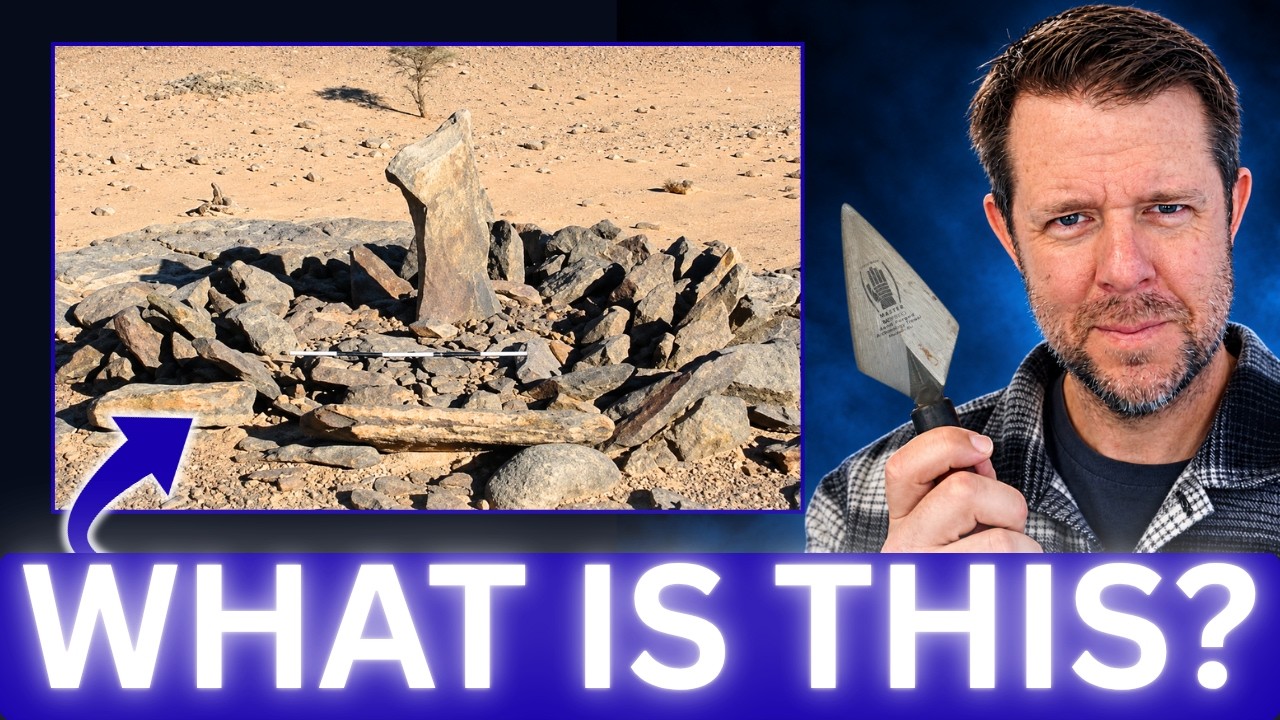
Okay, so to look at the cores, we are heading to a region called the Mesac Plateau. Down here, there are hundreds and thousands of structures, including our little baskets. So, cores are essentially relatively large circular monuments built across the landscape. They usually consist of a little stone platform kind of thing, sometimes surrounded by walls or standing stones, and they can be several meters across.
Now, it’s not the design of these structures that make them particularly interesting. It’s actually what was found inside of them, because it ends up that the ancient people of the Messac Plateau had potentially a little hobby that might seem a bit strange to us today. They loved beating cattle to death in order to make it rain. Cool. Now, this may sound utterly unbelievable, but I promise you it’s not a load of bull. So, let’s unpack these baskets and get into the beef of the matter. That was way too many puns even for me.
Hey guys, sorry to interrupt, but I’m ticking something off the bucket list because I’m here at Chatt Hulyuk. Now, if you like real phenomenal archaeology just like this, presented by a real archaeologist just like me, make sure you subscribe and turn on notifications so you don’t miss any cool archaeology.
So this is the paper I’m going to focus on today and the link is down in the description if you want to read it. The writers of the paper excavated a variety of stone structures in this region, not just the corays, but that’s what I’m going to focus on. So in the cores, they primarily found three different things: dead cattle, stone maces, and lots of pretty flowers. Now mix all of these things up together and we actually have a really interesting story.
So, first up, they radiocarbon dated the bones, and they found that these structures were used over 6,000 years ago, with radiocarbon dates being reported back as early as the middle fifth millennium BCE. Now, the animal remains inside were primarily cattle, especially adult cattle, which is great because adult cattle have a lot of meat on them, and eat them they did. And it ends up that a large portion of the bones were deliberately burnt, with many becoming completely calcinated, which is kind of where the bones are cooked at a high temperature for long enough that all the organic material kind of disappears and you’re left with these small white flaky very mineralized pieces of bone.
Now, because these bones have been burnt so much, the researchers suggest that after the meat had been eaten, the remaining bones were collected, burnt, and then deposited inside these monuments. So the evidence is that there was a lot of cattle being killed, eaten, and burnt. Amongst the cattle bones, they found quite a large number of these stone maces. Archaeologists repeatedly found these heavy stone objects in and around the monuments, often alongside the cattle remains. And there is evidence that some of these stone tools were made on the spot with evidence of chipstone next to a mace that could be refitted back onto it. So they were clearly an important part of what was happening here. But what they were exactly used for, that’s not quite certain.
The researchers’ theory is that some of these may have been used to kill cattle or perhaps deliver a final symbolic blow once the cattle was dying through other means. The ancient equivalent of one more for good measure. I mean, it’s a pretty aggressive way to kill an animal to kind of bonk it right on their head with a big stone mace. I mean, and I say that as someone who understands the circle of life. You know, my mom owns a farm. She raises cattle on it. And unfortunately for us, my kids, my nephews, and nieces have named every single one of those cows. And I will say, I just don’t think I could bring myself to hit one in the face with a rock in order to kill it. Especially cutie pie or vanilla milkshake. Fluffy Todd. That’s my boy Fluffy Todd.
So obviously with the cores being smack bang in the center of the Sahara where it is super hot and arid today, it means that the remains, that is the animal bones, are really badly preserved and quite fragmentary. So apart from being able to do C14 dating of the bones, they’ve only been able to look at one other type of scientific analysis, which is that they’ve done an analysis on isotopes. So what does that mean?
So, if you don’t know much about isotopes, as you eat and drink, your body is sucking in nutrients and chemicals, all the good stuff that helps us grow. And when a human or an animal is young, some of these chemical signatures get incorporated into things like your bones and teeth. Now, bones are constantly growing and changing, but teeth are different. Once they develop, they’re basically locked in, trapping a little chemical story of what you were exposed to as you grew up, as your teeth were developing. So archaeologists can study the isotopes in your teeth and hey presto, they can work out quite a lot about you. It’s why as an archaeologist I beg you please brush your teeth twice a day and floss because an archaeologist just like me in the future might want to dig up your skeleton and rip out one of your teeth and test it.
Okay, so back to our cattle. The isotopes in their teeth tell a really interesting story. So the research suggests that these cattle were generally being born around the same time of year, which fits with a seasonal pattern in how they were being managed. Some of the animals have different chemical signatures suggesting that they’ve been living and grazing in different areas before ending up in the same spot. And in a few structures where they had multiple cattle inside, the isotopic signature suggests that they came from different parts of the region. So rather than every animal coming from the same herd, this raises the possibility that they have different herds and therefore different groups of people bringing their cattle together at these monuments. And that’s really interesting because it kind of demonstrates that these aren’t isolated structures where a single family goes there and buries one of their dead cows. But instead, these are places where communities are coming together to share their love of beating cattle to death.
Now, they also looked at the archaeobotanical remains. That is all of the remains of plants that were present inside of these structures. And they preserved pretty well. There was a huge amount of fruit from a plant called a rumx or sorrel along with other seeds, fruits, and plant remains. In a couple of these structures, they even found concentrations from flowering plants, which suggests that actual flowers may have been brought into the monuments. How pretty.
So, the researchers think that this might indicate that the people were busy little bees and collected flowers as some form of offering that they placed inside the structure. Cool. And based on the plants they found, they think that these events were happening towards the end of the dry season, probably around April or May.
So what are these things? Well, in the thousands of fragments of bone that they analyzed, they didn’t find any human remains. So these aren’t tombs. They also didn’t find any kind of typical domestic assemblages that you might find in someone’s house. You know, lots of hearths and fireplaces where people are cooking. They’re not finding, you know, tons of chipstone for making stone tools or jewelry or any of that kind of stuff. And so when we discount burials and we discount domestic structures, what are we left with? Well, the only word we can really use is ritual. What is that?
Now, the joke in archaeology is that when you don’t know what a structure is, you just call it ritual. All right, stop. That’s all.
So with the fact that these events took place as far as we can see at the end of the dry season, the question is were they sacrificing cattle as part of rituals connected to the coming rains? Potentially the people were gathering here, killing and eating cattle, putting flowers down, carrying out these various rituals, and then moving back out into the wider region as the rains arrived. And that might explain why the cattle all look like they’ve been eating different things. We simply don’t know, but it’s a really interesting theory. What do you think? Let me know down in the comments what you think these structures were used for.
But why are they important to me? Why do I give a stuff about corbates? Well, because in the project that I co-direct in Saudi Arabia, we also have structures that we think are ritual structures. Dude, [screaming] stop. Now, these structures are called mustatal. They are monumental structures up to 600 m in length. And they are almost exclusively filled with the remains of horned animals like cattle and some sheep and goats. Now, I have a couple of videos about Musatil already, but guess what? I’m about to make another one because we have a paper that is about to be released on some new excavation results on Musatil from around the region of Kaibar in Saudi Arabia. These are the ones you can see on the screen. And I’m going to make sure that I bring you a video on those results.
And the best way you can make sure you don’t miss that video is to hit that subscribe button harder than an ancient Libyan hit a cow in the head with a stone mace. Whilst you’re there, why not press the like button? And do me a favor. If you have a really good cow joke or pun, chuck it in the comments because I clearly love a dad joke and I need more. And obviously, if you’re on your mobile phone, you can press that hype button. Anything like this helps with the algorithm, helps support me and the video, and also helps reveal the amazing archaeology of the Sahara to the wider world. Thank you so much for watching. And hey, these are for you. You deserve them.