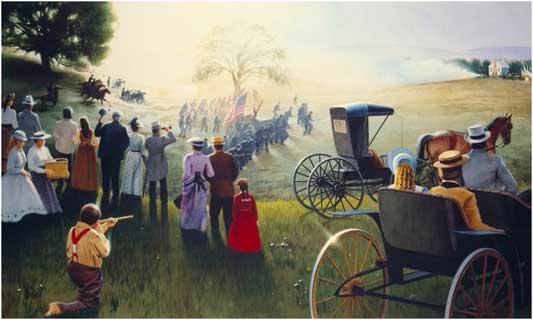
At the Battle of Bull Run:
Posted on 08/28/2026 7:11:04 PM PDT by Diana in Wisconsin
War is never a picnic, and the American Civil War became the deadliest war in US history. What everyone thought would end in a matter of weeks became a four-year battle between the Union and the Confederacy. The amount of supplies and rations needed was sometimes underestimated because the war dragged on, and soldiers on both sides had to get creative with their meals.
Soldiers during the Civil War were used to having their meals cooked for them, so it was a steep learning curve out on the battlefield and with sparse ingredients. The rations were technically edible but not always the tastiest, and while there were sometimes treats to boost morale, they were rare. These seven foods were real things that Civil War soldiers ate, making the best of what they were given.
Hardtack
A staple for Union soldiers during the Civil War was hardtack. Aptly named, hardtack was a rock-hard cracker made with flour, water, and salt. As long as it stayed dry, hardtack could last a long time, though the crates carrying hardtack would often get wet and mold or worms would begin to infest it. Soldiers soaked their hardtack in coffee, cooked it in lard, or broke it apart with the butts of their rifles to make it a bit more palatable.
Johnny Cakes
The Union army might have had hardtack, but the Confederate states didn't grow much wheat. The food Confederate soldiers more often had was Johnny cakes. These cakes were just as hard and dry as hardtack, but were made with cornmeal instead of flour. Without milk, sugar, or eggs to make cornbread, the Johnny cakes were hardly enjoyable, and Confederate soldiers would cook them with lard or even just steal food from their Union prisoners.
Salt Pork
When it was available, meat was given as part of the soldiers' rations. Usually pork, but sometimes beef, was overly salted and then stored in barrels of salt to preserve it as long as possible. Soldiers had to scrape off as much of the salt as they could before cooking the meat, but it still tasted incredibly salty. The salt pork was often the fattier portions of the animal, so the fat and grease could be used to cook other foods or as lamp oil.
Chicory Root Coffee
Coffee was another staple in the Union soldiers' rations, but the Confederate soldiers often had to struggle without it. They took to making their own substitutions, grinding up plants and vegetables to brew in the hopes it would taste similar. They used dandelions, rye, and sweet potatoes, but the most common substitute was chicory root, or the whole chicory plant. Some said it gave off a slightly similar taste to coffee, which was the best the Confederates could do until they could take rations from the Union soldiers or trade with them in temporary truces.
Desiccated Vegetables
Knowing that soldiers needed more than salt pork and hardtack to keep them healthy and strong, the Union and Confederacy began dehydrating vegetables to send to their troops. These weren't like the kale chips at Whole Foods, though. Several different vegetables, including carrots, onions, celery, and potatoes, were dried and then compressed into tight, hard pucks. They tasted so awful that soldiers started referring to them as "desecrated vegetables."
Condensed Milk
After seeing children sick from drinking spoiled milk, Gail Borden worked to make a shelf-stable milk. Using a vacuum evaporator, Borden invented condensed milk, which was popular with young children and Civil War soldiers alike. The Union army loved having a calorie-dense food that wouldn't spoil, and the Northern soldiers loved that it was sweet. Compared to their other rations, it was heavenly! Condensed milk played such a big role that some historians have said it helped the Union win the war.
Molasses
When sugar was hard to come by, molasses stepped up as the Civil War sweetener. This thick syrup was sent to the troops with their rations to aid in the eating of the less tasty offerings. Soldiers on both sides used molasses to sweeten their hardtack or Johnny cakes, as well as their coffee. Some men even made candy out of molasses since it was similar to taffy after boiling and drying it. This sweet treat helped keep morale from plummeting during an already depressing and bloody war.
Dear FRiends,
We need your continuing support to keep FR funded. Your donations are our sole source of funding. No sugar daddies, no advertisers, no paid memberships, no commercial sales, no gimmicks, no tax subsidies. No spam, no pop-ups, no ad trackers.
If you enjoy using FR and agree it's a worthwhile endeavor, please consider making a contribution today:
Click here: to donate by Credit Card
Or here: to donate by PayPal
Or by mail to: Free Republic, LLC - PO Box 9771 - Fresno, CA 93794
Thank you very much and God bless you,
Jim
I seem to recall reading that civilians would sometimes have ‘picnics’ while watching the battles...
Gen. Grant served crow at Appomattox.
I really doubt that the foods listed were available much to the average soldier unless he was on some kind of a brief leave.
At the Battle of Bull Run:
That story came from beginning of the war at Bull Run, and the day turned into shock and horror at the spectacle of the bloodiest battle in American history to that point, and the defeat of the Union forces.
Bookmark
Big ships and shore duty in the NAVY has good food.
I remember the Frugal Gourmet saying johnnycake was a term derived from “journey cake” —One of the most widely accepted theories suggests that the name “johnnycake” is a corruption of “journey cake.” This theory posits that the johnnycake was a convenient food for travelers, as it was easily portable and could be cooked quickly over an open fire. The name “journey cake” would have described its suitability for taking on journeys. Over time, the name may have evolved through colloquial usage, eventually becoming “johnnycake.”
https://meemawsrecipes.com/why-is-it-called-johnny-cake/
This theory aligns with the historical context of the colonial era, when travel was often arduous and food supplies were limited. The johnnycake’s simple ingredients and ease of preparation made it an ideal choice for those on the move. —from Meemaw’s Recipes.
As to Jeff Smith, Sthe PBS star of The Frugal Gourmet,
in 1997, Smith’s world was turned upside down. A series of allegations surfaced, accusing Smith of molesting several young men who had worked as interns on his show. The allegations dated back to the 1970s and 1980s, and several of the alleged victims came forward to share their stories.
Smith denied all of the allegations, but the damage had already been done. PBS immediately canceled “The Frugal Gourmet,” and Smith’s cookbooks were pulled from shelves. The chef’s reputation was in tatters, and he became a pariah in the culinary world.
From Flavorycooking.
I have adventured 17 year-old tuna something from an MRE. It reminded me of something like I might imagine alum to taste. Didn’t make me sick.
The tropical chocolate bars were similar to eating a stick of chalk.
None of it was anywhere near hard tack or salt pork though.
What about goober peas ?
Thanks.
Cool post - bump for later...
I like hickory, condensed can be used to make peanut butter cups, with molasses
While in Croatia in the 1980s we got to eat French rations , they were really good ,LOL
I am surprised that chicken was not a big part of the Civil War diet.
When I first read about it as a boy, it made an impression about the transformation of the event for the spectators, they had expected to see the glamour of the uniforms and brave men on a neat and honorable battlefield with some order and precision in the battle, and then their panic and horror at the terribleness and bloody chaos and panicked retreats of their boys in uniform, and their deaths and horrible wounds in such great numbers, and the biggest shock of all, to lose, shamed, to be routed by the confederates, and to have to reevaluate what this war might actually become instead of the short event that many had thought it would be.
I imagine that a lot of those spectators were deeply traumatized that day.
True dat.
I think the reason chicken used to be such a big deal was that chickens used to take a lot longer to develop to eating size, which is why chicken we ate in the past tasted better, and they didn’t have the factory chickens and chicken factories that we have today.
How chickens tripled in size since the 1950s
The story of how genetics shaped chicken into the go-to protein of choice around the world.
https://www.zmescience.com/feature-post/how-chickens-tripled-in-size/
That wasn’t just better cooking. Heritage chickens — breeds that existed before the industrial era, with genetic lineages that developed over generations of natural selection — produced meat that was genuinely different in composition. The muscle fibers were denser. The fat was distributed differently. The birds had lived long enough for their bodies to develop the kind of complexity that shows up on the plate.
Industrial chickens, by contrast”.........
https://www.msn.com/en-us/health/nutrition/the-real-reason-chicken-used-to-taste-different-and-what-the-industry-changed/ar-AA1YsR2l
Disclaimer: Opinions posted on Free Republic are those of the individual posters and do not necessarily represent the opinion of Free Republic or its management. All materials posted herein are protected by copyright law and the exemption for fair use of copyrighted works.