
Posted on 08/03/2026 5:06:18 AM PDT by Red Badger
Key points
* Your body needs a small amount of sodium to work properly, but too much sodium is bad for your health.
* While sodium has many forms, most sodium we consume is from salt.
* Most Americans consume too much sodium.
* Most sodium comes from processed and restaurant foods.
=============================================================
Health risks
Eating too much sodium can increase your blood pressure and your risk for heart disease and stroke. Together, heart disease and stroke kill more Americans each year than any other cause.
Most people eat too much sodium
Your body needs a small amount of sodium to work properly, but too much sodium is bad for your health. Americans consume more than 3,300 milligrams (mg) of sodium per day, on average. This is well above the federal recommendation of less than 2,300 mg of sodium daily for teens and adults as part of a healthy eating pattern.
Sodium in everyday foods adds up
Sodium is found in foods from almost all food categories. Some of the top sources of sodium for U.S. adults and children ages 1 and older are listed in the following table:
Sodium or salt?
Salt and sodium are not the same. Salt is sodium chloride, which is table salt. Sodium chloride is 40% sodium and 60% chloride. One teaspoon of table salt contains about 2,400 mg of sodium.
Sodium is a mineral found in many ingredients in common foods:
Monosodium glutamate (MSG).
Sodium bicarbonate (baking soda).
Sodium nitrate (a preservative).
Tips for Reducing Sodium Intake
Why it's important
Eating too much sodium can increase blood pressure and the risk for heart disease and stroke. Together, heart disease and stroke kill more Americans each year than any other cause.
Even foods that may not taste salty can be major sources of sodium. Foods with only moderate amounts of sodium, such as bread, can be major sources of sodium because they’re eaten so frequently.
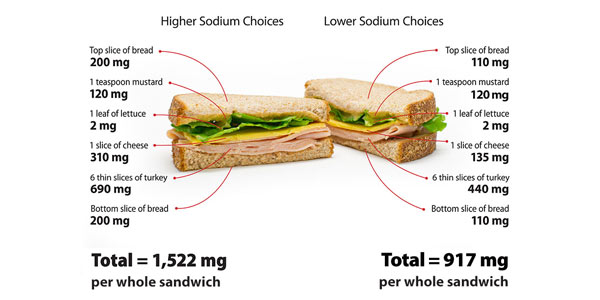
Choosing ingredients with lower sodium reduces the total sodium content of meals.
At the grocery store
* Buy fresh, frozen, or canned vegetables with no salt or sauce added.
* Choose packaged foods labeled "low sodium," "reduced sodium," or "no salt added" when available.
* Compare the amount of sodium in different products by reading Nutrition Facts labels. Check the amount of sodium per serving and the number of servings per container. Choose the options with the lowest amounts of sodium.
* When possible, purchase fresh poultry, fish, pork, and meat, rather than cured, salted, smoked, and other processed meats.
* For fresh items, check to see whether saline or salt solution has been added—if so, choose another brand.
* Ask your grocer if they have a low-sodium shopping list available.
At home
* When cooking, replace or reduce the amount of salt you use. Alternatives could be garlic, citrus juice, salt-free seasonings, or spices.
* Prepare rice, pasta, beans, and meats from their most basic forms (dry and fresh) when possible.
* Eat more fruits and vegetables.
* Limit sauces, mixes, and instant products, including flavored rice and ready-made pasta.
At restaurants
* Ask for nutrition information before you order, and select a lower sodium meal.
* Ask that no salt be added to your meal.
* Order vegetables with no salt added or fruit as a side item.
* Split a meal with a friend or family member.
* Keep takeout and fast food to an occasional treat.
Choose a heart-healthy diet
The Dietary Approaches to Stop Hypertension (DASH) eating plan is a simple, heart-healthy diet that can help prevent or lower high blood pressure. The DASH diet is low in sodium, cholesterol, and saturated and total fats. The diet is high in fruits and vegetables, fiber, potassium, and low-fat dairy products.
Dear FRiends,
We need your continuing support to keep FR funded. Your donations are our sole source of funding. No sugar daddies, no advertisers, no paid memberships, no commercial sales, no gimmicks, no tax subsidies. No spam, no pop-ups, no ad trackers.
If you enjoy using FR and agree it's a worthwhile endeavor, please consider making a contribution today:
Click here: to donate by Credit Card
Or here: to donate by PayPal
Or by mail to: Free Republic, LLC - PO Box 9771 - Fresno, CA 93794
Thank you very much and God bless you,
Jim
” Americans consume more than 3,300 milligrams (mg) of sodium per day, on average “
The real question is; how much of that 3300 mg is actually taken up by the body as elemental sodium?
What warnings did the CDC issue regarding COVID and the jab?
Thank you.
Heart problems are from too much sugar....not salt
I disagree with this premise. It’s bad if you already have underlying issues. It doesn’t cause the issue itself.
I agree. Same with sugar.
Your body needs a small amount of sodium to work properly, but too much sodium is bad for your health
——-
Salt and electrolytes are essential, particularly in hot weather and heavy exertion. Humans die without salt, they gloss over that. The link between sodium levels and high blood pressure is poorly understood, or at best laying a “one size fits all” template over it. The trick might be to get food producers to knock it back a bit.
Bingo. Agreed 100%.
I got rid of all added sugars, and most inherent sugary foods. Get the carbs low, like 20 mg per day, and then you have excellent BPs. YOu'll need to add salt occasionally to raise BP.
As for salts, get rid of the Morton crap, and look towards Himalayan and others.
My doctor got “in my face” to say, “You ARE watching your sodium consumption, aren’t you?”
Yes, I watch it go up every time I eat something, Doc..............
Sodium is a highly reactive metal (element #11).
I’ve personally witnessed a 1/4” square piece of sodium dropped into a glass of water...it bubbled like a Fizzy then the gas caught fire and continued burning until the sodium dissolved.
This is an article about the molecule sodium chloride, not the element sodium.
The writer is a fool.
It’s from our government..............
I agree. This is a therapeutic approach for people with hardened arteries.
How many young people die from higher sodium diets?
They don’t.
3300 is only 3 grams is only 1.2 ounces. The idea this could be bad for you is preposterous.
Bfl
my cardiacthoracic surgeon told me that salt is problematic only for those people who are salt sensitive, which isn’t that many except in the african-american population ...
still, junk food, highly processed food, fast food, and restaurant food are all loaded with a boatload of unhealthy additives and ingredients ... in general, the healthiest food is the food you cook/prepare yourselves from basic ingredients ...
I am a physician--M.D.
I also take Mounjaro. This has controlled my weight very well.
Every morning upon arising, I take and record my weight and blood pressure three times in each arm, recording the average. I also plot weight and blood pressure on chart paper.
I take these records to my physician every time I go for a check-up. He makes copies to show his patients how weight and blood pressure can be controlled.
It's easy once you get the hang of it. It becomes an easy habit, like brushing you teeth, combing your hair, or taking a shower.
I also have a strong family history of arteriosclerotic cardiovascular disease: mother, sister, father, aunt, uncles, grandfather, and both grandmothers died of it. I have no evidence of it.
Recently I underwent ultrasound evaluation of the arteries in my neck A question had been raised that I might have subclavian steal syndrome. I knew I didn't have it, and I was right, but I went along just for completeness sake and to be cooperative. No evidence of arteriosclerosis could be found.
I am 87 years old, look and feel much younger, evidently in excellent health.
My wife is too. She's 86. We've been married for 67 years. She also takes care of herself meticulously. In fact, I learned self-discipline from her.
Once you get in the habit of such discipline, it's easy; it becomes routine.
My physician said, "You've beat the curse!"
He's right.
You can too.
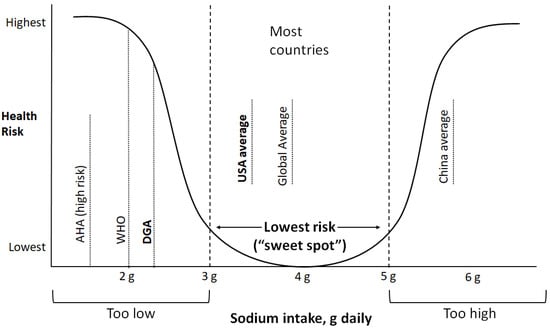
https://www.mdpi.com/2072-6643/13/9/3232
Disclaimer: Opinions posted on Free Republic are those of the individual posters and do not necessarily represent the opinion of Free Republic or its management. All materials posted herein are protected by copyright law and the exemption for fair use of copyrighted works.