Posted on 07/13/2026 11:32:57 AM PDT by Red Badger
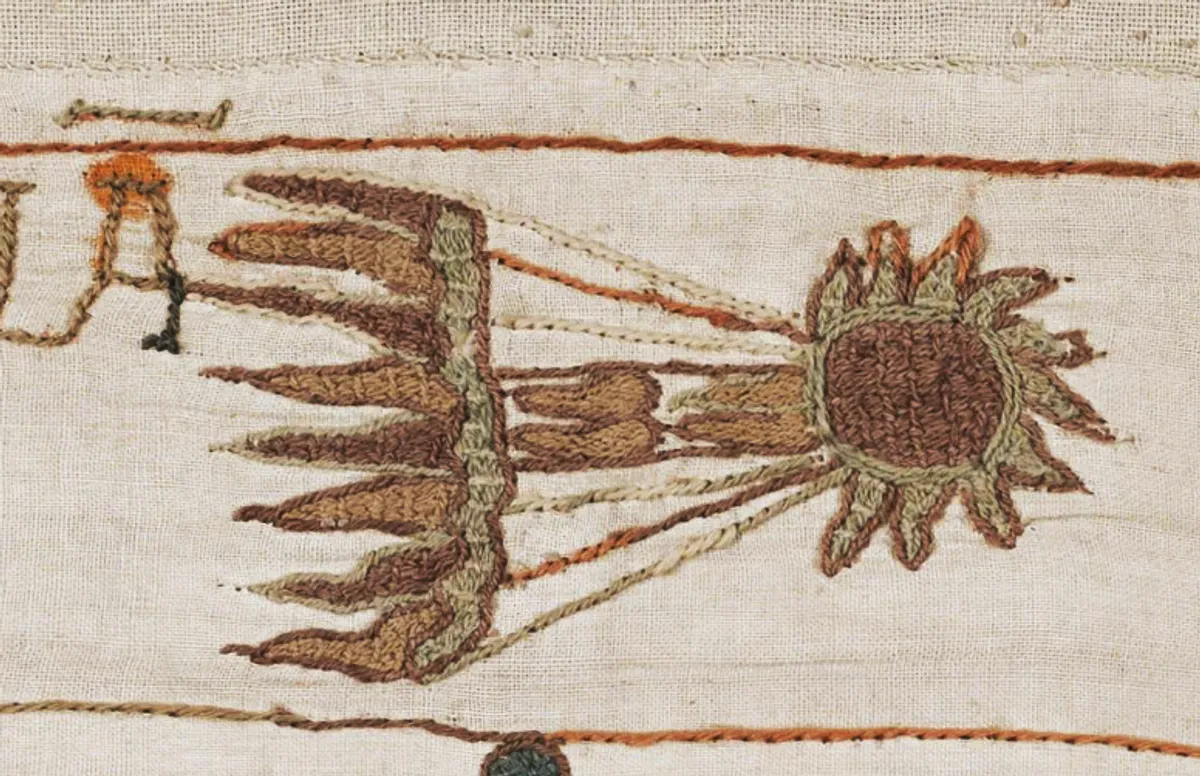
A detailed view of Halley's Comet in the Bayeux Tapestry.
Image credit: Unknown author via Wikimedia Commons (public domain)
============================================================================
The Bayeux Tapestry is one of the most famous textile works in the world, and for the first time in more than 900 years it has returned to England to be exhibited at the British Museum. The work of art depicts the events leading up to the Battle of Hastings of 1066 and the Norman conquest of England. It also depicts an important astronomical event, the return of Halley’s comet. Although not in the right place.
First of all, despite being the Bayeux Tapestry, it is actually an embroidery. A tapestry has the design woven into the fabric, while embroidery involves stitching it on. Despite the confusion, the work is one of the most impressive in the world. It is 68.3 meters (224 feet) long and originally 50 centimeters (19.7 inches) wide (though it now varies due to supporting cloth added later).
Blame it on the comet!
Comets have often been seen as a bad sign, an indication that something changing in the heavens might mean that something must be about to change on Earth too. Today we know that change is constantly happening, but in the past, the sky was seen as eternal and immutable. The presence of a comet was a challenge to that deeply held belief.
And that’s the symbolic meaning that Halley’s comet takes on in the Bayeux Tapestry. It appears soon after Harold became king in January 1066. The news is brought to the monarch, who then sees a ghostly fleet, a premonition of the Norman invasion that would take place later that year.
Even if we assume that the power of suggestion is such that hearing of a comet, King Harold immediately believes that he is in danger, there is an issue with this tale. Halley’s comet was not yet visible in January. It was only seen in late April.
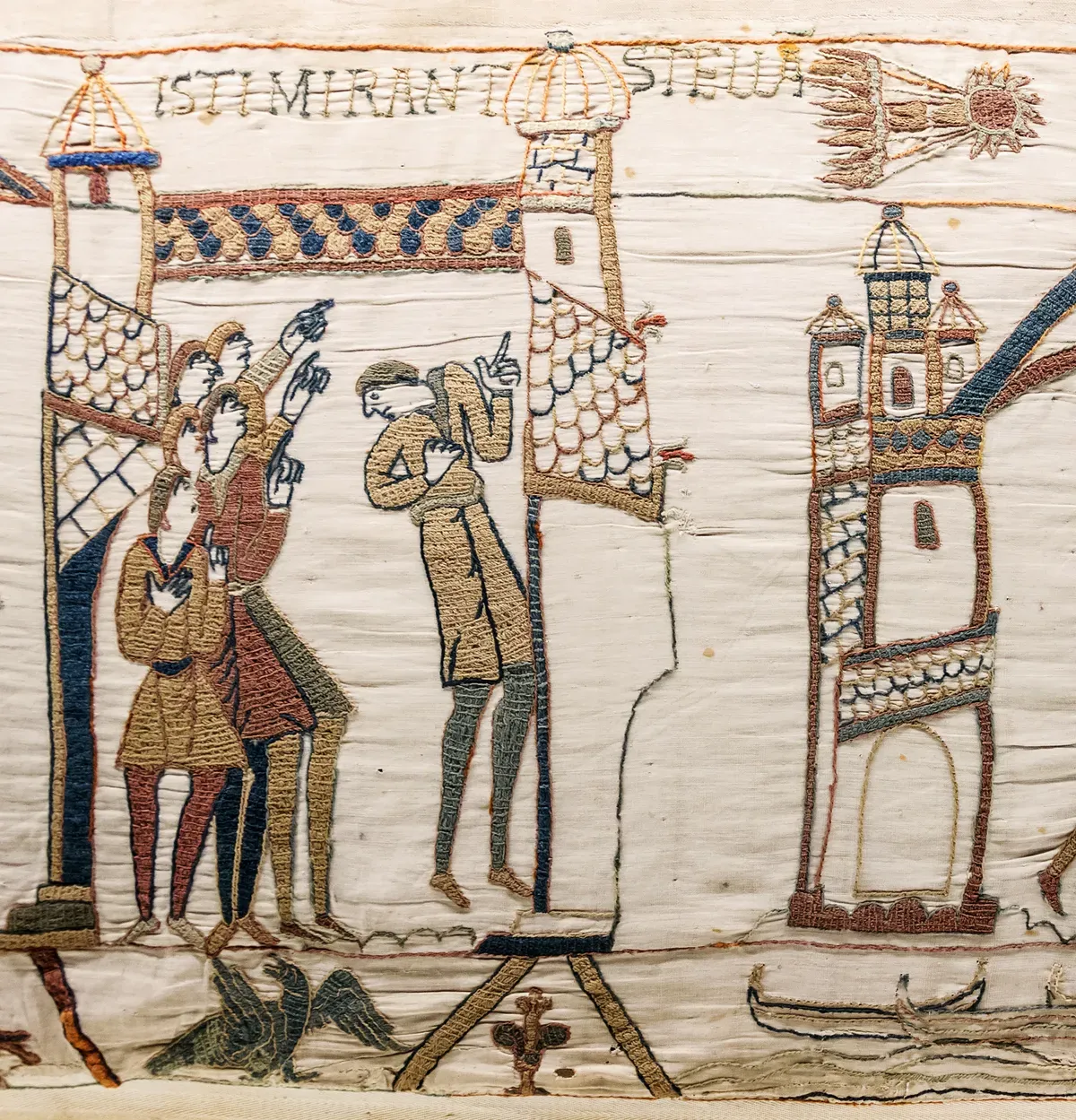
A portion of the tapestry showing a saw representaiton of the comet and sxi people inside a town point at the star. Halley's comet being spotted in the tapestry Image credit: Myrabella via Wikimedia commons (CC0 1.0)
=================================================================================
A constant celestial companion to humanity
“Halley's Comet is the only short-period comet that is easily visible from Earth with the naked eye. Its solar orbit time of 75-76 years makes it possible to see twice in a human lifetime. As a result, it is the most observed comet in human history, appearing in every major historical era,” Jake Foster, an astronomer at the Royal Observatory Greenwich, previously told IFLScience.
“Its depiction in the Bayeux Tapestry after appearing overhead during the Battle of Hastings in 1066 is one such example.”
The comet has been seen truly since the dawn of our species, with reports of its presence in the sky across history and across cultures. It takes its name from Edmond Halley, who would go on to be Astronomer Royal, and who was able to work out that the comet of 1682 had been near the center of the Solar System before.
It turned out that he might not have been the first to make this connection about the comet. A monk called Aethelmaer might have connected two passages of Halley to the same object. Still, he did not have the mathematical knowhow that would lead to the understanding of what comets really are.
“Halley's research included studying the astronomical records of two dozen comet sightings that occurred between the 14th and 17th centuries, examining their noted paths across the sky. Three of these sightings were found to have matching orbital patterns – factors such as reaching the same closest distance to the Sun (known as perihelion) and doing so from the same angle,” Foster told IFLScience.
“These sightings happened in 1531, 1607, and 1682, indicating an orbit time of 75-76 years. Halley even noticed that the comet was pulled on by the gravitational forces of Jupiter and Saturn when it got close to them, so he added this into his calculations to make his prediction even more precise. Halley first saw the comet with his own eyes in 1682 when he was 25 years old. He correctly predicted that it would return in 1758 but didn't live to see its return, dying in 1742 at the age of 85.”
Across science and art, the quintessential comet
Halley did not live long enough to see its namesake comet come back around, but his prediction was confirmed by Johann Georg Palitzsch, who was the first person to see the comet in 1758 on a cold Christmas Day.
And Christmas has a particular connection to the comet. The depiction of The Star of Bethlehem, the celestial sign that Jesus was born under according to one gospel, is usually pictured as a comet. And the inspiration is not just any comet, but Halley’s itself.
We can credit Giotto di Bondone's extraordinary 1305 fresco, The Adoration of the Magi, for this connection. The Christmas star is inspired by the Italian artist's own observation of Halley’s Comet during its 1301 passage.

the comet is potato shaped with one side release three jets of material. The nucleus of Halley's Comet, imaged by the Giotto probe on March 14, 1986. Image credit: ESA/MPS, CC BY-SA IGO 3.0
==========================================================================================
For this reason, the first space mission to comets, the European Space Agency's Giotto probe, was named after the artist. ESA’s Giotto was also the first deep space mission for the agency, and it encountered comets Halley and Grigg–Skjellerup. Its close encounter with Halley’s comet delivered the closest views yet of a cometary nucleus.
The last time Halley’s comet was around us, it was 1986, and it was the worst view that humanity had had of the comet in 2,000 years. We can be certain that in 2061, we will get a much better spectacle.
As my kids used to say “point my head” I don’t see the answer. Why coudn’t it been 1066 ? 1986- 1066= 820 / 75= 10.93333, so for 200 leap years and month subtracted for Gregorian to Julian , I can’t do the math though I know someone who could, don’t want to bother him without permission. Anyway, I waited for 1986 ever since I was 8 years old, so it reallv was a great disappointmnet
By the 1680s-90s there actually was a fair amount of printed material to draw on, just not "literature" in the popular sense — it was specialist astronomical compendia. The big one was Johannes Hevelius's Cometographia (1668), a massive compiled catalog of historical comet observations going back centuries, plus Stanisław Lubieniecki's Theatrum Cometicum (1667), which did something similar. Kepler and earlier astronomers like Peter Apian and Regiomontanus had also left published observational records. So a large chunk of the "24 earlier sightings" came from library research into these existing scholarly compilations rather than Halley personally tracking down eyewitnesses.
For contemporary data (the 1680s comets), he didn't need to reconstruct anything secondhand — he was part of it directly. He observed the Great Comet of 1680 himself, then traveled to Paris and worked with Giovanni Cassini to refine its orbit using additional observations supplied by John Flamsteed (Astronomer Royal) from Greenwich. This is really the answer to how sightings from far-flung locations would get collected question: Europe's astronomers by this point were linked through the Royal Society and similar bodies (Paris Observatory, Danzig, Greenwich), corresponding by letter — the so-called "Republic of Letters." Halley himself was Clerk of the Royal Society and habitually traveled to meet fellow astronomers (he'd visited Hevelius in Danzig in 1679 partly to referee a dispute over instrument accuracy). So the network wasn't formal "communications" in a modern sense, but a working correspondence and travel circuit among a fairly small community of observers who all knew each other and shared data by mail.
In short, Halley used older sightings, mostly compiled library-style from prior astronomers' printed catalogs (Hevelius, Lubieniecki, Kepler) and recent sightings, gathered through direct correspondence and personal collaboration within the tight European astronomical community centered on the Royal Society and Paris Observatory.
His trip to Danzig was notable for me. My gr-grandfather moved to Danzig around 1890 from Cologne, my grandfather and father were born in Danzig.
So Queen Elizabeth was a remarkable monarch for surviving the 1986 visit of Halley's Comet unscathed.
Maybe it was just a brief, but memorable bolide crackling and exploding in the atmosphere similar to the one over Russia a few years ago?
That or..."You know, do I have to say it?"

sorry, 920 years, never mind
Good catch. Google search....
The apple traditionally represents the forbidden fruit from the Garden of Eden, symbolizing the original sin and the fall of mankind.
Scholars and art historians interpret the cucumber in a few ways. Some believe it represents the promise of resurrection, redemption, and a new beginning.
Others suggest it was used by Crivelli to symbolize the male side of sin—complementing the female aspect represented by the apple.
Both fruits are placed in the extreme foreground using trompe l’oeil (an optical illusion), making them appear as if they are resting on the edge of your real-world space just before you step into the painting’s frame.
-—ArtRussia.org and DailyArt.
https://www.facebook.com/groups/1874865979439648/posts/3306737092919189/
A comet leaves a trail of dust and debris that continues in the same orbit until it is attracted to some other body. So some of Halley’s pieces may still be entering our atmosphere from time to time.
Same goes for all the other comets out there............
Dominus Vobiscum!
And a Happy Dominoes Pizza to you too!.............
I have been somewhat dissapointed at the comets over the last 50 years.
None have that fire-ball look with a tail.
One was this faint glow in the west, in the morning before sunrise. It was there kind of in the same spot as I went to work.
Another was a glow overhead. I used my binoculars and pointed where the star-gazer webs said to. Well, the glow was there next to some star for a few days. — OK — I guess I saw it.
Another one was like them. It may have had a directional tail.
None of these were of such magnitude and brilliant spendor that I quaked and dived under my bed to prepare for the end of the world.
None were such that I even remember their name or date.
Oh, one was Hale Bopp - Maybe it had a visible tail.
The comet on the tapestry is the biggest and best I have seen so far.
Lol!
Probably back in the day, they did not have the light pollution that obliterates my night sky.
Laying on the lawn 70 years ago at night was brilliant.
Not now.
I remember all the hype around Kohoutek. What big bust that was!......................
Well that's cool. They built it on the metric system.
In 1970 there was a bright comet in the morning sky. It’s the only one I have been able to see without binoculars. I don’t remember the name of the comet offhand.
It’s amazing to me that the thing could zoom out from the sun for 36-38 years and the sun’s gravity could still pull it back for another pass.
This is a castle 🏰
And we DO have tapestries
And if you’re Scottish Law
then I am Mickey Mouse!!
As I remember it was during a full moon that the 1986 Halley’s Comet appeared. The moonlight almost completely obscured the comet. From my backyard it was barely visible. When I visited a local astronomy club’s public viewing it was not much better through a large telescope.
👀
Don’t blink!
Disclaimer: Opinions posted on Free Republic are those of the individual posters and do not necessarily represent the opinion of Free Republic or its management. All materials posted herein are protected by copyright law and the exemption for fair use of copyrighted works.