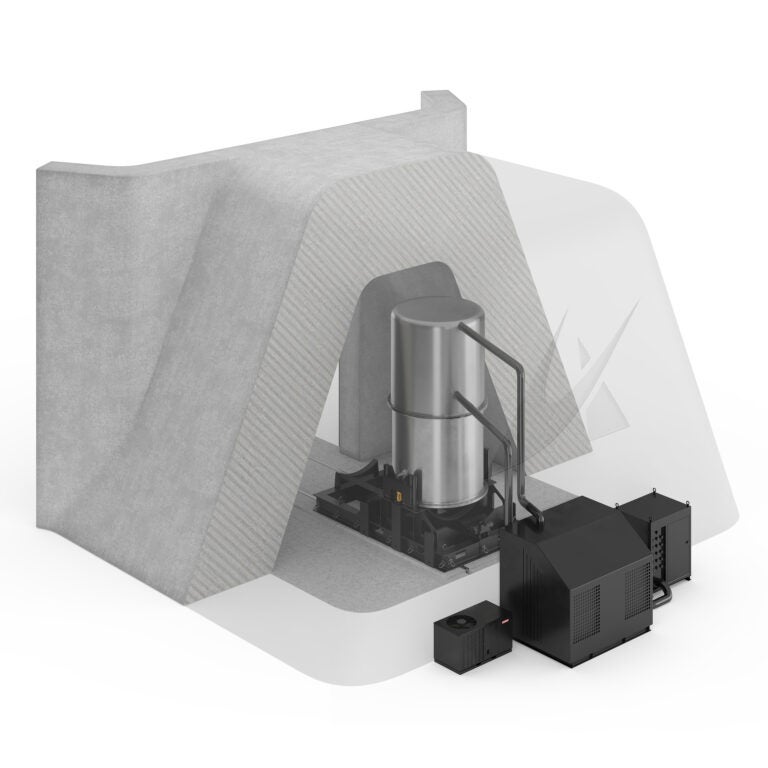
The micro reactor is being designed to be used for DOD mobile power supply.
Posted on 06/05/2026 9:07:53 AM PDT by Pontiac
Antares Nuclear Inc.’s Mark-0—a sodium heat-pipe-cooled microreactor fueled by high-assay low-enriched uranium (HALEU) tri-structural isotropic (TRISO) fuel compacts—has achieved zero-power criticality at Idaho National Laboratory’s (INL’s) Reactor and Critical Experiment (RACE) facility, becoming the first advanced reactor to reach that milestone under the Department of Energy’s (DOE’s) Reactor Pilot Program.
The development, announced on June 4, also marks the 53rd reactor built at the INL site since 1951 and the first novel reactor design to achieve criticality at the laboratory in more than 50 years, according to INL Laboratory Director John Wagner. The much-watched DOE Reactor Pilot Program, established under President Trump’s May 2025 Executive Order 14301, directs the DOE to accelerate reactor testing and to target at least three advanced-reactor criticalities by July 4, 2026.
“Criticality is the condition at which a nuclear fission chain reaction becomes self-sustaining,” Wagner explained in a LinkedIn post. “What Antares achieved is specifically zero-power criticality—the chain reaction was sustained at essentially no measurable energy output. This is not electricity generation. It is not full-power operation. It is proof that the system works: the scientific and engineering validation that every subsequent step depends on,” he wrote. “That distinction matters for context. It should not diminish what happened.”
The zero-power criticality milestone marks a significant step for Torrance, California–headquartered Antares, which was founded in 2023 and has raised more than $140 million in private capital, including a $96 million Series B round that closed in December 2025. The company announced Jan. 26 that DOE had approved its Preliminary Documented Safety Analysis for Mark-0, calling the approval a key step toward fabrication, assembly, installation, and operation under the Reactor Pilot Program.
Antares began machining the Mark-0 graphite core on Jan. 12 at its Antares Prime facility, and fuel fabrication for its first reactors has been underway through BWX Technologies since October 2025 using HALEU secured through a DOE allocation. Antares says it holds agreements with the U.S. Air Force, Space Force, NASA, and the Defense Innovation Unit, and is advancing toward initial deployments for defense and space customers in 2028.
“Now that Mark-0 is critical, the real work is just beginning,” said Antares CEO Jordan Bramble in a LinkedIn post on June 4. “I want to reiterate how this fits into our larger roadmap to mature our technology to its commercial potential. This should be obvious, but the goal of a reactor is to sell electricity to customers.”
Following reactor physics experiments, Antares will execute “the next phase of our roadmap—sustained electricity production,” Bramble said. Antares is “able to move fast towards this milestone because we’ve already completed over 6 months of full-power thermal testing in an electrical prototype. We will perform version 2.0 of this in 2026. This is an easier, more iterative way to test, because there is no regulatory process, and you can disassemble to examine material effects.”
He added: “All of our iterative testing sets us up to produce electricity for 6+ months. Hundreds of days, not hundreds of hours. We’re able to test for longer and faster because we’ve designed our reactor around a proven, fully qualified fuel spec developed under Project Pele.”
The Mark-0 is a small, high-temperature, sodium heat-pipe reactor configured specifically for zero-power criticality testing, according to a DOE Idaho Operations Office categorical exclusion determination. Unlike a power-producing prototype, the Mark-0 version, while “not equipped with power conversion or heat removal systems,” is designed to serve as a platform for validating reactor physics, reactivity control behavior, and system-level safety performance in operation, while producing no measurable thermal output.
But Mark-0 is only Antares’ first iterative step. Speaking during a March 31 American Nuclear Society webinar, Antares CEO Jordan Bramble said the first criticality test was “a stepping stone” toward the company’s “North Star” of an electricity-producing prototype reactor. He said the test would provide “a huge validation of the performance of our control systems as well as our reactor physics,” while also testing the company’s DOE authorization pathway, supply chain, fueling approach, and assembly techniques.
The work is crucial to feed development of its commercial product, the R1 microreactor, a modular, transportable unit rated at 100 kWe to 1-MWe, designed to operate for six or more years between refueling without connection to the commercial grid. The R1 is slated to use a TRISO-fueled prismatic graphite core, passive sodium heat pipes for primary heat transport, a fin-and-tube primary heat exchanger, and a simple recuperated nitrogen-closed Brayton cycle for power conversion operating at less than 300 psi. As pivotally, Antares has designed the system to ship in an integrated transport cradle that includes shielding, and to condition electricity through a power management and distribution node designed to connect directly to installation microgrids. Antares suggests the architecture is optimized for reliability, uptime, and manufacturability rather than maximum power density.
The Mark-0 test reactor is installed inside Building MFC-793, the Sodium Components Maintenance Shop at INL’s Materials and Fuels Complex, below grade inside a pit on the east side of the high bay. Given that the Mark-0 is not anticipated to produce thermal energy or power, commissioning was limited to less than six months, the operational phase to less than one month, and decommissioning to less than six months, the DOE filing suggests.
After operations, the DOE said the Mark-0 test reactor will cool on site for 30 to 180 days before defueling. The fuel and moderator blocks are expected to be removed, packaged into standard DOE canisters, and transferred to appropriate storage or disposal locations. The filing, however also notes that Antares plans to retain the HALEU TRISO fuel after Mark-0 activities and to use the same fuel in the Antares R1 Mark-1 reactor, the next iteration.
Mark-1, which Antares plans to operate at the same MFC-793 test facility at INL in 2027, will be a full-power operation integrated with the nitrogen-closed Brayton cycle power conversion system. It will validate temperature-dependent reactor effects, reactivity feedback, and the coupled behavior between the reactor core and the power conversion system. Mark-1, Antares’ “ultimate development milestone,” will effectively be its first full-scale, commercially viable, electricity-producing version of the reactor.
Meanwhile, running in parallel through 2026, Antares is conducting a second campaign of electrically heated demonstration units at its Antares Prime facility in Torrance, California, to incorporate an updated heat pipe design and control system. That non-nuclear testing program, which requires no regulatory process and allows disassembly for material inspection between runs, is likely intended to close out heat pipe, heat exchanger, and power conversion system qualifications and, crucially, to set the technical conditions for electricity production in 2027.
The iterative steps are set to establish a pathway for initial production deployments. In April 2026, the Department of the Air Force and the Defense Innovation Unit selected Antares under the Advanced Nuclear Power for Installations (ANPI) initiative to deploy a prototype microreactor at Joint Base San Antonio. While the INL tests are being executed under a DOE authorization pathway using a dedicated test setup, the ANPI effort involves a separate regulatory track. Antares anticipates siting, licensing, constructing, operating, and decommissioning its R1 microreactors at JBSA, with systems targeted for deployment by 2028 or earlier, subject to environmental review and regulatory approvals.
“Hitting our commitments is everything to us. Nuclear in America has been defined for too long by delays, by companies that said they would and then didn’t,” Bramble said on June 4. “We said criticality in 2026, electricity production in 2027, and power to the warfighter in 2028. Today is the first of those commitments delivered on the schedule we set. The President and DOE set an ambitious timeline for reactor testing, and we met that challenge. I want to thank our partners at the Department of Energy, Idaho National Lab, BWXT, and the U.S. Army. This is what happens when industry and government work together to accomplish big things.”
The Mark-0 operates on HALEU—uranium enriched to less than 20% U-235—in TRISO fuel compacts, loaded to less than 120 kilograms total for the reactor’s operational life. TRISO particles coat uranium kernels in successive layers of carbon and silicon carbide, which contain fission products under high temperature and irradiation. Most advanced non-light-water designs require HALEU because their neutron physics demand higher enrichment than the roughly 4% U-235 used in conventional light-water reactor fuel.
However, no U.S. commercial enricher currently produces HALEU at commercial scale yet. While Centrus Energy’s 16-machine demonstration cascade in Piketon, Ohio, has produced just over 920 kilograms under a DOE contract—enough for early demonstration work—DOE and the National Nuclear Security Administration (NNSA) will cover the Mark-0’s feedstock requirement by providing government-held scrap material, which BWX Technologies (BWXT) processed at its Specialty Fuels Fabrication facility in Lynchburg, Virginia, and fabricated into finished TRISO compacts.
For longer-term supply, Antares signed what Urenco described as “the world’s first multi-year” commercial HALEU supply contract in May 2026, under which Urenco will supply enrichment services from its Advanced Fuels Facility at Capenhurst in the UK. As POWER reported earlier this week, Urenco’s Advanced Fuels Facility is planned to come online in 2031 at an initial output of up to 27 metric tons per year—enough to supply up to 30 advanced reactors.
Antares, notably, modeled its fuel on TRISO compacts BWXT developed for Project Pele—the U.S. Army’s Strategic Capabilities Office program to build a 1.5-MW transportable microreactor. BWXT said that TRISO fuel specification was developed within DOE’s Advanced Gas Reactor program over several decades and, paired with BWXT’s “decades of TRISO development” in Lynchburg, helped accelerate Antares’ path to criticality.
“BWXT’s TRISO fuel supported our path to criticality,” Bramble confirmed in a press release. “Building on a proven fuel specification developed through Project Pele let our team focus on what we had to prove ourselves: our control system and reactor physics. We’re grateful for a partnership that continues as we move from neutrons to electrons.”
BWX Technologies President and CEO Rex D. Geveden said the milestone underscores the company’s role in advanced fuel fabrication. “Our skilled workforce, advanced manufacturing technologies and nuclear-qualified supply chain are driving a new generation of reactor demonstrations across the country,” he said. Joe Miller, BWXT’s president for Government Operations, added that Antares is “moving quickly to progress from concept to criticality,” and BWX Technologies said it will continue supporting Antares with ongoing TRISO fuel manufacturing as the program advances.
The micro reactor is being designed to be used for DOD mobile power supply.
ONE STEP CLOSER..................
Waiting for AI to get that one designed, built and into backyards so it will be able to power the home cheaply and itself indefinitely. Then the fun’ll begin!
“DOD mobile power supply”
It’s obviously got enough enriched uranium to go critical.
It’s 20% enriched uranium would allow a bad entity to make an atomic bomb with maybe 10% of the effort required if started from natural uranium.
The ironic thing is we live in a universe filled with radioactivity. Our World protects us from most of it but it still has a little bit that is with us every single day
HaHa my thought exactly.
Nuke powered cars on the horizon?
“The Mark-0 operates on HALEU—uranium enriched to less than 20% U-235—in TRISO fuel compacts, loaded to less than 120 kilograms total for the reactor’s operational life....”
“Centrus Energy’s 16-machine demonstration cascade in Piketon, Ohio, has produced just over 920 kilograms under a DOE contract.”
So a mere 16 machines made almost enough higher than typical reactor essential U-235 as Iran’s efforts.
Nah, they’d still have to refine much much much further. The real threat would be a bad actor making a dirty bomb or just leaving the uranium in the a few trash cans in a crowded area. Or in a sewer, subway, Stadium, etc...
I want to install one in the bed of my Ford Lightning !
We could have them already had it not been for the Enviros................
It's fun to remind anti-nuke types that their blood contains radioactive potassium-40. You can see them get all itchy.
Good on camping trips.
Is that concrete shielding around the unit? Lead? Graphite? How thick is it? How much does it weigh? IOW, how "mobile" is it?
Will power be generated using traditional methods: heat, steam and turbines? How much bigger will the unit be when this is added? How much power can be created? Using how much water?
Why camping trips in particular?
..their blood contains radioactive potassium-40...
Bananas are high in Potassium. That is why they are wrapped in yellow.
Next they’ll be putting trefoil stickers on bananas as a warning.
I want one. For the Christmas lights. Maybe two.
One wonders how much of that 20% U-235 enriched material could be reprocessed from what has accumulated at Yucca Mountain or sits in pools at existing facilities.
Weapons grade Uranium has to be enriched above 80%.
After the reactor has been at full power for a few months the radiation from the fission products will protect the reactor from any but the most determined and well informed thieves.
Disclaimer: Opinions posted on Free Republic are those of the individual posters and do not necessarily represent the opinion of Free Republic or its management. All materials posted herein are protected by copyright law and the exemption for fair use of copyrighted works.