Posted on 05/02/2026 11:48:38 AM PDT by Red Badger
A benchtop fusion reactor increased neutron output by packing more deuterium into palladium with electrochemistry.
Tabletop fusion reactor boosts deuterium-deuterium fusion rates by 15% using electrochemical loading in palladium. (CREDIT: UBC)
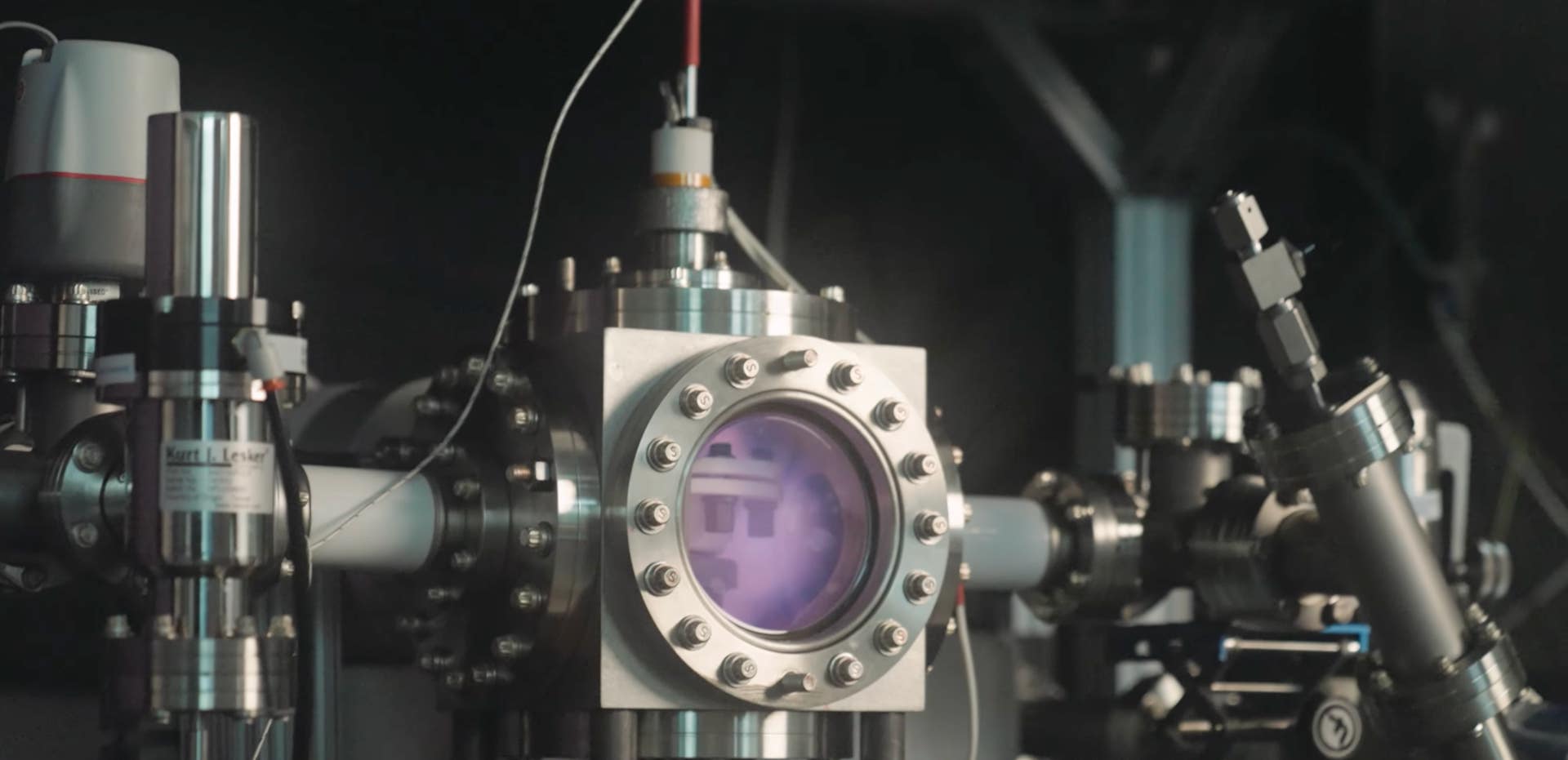
Nuclear fusion usually brings to mind sprawling facilities, blistering temperatures, and machines built on a scale that can swallow budgets whole. This device does something stranger. It sits on a lab bench, runs at room temperature, and still produces a measurable fusion signal.
Researchers at the University of British Columbia say their compact setup, called the Thunderbird Reactor, increased fusion rates by about 15% by packing more deuterium into a metal target through electrochemistry. The result does not come close to producing useful power. It does, however, point to a new way of studying how fusion reactions might be nudged along inside solid materials.
The work, published in Nature, centers on a simple idea. Fusion depends heavily on how often fuel atoms collide. Raise the fuel density, and the odds of those collisions go up.
That matters because deuterium, a heavy form of hydrogen often used in fusion experiments, can be packed into solid metals at densities that are difficult to maintain in many other fusion systems. Instead of trying to recreate the sun inside a giant machine, the UBC team focused on loading deuterium into palladium, a metal known for its ability to absorb large amounts of hydrogen.
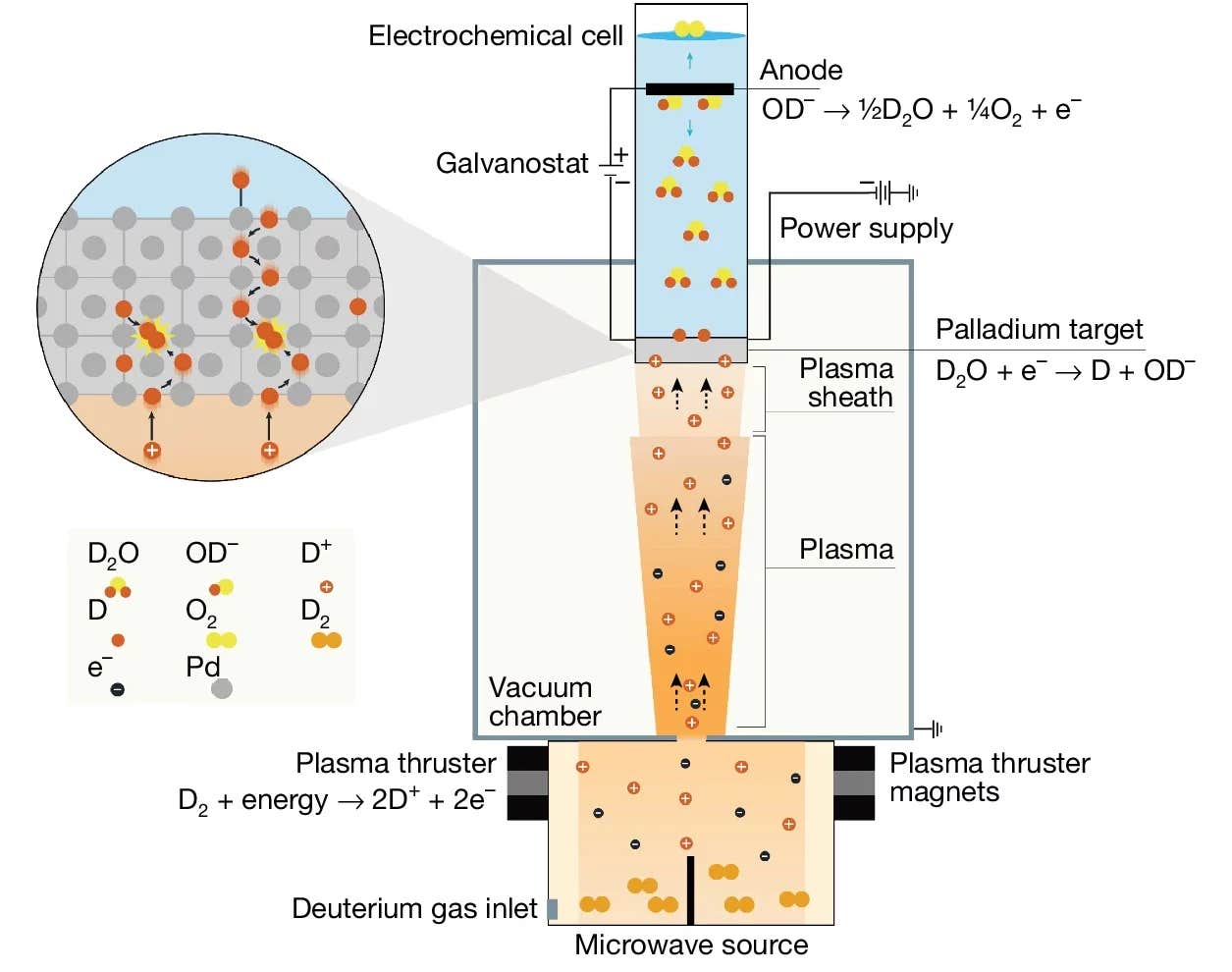
Working principle of the Thunderbird Reactor. Deuterium gas (D2) is fed to the plasma thruster through the deuterium gas inlet. The D2 is ionized by a microwave source. (CREDIT: Nature)
A reactor built around a metal target
The Thunderbird Reactor has three main parts: a plasma thruster, a vacuum chamber, and an electrochemical cell. On one side of a 300-micrometer-thick palladium target, the plasma thruster fires deuterium ions toward the metal. On the other side, the electrochemical cell pushes in more deuterium from heavy water.
That dual-loading design is the heart of the experiment.
“The goal is to increase fuel density and the probability of deuterium–deuterium collisions, and as a result, fusion events,” said Professor Curtis P. Berlinguette, a Distinguished University Scholar at UBC and the project’s lead researcher.
The setup is compact by fusion standards, measuring about 120 by 80 by 70 centimeters, small enough to fit on a standard laboratory bench. It does not rely on the large and complex ion optics found in many accelerator systems. Instead, it uses a plasma sheath near the palladium target to accelerate deuterium ions into the metal.
Inside that target, some of the deuterium atoms can collide and fuse. One branch of that reaction produces neutrons, and those neutrons are what the researchers tracked.
Why neutrons mattered more than heat
Fusion research has a long and sometimes bruising history in this area. In 1934, Mark Oliphant and Ernest Rutherford demonstrated deuterium-deuterium fusion by bombarding a solid target loaded with deuterium. Decades later, in 1989, the cold fusion claims made by Martin Fleischmann and Stanley Pons drew global attention, then swift skepticism, after other groups failed to reproduce the reported excess heat.
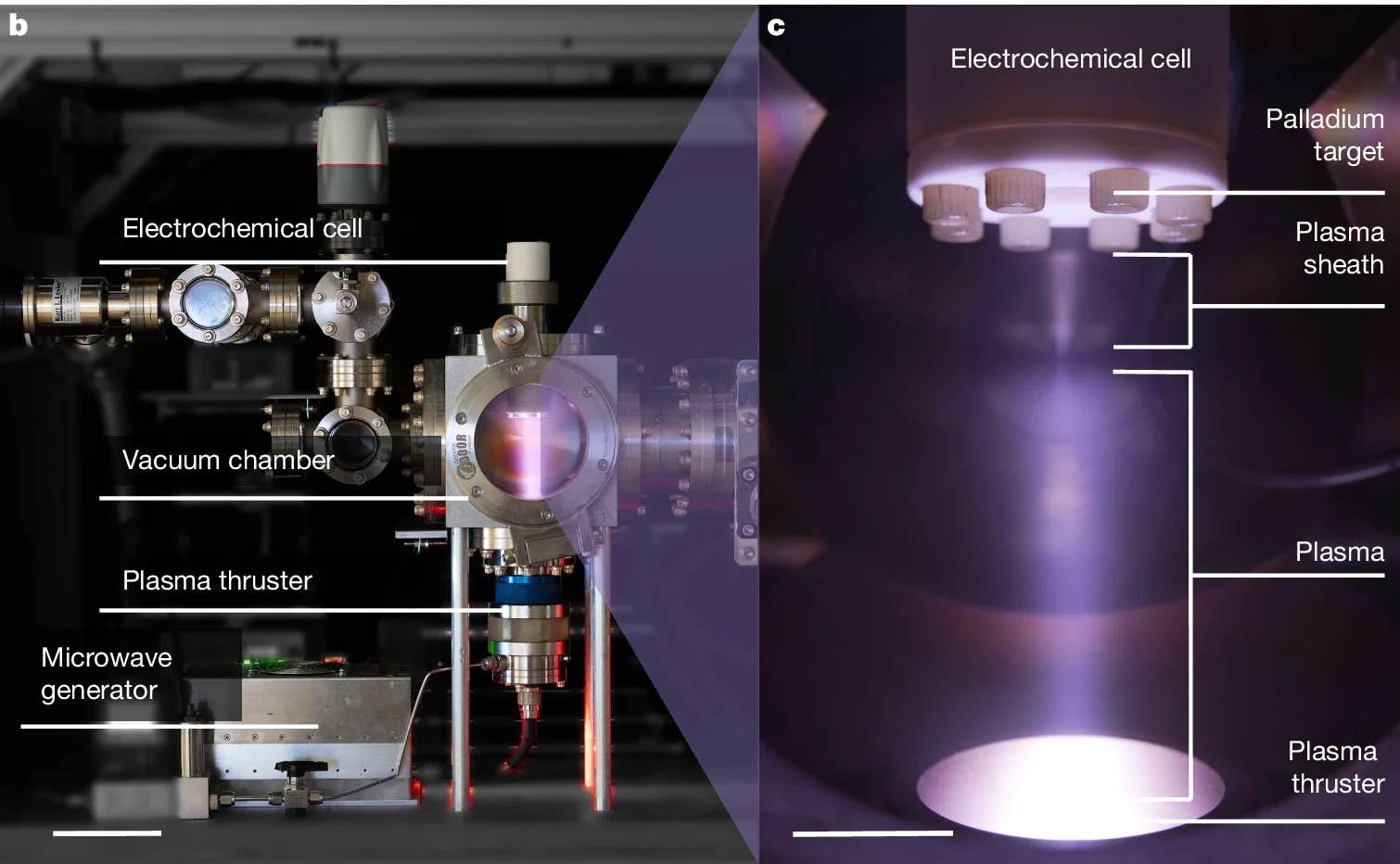
Photographs of the Thunderbird Reactor (b) and the electrochemical cell (c). (CREDIT: Nature) That history shaped the UBC team’s approach.
Rather than looking for unusual heat, the researchers looked for a nuclear signature that would be much harder to misread. They used a neutron-sensitive scintillation detector positioned 12 centimeters from the palladium target. The system was built to distinguish neutrons from background gamma rays, excluding more than 99.9999% of gamma-ray events.
Background neutron production in the lab measured about 0.21 neutrons per second. Once the reactor was running and a negative 30-kilovolt voltage was applied, neutron production climbed to a stable rate of roughly 130 to 140 neutrons per second after about 30 minutes.
The team said the measured neutron energy matched what would be expected from deuterium-deuterium fusion. They also compared the detector response with simulations from two Monte Carlo transport codes and used additional analysis to check whether the neutron spectrum aligned with a D-D fusion source.
Adding electrochemistry changed the numbers After establishing a baseline with plasma loading alone, the researchers removed the palladium target, heated it to 400 degrees Celsius under vacuum to drive out the deuterium, and then repeated the experiment. Once neutron production stabilized again, they switched on the electrochemical cell.
That was the critical moment.
The electrochemical cell used a deuterated electrolyte made from potassium carbonate in heavy water. When the current was applied, deuterium entered the palladium from the liquid side while deuterium ions continued arriving from the plasma side. In three separate campaigns using different palladium targets, neutron production increased from phase I saturation values of 135.5, 142.9, and 138.6 neutrons per second to phase II values of 156.7, 159.2, and 164.3 neutrons per second.
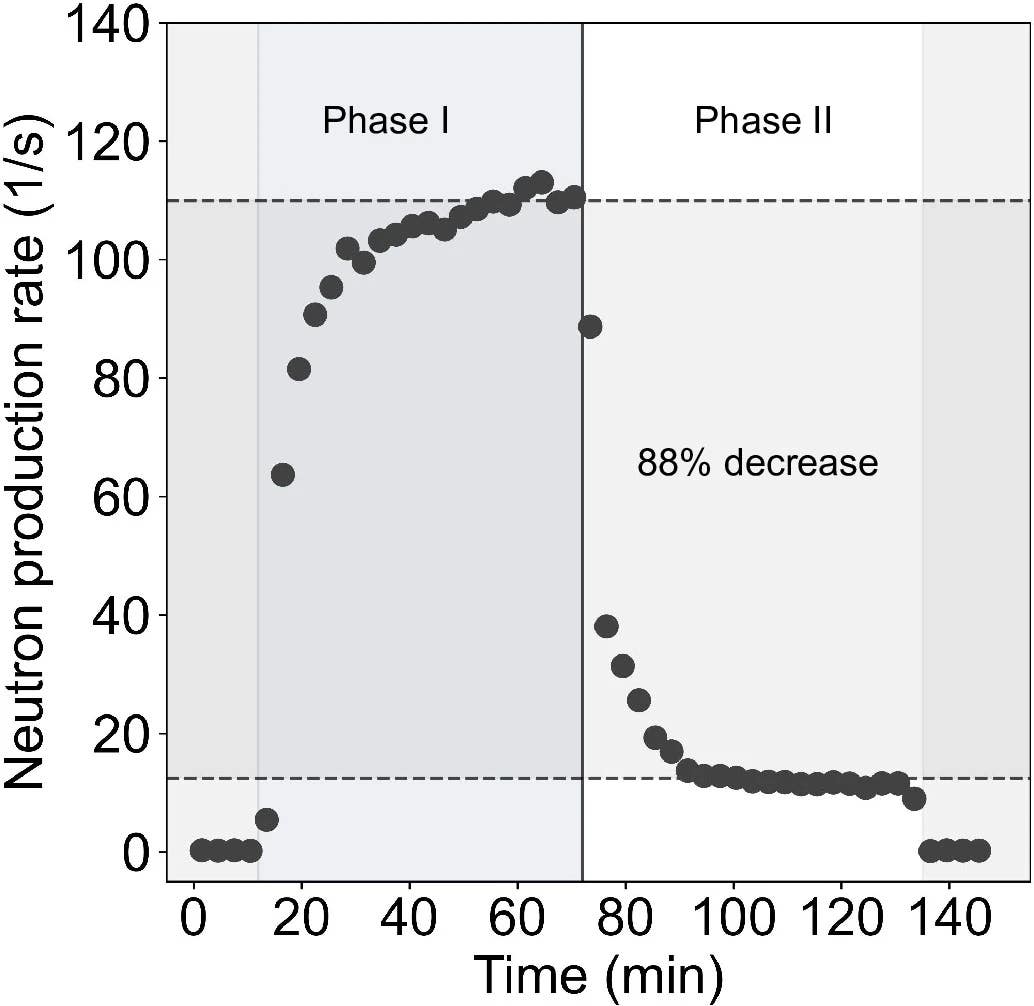
The impact of using H2O as a solution on neutron production rate. (CREDIT: Nature)
Taken together, the average increase was 15%, with an uncertainty of 2%.
“Using electrochemistry, we loaded much more deuterium into the metal, like squeezing fuel into a sponge,” Berlinguette said. “While we didn’t achieve net energy gain, the approach boosted fusion rates in a way other researchers can reproduce and build on.”
The researchers also ran a comparison using ordinary water instead of heavy water in the electrochemical chamber. In that case, neutron production dropped sharply, by 88.3%. That supported their argument that the added deuterium, not just the electrical setup, was responsible for the change.
One sentence matters here: this was not an energy breakthrough.
The reactor’s neutron yield corresponded to only about 10⁻⁹ watts, while the system consumed 15 watts of input power. The fusion reactions produced far less energy than the machine required to run.
A small result, but not a trivial one The team argues that the significance lies elsewhere. They say this is the first clear demonstration that electrochemical loading of a metal target can raise fusion rates in a controlled reactor by increasing fuel density.
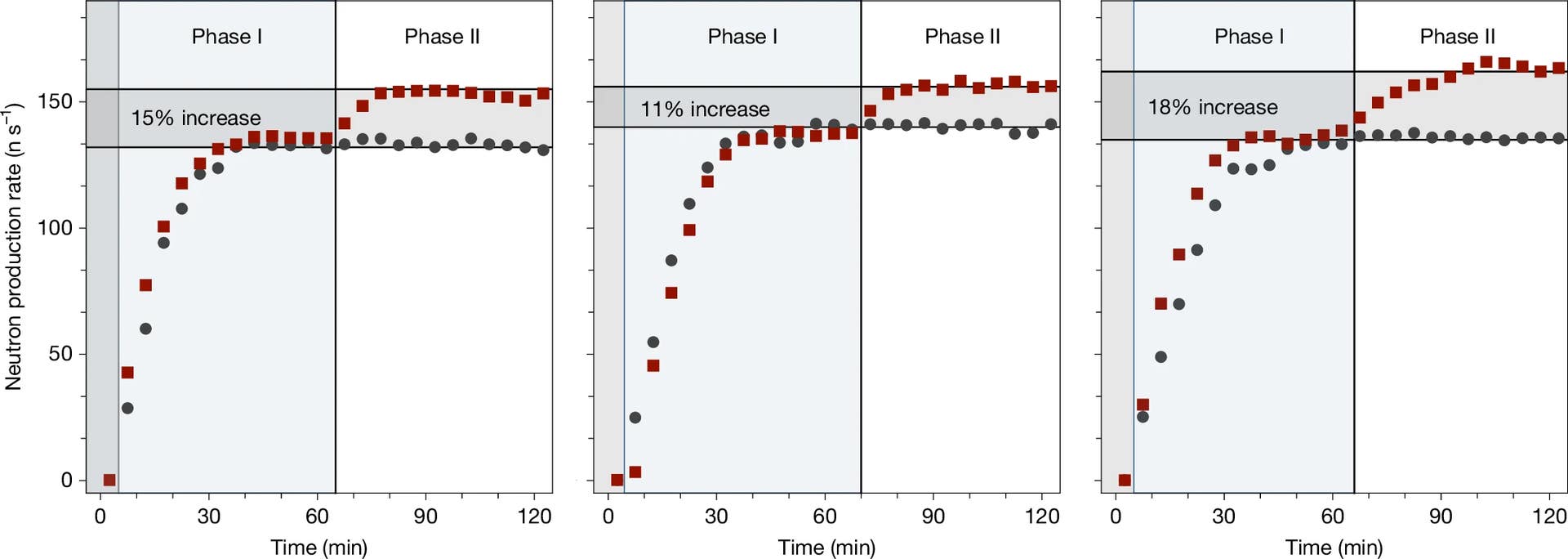
Three separate experimental campaigns showing neutron production rate using PIII as a function of time, with and without electrochemical loading of the palladium target. (CREDIT: Nature) Still, they are careful about the limits. The gain was slight. The maximum deuterium loading in palladium at room temperature places a ceiling on how far this exact system can go unless other mechanisms come into play. The researchers were also unable to directly measure the deuterium-to-palladium ratio during the fusion experiment itself, though related measurements indicated high deuterium loading in the metal.
They also noted that contamination of the deuterated electrolyte by ordinary water from air exposure may have contributed to differences between runs.
None of that makes the result less interesting. It just keeps it in bounds.
Practical implications of the research
This reactor is not about replacing large fusion projects tomorrow. Its value is that it gives researchers a smaller, more accessible platform for testing ideas about fuel loading, target materials, and low-energy fusion behavior inside solids.
The UBC team suggested several paths for improvement, including using plasmas at higher pressures to create more ions at the target and testing metals such as niobium or titanium, which can hold more deuterium than palladium. They also raised the possibility of studying whether fusion byproducts such as helium-3 and tritium could feed secondary reactions in a deuterium-rich target.
For now, the Thunderbird Reactor does something more modest but still useful. It brings fusion research down from giant national facilities to something that can fit on a bench, where more labs may be able to probe the basic science.
Research findings are available online in the journal Nature.
The original story "Thunderbird Reactor: New room-temperature fusion reactor that fits on a tabletop" is published in The Brighter Side of News.
Ping!.................
The democRATs will pass laws preventing any further development. They think this is perfect just the way it is.
When one fits into a DeLorean, call me.
It seems to me that to initiate a ‘fusion’ reaction, physicists could harness the Strong Nuclear Force to increase the pressure on a deuterium atom or two to fuse...........
 .
.

Didn’t California ban all gas powered cars by 2030? So I assume they will have a fusion engine all set by then
Mmmmmm...wheels...

Trump said, “Two things that always work: Walls and Wheels”
What’s the price?
Good call! As we know, California politicians are most wise.
/s (as if necessary to add!)
From wiki
An early radio jingle, which followed a blues theme, contained the lyrics: What’s the word? Thunderbird! / How’s it sold? Good and cold. / What’s the jive? Bird’s alive! / What’s the price? Thirty twice.. Inflation later necessitated an update to the last line to “a dollar twice”[7]
As of 2018, the original wine was discontinued and the Thunderbird name and logo repurposed for a new range of traditional wines in black bottles.
That said it seems the original isn’t around anymore so it’s priceless!
Magnetized Target Fusion:
Not to be an ass, but so what's the point?
Research. You obtain knowledge and share it with others. If you do not find it useful just skip the article and let others discuss it.
I think the point is as mentioned, to stimulate thinking along different lines and provide raw data.
It might just take a genius like a Musk to walk in on this and run off with a great idea on how to apply a bit of it to something totally unrelated. Weirder things have happened.
As to baseload fusion I doubt any progress will be made until all work on that damnable Tokamak design is abandoned. I still think that cokamamie design was planted on us by the dying USSR — the bastids. A pinch design makes far more sense.
Disclaimer: Opinions posted on Free Republic are those of the individual posters and do not necessarily represent the opinion of Free Republic or its management. All materials posted herein are protected by copyright law and the exemption for fair use of copyrighted works.