Posted on 05/01/2026 10:33:42 PM PDT by Red Badger
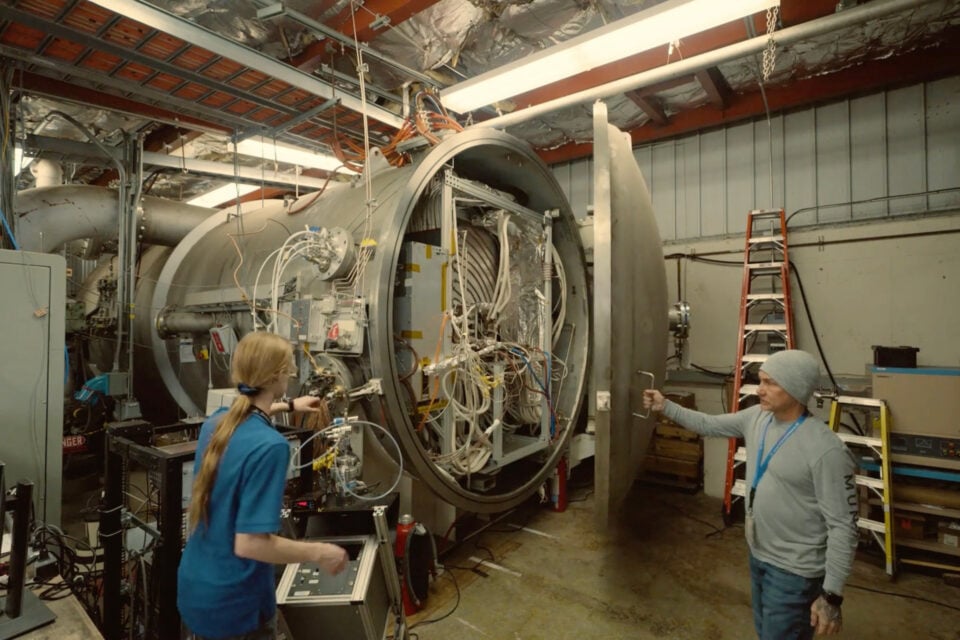
The prototype thruster is enclosed in a condensable metal propellant (CoMeT) vacuum facility at NASA's JPL. NASA/JPL-Caltech
NASA engineers recently tested a next-generation electric propulsion system that could one day power a crewed mission to Mars.
NASA fired up a prototype of its electromagnetic thruster inside a vacuum chamber, reaching power levels of up to 120 kilowatts—the highest achieved in U.S. tests of an electric propulsion system. That’s over 25 times the power of the electric thrusters aboard the current Psyche mission, which launched in 2023 on a journey to explore a metal-rich asteroid.
VIDEO AT LINK..........
“Designing and building these thrusters over the last couple of years has been a long lead-up to this first test,” James Polk, senior research scientist at NASA’s Jet Propulsion Laboratory (JPL), said in a statement. “It’s a huge moment for us because we not only showed the thruster works, but we also hit the power levels we were targeting. And we know we have a good testbed to begin addressing the challenges to scaling up.”
Fired up
Electric propulsion systems use magnetic fields and electric currents to accelerate propellant to high speeds. This type of propulsion uses up to 90% less propellant than traditional, high-thrust chemical rockets, according to NASA.
Current electric propulsion thrusters rely on solar power to accelerate propellant, reaching high speeds over time through a low continuous thrust. NASA’s recently tested electromagnetic thruster, on the other hand, runs on lithium metal vapor. The lithium-fed magnetoplasmadynamic (MPD) thruster uses high currents interacting with a magnetic field to electromagnetically accelerate lithium plasma.
Lithium-fed thrusters could potentially operate at high-power levels, using propellant efficiently and providing greater thrust power than the electrical thrusters currently in use, according to NASA. Once fully developed and paired with a nuclear power source, the MPD could help reduce launch mass to support larger payloads for human Mars missions.
During the test, the electric thruster was placed inside a 26-foot-long (8-meter-long) water-cooled vacuum chamber at JPL’s Electric Propulsion Lab. Engineers fired up the thruster and watched it come to life. During five ignitions, the thruster reached temperatures over 5,000 degrees Fahrenheit (2,800 degrees Celsius). The thruster’s nozzle-shaped outer electrode emitted a vibrant red plume, while the tungsten electrode at its center glowed bright white.
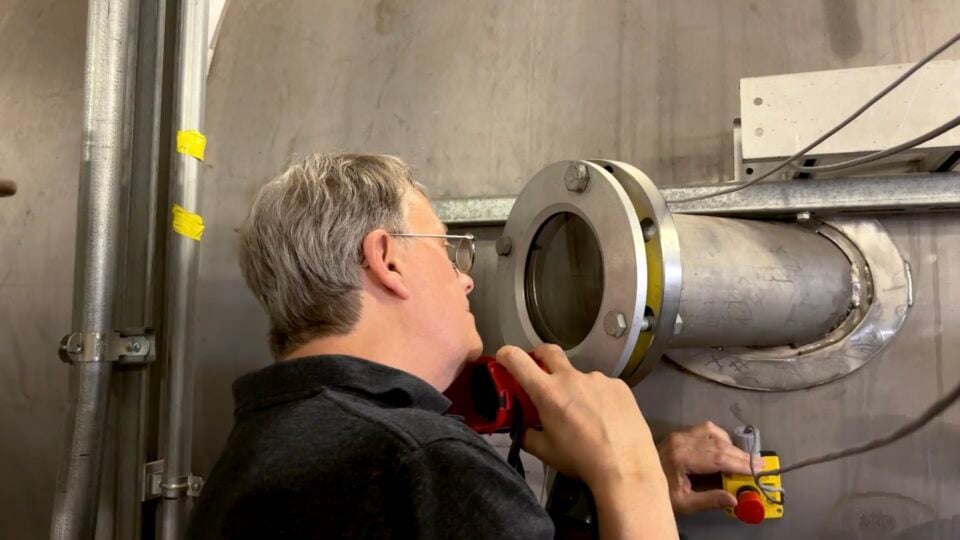
JPL senior research scientist James Polk peers into the condensable metal propellant (CoMeT) vacuum facility at JPL’s Electric Propulsion Lab. Credit: NASA/JPL-Caltech
Ticket to Mars?
NASA’s JPL has been developing the MPD thruster for the past two and a half years in collaboration with Princeton University and NASA’s Glenn Research. The work is funded by NASA’s Space Nuclear Propulsion project, with the aim of launching a human mission to Mars by supporting a megawatt-class nuclear electric propulsion program.
“At NASA, we work on many things at once, and we haven’t lost sight of Mars,” NASA Administrator Jared Isaacman said in a statement. “The successful performance of our thruster in this test demonstrates real progress toward sending an American astronaut to set foot on the Red Planet.”
Data from the first demonstration will help inform an upcoming series of tests of the electromagnetic thruster. The team is aiming to reach power levels between 500 kilowatts and 1 megawatt per thruster in coming years.
Launching a crewed spacecraft to Mars might require 2 to 4 megawatts of power, meaning multiple MPD thrusters operating for more than 23,000 hours. This presents a challenge as the hardware operates at high temperatures, and the team needs to prove that the thruster’s components can withstand the heat for multiple hours during upcoming tests.
“We will continue to make strategic investments that will propel that next giant leap,” Isaacman added.
SPACE PING!................
Nothing can match the 1.21 gigawatt flux capacitor.
"YOU'LL SHOOT YOUR EYE OUT! YOU'LL SHOOT YOUR EYE OUT!"
At least the thruster won’t get depressed.
23,000 hours... = 2.6 years
I dont catch the drift... why would you need constant propulsion for 2.6 years? Propel to get to speed, do a 180 and propel to stop. ...and where are they going to put 2.6 years worth of fuel no matter how efficient the thrusters are?
Good ol school new name ion engine
How long before some NASA homo sells the technology to China?
Now that NASA is no longer a Muslim Outreach organization, they may actually be doing space work. However, why don’t they use the same rockets 🚀 they used for the Mars rover? Or did they lose those designs along with all the Apollo designs and data?
I dont catch the drift... why would you need constant propulsion for 2.6 years? Propel to get to speed, do a 180 and propel to stop. ...and where are they going to put 2.6 years worth of fuel no matter how efficient the thrusters are?
It’s all a matrer of force=mass x accelleration. Lithium is heavier/denser than, say, hydrogen, and if it is being ejected at much higher speeds than a chemical rocket so you don’t need as much of it.
Good to hear from from you. (Hope are well.)
Sounds like they (NASA) have tested the prototype Lithium in a “space-cold” vacuum chamber, but NOT by using a nuke to power it. The “nuclear drive” sounds like the 1-2 Megawatt reactor is the long-term GOAL as a continuous electric power source for the lithium drive.
23,000 hours worth of Burn?? you cant convince me this system is THAT efficient.
If you cant answer my question, say nothing.
I'm waiting for the dilithium propulsion system!
Regards,
Specific impulse (usually abbreviated as Isp) is a physical quantity defined as the ratio of change in momentum (impulse) to the mass used, usually fuel. It typically uses units of metres per second (a SI unit) or feet per second (in imperial units). It is equivalent to thrust (a force, in newtons or pounds) per mass flow rate (in kg/s or lbm/s). - WikipediaCurrent ion thrusters (of which this is just a variant) provide only extremely low thrust (think: perfume atomizer or, at best, underarm deodorant spray!) - but can at least do so for a long time, and - get this! - with very good efficiency (= consumption of power to achieve acceleration).
The high efficiency is the selling point! They can't be used to blast off a celestial body (like the Earth or Moon), because their thrust is so weak - but once in orbit (or on an interplanetary trajectory), that gentle thrust can be applied for weeks / months.
For unmanned probes, that's ideal! In the case of crewed missions, you can't afford to wait hours in order to boost speed by a lousy couple of m/s - even if it's 10X more efficient that chemical fuels.
The lithium thruster discussed here is supposedly 25X more-powerful than previous ion thrusters. Probably still not powerful enough for a crewed Earth-Mars mission - but they are hopeful that it can be further improved.
Regards,
Ok... lotta words and effort in posting. but I will ask the same question yet again....
Is this system efficient enough the burn 23,000 hour-2.6 years-with the amount of fuel that can fit in the proposed Mars Mission Rocket??
The article clearly says they need 23,000 hours of burn time. I cannot see how this is even possible/needed. they are not in constant thrust the entire way to and from. there is acceleration on the start, and thrust to slow down on arrival and maneuvering.
or am I reading that wrong and the 23,000 hours is testing time??
This article is about an electric propulsion system. At present, the prototype is an electric propulsion system employing a novel propellant (lithium) that is powered (heated up / vaporized and - using electromagnetic fields - accelerated) using electricity taken from the lab's mains (wall socket) - i.e., they are probably designing - in parallel - the actual power supply that will have to be installed onboard the spacecraft. That onboard power supply will be nuclear - and thus thousands of times more efficient (kWh per kg of fuel) than any known chemical fuel.
Perhaps your confusion is due to your misunderstanding of the fact that, in a conventional (chemical) rocket, the fuel (e.g., a mixture of liquid oxygen as the oxidizer and some combustible substance like alcohol - in the old V-2 rockets) is simultaneously the propellant. The chemical reaction (burning) of the oxygen and alcohol creates the energy which heats up the throw-mass (i.e., the resultant CO2 and H2O of the exhaust).
In the novel electric propulsion system discussed here, the propellant and the fuel are two separate things.
Do you grant that a pound of, say, Uranium can be used to generate much, much more energy than, e.g., a pound of conventional solid rocket fuel or LOX/Hydrazine mixture?
Well, that's the trick here!
Regards,
man answer the dang question. I dont need your windy explanation on the theory behind this propulsion system. I’m asking you if the system is THAT efficient for 23,000 hours worth of propulsion in the amount of “Fuel” that can fit in the rocket!!!!!!!!!!!!!!!!!!!!!!!!!!!!!!!!!!
I repeat: Do you grant that a pound of, say, Uranium can be used to generate much, much more energy than, e.g., a pound of conventional solid rocket fuel or LOX/Hydrazine mixture?
A couple of pounds of U-238 can provide enough energy (heat - used to vaporize water to form expanding steam to spin turbines) to power a U.S. supercarrier for a year. By the same token, that same amount of nuclear fuel could be used to generate electricity - which would then be used to 1) vaporize lithium (think: electric arc furnace) and 2) accelerate the ionized (and hence now magnetic) lithium using electromagnets, thus providing momentum.
The expanding plasma (cuz it's now more than just a vapor - the lithium atoms have been stripped of their electrons) still wouldn't be all that powerful (i.e., provide that much "push") - but the electromagnets (think linear particle accelerator) do the rest of the job - accelerating them to near light speed.

Can you imagine how much "umpf" even a tiny trickle of ionized lithium would yield when accelerated to, say, 250,000 km per sec?!
That's thousands of times more acceleration than is possible with conventional chemical rocket propulsion systems. The few pounds of U-238 needed for a crewed Mars mission could fit in a lunchbox! It's the electromagnets that consume most of the onboard power plant's output.
There's your explanation - take it or leave it!
Regards,
Acceleration at 1 g and deceleration of 1g is my guess.
Disclaimer: Opinions posted on Free Republic are those of the individual posters and do not necessarily represent the opinion of Free Republic or its management. All materials posted herein are protected by copyright law and the exemption for fair use of copyrighted works.