Think of it, Troy could still be around today if they had Ivermectin. They could have dewormed all those Greeks right out of there.
Posted on 01/18/2026 2:12:09 PM PST by nickcarraway
To the Greeks, the Trojan War is one of the most famous events in their history, and it is also one of the most well-known stories in Greek mythology. However, the question about whether or not the Trojan War truly happened remains. The discovery of Troy in the eighteenth century seemed to vindicate Homer’s account, but the reality is much more complicated than that.
Does the city of Troy prove the Trojan War really happened? For many people, the discovery of the city of Troy proves that the Trojan War really happened. According to this train of thought, such a discovery shows that Homer was writing about the actual world rather than baseless fantasies. However, this logic requires a closer look.
Contrary to what many people believed, it is not the case that Troy ceased to exist long before Homer’s time. His writing about it did not preserve some ancient tradition. On the contrary, the city of Troy continued to exist up until Homer’s time and long after. Alexander the Great even visited it.
Therefore, Homer could simply have been using a place that really existed in his time as the setting for his story. It would be no different to someone today using London or New York as the setting of a fantasy or sci-fi movie.
Hittite letters Nonetheless, archaeologists eventually discovered ancient Hittite documents which spoke about conflicts in the region of Troy. These documents referred to the Ahhiyawa ( the Achaeans of Homer), almost certainly the Mycenaean Greeks, engaging in war in western Anatolia. They even mention a city named Wilusa, which most scholars understand to be Troy (also called Ilios).
Grecian Delight supports Greece Does this evidence actually prove that the Trojan War happened? Despite many researchers attempting to make this argument, more recent research shows that this does not stand up to scrutiny. The Hittite records merely speak of a conflict concerning Wilusa rather than a war. This conflict ended peacefully, and the city was not destroyed as a result.
While it is true that there is evidence of a destruction layer at Troy dating to circa 1180 BCE, the Phrygians appear to have been responsible for that. Their material culture appears in Troy immediately above the destruction layer.
Lack of evidence for the Trojan War from Homer’s writings A further issue is the fact that Homer wrote about the Trojan War many centuries after it supposedly occurred, according to the traditional chronology. For this reason, many scholars dismiss the idea that the Iliad could preserve historical facts.
On the other hand, other scholars have argued that the Iliad clearly displays accurate information regarding Bronze Age Greece. The weapons and armor, according to some, are right out of that era. Hence, this supposedly proves that the Iliad preserves authentic information from the era of the Trojan War.
Nevertheless, more modern research from scholars such as Hans van Wees, Jonas Grethlein, and Irene de Jong among others indicates that these earlier conclusions were based more on wishful thinking than anything else. Rather, Irene de Jong explains that the world of the Iliad appears to be “in almost all respects a reflection of [the] poet’s own world,” that is, the eighth or seventh century BCE.
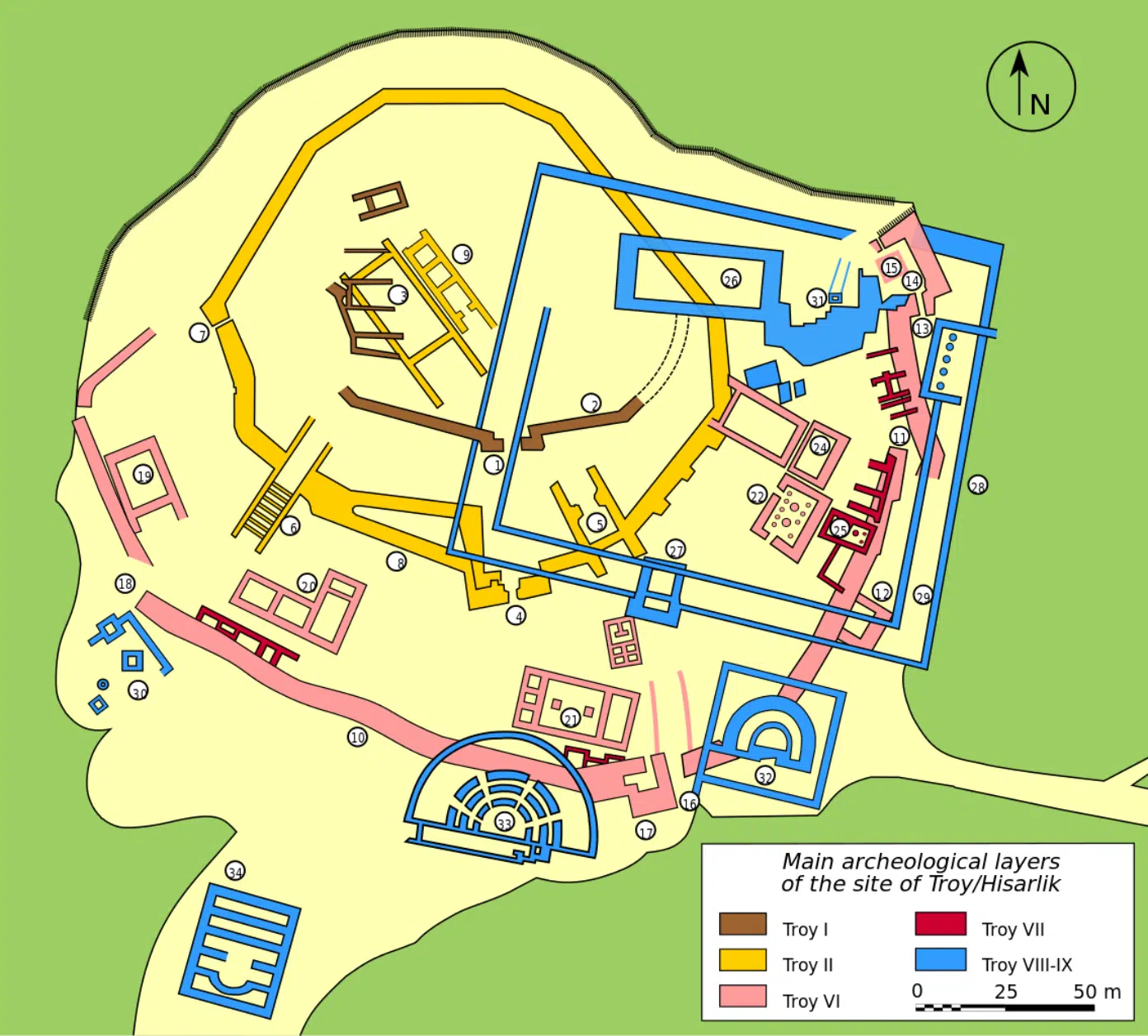
Plan of the various layers of Troy Plan showing the Troy of Homer’s day (and after) in blue. Credit: Wikipedia Commons, public domain. Did the Trojan War take place around Homer’s time? Despite the clear lack of evidence for the Iliad preserving traditions of a historical Trojan War from the Bronze Age, this does not mean that it is necessarily fictional. It could well be that the Trojan War happened but later on in history. What basis is there for suggesting this?
In short, there is explicit evidence that various other events which allegedly occurred around the time of the Trojan War actually happened not long before Homer’s time. For example, the Greeks allegedly settled in the area of Rome about half a century before the Trojan War. Archaeology has uncovered evidence of a possible Greek colony in Rome dating to the eighth century BCE.
Greek legend has it that the Greeks generally settled in southern Italy in the immediate aftermath of the Trojan War. When was this historically? While there was a trickle of colonization from the mid-eighth century BCE, there was much more widespread colonization beginning around 700 BCE.
The adoption of the Phoenician alphabet by the Greeks supposedly happened long before the Trojan War, yet archaeology shows that this happened after 900 BCE. Furthermore, King Midas allegedly lived just before the time of the Trojan War. Nevertheless, historical records show that he actually lived at the end of the eighth century BCE.
Theseus was a figure from Greek legend who also lived just before the Trojan War, yet some scholars argue that he may have lived in the eighth century BCE as well.
The real Trojan War in the Iron Age Based on these examples and many others, it would not be surprising in the slightest if the Trojan War turned out to have really happened in the Iron Age. This would not be long before Homer’s time. After all, most ancient Greek historians placed Homer just fifty to a hundred and fifty years after the war, yet we know that Homer lived in the seventh century BCE.
In fact, an analysis of the evidence from one of the very earliest records pertaining to the time frame of the Trojan War relative to other events indicates it could very well have happened in the eighth century BCE.
One of the most important figures of the Trojan War was Agamemnon, the king who led the Greeks. Interestingly, there is a historical record of a king named Agamemnon who was active in western Anatolia not far from Troy in the late eighth century BCE.
Is there any record of the Greeks engaging in war in this area at this time? Well, one of the allies of the Trojans according to the Iliad was the Lydians. Historically, we know that the Greeks were waging war against the Lydians during the turn of the seventh century BCE.
The Assyrians, likewise, were supposedly allies of the Trojans. We see this as early Ctesias in circa 400 BCE. Interestingly, there are Assyrian records of military conflicts with the Greeks at this time. Therefore, the evidence is clear that the Greeks were engaging in war against at least some of the Trojans’ allies from the legends of the Trojan War.
The city of Troy Does the evidence from Troy itself, however, support the conclusion that the Trojan War really happened in the eighth century BCE? Despite common misconceptions, Troy not only still existed, but it thrived at this time. It appears to have been the center of a small trading empire that encompassed various nearby islands.
The grand stone walls of Troy that had been built in the Bronze Age were not only still standing at this time but were still in use and had had work done on them in the eighth century BCE. Moreover, the general description of the Trojans in the Iliad fits the reality of that era. They were, in fact, Greek descendants and had a temple of Athena.
At some point shortly after the turn of the seventh century BCE, the city of Troy was destroyed. Was this the destruction at the end of the Trojan War? Admittedly, we cannot confirm that the Greeks were responsible for this layer in Troy VIII. Some scholars argue it was caused by an earthquake. Yet others believe it was caused by an attack. In any case, we do know that the Greeks were attempting to expand around the time of this destruction layer.
Think of it, Troy could still be around today if they had Ivermectin. They could have dewormed all those Greeks right out of there.
Why should I blame her that she filled my days
With misery, or that she would of late
Have taught to ignorant men most violent ways,
Or hurled the little streets upon the great,
Had they but courage equal to desire?
What could have made her peaceful with a mind
That nobleness made simple as a fire,
With beauty like a tightened bow, a kind
That is not natural in an age like this,
Being high and solitary and most stern?
Why, what could she have done, being what she is?
Was there another Troy for her to burn?
—WB Yeats
Fight On!
Yes, Trojan won over Durex.
All of these were probably preserved in an oral tradition going back to the Bronze Age, so having a king named "Agamemnon" in the 8th century B.C. may just be a contemporary borrowing a name already famous from epic poetry.
Reminds me Vienne in France where archaeologists in the 1920s were shocked to discover a large Roman theater under medieval buildings.
The locals had always called the street, "Rue du Theatre."
If the Trojan War never happened, where does that leave Odysseus?
He just ran out on Penelope?
All cultures have their origin story based on Myth.
Greeks - Trojan War
Romans - Romulus and Remus
Anglo Saxons - Hengist and Horsa
Hebrews - Moses
Christians - Jesus
Just a few examples.
He just ran out on Penelope?
—
Yep. In Nikos Kasanzakas’ “The Odyssey, a Modern Sequel”. He leaves and takes his now grown son, Telemachus with him
Selections from the FRchives:
Just finished the Iliad again. Well worth reading. Hercules destroyed the city earlier, then it was rebuilt by Poseidon who later hated Troy for when he built it for the Trojans they stiffed him on his pay.
Which translation?
Of course there was a Trojan War.
Nope... It never happened.. That’s why Homer wrote about it.
Of course it happened. Don’t be so obtuse.
Homer’s descriptions of Greek armor are accurate for the period of 1200 B.C. the time period he placed the Trojan war in, almost 400 years before his own time.
Also the evidence of war at that time, spear points, sling missiles, burnt areas and hastily buried bodies...some of which points to Greek origin.
For anyone interested, the historian Barry Strauss recently published an excellent book on the subject. He makes a very good case that the Trojan war was history not myth. Homer’s story is like a small snapshot of events embroidered with legend.
Robert Fagles translation . Penguin Classics.
And you list Moses and Jesus as “myths”.
You being deliberately offensive?
Yep.
To me they are. You gonna be O.K.?
Nobody today can prove whether the Trojan War took place in 1200 BC or 800 BC.
It is kind of splitting hairs to me. I mean, it is significant if it took place in the Iron Age rather than the Bronze Age, but we are talking a difference of 400 years, not 2000 years. It still feels like splitting hairs to me.
Otherwise, none of the speculation discussed in the article disproves that a war took place in 1200 BC with Greeks defeating Trojans. The article pretends that a defeated Troy with walls pulled down could never be rebuilt anytime during the intervening years between 1200 BC and 800 BC.
I am given to understand the site of Troy was rebuilt upon several times. You don’t just abandon a key strategic capiitol and hub of economic activity, because somebody sacked it a generation ago. Somebody either stayed there or returned to there.
That Troy was thriving in 800 BC doesn’t prove in the least that it may well have been sacked in 1200 BC.
So just what is the proof in this article?
Disclaimer: Opinions posted on Free Republic are those of the individual posters and do not necessarily represent the opinion of Free Republic or its management. All materials posted herein are protected by copyright law and the exemption for fair use of copyrighted works.
