Posted on 11/30/2025 7:32:13 PM PST by Red Badger
Progress in cutting the global toll of cancer remains painfully slow, but a new blood test has sparked unusual levels of hope. Researchers say it could one day make routine screening far more effective by catching cancers earlier, when treatment has the best chance of saving lives.
The Galleri blood test, developed by US firm Grail, is the latest entrant to attract worldwide attention, after early trial results were described as “exciting” by researchers.
A press release claims the test, currently being trialled by the NHS, can detect signals from 50 cancers and correctly identify the disease in 62% of people who receive a positive result.
It also appears to be highly accurate at ruling cancer out, with a reported 99.6% success rate among those who were disease-free. At first glance, these headline figures appear to represent a significant step forward.
But before we reach for the champagne, it’s worth looking more closely at what these numbers really mean. Early promise does not always translate into real-world performance.
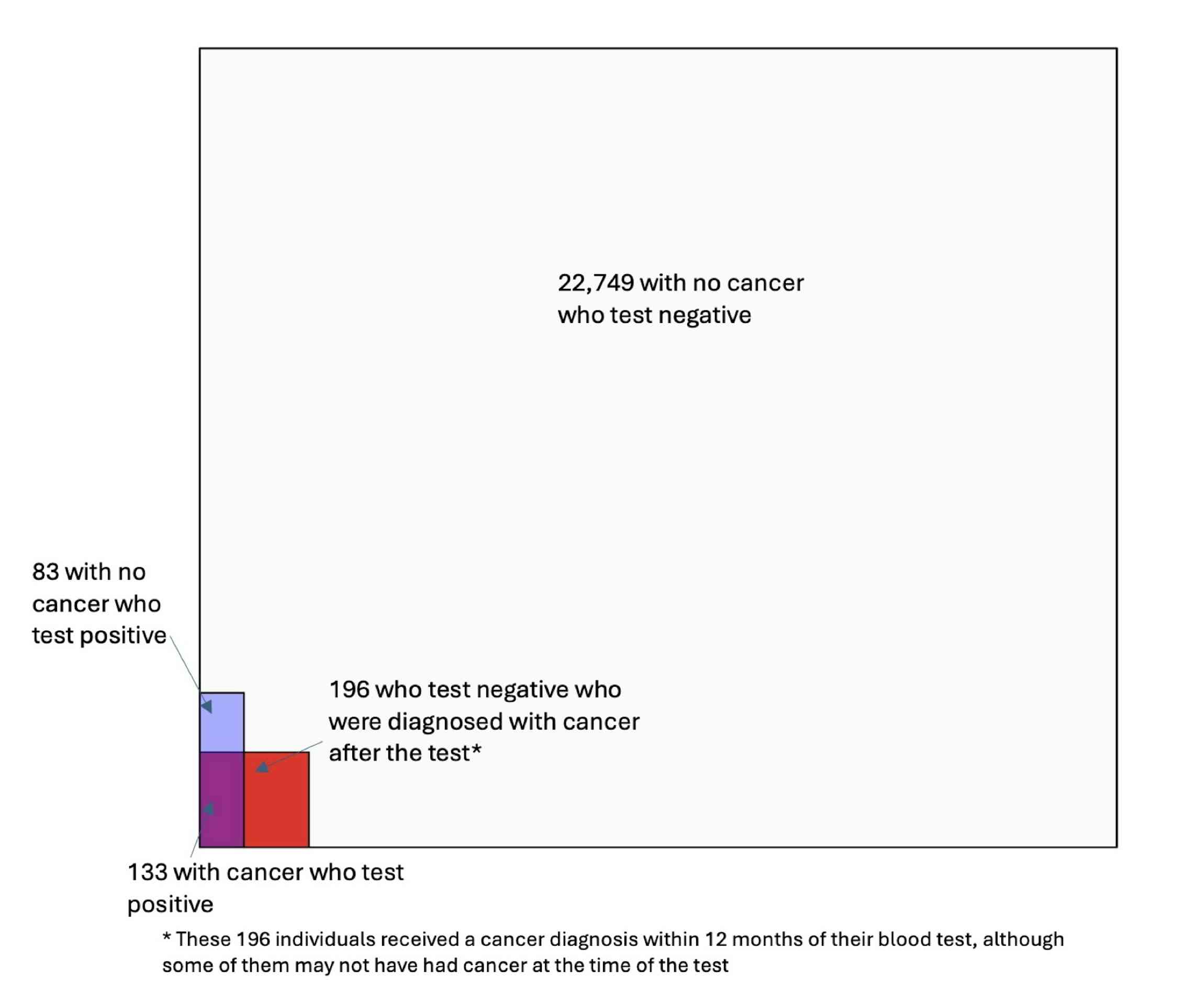
The Pathfinder 2 trial, involving 23,161 people aged over 50 from the US and Canada with no prior cancer diagnosis, produced the figures now circulating widely. Of the 216 participants who tested positive, 133 were later found to have cancer, giving the “positive predictive value” (PPV) of 62% that has been so widely reported.
That metric answers a crucial question: “If I test positive, what’s the chance I actually have cancer?” It also means, however, that 38% of positive results were false alarms.
Specificity – how often a test avoids falsely diagnosing cancer – is equally important, given the anxiety and medical follow-up triggered by an incorrect result. Here, the test performed well: 99.6% of people without cancer received a correct negative result.
Yet even this strong number has implications. If everyone aged over 50 in the UK were tested – more than 26 million people – the same rate would still generate over 100,000 false positives.
What has been less widely discussed is sensitivity, the measure of how many true cancer cases the test actually detects. On this measure, the result was 40.4%, meaning the test missed around three in every five cancers that appeared over the following year.
The Galleri cancer test in numbers. John Ferguson, CC BY-SA The Figure That’s Been Less Widely Reported That shortfall may disappoint those hoping for a catch-all screening tool. It also raises the risk that patients could be falsely reassured by a negative result, potentially delaying a diagnosis.
Statisticians caution that the reported PPV, specificity and sensitivity are estimates rather than fixed values, and each comes with uncertainty. They also note that tests often perform less well outside carefully controlled trials, meaning real-world accuracy could be lower.
So, where does this leave the Galleri test? It may well become a useful addition to future screening programs, provided that negative results are not viewed as definitive by patients or doctors.
But the low sensitivity means many cancers would still be missed in its current form. The test is also expensive – US$949 (£723) in the US – and no evidence yet shows that widely using it reduces cancer deaths.
The early data is encouraging, but perhaps the excitement deserves to be tempered. This technology may be a step forward, but it is not a solution on its own.
John Ferguson, Senior Lecturer in Statistical Science, University of Galway. He does not work for, consult, own shares in or receive funding from any company or organization that would benefit from this article, and has disclosed no relevant affiliations beyond their academic appointment.
This article is republished from The Conversation under a Creative Commons license. Read the original article.
interesting

Beat me to it! And well played.
“38% of positive results were false alarms”
would be surprised if this test in it’s current form would be approved by the FDA given such an insanely high false positive rate, esp. for a disease as devastating as cancer ...
p
Instead of using a test to find out if you have cancer how about preventing cancer?
do not smoke
do not drink
eat lots of vegetables and fruits
keep weight under optimum based on height
exercise regularly
Your chances of getting cancer will drop significantly.
My mind is mush after reading this.
Well, at least you don’t have cancer!............
I’ve been getting the Signatera test after my colon cancer metastasized into lung cancer. I’ve had eight negative results over two years.
Signatera is a personalized blood test that detects the DNA of your cancer in your blood. Signatera is a custom-built, highly sensitive test that uses tumor and blood samples to detect very low levels of molecular residual disease (MRD), or small traces of cancer, using circulating tumor DNA (ctDNA), allowing an individual and their healthcare provider access to more information, sooner.
Per their website, “A positive Signatera™ result predicts relapse with overall positive predictive value more than 98%.” Keep in mind that this test is for reoccurrence of cancer for people who have already been diagnosed with cancer and are currently in remission. It is NOT a general cancer screening test, but an individualized test to detect a marker or indicator of their being a possibility of reoccurrence of cancer.
If the cost of the Galleri blood test in the article is relatively low, these results are absolutely fabulous to use as a generalized screening test for cancer markers. Keep in mind that most people only get tested if they are exhibiting symptoms, thus a generalized screening test will result in lower accuracy.
The NHS-Galleri trial is a research trial to see how well the Galleri blood test works in the NHS. The aim of the trial is to see if using the Galleri test alongside existing cancer screening can help to find cancer early. Finding cancer early often means it is easier to treat.
Over 140,000 volunteers aged 50–77 have registered to take part in the trial after receiving an invitation letter from the NHS. Participants have been invited to attend three appointments over two years, about 12 months apart.
Although appointments are complete, data is still being collected to help with the research. Final trial results are expected to be available from 2026 but may take longer.
Search for the latest results of the NHS Galleri Trial:
Key findings and trial status
Interim NHS results: NHS England stated in May 2024 that the interim results from the first year of the NHS trial were not “compelling enough” to proceed with a large-scale program at that time.
US PATHFINDER 2 trial results: A separate, parallel trial in the US, PATHFINDER 2, released topline data in October 2025 showing Galleri increased cancer detection by over seven-fold when used alongside existing screenings.
Final results awaited: The full, three-year NHS-Galleri trial is ongoing, with final results expected in 2026.
Trial purpose: The trial’s primary goal is to determine if the Galleri test can help the NHS detect cancer earlier in the population and to assess the best way to refer patients with a positive signal for further investigation.
What this means for participants
No individual results: Participants in the NHS trial will not receive their individual test results, regardless of whether they were in the test or control group. This is to maintain the trial’s integrity.
Future use: The blood samples from the trial will not be used for any other purpose. However, it is possible that samples from the control group will be tested in the future for research purposes.
Not a diagnostic test: A positive result on the Galleri test is not a definitive cancer diagnosis. It indicates that a cancer signal has been detected, and further medical investigation is required.
What the Galleri test does
Detects cancer signals: The Galleri test identifies fragments of cancer DNA circulating in the blood to detect a “cancer signal”.
Detects multiple cancer types: It is designed to detect a common signal shared by over 50 different types of cancer, including many for which there is no current national screening program (e.g., lung, stomach, pancreatic, ovarian).
Predicts cancer origin: The test can predict the origin of the cancer signal in the body with reasonable accuracy.
Drug companies won’t stand for this. They want a strong case to develop so the patient needs the most virulent drug and treatment available.
Ping
The Signatera approach sounds practically as ideal as we could hope for, with today’s technology.
That is one everyone who has had cancer should get.
Disclaimer: Opinions posted on Free Republic are those of the individual posters and do not necessarily represent the opinion of Free Republic or its management. All materials posted herein are protected by copyright law and the exemption for fair use of copyrighted works.