Posted on 12/16/2024 1:13:45 PM PST by Red Badger
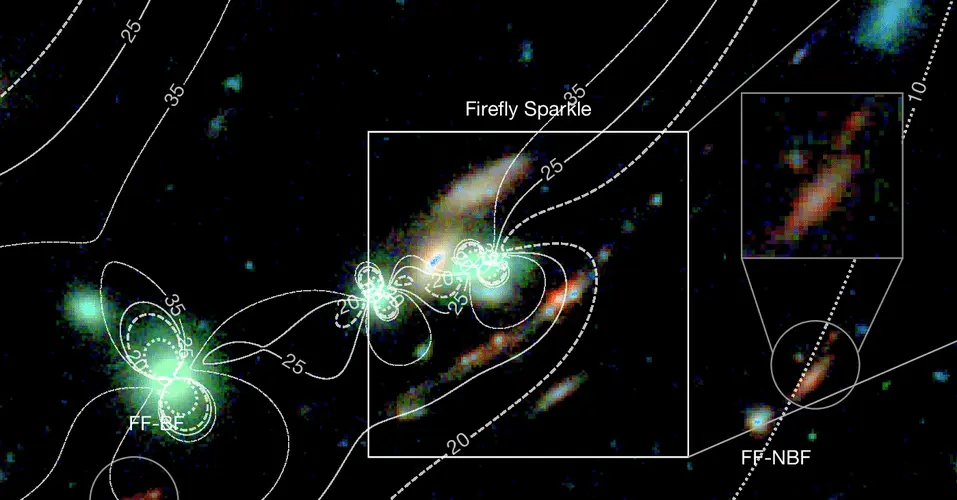
A galaxy just 600 million years old, nicknamed “Firefly Sparkle,” has recently been discovered thanks to the James Webb Space Telescope (JWST), offering an unprecedented glimpse into the formation of galaxies like our own Milky Way.
This low-mass galaxy, located 13.4 billion light-years away, provides a vivid snapshot of the early cosmos. It showcases dense star clusters cocooned in gas and dust, which are akin to the building blocks of galaxies and offer clues to how larger structures like the Milky Way were born.
The discovery, published in Nature and revealed by a team of Wellesley College-led astronomers, sheds light on how galaxy formation unfolds in extreme environments characterized by intense star formation and low metallicity.
The findings also highlight the JWST’s revolutionary capabilities in unearthing cosmic mysteries through gravitational lensing and advanced spectroscopy.
“These remarkable images give us an unprecedented picture of what our own galaxy might have looked like when it was being born,” co-lead author and assistant professor of astronomy at Wellesley College, Dr. Lamiya Mowla, said in a statement. “By examining these photos of the Firefly Sparkle, we can better understand how our own Milky Way took shape.”
Firefly Sparkle is located in the magnified region of the galaxy cluster MACS J1423.8+2404, a powerful gravitational lens that amplifies the young galaxy’s distant light. With a confirmed redshift of 8.296, it is among the farthest galaxies ever observed, providing astronomers with unparalleled detail.
“As an observational astronomer studying the structural evolution of astronomical objects in the early Universe, I want to understand how the first stars, star clusters, galaxies, and galaxy clusters formed in the infant Universe and how they changed as the Universe got older,” Dr. Mowla explained. “I didn’t think it would be possible to resolve a galaxy that existed so early in the universe into so many distinct components, let alone find that its mass is similar to our own galaxy’s when it was in the process of forming.”
Ten-star clusters comprise nearly 50% of the galaxy’s stellar mass, with individual clusters ranging between 100,000 and 1 million solar masses. Their compact sizes and densities exceed even the globular clusters of the Milky Way, hinting at an intense star formation period that defies contemporary models.
“These observations provide our first spectrophotometric view of a typical galaxy in its early stages, in a 600-million-year-old Universe,” researchers wrote.
The Firefly Sparkle’s discovery is a testament to JWST’s capabilities. Previous telescopes, including Hubble, identified the galaxy but could only hint at its extraordinary nature.
JWST’s suite of instruments—particularly the NIRSpec and NIRCam—allowed researchers to pinpoint its redshift, resolve individual clusters, and analyze emission lines indicative of physical conditions.
The galaxy’s spectrum revealed high electron temperatures and extremely low metallicity, a hallmark of early-universe galaxies. Such conditions foster rapid star formation, with the central cluster showing a “top-heavy” initial mass function, favoring massive stars over smaller ones. These findings align with predictions from cosmological simulations, bridging theoretical models and observational data.
The Firefly Sparkle is not alone. Two neighboring galaxies, nicknamed Firefly-Best Friend and Firefly-New Best Friend, were also identified in the same lensing field.
Both galaxies exhibit similar redshifts and emission properties, suggesting a shared formation history. Such galactic trios are rare and offer a unique laboratory to study interactions in the early Universe.
Firefly Sparkle’s star clusters are crucial to understanding how galaxies evolve. Densely packed with stars, each cluster likely formed in bursts triggered by intense gravitational interactions or gas accretion. Over time, such clusters may merge, creating the nuclei of larger galaxies or surviving as globular clusters orbiting the galactic halo.
Photometric modeling indicates that these clusters are between 10 and 100 million years old, making them among the youngest known. Their specific star formation rates are high, indicating active stellar mass assembly. This rapid growth echoes the conditions expected in the progenitors of Milky Way-like galaxies.
The discovery of Firefly Sparkle raises intriguing questions about galaxy formation and the role of star clusters. Are such clusters universal building blocks, or do they represent a unique pathway in galaxy evolution?
Simulations suggest that such clusters might survive tidal forces to become present-day globular clusters, while others might disintegrate into diffuse stellar populations.
The discovery also challenges conventional models of the initial mass function (IMF) in star formation. The “top-heavy” IMF observed in the Firefly’s central cluster deviates from the standard Kroupa or Salpeter IMFs, indicating that the earliest galaxies may have formed stars under radically different conditions.
Ultimately, the discovery of Firefly Sparkle is likely just the beginning. With planned observations by JWST and complementary studies using the Atacama Large Millimeter/submillimeter Array (ALMA), astronomers aim to uncover the detailed gas dynamics and further refine the models of early star formation.
Additionally, as lensing models improve and JWST’s sensitivity expands, researchers hope to identify even fainter and older galaxies. Such discoveries will illuminate the Universe’s first billion years, a period that remains largely uncharted.
“There is so much going on inside this tiny galaxy, including so many different phases of star formation,” Dr. Mowla said. “These images are the very first glimpse of something that we’ll be able to study—and learn from—for many years to come.”
Tim McMillan is a retired law enforcement executive, investigative reporter and co-founder of The Debrief. His writing typically focuses on defense, national security, the Intelligence Community and topics related to psychology. You can follow Tim on Twitter: @LtTimMcMillan. Tim can be reached by email: tim@thedebrief.org or through encrypted email: LtTimMcMillan@protonmail.com
Webb Ping!......................
how the hell do they know its 600 million years old if they just discovered it!?? how do they know its exact distance!??
They can measure fairly accurately the ‘Red Shift’ of it’s light components and from that deduce it’s age and distance...........
Another day. Another “anomaly” that stands the standard model of the universe on its head.
Scientific research is loaded with “anomalies”(facts that don’t fit theories) which never seem to faze the PhD know-it-alls. The Webb scope keeps finding things that impeach Big Bang.
For that matter the fossil record does not support Darwin even ignoring the unexplainable Cambrian Explosion.
None of this affects the smug scientific establishment in the slightest.
Any idea what the contour lines in the image represent?
🤖
No Idea...................

👍🏼👍🏼
sorry to be a fart in the car but my faith in the “truth” only goes this far...
Our next door neighbor Andromeda looks similar to the Milky Way but is twice as large. Only 2.5M light years away and will someday merge with the Milky Way.
“Early Galaxy”
Better late than never.
Every time they find something they don’t understand, they proudly say “We are learning more.”
Every time ordinary people look at their work and say, “I think you might be wrong”, they snarl “Science denier!!”
🙄
Hard to believe an adult wrote that post.
“All those memories will be gone. Like tears in rain.”
One of the very best lines in all of cinema was ad libbed by Rutger Hauer.
And they said it has a McDonald’s and a Walmart, too..
It doesn’t look a day over 599 million years to me.
Look up and read about the Great Attractor.
We are at this moment being pulled toward it at 1.3 million miles per hour. There will only be left protons and electrons, maybe, when joined.
Y’all have to keep in mind astronomical observations
are of things that were, not things that may no longer exist.
Disclaimer: Opinions posted on Free Republic are those of the individual posters and do not necessarily represent the opinion of Free Republic or its management. All materials posted herein are protected by copyright law and the exemption for fair use of copyrighted works.