Posted on 10/17/2022 12:34:22 PM PDT by Red Badger
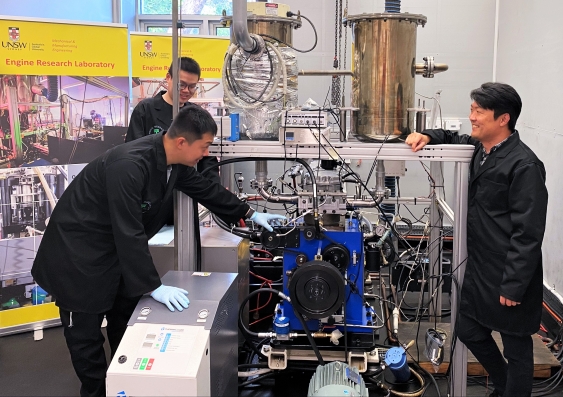
Team from UNSW Engine Research Laboratory develop new Hydrogen-Diesel Direct Injection Dual-Fuel System that significantly cuts carbon emissions.
Hydrogen-Diesel Direct Injection Dual-Fuel System team
The Hydrogen-Diesel Direct Injection Dual-Fuel System has been developed by a team from the UNSW Engine Research Laboratory led by Professor Shawn Kook (right), and including Xinyu Liu (back left) and Jinxin Yang (front left). Photo from Prof. Shawn Kook
**********************************************************************************
Engineers from UNSW Sydney have successfully converted a diesel engine to run as a hydrogen-diesel hybrid engine – reducing CO2 emissions by more than 85 per cent in the process.
The team, led by Professor Shawn Kook from the School of Mechanical and Manufacturing Engineering, spent around 18 months developing the Hydrogen-Diesel Direct Injection Dual-Fuel System that means existing diesel engines can run using 90 per cent hydrogen as fuel.
The researchers say that any diesel engine used in trucks and power equipment in the transportation, agriculture and mining industries could ultimately be retrofitted to the new hybrid system in just a couple of months.
Green hydrogen, which is produced using clean renewable energy sources such as wind and solar, is much more environmentally friendly than diesel.
Hydrogen-Diesel Direct Injection Dual-Fuel System
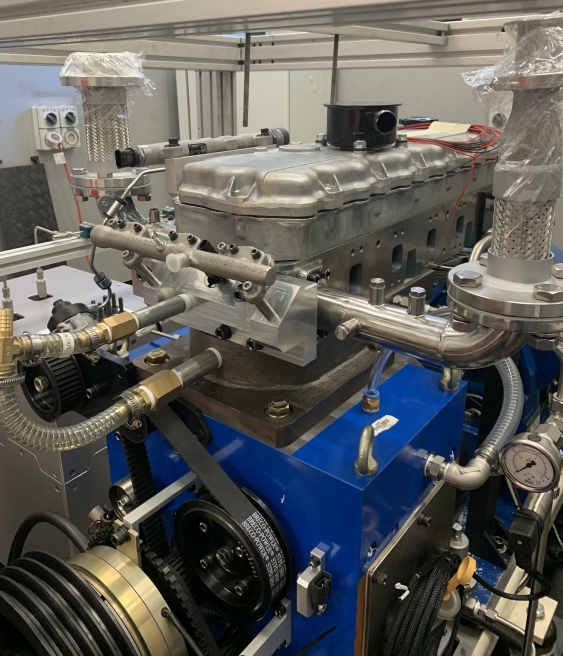
The Hydrogen-Diesel Direct Injection Dual-Fuel System developed at UNSW enables a traditional diesel engine to be retrofitted to run as a hydrogen-diesel hybrid engine. Photo by Prof. Shawn Kook
**********************************************************************
And in a paper published in the International Journal of Hydrogen Energy, Prof. Kook’s team show that using their patented hydrogen injection system reduces CO2 emissions to just 90 g/kWh – 85.9 per cent below the amount produced by the diesel powered engine.
“This new technology significantly reduces CO2 emissions from existing diesel engines, so it could play a big part in making our carbon footprint much smaller, especially in Australia with all our mining, agriculture and other heavy industries where diesel engines are widely used,” says Prof. Kook.
“We have shown that we can take those existing diesel engines and convert them into cleaner engines that burn hydrogen fuel.
“Being able to retrofit diesel engines that are already out there is much quicker than waiting for the development of completely new fuel cell systems that might not be commercially available at a larger scale for at least a decade.
“With the problem of carbon emissions and climate change, we need some more immediate solutions to deal with the issue of these many diesel engines currently in use.”
High-pressure hydrogen direct injection The UNSW team’s solution to the problem maintains the original diesel injection into the engine, but adds a hydrogen fuel injection directly into the cylinder.
The collaborative research, performed with Dr Shaun Chan and Professor Evatt Hawkes, found that specifically timed hydrogen direct injection controls the mixture condition inside the cylinder of the engine, which resolves harmful nitrogen oxide emissions that have been a major hurdle for commercialisation of hydrogen engines.
“If you just put hydrogen into the engine and let it all mix together you will get a lot of nitrogen oxide (NOx) emissions, which is a significant cause of air pollution and acid rain,” Prof. Kook says.
“But we have shown in our system if you make it stratified – that is in some areas there is more hydrogen and in others there is less hydrogen – then we can reduce the NOx emissions below that of a purely diesel engine.”
Hydrogen-Diesel Direct Injection Dual-Fuel System
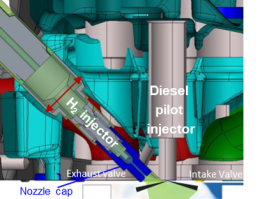
The Hydrogen-Diesel Direct Injection Dual-Fuel System features independent control of hydrogen direct injection timing, as well as diesel injection timing, enabling full control of combustion modes – premixed or mixing-controlled hydrogen combustion. Image from Prof. Shawn Kook
*********************************************************************************
Importantly, the new Hydrogen-Diesel Direct Injection Dual-Fuel System does not require extremely high purity hydrogen which must be used in alternative hydrogen fuel cell systems and is more expensive to produce.
And compared to existing diesel engines, an efficiency improvement of more than 26 per cent has been shown in the diesel-hydrogen hybrid.
That improved efficiency is achieved by independent control of hydrogen direct injection timing, as well as diesel injection timing, enabling full control of combustion modes – premixed or mixing-controlled hydrogen combustion.
The research team hope to be able to commercialise the new system in the next 12 to 24 months and are keen to consult with prospective investors.
They say the most immediate potential use for the new technology is in industrial locations where permanent hydrogen fuel supply lines are already in place.
That includes mining sites, where studies have shown that about 30 per cent of greenhouse-gas emissions are caused by the use of diesel engines, largely in mining vehicles and power generators.
And the Australian market for diesel-only power generators is currently estimated to be worth around $765 million.
“At mining sites, where hydrogen is piped in, we can convert the existing diesel engines that are used to generate power,” says Prof. Kook.
“In terms of applications where the hydrogen fuel would need to be stored and moved around, for example in a truck engine that currently runs purely on diesel, then we would also need to implement a hydrogen storage system to be integrated into our injection system.
“I do think the general technology with regards to mobile hydrogen storage needs to be developed further because at the moment that is quite a challenge.”
People who want to reduce CO2 also hate food and puppies and guppies and yuppies and a green(er) planet.
This is not much different than a gasifier. The engine doesn’t actually run on liquid gas.
So is the sun.
Got you 100% on that binding, and thanks!
“Any diesel engine could be retrofitted to burn hydrogen in just a couple of MONTHS....” Not a real strong sales point, if I may say so.
the major problem with hydrogen is, the there is NONE on the Earth in pure form.
This machine would be great on the Sun, which has a lot of hydrogen.
On the Earth, it has to be made, using fossil fuels!
Basically the same problem like electricity.
It is clear on the moving vehicle, but dirty somewhere, where the power is made.
Two Words: Hydrogen Embrittlement
On a million mile diesel engine, that’s a killer.
Maybe you could run a diesel generator to crack water??
“Filling it up and using it up in short order works where you can do that.”
I’ve seen some with a hydrogen generator in the vehicle.
Hydrogen stock is a good investment major countries are gearing up production for it.
Makes pulling dead EV cars to the side of the road.

“crack water?” Does Hunter know about that?
Anyway, my first car was a 1930 Model A Ford. The gas tank was the dashboard. Didn’t seem like a problem at the time. But driving a hydrogen bomb around would seem to up the odds of a screwup a bit?
I have something almost as good. If connects to your fuel line and aligns the molecules magnetically for 20 % better fuel mileage. Send me 29.95 plus 10.00 shipping and handling and thumb your nose at big oil. Or big hydrogen. Or whatever.
Some people on youtube have done testing of cars with and without hydrogen generators. With hydrogen they get worse mileage.
File this with 200mpg carburetors.
True, but the oceans are closer and cooler....................
Disclaimer: Opinions posted on Free Republic are those of the individual posters and do not necessarily represent the opinion of Free Republic or its management. All materials posted herein are protected by copyright law and the exemption for fair use of copyrighted works.