Posted on 09/28/2022 1:00:50 PM PDT by Red Badger
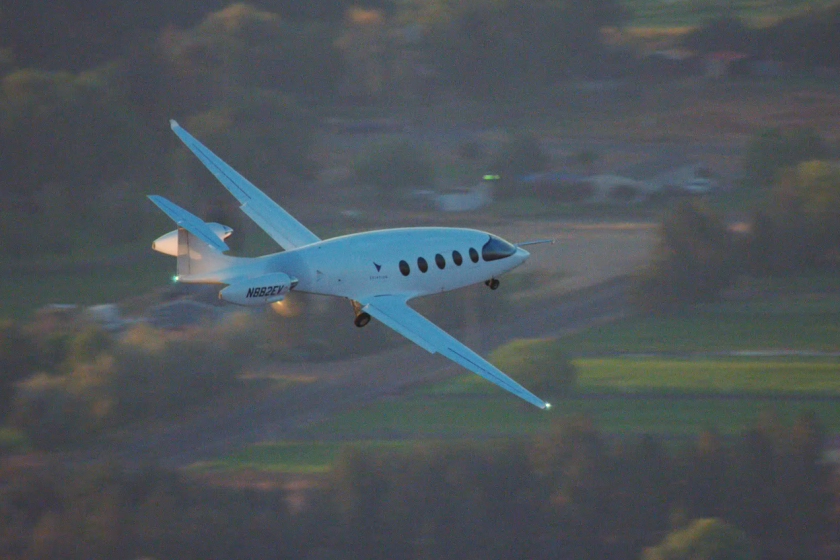
A historic moment for zero-emissions flight, as the 9-seat Alice commuter plane makes its first test flightEviation
After showing off with some extravagant runway wheelies last week, Alice, the "world's first all-electric commuter aircraft," lifted off overnight on a historic first flight. It's another major milestone toward zero-emissions medium-range air travel.
Alice took off at 7.10 am local time from Grant County International Airport in Washington state, and made a short, 8-minute circuit, reaching an altitude of 3,500 ft (1,067 m) before coming in and touching down.
"Today we embark on the next era of aviation – we have successfully electrified the skies with the unforgettable first flight of Alice," said Eviation President and CEO Gregory Davis. "People now know what affordable, clean and sustainable aviation looks and sounds like for the first time in a fixed-wing, all-electric aircraft. This ground-breaking milestone will lead innovation in sustainable air travel, and shape both passenger and cargo travel in the future."
Eviation is targeting 2026 for FAA certification and entry into service Eviation is targeting 2026 for FAA certification and entry into serviceEviation It is indeed a significant moment, although there's a way to go yet. The Alice we see flying in the video below is still an experimentally registered prototype, rather than a fully certified production aircraft. Eviation still has to run it through a full and rigorous flight test regime, and jump through the many hoops of FAA certification, not just for the aircraft and all its systems, but also for the company itself as a design organization and a production facility. The company hopes to have this all squared away and get Alice into service by 2026.
(Excerpt) Read more at newatlas.com ...
Don’t expect much. He got a good ol punch to the nuts in post #47.
“I appreciate they may not be flavour of the month around these parts, but I read an interesting article about the new Russian hybrid aircraft engines.
“Prius “powered aircraft. It was serious and they are going into production.
If anyone is interested I think it was a Sukhoi and Kamov project.”
Oooohhhhh!!! Hybrid technology combined with Russian aircraft design, quality, and reliability! How do I sign up on the list for “HELL NO!” ?
Zero Emissions?? well I guess they forgot about the charging part... and, I wonder whats gonna happen the first time those batteries catch on fire??
I think this is the company that started in Prescott AZ. They never flew an aircraft out here but one of the aircraft did catch on fire on the ground. Not sure how extensive but they are not based here in Prescott.
Wait till one of those blow up. A little lightening ought to do it.
“>zero-emissions flight
Powered by coal.”
There is a reason Montana has a $1,000,000,000+ Coal Tax Fund (can’t be touched without a 75% approval of both House and Senate and Governor).
The fund gets larger every day...
I’ll compile the list from this thread tomorrow. :D
The battery is going to explode—sooner or later!!!!
Forward-facing propellers on the rear wings are a no-no due to icing sloughing off the main wings.
I read 80 miles. and then charging takes 3 hours.
I think you are on to something... Slingshoting or catapulting it might add a couple of minutes of flight time.

Same here, but if it fills that niche, more power to them.
(a) No person may operate a civil aircraft in IFR conditions unless it carries enough fuel (considering weather reports and forecasts and weather conditions) to -
(1) Complete the flight to the first airport of intended landing;
(2) Except as provided in paragraph (b) of this section, fly from that airport to the alternate airport; and
(3) Fly after that for 45 minutes at normal cruising speed or, for helicopters, fly after that for 30 minutes at normal cruising speed.
(b) Paragraph (a)(2) of this section does not apply if:
(1) Part 97 of this chapter prescribes a standard instrument approach procedure to, or a special instrument approach procedure has been issued by the Administrator to the operator for, the first airport of intended landing; and
(2) Appropriate weather reports or weather forecasts, or a combination of them, indicate the following:
(i) For aircraft other than helicopters. For at least 1 hour before and for 1 hour after the estimated time of arrival, the ceiling will be at least 2,000 feet above the airport elevation and the visibility will be at least 3 statute miles.
(ii) For helicopters. At the estimated time of arrival and for 1 hour after the estimated time of arrival, the ceiling will be at least 1,000 feet above the airport elevation, or at least 400 feet above the lowest applicable approach minima, whichever is higher, and the visibility will be at least 2 statute miles. [Doc. No. 98-4390, 65 FR 3546, Jan. 21, 2000]
Yes it’s loosely based on the Columbia 400, but with a bigger engine/de-ice/modern Garmin avionics.
It’s just the wife and me trucker. Very easy to fly.
Being a IDF guy, I always flew Mooneys but they’re just tight with more than just me.
empty or full of passengers?
sorry for the error
“local commuter and air taxi services”
That’s all I see, too. And what are the benefits? Fewer engine overhauls, far less complex engine with no moving parts. You still need to power aux loads like AC.
I find it hard to believe that lithium batteries will ever be safe enough for this application.
Hydrocarbon fuels store 13 times more energy per pound than batteries. That value is not changing much through R&D, either.
I am working on aerial recharging. I start with a C-130 and some really long extension cords on cable reels in the cargo hold...
Jim Croce, Skynyrd, Buddy Holly, Ritchie Valens, John Denver, etc.
Disclaimer: Opinions posted on Free Republic are those of the individual posters and do not necessarily represent the opinion of Free Republic or its management. All materials posted herein are protected by copyright law and the exemption for fair use of copyrighted works.