
Posted on 08/27/2022 6:29:31 AM PDT by Diana in Wisconsin
The Weekly Gardening Thread is a weekly gathering of folks that love soil, seeds and plants of all kinds. From complete newbies that are looking to start that first potted plant, to gardeners with some acreage, to Master Gardener level and beyond, we would love to hear from you.
If you have specific question about a plant/problem you are having, please remember to state the Growing Zone where you are located.
This thread is a non-political respite. No matter what, you won’t be flamed, and the only dumb question is the one that isn’t asked.
It is impossible to hijack the Weekly Gardening Thread. Planting, Harvest to Table Recipes, Preserving, Good Living - there is no telling where it will go - and that is part of the fun and interest. Jump in and join us! Send a Private Message to Diana in Wisconsin if you'd like to be added to our New & Improved Ping List.
NOTE: This is a once a week Ping List. We do post to the thread during the week. Links to related articles and discussions which might be of interest to Gardeners are welcomed any time!
How To Ferment Almost Anything At Home (+10 Recipes To Get Started)
Getting more value from your garden produce or farmers’ market haul is always the goal, and few kitchen hacks have a higher return on investment than fermenting.
Small batch fermentation is a simple preservation strategy that boosts both the flavors and nutritional value of your vegetables.
Fermenting 101: Understanding the Basics
This time tested method of food preservation is most likely a happy accident of history.
Laborers likely packed fresh produce in pots with salt and came back weeks later to discover the fermented result. Most cultures with abundant salt supplies had a tradition of fermenting, from sauerkraut in Europe to kimchi in Korea and soured grain dishes across Africa.
Though the specifics can vary, the process is simple.
You’ll rough cut your produce of choice to release juices and increase surface area. Next you’ll add in salt or brine, which draws moisture out of the vegetables while inhibiting spoiling.
Let everything mingle together in an oxygen-free environment so the lactobacillus bacteria can do its job of digesting the natural sugars and transforming them into lactic acid. This acid creates a distinctive tangy flavor while preventing harmful microbes from getting established.
You can enjoy the end product immediately or store it in a cool place for future enjoyment. Refrigeration will stop the fermentation process—any ferment left on the counter will continue to soften and sour.
But why should you ferment in the first place? Let’s explore its advantages.
https://www.ruralsprout.com/home-fermenting/

8 Reasons To Start Fermenting
1. Easy, Natural Food Preservation:
Don’t let this low-tech simplicity scare you; fermentation is one of the safest food preservation strategies. It’s the perfect way to improve the shelf life of homegrown produce without any more effort than prepping the ingredients and waiting for microbes to do their job. Compare it to canning, which requires you to sterilize and boil jars for long periods, and you’ll see the appeal of fermentation’s simplicity.
2. Enhanced Flavors:
The fermentation process creates lactic acid, which adds an appealing tangy taste to the dish.
3. Acts as a Digestive Aid:
Fermented foods have long been used as a natural remedy for stomach problems. They can stimulate the production of digestive juices, keep your stomach at the optimal pH level, and break down complex carbohydrates so your system better absorbs their nutritional benefits.
4. Supports the Endocrine System:
Fermented foods may help you moderate your hormones. The gastrointestinal tract is the body’s largest endocrine organ, and keeping it healthy will positively affect your mood, weight, and immune system.
5. Lowers Disease Risk:
Adding ferments to your diet may stave off lifestyle diseases. One study in the British Journal of Nutrition determined that eating fermented dairy can lower your risk of coronary heart disease. Another study found that good gut bacteria (the kind fermented foods provide) reduced the risk of cancer for mice.
6. Better for the Planet:
Canning and freezing are both energy-intensive ways to preserve food. Learning how to use a home fermentation kit, in contrast, requires nothing more than some counter space, which makes you less dependent on fossil fuels for food storage.
7. May Boost Nutrition Content:
Not only do fermented vegetables retain their original nutritional benefits, but this “predigestion” process actually increases their bioavailability (especially calcium and vitamin C), so your body can absorb a higher percentage of them. Fermentation also synthesizes nutrients associated with skin, nail, and hair health, including biotin, folic acid, and vitamin B12.
8. Delivers Probiotics:
Consuming fermented foods gives your stomach a dose of beneficial bacteria known as probiotics. They collectively improve your gut microbiome for wide-ranging health benefits.
It doesn’t take much time or specialty equipment to learn how to ferment, so consider experimenting with homemade ferments for your next culinary adventure.

Thanks to Pete for suggesting this thread idea! After reading the article a few times, I am anxious to try making Apple Cider Vinegar; have a glut of apples this season, the Fermented Ketchup; I should have enough tomatoes and Lacto Fermented Garlic; we had a good crop this season.
Fermenting & brewing - perfect ... thinking about doing some of this (elderberries).
+++++++++++++++++++++++++++++++++++++
The garden is gradually dying out so not much going on there. The main event are the flowers – 2 beds of zinnias blooming and the tithonia and sunflowers started blooming this week. There is a 3rd bed of zinnias where I've planted some commercial seeds & some are coming up. Those commercial seeds are for very large zinnias and I'm hoping to harvest seeds for next year.
My mom is looking at replacing a lot of her gardens which have become gourmet salad bars for the deer (hostas, sedum, day lilies, rose bushes) with plants that the deer won't eat. She bought four Echinachea plants a couple of weeks ago – really pretty & the deer are leaving them alone. It is expensive buying plants like the Echinacheas that are already blooming. I want to clean out a small shed to use for starting garden plants next spring and we could do flowers at the same time.
There was a long post this week by The Heirloom Gardener on elder berries that was not only informative, but also had several very old recipes, which were interesting. One of them involved pork & since I'm getting a half hog the end of September, that one was definitely saved. There are also recipes for wine, cordial & vinegar. I've been very interested in elderberries for medicinal purposes recently and did a little research to see about growing them – the deer love them, pretty much all parts, so that would be a major problem. It would definitely be easier & likely cheaper in the long run, to just buy a pound of organic berries to make elderberry syrup. Making syrup and maybe vinegar would be a good winter project and I have enough bottles left over from making vanilla that I could use to gift a couple of bottles of syrup, maybe for Christmas. Elderberry was the International Herb Association's “Herb of the Year” in 2013.
The Heirloom Gardener also posted a quote from Henry David Thoreau (artwork James Nairn)::
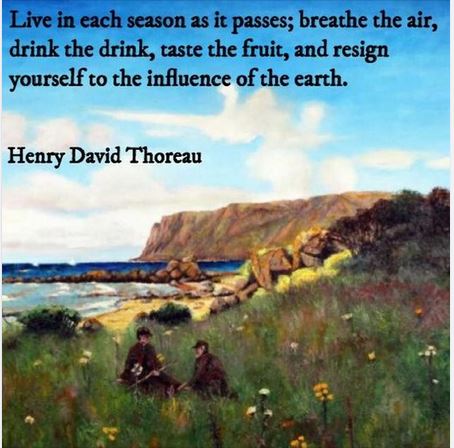
I like this quote a lot – even though we've had a brutal summer, there have been aspects to enjoy above & beyond the garden. Now that we're closing in on September, I'm more than ready to “live in Fall”!
CLICK ON THE TIN PIE SAFE!

(If you are unsure, its on the left!)
Been fermenting everything from veggies to barley and even a good bit of corn on occasion for many years. Cool thread!


Yes, buying perennials can be very expensive! Maybe you could ask some neighbors for pieces of some of the things you need? Coneflower are pretty easy from seed; you’ll have luck with that. Just be warned; they love to revert back to their basic purple origins; I have some hybridized ones that are changing colors every year. And they were NOT cheap, either.
Anyone know what causes that other than Mother Nature, Herself?
Can’t wait to see pictures of your zinnias! They’ve been so pretty in the past. :)
I am SO ready for Fall, too. I love Fall and Spring, best. Summer and Winter are just work, work, work on the farm. Everything takes 100X longer to do in the Winter. But, I like the sports! We’re supposedly getting a lot of snow this Winter, which would be nice! Haven’t had my snowshoes out in 2 years! Grrrr!
Ellendra is your Elderberry expert, BTW.
Back to The Cannery with me, today. Dealing with apples, which isn’t turning out to be as horrible as I thought it would be. ‘Law & Order SVU’ marathon on TV will help while I’m chopping and peeling! :)
Terrific! We’ll ping you if we run into problems. ;)
Bkmk ferment
I’m up to my eyeballs in tomatoes and so am canning them up into sauce and stewed tomatoes. And giving away what I can.
I guess it’s been drier here than I realized because our pond is way down, but that has enabled us to do some work around the edge of it that needed to be done but is normally inaccessible.
Our wood splitting is coming along nicely. We’ll be warm for a couple winters at least.
Mom has a spot where she sprinkled some mixed seeds from a packet someone gave her. There were cone flowers & blanket flowers mixed in there. Of course, the cone flowers were the basic purple. I really liked them so I hope we can successfully grow them. I think the blanket flowers are really pretty and she could certainly use them in a lot of places for color.
The deer never used to eat the sedum, but two years ago, we had a doe with twins and she was HUNGRY. Our next door neighbor is the junk hole on the road - his front yard is so grown up you can’t see the house & that is where she stashed the twins while she was out & about. Once the twins were old enough, we saw them quite often. Anyway, that was the beginning of the sedum being eaten up. Either she’s still around & has developed a taste for them and/or the twins are copying their mom. We do have one big doe (twin mama, is that you?) hanging around this year - she goes & eats windfall apples under the old tree in the pasture, then my brother has seen her heading up our way so she’s probably checking out the salad bar. Mom has been covering the hostas with row cover at night & that has kept her from eating most of them.
A previous steer (Dinner) didn’t eat the Sedum, but he DID eat all the Hosta on the north side of the house!
They recovered nicely. Well, Dinner didn’t. ;)
Sedum make a VERY pretty Fall bouquet if you have various colors and textures. I made up bouquets and left them at the ends of our check out stands at the garden center. They got a lot of attention and I sold a LOT of Sedum for Fall planting. ;)
When I tire of my roses (fighting Japanese Beetles is getting really old!) I may pull them all out and plant nothing but Sedum in their place, all around the Greenhouse. :)
Mom had gorgeous sedum & used them in arrangements ... that’s one reason she’s so upset the deer are now eating them.
The hostas are ‘goners’ if deer are around. The solid green are preferred & after they’ve eaten those, they’ll go for the variegated ones.
Metmom; Augie stocked his pond with perch. Is yours also stocked or is just whatever nature provided?
Cordonbleu: The Art of Fermentation
How much salt?
The trick to perfecting your fermented vegetables is to be precise with the salt and water ratio. You will find there is a lot of trial and error involved to obtain your preferred taste, as it is a fine balance.
Salt is a critical ingredient and when used in the right proportions, creates the perfect environment to control the growth of microorganisms and create a ' happier' ferment. Salt in fermentation encourages the growth of healthy bacteria, while at the same time kills off bad bacteria. We need to be precise when measuring the salt and water, especially when fermenting vegetables that will be submerged in brine.
“https://static.cordonbleu.edu/Files/MediaFile/76377.jpg
Three common methods of preparing vegetable ferments include:
The dry salting method: Toss the vegetables with salt and allow the salt to draw liquid from the vegetables. For this, the typical amount of salt to be used would be approximately 1 tablespoon for every 680 grams of vegetables. The salt effectively stabilises the environment while the bacteria involved in the fermentation take hold. This technique is commonly used for sauerkraut.
The pre-brining method: Mix a brine by dissolving salt in water and then soaking the vegetables in the brine. This is followed by draining off the brine and then compressing the vegetables to encourage further liquid to escape the vegetables and cover the vegetables for the fermenting process. A stronger brine of 4 tablespoons of salt for 1 litre of water is effective for this method.
The art of fermentation is an age-old process which requires some precision and knowledge. The health advantages and environmentally conscious benefits makes fermentation the perfect skill to adopt today. Mastering the salt to water ratio as the trick to great fermented vegetables will not only allow you to perfect the craft, but will also guide you in understanding it’s important role in fermentation when starting out.
Nice thread. We have kefir grains going on 25+ years now. I have a short glass nearly every night. We also do sauerkraut and refrigerator kosher pickles. We also make pickled banana pepper rings. Tried kimchee once and that was enough. I guess I didn’t like the radish in it. Best resource for kefir is an old old website.
Best place to buy kefir grains is etsy believe it or not.
Disclaimer: Opinions posted on Free Republic are those of the individual posters and do not necessarily represent the opinion of Free Republic or its management. All materials posted herein are protected by copyright law and the exemption for fair use of copyrighted works.