Posted on 02/15/2022 6:27:12 AM PST by Red Badger
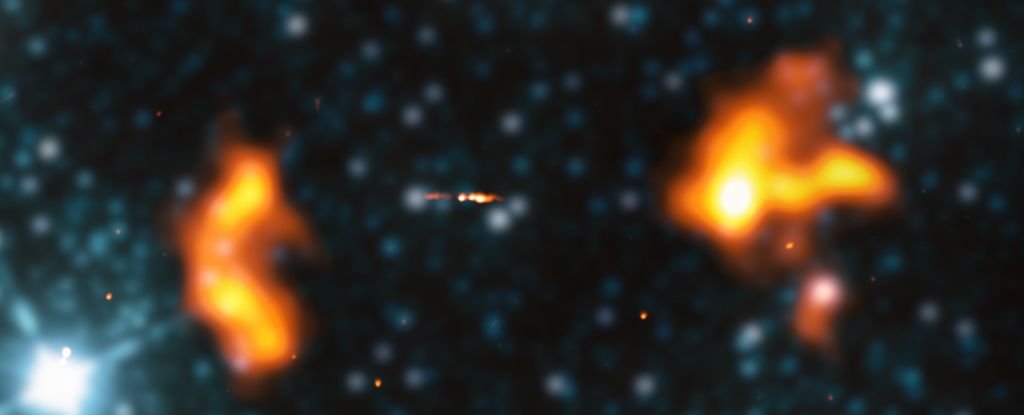
The radio lobes of Alcyoneus. (Oei et al., arXiv, 2022)
Astronomers have just found an absolute monster of a galaxy.
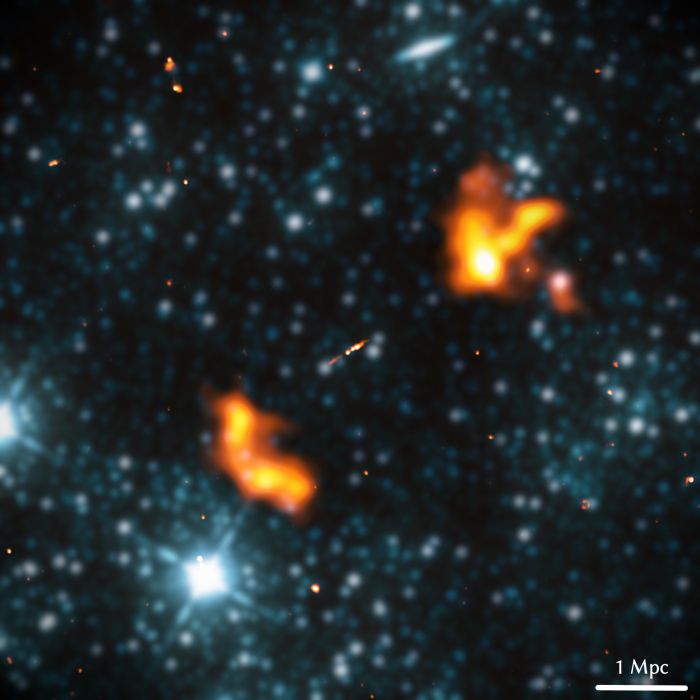
Lurking some 3 billion light-years away, Alcyoneus is a giant radio galaxy reaching 5 megaparsecs into space. That's 16.3 million light-years long, and constitutes the largest known structure of galactic origin.
The discovery highlights our poor understanding of these colossi, and what drives their incredible growth. But it could provide a pathway to better understanding, not just of giant radio galaxies, but the intergalactic medium that drifts in the yawning voids of space.
Giant radio galaxies are yet another mystery in a Universe full of mysteries. They consist of a host galaxy (that's the cluster of stars orbiting a galactic nucleus containing a supermassive black hole), as well as colossal jets and lobes that erupt forth from the galactic center.
These jets and lobes, interacting with the intergalactic medium, act as a synchrotron to accelerate electrons that produce radio emission.
We are pretty sure we know what produces the jets: an active supermassive black hole at the galactic center. We refer to a black hole as 'active' when it's guzzling down (or 'accreting') material from a giant disk of material around it.
Not all the material in the accretion disk swirling into an active black hole inevitably ends up beyond the event horizon. A small fraction of it somehow gets funneled from the inner region of the accretion disk to the poles, where it is blasted into space in the form of jets of ionized plasma, at speeds a significant percentage of the speed of light.
These jets can travel enormous distances before spreading out into giant radio-emitting lobes.
Alcyoneus lobes inset
The radio lobes of Alcyoneus. (Oei et al., arXiv, 2022)
This process is pretty normal. Even the Milky Way has radio lobes. What we don't really have a good handle on is why, in some galaxies, they grow to absolutely gargantuan sizes, on megaparsec scales. These are called giant radio galaxies, and the most extreme examples could be key to understanding what drives their growth.
"If there exist host galaxy characteristics that are an important cause for giant radio galaxy growth, then the hosts of the largest giant radio galaxies are likely to possess them," the researchers, led by astronomer Martijn Oei of Leiden Observatory in the Netherlands, explain in their preprint paper, which has been accepted for publication in Astronomy & Astrophysics.
"Similarly, if there exist particular large-scale environments that are highly conducive to giant radio galaxy growth, then the largest giant radio galaxies are likely to reside in them."
The team went looking for these outliers in data collected by the LOw Frequency ARray (LOFAR) in Europe, an interferometric network consisting of around 20,000 radio antennas, distributed throughout 52 locations across Europe.
They reprocessed the data through a new pipeline, removing compact radio sources that might interfere with detections of diffuse radio lobes, and correcting for optical distortion.
The resulting images, they say, represents the most sensitive search ever conducted for radio galaxy lobes. Then, they used the best pattern recognition tool available for locating their target: their own eyes.
This is how they found Alcyoneus, spewing forth from a galaxy a few billion light-years away.
"We have discovered what is in projection the largest known structure made by a single galaxy – a giant radio galaxy with a projected proper length [of] 4.99 ± 0.04 megaparsecs. The true proper length is at least … 5.04 ± 0.05 megaparsecs," they write.
Once they had measured the lobes, the researchers used the Sloan Digital Sky Survey to try to understand the host galaxy.
They found that it's a fairly normal elliptical galaxy, embedded in a filament of the cosmic web, clocking in at around 240 billion times the mass of the Sun, with a supermassive black hole at its center around 400 million times the mass of the Sun.
Both of these parameters are actually at the low end for giant radio galaxies, which could provide some clues as to what drives the growth of radio lobes.
"Beyond geometry, Alcyoneus and its host are suspiciously ordinary: the total low-frequency luminosity density, stellar mass and supermassive black hole mass are all lower than, though similar to, those of the medial giant radio galaxies," the researchers write.
"Thus, very massive galaxies or central black holes are not necessary to grow large giants, and, if the observed state is representative of the source over its lifetime, neither is high radio power."
It could be that Alcyoneus is sitting in a region of space that is lower density than average, which could enable its expansion – or that interaction with the cosmic web plays a role in the object's growth.
Whatever is behind it, though, the researchers believe that Alcyoneus is still growing even bigger, far away in the cosmic dark.
The research has been accepted for publication in Astronomy & Astrophysics, and is available on arXiv.

Much mischief occurs when the theoretical is confused with data that has been confirmed by the scientific method. Hypotheses are interesting but must be confirmed by experimentation that must be repeatable. Sorry but facts matter.
So, what I get from this article is the radio lobes are 16.3 million light-years across, not the actual galaxy of stars. I’m sure the actual galaxy of stars isn’t much bigger than ours, not 163 times as big as implied in the headlines ...

"billions and billions"
Wait a minute....
You mean...SCIENCE.... was...poor on this topic before now?
No....................
There goes the upcoming "not tonight I have a headache" excuse.
Great lines!
I’m just starting to get into Shakespeare, in film for now. I recently watched
“The Tragedy of MacBeth” with Denzel Washington, and “Hamlet” with Sir Richard Burton, and enjoyed them both. Also “Romeo and Juliet” from 1968.
... and there’s an estimated 100 billion solar systems in just the Milky Way. The idea of that galaxy having 16.3T solar systems...
It does blow the mind a bit...
WHY would that break my brain. The universe is infinite or do scientist believe it’s Flat and eventually you’ll fall off?-)
The universe is infinite?..................are you sure?.............
Yes! Just like every atom is a universe within a universe:-)
The edge of the universe (known universe) is about 14.5 billion light years away. It is not possible (at this time) to see farther then the know universe. Or put another way, since the universe is expanding at light speed seeing beyond it is not possible.
The Hubble volume, or particle horizon, are both attempts to explain why we can’t “see” any further out than about 14B LY. This assumes that the “expansion” used to explain certain cosmological data points is valid, relatively uniform, etc...
I think they’re wrong... We have already proven that space/time bends. What if over enough distance... it isn’t just bent, but knotted? Twisted back on itself. Or otherwise in motion. Kinda takes the nice “under perfect conditions” numbers used in prevailing cosmology and tosses a bag of angry kittens in the middle of it all.
Is there a defined “edge” beyond which there is nothing else? Or do you end up in another Universe once you’ve hit a certain point?
Dunno. Haven’t been there yet.
Only 3 billion lightyears away?? Sometimes I think astronomers see some blurry crap that no one else knows where it it and make stuffy up just to get noticed
Being 3 billion light years away, I’m sure it’s significantly smaller by now....................
Reddish and small. Hm, that could be a lot of things, actually.
Caption: “Ahhh, that WAS one of mine...Mmmmm, mmm, mmm...Smells good!”
There’s nothing like the universe to bring you down to earth!
By comparison, The Milky Way is just a speck and we are just a speck of dust in that speck.................
Disclaimer: Opinions posted on Free Republic are those of the individual posters and do not necessarily represent the opinion of Free Republic or its management. All materials posted herein are protected by copyright law and the exemption for fair use of copyrighted works.