Posted on 12/28/2021 6:45:54 AM PST by Red Badger
Scientists have succeeded in cultivating an archaeon that converts oil into methane. They describe how the microbe achieves the transformation and that it prefers to eat rather bulky chunks of food.
Microorganisms can convert oil into natural gas, i.e. methane. Until recently, it was thought that this conversion was only possible through the cooperation of different organisms. In 2019, Rafael Laso-Pérez and Gunter Wegener from the Max Planck Institute for Marine Microbiology suggested that a special archaeon can do this all by itself, as indicated by their genome analyses. Now, in collaboration with a team from China, the researchers have succeeded in cultivating this “miracle microbe” in the laboratory. This enabled them to describe exactly how the microbe achieves the transformation. They also discovered that it prefers to eat rather bulky chunks of food.
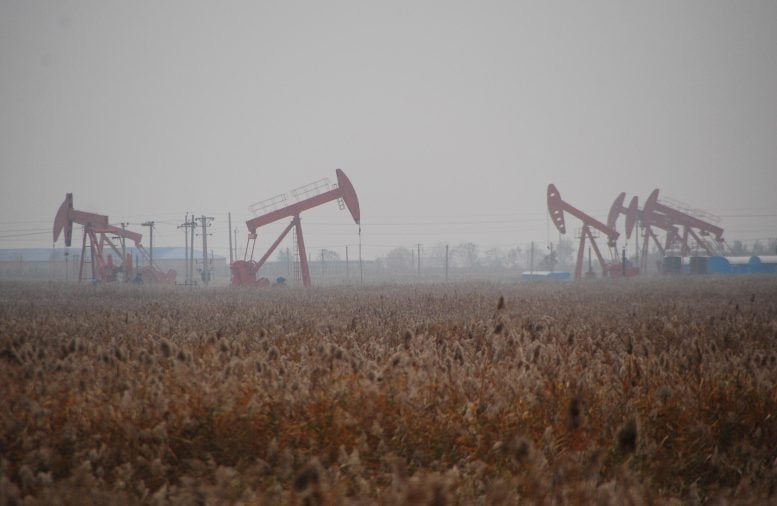
In an oil field like this, Gunter Wegener and his colleagues found the microorganisms that now also live in their laboratory. Genetic information shows that they are widespread and even live in the deep sea. Credit: Yoshi Canopus
Underground oil deposits on land and in the sea are home to microorganisms that use the oil as a source of energy and food, converting it into methane. Until recently, it was thought that this conversion was only possible in a complicated teamwork between different organisms: certain bacteria and usually two archaeal partners. Now the researchers have managed to cultivate an archaeon called Methanoliparia from a settling tank of an oil production facility that handles this complex reaction all by itself.
Enzymes just in case This “miracle microbe” breaks down oil into methane (CH4) and carbon dioxide (CO2). “Methanoliparia is a kind of hybrid creature that combines the properties of an oil degrader with those of a methanogen, i.e. a methane producer,” explains study author Gunter Wegener from the Max Planck Institute for Marine Microbiology and the MARUM – Center for Marine Environmental Sciences at the University of Bremen.
Methanoliparia Cells Image from the epifluorescence microscope: Methanoliparia cells (green) from the laboratory cultures. The oil droplet that the archaea colonized can be seen as a reddish glow. The red dots display rare bacteria in the culture. Credit: Rafael Laso-Pérez/Max Planck Institute for Marine Microbiology; from: Zhou et al., Nature, 2021
Now that the researchers have succeeded in cultivating these microorganisms in the laboratory, they were able to investigate the underlying processes in detail. They discovered that its genetic make-up gives Methanoliparia unique capabilities. “In its genes it carries the blueprints for enzymes that can activate and decompose various hydrocarbons. In addition, it also has the complete gear kit of a methane producer,” says Wegener.
New pathway of methanogenesis In their laboratory cultures, the researchers offered the microbes various kinds of food and used a variety of different methods to keep a close eye on how Methanoliparia deal with it. What was particularly surprising to see was that this archaeon activated all the different hydrocarbons with one and the same enzyme. “So far, we have only cultivated archaea that live on short-chain hydrocarbons such as ethane or butane. Methanoliparia, on the other hand, prefers heavy oil with its long-chain compounds,” says co-author Rafael Laso-Pérez, who now works at Spain’s National Center for Biotechnology (CNB).
“Methanogenic microbes that use long-chain hydrocarbons directly – we didn’t know these existed until now. Even complicated hydrocarbons with ring-like or aromatic structures are not too bulky for Methanoliparia, at least if they are bound to at least one longer carbon chain. This means that besides our other exciting results we have also found a previously completely unknown pathway of methanogenesis.”
Methanoliparia Cultures It doesn’t look like much, but it’s full of surprises: Bottles like these harbor the cultures of Methanoliparia. Credit: Lei Cheng
Detectable from the oil tank to the deep sea The Methanoliparia cells cultured for the present study originate from one of China’s largest oil fields, the Shengli oil field. However, genetic analyses show that these microbes are distributed all over the world, even down to the deep sea. “Our results hold an entirely new understanding of oil exploitation in subsurface oil reservoirs. Both the wide distribution of these organisms and the potential industrial applications make this an exciting field of research in the coming years,” Wegener concludes.
Reference: “Non-syntrophic methanogenic hydrocarbon degradation by an archaeal species” by Zhuo Zhou, Cui-jing Zhang, Peng-fei Liu, Lin Fu, Rafael Laso-Pérez, Lu Yang, Li-ping Bai, Jiang Li, Min Yang, Jun-zhang Lin, Wei-dong Wang, Gunter Wegener, Meng Li and Lei Cheng, 22 December 2021, Nature. DOI: 10.1038/s41586-021-04235-2
Are you sure you want all oil turned into Methane when it gets loose ,LOL
“This “miracle microbe” breaks down oil into methane (CH4) and carbon dioxide (CO2).”
I wonder how if greta feels it’s a miracle microbe.
bkmk
2023
Methane air levels now exceed CO2 levels - plenet doomed.
Remember the big gulf oil mess. I believe the scientists were absolutely stunned at the rate that mother nature ate up the oil. I’ll try and find an old article.
I see a John Carpenter movie in the making...
What percentage of the oil is ‘lost’ by the organism eating it?
“converts oil into methane . . . and that it prefers to eat rather bulky chunks of food.”
I understand completely.
My Mother in Law can eat sausages seared in Olive Oil and make methane.
Ain’t nothing new under the sun.
So...can you inject this into tar sands and shale formations and instead of oil just harvest the natural gas instead?
In their zeal and fanaticism to eliminate oil dependency, scientists inject Methanoliparia cultures into land and ocean oil wells.
Ocean bottoms begin to warm from the heat generated by the interaction, causing the methane frozen on the oceans’ bottoms to rise, converting Earth’s atmosphere back into a methane-based atmosphere, killing off all oxygen breathers.
Climate change, isn’t it wonderful?
My Liver can do that. };-)
What is the benefit of this and if released like COVID, what will it do to oil stocks, evertwhere?
So it's not man-made climate change. It's microbe-made climate change.
A microbe that breaks down oil...I’d rather have a microbe that can do the opposite.
“Are you sure you want all oil turned into Methane when it gets loose ,LOL”
That was my first thought: And, this is a benefit why......?
And the Chinese made it. Haha, sure!
We’ve known that methane is spewed by the oceans for a very long time. I have books from the 1850’s that explain it.
Methane is Natural Gas, that we all use to one extent or another. It’s used to make fertilizer, for one. Warms our homes, cooks our food and makes our electricity...................
There are frozen balls of methane ice at the bottom of the oceans........................
Disclaimer: Opinions posted on Free Republic are those of the individual posters and do not necessarily represent the opinion of Free Republic or its management. All materials posted herein are protected by copyright law and the exemption for fair use of copyrighted works.