Posted on 07/27/2021 8:16:51 AM PDT by Red Badger
The collaborative research team formed by the Department of Pharmacology and Pharmacy and Department of Microbiology, LKS Faculty of Medicine, The University of Hong Kong (HKUMed), has developed an inhalable dry powder formulation of tamibarotene, a repurposed drug that exhibits broad-spectrum antiviral activity against SARS-CoV-2, MERS-CoV and influenza A H1N1 virus following pulmonary delivery. The work has been published online in Advanced Therapeutics in June 2021.
In response to the unpredictable epidemic and pandemic outbreaks of influenza and coronavirus, early administration of a broad-spectrum antiviral agent could be an effective strategy to control the spread of respiratory infections. The HKUMed research team has previously reported that a retinoid derivative, AM580, demonstrated broad-spectrum antiviral activity against coronaviruses (MERS-CoV, SARS-CoV and SARS-CoV-2) and influenza virus.
An analog of AM580, tamibarotene, is an orally active retinoid derivative for the treatment of acute promyelocytic leukemia currently marketed in Japan. With an antiviral activity comparable to AM580, tamibarotene has an established safety profile in human with milder adverse effects than other retinoid derivatives. Tamibarotene is available as an oral tablet, which is difficult to achieve robust antiviral activity in the respiratory tract due to inadequate lung distribution following oral administration. When high dose is administered to compensate the insufficient lung distribution, toxic side effects are expected because of the extensive systemic exposure.
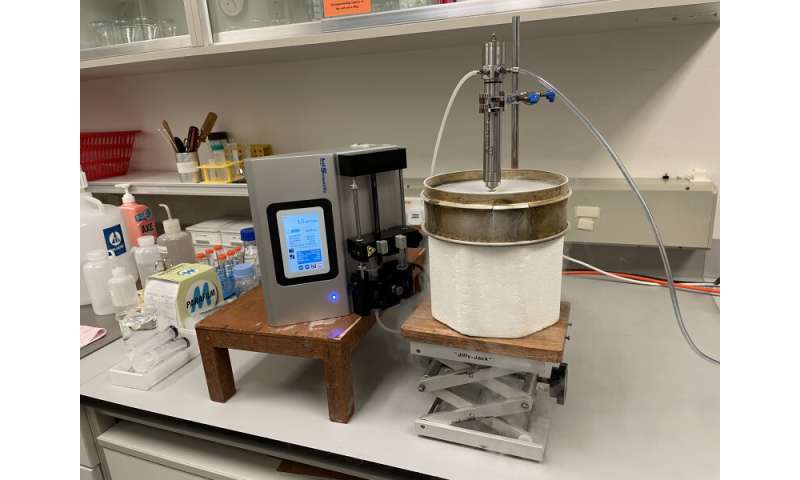
Photos of spray-freezing step in spray freeze drying process.
Liquid is fed into a nozzle and atomised into fine droplets. Those droplets fall into liquid nitrogen (inside the white styrofoam container) and become frozen. Credit: The University of Hong Kong By contrast, pulmonary delivery is a non-invasive administration route that can maximize local concentration in the lung and reduce systemic exposure, thereby reducing the risk of adverse effects and improving therapeutic efficacy. Inhaled powder formulation of broad-spectrum antiviral drug can be used on outpatient basis due to the ease of (self-)administration as prophylaxis and treatment for respiratory viral infections.
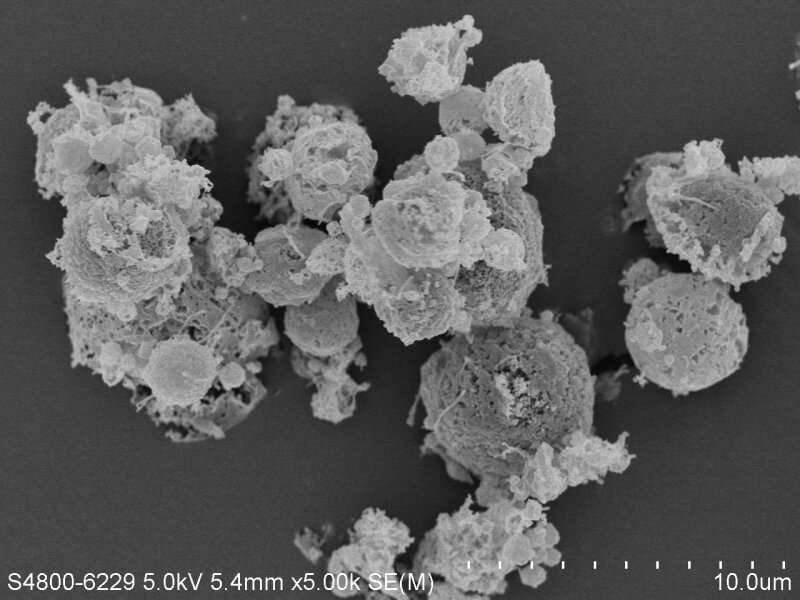
Inhaled dry powder formulation of tamibarotene was prepared by spray freeze drying, a particle engineering technique that combines spray freezing and freeze drying to produce particles with excellent aerosol properties for inhalation. The HKUMed research team found that a prophylactic dose of tamibarotene powder delivered by intratracheal administration significantly reduced virus titer and viral RNA load of SARS-CoV-2 in the hamsters' lungs, and the antiviral efficacy was comparable to intratracheally administered remdesivir. The broad-spectrum anti-coronavirus activity of inhaled tamibarotene powder was also demonstrated in MERS-CoV-infected mice model as pre-challenge prophylaxis. Moreover, remarkable anti-influenza activity of tamibarotene powder formulation was demonstrated by the improved survival rate of mice and alleviated disease severity when administered either intratracheally as prophylaxis or intranasally as treatment.
"Currently, there is no inhaled powder formulation of antiviral available on the market for COVID-19 treatment. Tamibarotene dry powder with broad-spectrum antiviral activity presents a new strategy for COVID-19 management, especially as prophylaxis and treatment for outpatients when in-patient healthcare cannot be provided," said Dr. Jenny Lam, associate professor, Department of Pharmacology and Pharmacy, HKUMed, who initiated the study. "With the favorable safety profile of tamibarotene and based on the findings in the present study, clinical trials evaluating inhaled tamibarotene for its safety and as at-home treatment for COVID-19 could be considered."
Since tamibarotene exerts its antiviral activity by targeting lipid metabolism in the host cells, it is advantageous in responding to mutated or drug-resistant virus strains. More importantly, by demonstrating antiviral efficacy against SARS-CoV-2 and H1N1 virus in respective animal models, inhaled tamibarotene presents a possible solution for COVID-19 and influenza co-infection.
Explore further
Scientists uncover potential antiviral treatment for COVID-19
More information: Qiuying Liao et al, Inhaled Dry Powder Formulation of Tamibarotene, a Broad‐Spectrum Antiviral against Respiratory Viruses Including SARS‐CoV‐2 and Influenza Virus, Advanced Therapeutics
(2021).
DOI: 10.1002/adtp.202100059
Provided by The University of Hong Kong
Gates and Fauci can’t let this come out.
Hunter Biden would approve it..................
and....once again, Trump was right.
If the FedGov suddnly stops pushing the jab, start wearing one of those 3M Respirators.
That is the first thing I thought ... does one ingest it by ‘doing lines?’
Therefore it will never see the light of day. Especially if it is off-patent and cheap.
 ...................
If it works, the FDA will prohibit its use.
Journal of Controlled ReleaseI wonder how much efficacy improvement you get by spray freeze drying versus normal pulverization. Could you crush tablets in a mortar and pestle and use that resulting powder with similar efficacy?
Volume 300, 28 April 2019, Pages 93-101Spray freeze drying: Emerging applications in drug delivery
By D. A. Vishali, J. Monisha, S.K. Sivakamasundari, J. A. Moses, and C. AnandharamakrishnanAbstract
Spray freeze drying is relatively a recent drying technique involving heterogeneous set of steps which includes droplet formation, freezing, and sublimation. It has proven benefits over other drying methods in terms of producing products with improved structural integrity, superior quality, and better shelf stability. With such merits, spray freeze drying has found numerous applications in the field of drug delivery. Spray freeze drying yields particles of sizes and densities that show higher stability in the lungs, nasal mucosa, intestine, and skin, as compared to other drying technologies. These particles also possess the vital trait of sustained release and specificity through various delivery routes as compared to conventional drying techniques.
Probably a lot like making Dippin’ Dots!.................
Dippin' Dots are beads of cryogenically frozen ice cream – that means it’s super cold! We use high quality ice cream ingredients, the same found in regular ice cream, and flash freeze it into tiny beads. In other words, we freeze it really fast at extremely cold temperatures, -320ºF to be exact! The ice cream is then packaged and shipped around the world. All Dippin' Dots for our U.S. customers, and much of the world, are produced at our headquarters in Paducah, Kentucky.Just don't go snorting Dippin' Dots expecting antiviral activity. You might get some great brain freeze, though.
Like inhaling a ‘disinfectant’ or something?
Disclaimer: Opinions posted on Free Republic are those of the individual posters and do not necessarily represent the opinion of Free Republic or its management. All materials posted herein are protected by copyright law and the exemption for fair use of copyrighted works.
