Posted on 05/21/2021 7:45:49 AM PDT by Red Badger
Out of Thick Air: Transforming CO2 Into Light-Emitting Carbon
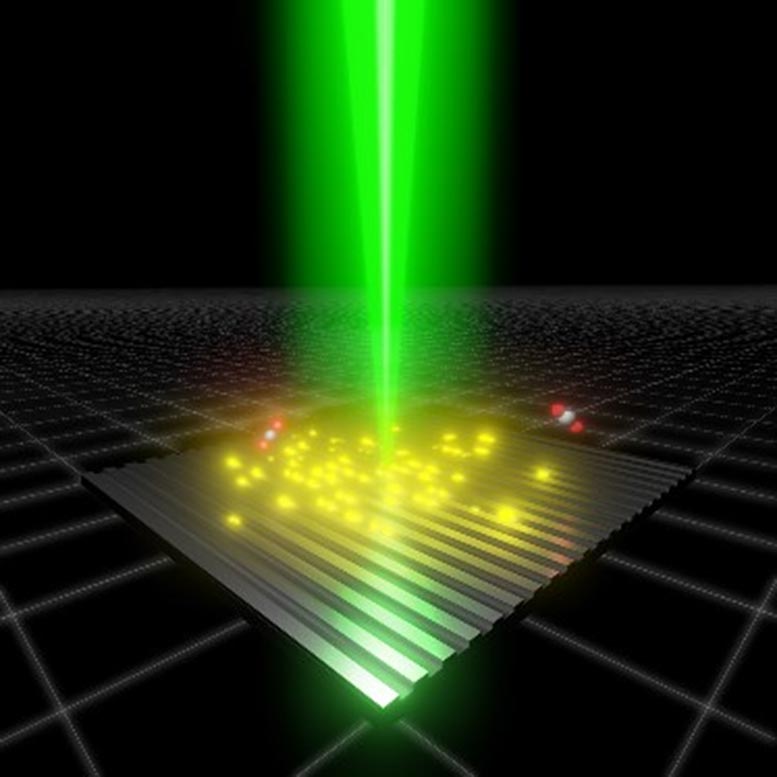
This image shows light emission, a process known as photoluminescence, from solid carbon which has formed on a silver nanostructure, illuminated by green light. Credit: University of Ottawa, OSA Optica
==================================================================
A team of researchers at the University of Ottawa has found a way to use visible light to transform carbon dioxide gas, or CO2, into solid carbon forms that emit light. This development creates a new, low-energy CO2 reduction pathway to solid carbon that will have implications across many fields.
We talked to lead author Dr. Jaspreet Walia, Post-Doctoral Fellow in the School of Electrical Engineering and Computer Science at the University of Ottawa, and research lead Dr. Pierre Berini, uOttawa Distinguished Professor and University Research Chair in Surface Plasmon Photonics, to learn more.
Please tell us about your team’s discovery.
Pierre Berini: “We have reduced carbon dioxide, a greenhouse gas, to solid carbon on a nanostructured silver surface illuminated with green light, without the need for any other reagents. Energetic electrons excited on the silver surface by green light transfer to carbon dioxide molecules, initiating dissociation. The carbon deposits were also found to emit intense yellow light in a process known as photoluminescence.”
How did you come to these conclusions?
Jaspreet Walia: “We used a technique known as Raman Scattering to probe the reaction in real time to determine which products, if any, were forming. To our surprise, we consistently observed signatures of carbon forming on the surface, as well as bright and visible yellow light emanating from the sample.”
Why is it important?
Pierre Berini: “Recently, there has been considerable global research effort devoted to developing technologies that can transform CO2 using visible light. Our work not only demonstrates that this is possible, but also that light emitting solid carbon can be formed.”
What are the applications of this discovery in our lives?
Jaspreet Walia: “This fixed pathway for reagent-less CO2 reduction to light emitting solid carbon, driven by visible light, will be of interest to researchers involved in the development of solar driven chemical transformations, industrial scale catalytic processes, and light-emitting metasurfaces.”
“More specifically, with respect to the creation of carbon directly from CO2 gas, our findings will have an impact on research involving plasmon assisted reactions and I would expect the emergence of applications in the oil and gas industries, where catalytic transformations involving carbon-based compounds is a key focus area.”
“Next-generation reactions involving CO2 and light could also lead to other useful outcomes, such as the potential for artificial photosynthesis. Our findings could be used for light control and manipulation at the nanoscale, or to possibility realize flat light sources due to the light-emitting aspect of our discovery. The nanostructured carbon itself could also be used in catalysis.”
“Finally, the wavelength (color) of the light emitted from carbon dots on a silver surface could be very sensitive to the local environment, making it an attractive sensing platform for pollutants, for example.”
Is there anything you would like to add?
Pierre Berini: “We have learned how to form solid carbon deposits that emit light “out of thick air”, in a breakthrough enabled by light-assisted transformation of CO2 gas driven by energetic electrons. The project was entirely driven by curiosity, with no set expectations on outcomes, and benefitted from close collaboration with graduate students Sabaa Rashid and Graham Killaire, as well as Professors Fabio Variola and Arnaud Weck.”
Reference: “Reconfigurable carbon quantum emitters from CO2 gas reduced via surface plasmons” by Jaspreet Walia, Sabaa Rashid, Graham Killaire, Fabio Variola, Arnaud Weck, and Pierre Berini, 14 May 2021, Optica. DOI: 10.1364/OPTICA.424170
The research took place at the uOttawa Centre for Research in Photonics, from January 2020 to present. The paper is published in the journal Optica as a memorandum.
How much CO2 is generated powering the light beam?
Don’t know. But if they can get the carbon to crystallize...................


“On a silver nanostructure” indicates that it will be a costly process.
LOL
“A technique known as Raman Scattering”
Happens to me too when I tear open those plastic bags of Japanese noodles.
If they can get CO2 to disassociate at low energy input, that would be quite significant.
May be a method to improve /speed up carbon fiber production as well...just have to make the silver backing into a moving pallet and find a way to remove the build up without destroying the silvered surface.
So, a bit familiar with Raman and LIBS and similar light induced emitting tech in counter IED research during the Iraq war, these folks are thinking of using such structures as tools to look for and identify TIMS/TICS or whatever.
How is this of any great value compared to the stand off capability of LIBS,(laser induced breakdown spectroscopy)?
A small tech startup in the 2006 era was able to detect target items from as far as 30 m trace and 200m bulkvwith a portable laser spectroscopy unit.
Been awhile so give forgotten much.

So, more CO2 is needed? I’m on it.
Disclaimer: Opinions posted on Free Republic are those of the individual posters and do not necessarily represent the opinion of Free Republic or its management. All materials posted herein are protected by copyright law and the exemption for fair use of copyrighted works.