Posted on 11/02/2020 9:00:30 AM PST by Red Badger
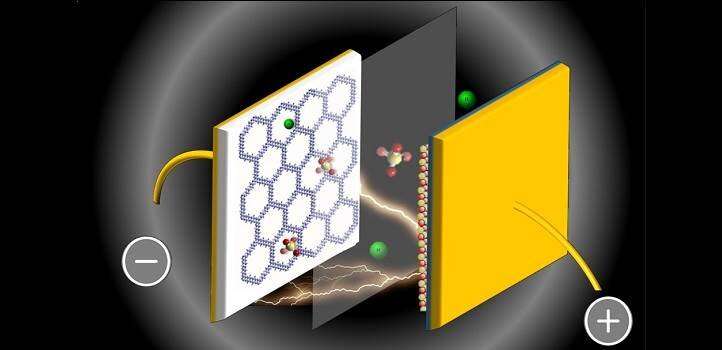
Schematic depiction of the asymmetric supercapacitor with the porous COF as the negative electrode shown on the left. Credit: KAUST, Osama Shekhah
=========================================================================
Carefully designed covalent organic frameworks could make supercapacitor electrodes that have a greater ability to store electric charge.
A porous organic material created at KAUST could significantly improve energy storage and delivery by supercapacitors, which are devices that are able to deliver quick and powerful bursts of energy.
Supercapacitors use technology that is significantly different from the reversible chemical reactions used in rechargeable batteries. They store electrical energy by building up a separation of positive and electric charge and this ability enables them to supply quick bursts of energy needed, for example, to power the acceleration of electric cars, or open emergency doors in aircraft. They have a weakness, however, in the relatively low quantity of energy that they can store, a property known as their energy density.
The KAUST research team found a way to increase the energy density using materials known as covalent organic frameworks (COFs). These are crystalline porous polymers formed from organic building blocks held together by strong "covalent" bonds—the type that holds atoms together within molecules.
The reason for the previously low performance of COFs, the team found, is related to their low conductivity. They were able to overcome this limitation by exploring modified structures, which allowed electrons to become "delocalized," meaning that they were able to move widely throughout the molecules.
Furthermore, including carefully selected molecular functional groups also assisted the chemical changes required for increased energy storage performance.
The researchers designed layered two-dimensional COFs to effectively exploit multiple charge storage mechanisms in a single material. In so doing, they were able to significantly increase the charge storage capacity of the COF.
"The storage ability of our new material surpasses all previously reported COFs, and its capacitance is competitive with the best-known supercapacitor materials," explains Sharath Kandambeth, the postdoc who is first author of the study.
"The physical porous structure of the COF also facilitates and promotes the transport and storage of ions that carry electric charge," Kandambeth adds.
Supercapacitors have negative and positive electrodes separated by a material that charged particles can move through. The specific category of compounds developed by the KAUST team, known as Hex-Aza COFs, performed well when used as the negative electrodes of high-performance supercapacitors. When combined with another material as the positive electrode, such as RuO2, they resulted in an asymmetric supercapacitor device with a wide voltage range. In addition to higher energy density the electrodes also allow the supercapacitors to deliver energy for longer, which should widen the range of suitable applications.
"We are now trying to combine our Hex-Aza COF materials with relatively cheaper metal oxide positive electrodes to create new supercapacitors that we hope to move toward commercialization," says Mohamed Eddaoudi, leader of the research team.
===========================================================================
More information: Sharath Kandambeth et al. Covalent Organic Frameworks as Negative Electrodes for High‐Performance Asymmetric Supercapacitors, Advanced Energy Materials (2020). DOI: 10.1002/aenm.202001673 Journal information: Advanced Energy Materials
Provided by King Abdullah University of Science and Technology
;-) 

In her day, Faith was quite the hottie.
Disclaimer: Opinions posted on Free Republic are those of the individual posters and do not necessarily represent the opinion of Free Republic or its management. All materials posted herein are protected by copyright law and the exemption for fair use of copyrighted works.