Posted on 11/09/2023 12:47:07 PM PST by Diana in Wisconsin
Mainstream economics portrays inflation — defined as a currency that loses a bit of purchasing power each year — as necessary to lubricate the gears of commerce.
What they don’t seem to understand (or would like the rest of us to not understand) is that inflation is also a tool for redistributing wealth from one class to another. It pushes up the price of stocks, bonds, and real estate, enriching the owners of those assets while making day-to-day life a lot harder for people who live paycheck to paycheck.
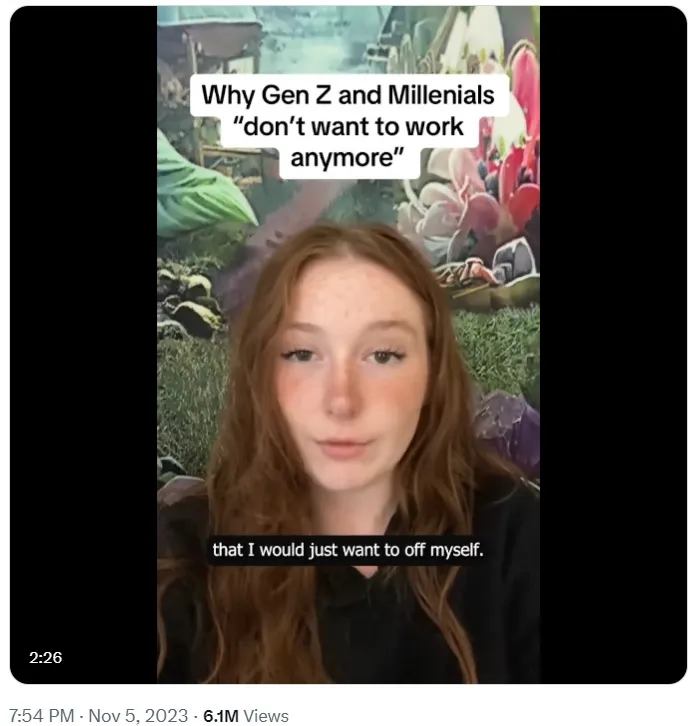
This obviously makes the victims mad. Here’s a 20-something American explaining their situation:
And here’s a chart that illustrates how this works for housing (the yellow line is home prices, blue is incomes).
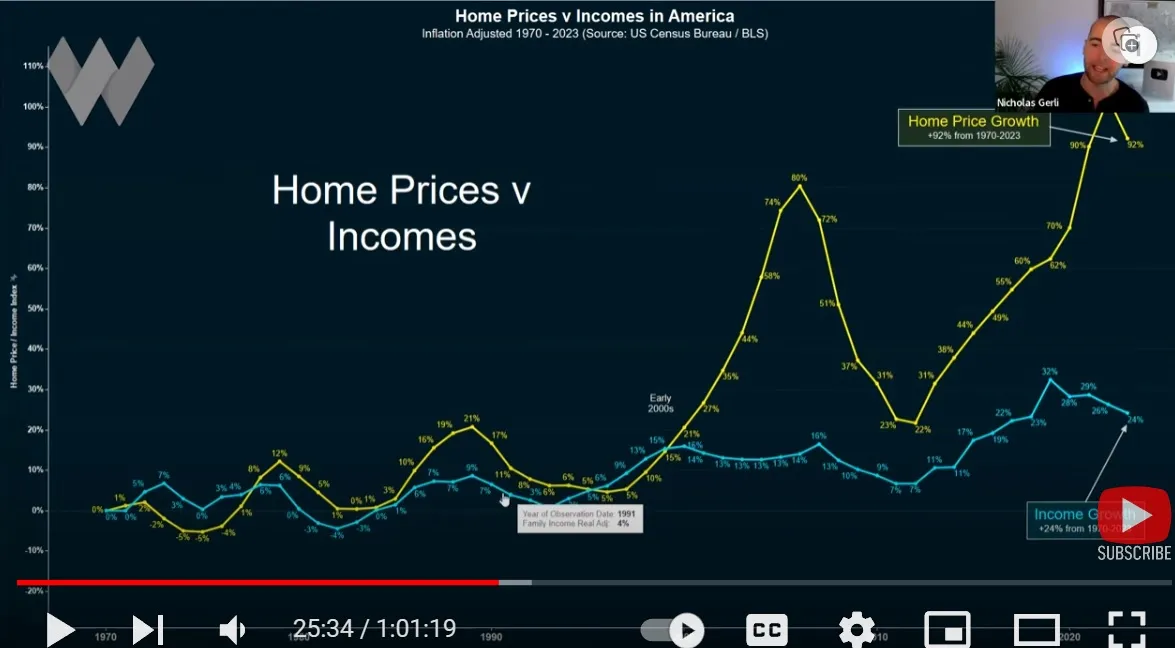
Say you’re 28 years old in today’s America and you’d like the kind of starter house that your parents bought at a similar age. You’ve cobbled a couple of part-time jobs into 40 hours a week and make, in dollar terms, pretty much what your parents did 30 years ago. But the $90,000 house they bought back in the day is now $300,000, which is orders of magnitude beyond your means. What do you do? You rent, of course, with exactly zero chance of ever buying because your part-time jobs don’t offer a path to middle-class money.
The story is the same for health care, college tuition, food, cars, and pretty much everything else. The life that was easily accessible for your parents in the 1990s is out of reach for you.
Then add in all the headlines about illegal immigrants being put up in luxury hotels, politicians insider trading their way to massive fortunes, and hundreds of billions of dollars being dumped into proxy wars around the world, and you’re naturally going to resent the rigged game you’ve been born into. You’ll be open to populist and/or socialist political pitches. You’ll look for ways to cut corners the way boomers seem to do. Or you’ll just opt out of the system, joining the “I don’t want to work” movement that has your grandparents so aghast.
You’ll have valid a point. A financial system that relies on ever-increasing debt and a soaring money supply by definition transfers wealth from workers to investors. So it’s no surprise that the monetary reset of 1971 and the banking deregulation of the 1990s produced today’s world. The people in charge know exactly what they’re doing. And your generation is being impoverished and radicalized.
What kind of awakening?
A rebellion is coming, and there are (at least) two ways it could go:
Authoritarian redistribution. This is the banana republic scenario that plays out regularly in Latin America’s oligarchies. A handful of people gain control of the economy and enrich themselves at the expense of the peasants until the peasants rebel and redistribute everything by force. The resulting police state turns into a different flavor of oligarchy and collapses via a military coup. Rinse and repeat.
A return to first principles. The peasants (and an enlightened handful of elites) conclude that today’s widening inequality is caused by unsound money that gives governments and bankers carte blanche to manipulate markets for their own enrichment. But instead of going authoritarian, the rebellion takes the shape of a return to sound money and limited government — in other words, they just reinstate the Constitution. The big banks and other near-monopolies are broken up, the military empire is shut down, factories are brought back home, and competition for workers drives wages back up to their historical norms. And an updated version of the gold standard eliminates inflation as a wealth transfer scam.
Which is more likely? 90-10 in favor of scenario 1, based on recent history. But we can always hope.
But the elites who control federal government are richer than ever. So why expect anything to get better? Keep electing creatures like Haley & DeSantis, who are in the pockets of their rich donor class, American lower middle class will get more screwed every year.
Very Interesting Find!
Bump for later. Lots of food for thought.
There’s crony capitalism for you. I
The young lady makes me laugh,in 1979 (when I knew EVERYTHING) I was 18 and had had enough of home...what a shock to enter the rental world and then all the other costs to provide myself transportation / auto insurance / gas / food / clothing / household goods etc..you get the picture. I had a friend and we became roommates in a studio with a kitchenette and a bathroom down the hall in the crappiest part of town. The initial experience showed me how to appreciate GOOD neighborhoods and being thrifty in all aspects of shopping. I fixed my own cars in every way (even changing over tires myself...I paid for no labor that I could do myself. College never interested me as I started the building trades and learned “how to” while getting paid. I can now build a structure from the ground up doing ALL of the plumbing/sewer/electrical/obtained a journeyman’s license from Local 33 out of Dorchester...I did what was best for me and didn’t count on any “society” to make things comfy for me. Also this young lady needs to count her blessings for just having access to clean water/sewerage/grocery stores/good roads...she is just young AND a female so I have less empathy just for that...entitled broad. Maybe she should bag a wallet and get prego an then divorce him and she’s be home free? Don’t they teach that anymore?
Kids remain at home with parents later and later.
Younger generations will only have two addresses in their lifetime - the parent’s house when born and the cemetery.
Donald Trump is a billionaire and as far as I know, he donated to Hillary Clinton’s Senate campaign.
A Connecticut Yankee in King Arthur’s Court, by Mark Twain 1889
CHAPTER XXXIII
SIXTH CENTURY POLITICAL ECONOMY
(excerpt)
“In your country, brother, what is the wage of a master bailiff, master hind, carter, shepherd, swineherd?”
“Twenty-five milrays a day; that is to say, a quarter of a cent.”
The smith’s face beamed with joy. He said:
“With us they are allowed the double of it! And what may a mechanic get—carpenter, dauber, mason, painter, blacksmith, wheelwright, and the like?”
“On the average, fifty milrays; half a cent a day.”
“Ho-ho! With us they are allowed a hundred! With us any good mechanic is allowed a cent a day! I count out the tailor, but not the others—they are all allowed a cent a day, and in driving times they get more—yes, up to a hundred and ten and even fifteen milrays a day. I’ve paid a hundred and fifteen myself, within the week. ’Rah for protection—to Sheol with free-trade!”
And his face shone upon the company like a sunburst. But I didn’t scare at all. I rigged up my pile-driver, and allowed myself fifteen minutes to drive him into the earth—drive him all in—drive him in till not even the curve of his skull should show above ground. Here is the way I started in on him. I asked:
“What do you pay a pound for salt?”
“A hundred milrays.”
“We pay forty. What do you pay for beef and mutton—when you buy it?” That was a neat hit; it made the color come.
“It varieth somewhat, but not much; one may say seventy-five milrays the pound.”
“We pay thirty-three. What do you pay for eggs?”
“Fifty milrays the dozen.”
“We pay twenty. What do you pay for beer?”
“It costeth us eight and one-half milrays the pint.”
“We get it for four; twenty-five bottles for a cent. What do you pay for wheat?”
“At the rate of nine hundred milrays the bushel.”
“We pay four hundred. What do you pay for a man’s tow-linen suit?”
“Thirteen cents.”
“We pay six. What do you pay for a stuff gown for the wife of the laborer or the mechanic?”
“We pay eight cents, four mills.”
“Well, observe the difference: you pay eight cents and four mills, we pay only four cents.” I prepared now to sock it to him. I said: “Look here, dear friend, what’s become of your high wages you were bragging so about a few minutes ago? “—and I looked around on the company with placid satisfaction, for I had slipped up on him gradually and tied him hand and foot, you see, without his ever noticing that he was being tied at all. “What’s become of those noble high wages of yours?—I seem to have knocked the stuffing all out of them, it appears to me.”
But if you will believe me, he merely looked surprised, that is all! he didn’t grasp the situation at all, didn’t know he had walked into a trap, didn’t discover that he was in a trap. I could have shot him, from sheer vexation. With cloudy eye and a struggling intellect he fetched this out:
“Marry, I seem not to understand. It is proved that our wages be double thine; how then may it be that thou’st knocked therefrom the stuffing?—an miscall not the wonderly word, this being the first time under grace and providence of God it hath been granted me to hear it.”
Well, I was stunned; partly with this unlooked-for stupidity on his part, and partly because his fellows so manifestly sided with him and were of his mind—if you might call it mind. My position was simple enough, plain enough; how could it ever be simplified more? However, I must try:
“Why, look here, brother Dowley, don’t you see? Your wages are merely higher than ours in name, not in fact.”
“Hear him! They are the double—ye have confessed it yourself.”
“Yes-yes, I don’t deny that at all. But that’s got nothing to do with it; the amount of the wages in mere coins, with meaningless names attached to them to know them by, has got nothing to do with it. The thing is, how much can you buy with your wages?—that’s the idea. While it is true that with you a good mechanic is allowed about three dollars and a half a year, and with us only about a dollar and seventy-five—”
“There—ye’re confessing it again, ye’re confessing it again!”
“Confound it, I’ve never denied it, I tell you! What I say is this. With us half a dollar buys more than a dollar buys with you—and therefore it stands to reason and the commonest kind of common-sense, that our wages are higher than yours.”
He looked dazed, and said, despairingly:
“Verily, I cannot make it out. Ye’ve just said ours are the higher, and with the same breath ye take it back.”
“Oh, great Scott, isn’t it possible to get such a simple thing through your head? Now look here—let me illustrate. We pay four cents for a woman’s stuff gown, you pay 8.4.0, which is four mills more than double. What do you allow a laboring woman who works on a farm?”
“Two mills a day.”
“Very good; we allow but half as much; we pay her only a tenth of a cent a day; and—”
“Again ye’re conf—”
“Wait! Now, you see, the thing is very simple; this time you’ll understand it. For instance, it takes your woman 42 days to earn her gown, at 2 mills a day—7 weeks’ work; but ours earns hers in forty days—two days short of 7 weeks. Your woman has a gown, and her whole seven weeks wages are gone; ours has a gown, and two days’ wages left, to buy something else with. There—now you understand it!”
He looked—well, he merely looked dubious, it’s the most I can say; so did the others. I waited—to let the thing work. Dowley spoke at last—and betrayed the fact that he actually hadn’t gotten away from his rooted and grounded superstitions yet. He said, with a trifle of hesitancy:
“But—but—ye cannot fail to grant that two mills a day is better than one.”
Shucks! Well, of course, I hated to give it up. So I chanced another flyer:
“Let us suppose a case. Suppose one of your journeymen goes out and buys the following articles:
“1 pound of salt;
1 dozen eggs;
1 dozen pints of beer;
1 bushel of wheat;
1 tow-linen suit;
5 pounds of beef;
5 pounds of mutton.
“The lot will cost him 32 cents. It takes him 32 working days to earn the money—5 weeks and 2 days. Let him come to us and work 32 days at half the wages; he can buy all those things for a shade under 14 1/2 cents; they will cost him a shade under 29 days’ work, and he will have about half a week’s wages over. Carry it through the year; he would save nearly a week’s wages every two months, your man nothing; thus saving five or six weeks’ wages in a year, your man not a cent. Now I reckon you understand that ‘high wages’ and ‘low wages’ are phrases that don’t mean anything in the world until you find out which of them will buy the most!”
It was a crusher.
But, alas! it didn’t crush. No, I had to give it up. What those people valued was high wages; it didn’t seem to be a matter of any consequence to them whether the high wages would buy anything or not. They stood for “protection,” and swore by it, which was reasonable enough, because interested parties had gulled them into the notion that it was protection which had created their high wages. I proved to them that in a quarter of a century their wages had advanced but 30 per cent., while the cost of living had gone up 100; and that with us, in a shorter time, wages had advanced 40 per cent. while the cost of living had gone steadily down. But it didn’t do any good. Nothing could unseat their strange beliefs.
MARK TWAIN
HARTFORD, July 21, 1889
https://www.gutenberg.org/files/86/86-h/86-h.htm
The United States is heading towards a name change to North Argentina.
This is a good article but it misses an important point.
I would go one step beyond what the author says here, and suggest that what has happened in the U.S. over the last few generations may have simply been the inevitable consequence of our social and economic development. Consider this:
1. When you enjoy the highest standard of living in the history of the human race, there's less room for "natural" growth than there was previously. People basically have everything they need to live a normal, comfortable life.
2. To generate growth in this scenario, it is necessary to convince people to buy a lot of things they don't need. This is why so much of the economic growth in my lifetime is tied to completely unnecessary things like multiple cars, second homes, expensive vacations, restaurant meals replacing home-cooked meals, useless college education, etc.
3. Once you get through Step #2 and most of your population has everything they need and many things they don't need, it's almost inevitable for a socialist/fascist economic model to take root and grow. This is because the only way to generate growth in this scenario is to FORCE people to buy many things they don't need -- and don't even want. These things would include vaccine mandates, increasingly expensive products designed to meet stupid government requirements, corn in your gasoline, a massive government bureaucracy, and generally just buying a lot of crap for other people (through public schools, government-subsidized college education, private and taxpayer-funded health "insurance," food stamps, etc.).
4. The end result here is that life itself becomes ridiculously expensive and unaffordable because the cost of living has been inflated by the gross inefficiency of all this nonsense. Eventually, everyone just works as an employee of the government -- either directly, or for a private company that relies on government protection and rent-seeking regulations to stay in business.
Well said!
Disclaimer: Opinions posted on Free Republic are those of the individual posters and do not necessarily represent the opinion of Free Republic or its management. All materials posted herein are protected by copyright law and the exemption for fair use of copyrighted works.