Posted on 01/29/2026 8:35:34 AM PST by SunkenCiv
According to a statement released by University College London, a team of researchers led by Simon Parfitt of University College London and London's Natural History Museum reviewed materials unearthed at the Boxgrove Paleolithic site in southern England in 1990. Among the artifacts, the scientists identified a 500,000-year-old tool made of elephant or mammoth bone. The outer layer of elephant bone would have been softer than stone, and yet harder than the bones of other animals. "Elephant bone would have been a rare but highly useful resource, and it's likely this tool was of considerable value," Parfitt said. The age of the hammer suggests that it was made and used by either Neanderthals or members of Homo heidelbergensis. Examination with 3D scanning methods and electron microscopes revealed notches and impact marks in the bone. Fragments of flint were detected in some of these notches. The researchers conclude that the elephant bone tool had been used as a "retoucher" to sharpen stone tools and restore their shape after use. Read the original scholarly article about this research in Science Advances. To read about 1.5-million-year-old elephant bone implements unearthed in Tanzania, go to "The Bone Toolkit."
(Excerpt) Read more at archaeology.org ...
Nice!
I looked over the Middle Kingdom boat with rowers, but A) it’s pretty big, and B) would probably need a special case to keep it from crumbling in the summer humidity here. Oh, and is way outside my budget. 😊 Lots of ancient and some medieval helmets and other armor for those interested.
Neanderthals were our (ugly) kissing cousins, not our direct ancestors.
They are a very reputable auction house. I have bought from them in the past. Mostly Bronze Age short swords.
They were definitely our ancestors. We carry as much (known) Neandertal DNA as we do from each of our great-great-great-great-grands.
Nice!
In any case, it's good to have these discussions without having the thread hijacked by some loon who insists that there were no people (or anything else) before 6,000 years ago!
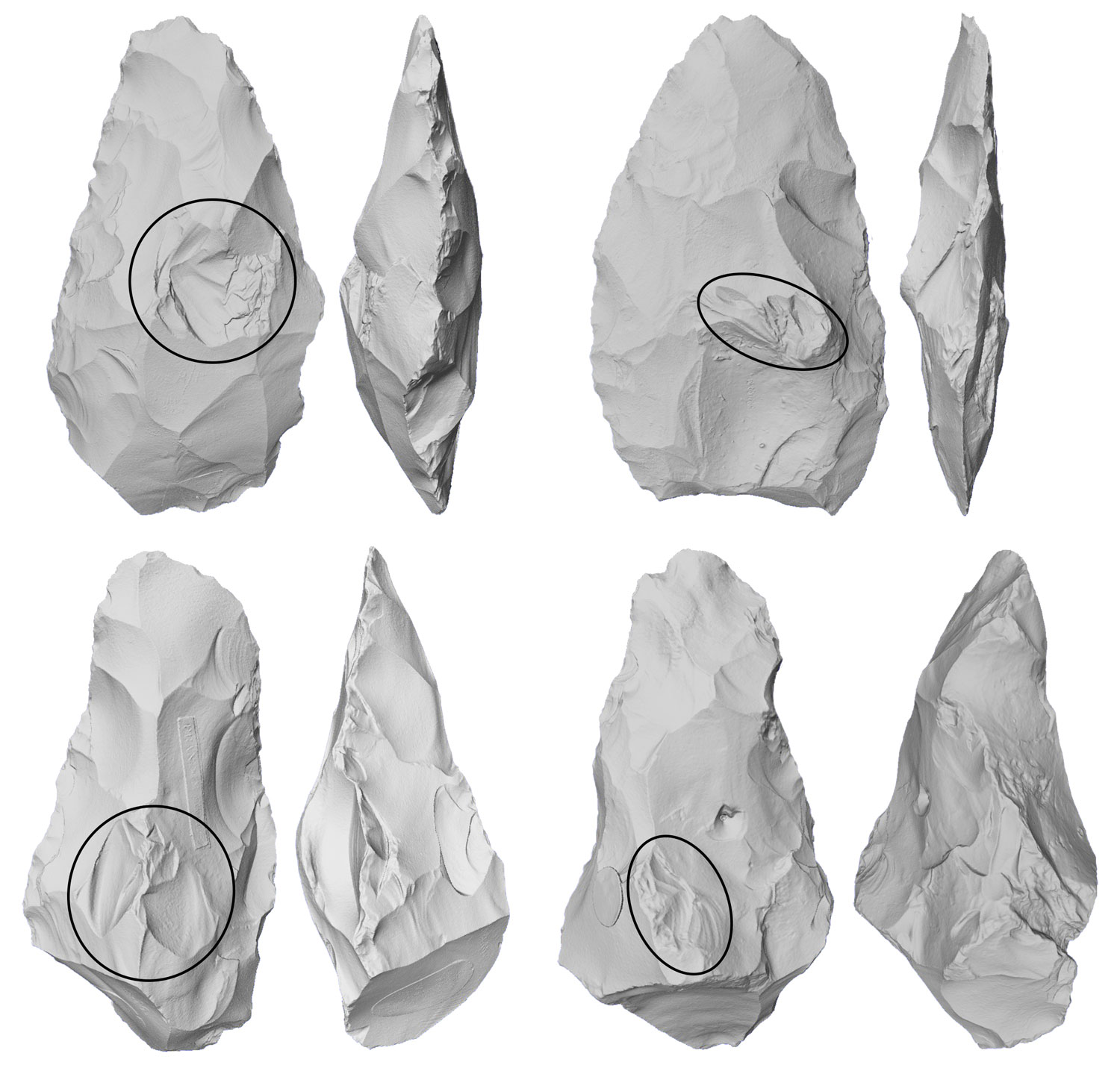
IFL Science reports that the stone knapping skills of Paleolithic humans living in Britain drastically improved about 500,000 years ago. Handaxes made in Britain more than 560,000 years ago are generally relatively thick and asymmetrical with irregular edges, while handaxes made in Britain after about 480,000 years ago are thin, symmetrical, and regular-edged, according to Ceri Shipton of the Australian National University and her colleagues. The researchers experimented with recreating the tools, and found that the change could be accounted for by learning to rotate a piece of flint continually to produce the optimal angle for striking off a flake of stone. They also determined that the process is aided by using soft hammers made of antler or bone, rather than another stone. In addition, the scientists learned that it is easy to understand how to make symmetrical tools but it is a difficult skill to master, even after 90 hours of training. Previous studies have shown that such advanced knapping training can produce changes in the right ventral premotor cortex of the brain, which is associated with fine motor control and speech. Shipton and her colleagues suggest that the changes observed in prehistoric toolmaking could therefore reflect an evolving physical ability to talk. Read the original scholarly article about this research in the Journal of Archaeological Science: Reports. To read about biological and cultural factors that influenced the development of language, go to "You Say What You Eat."Examples of British Acheulean handaxes where lumps (in ovals) have been flaked directlyblockquote>Courtesy Ceri Shipton
Disclaimer: Opinions posted on Free Republic are those of the individual posters and do not necessarily represent the opinion of Free Republic or its management. All materials posted herein are protected by copyright law and the exemption for fair use of copyrighted works.