Skip to comments.
Iranian Regime tv Channel One hacked while it was airing Khamenie speech
various
| 10-8-22
Posted on 10/08/2022 1:05:38 PM PDT by nuconvert
Iranian Regime national tv Channel One hacked about an hour ago. During a broadcast of Khamenie speech, a red crosshair appeared over his face and chanting of Women. Life. Freedom. There was writing to the side saying "Rise up. Join us". Also 4 photos at the bottom of the screen of young people killed and additional writing: "The blood of our youth is dropping from your paws".
Also, there was a huge banner in the middle of Tehran highway today that read: We are no longer afraid of you. We will fight.
Also, attempted attack on IRI ambassador in Denmark. Her bodyguard was stabbed. Diplomatic Security intervened before the attacker could stab the ambassador.
TOPICS:
KEYWORDS: basij; deathtothemullahs; denmark; ebrahimrigi; erdogan; iran; iranprotests; iraq; irgc; iri; israel; khameini; khamenei; kurdistan; lebanon; mahsaamini; mullahloversonfr; mullahsmustbekilled; najisharifizindashti; protests; qudsforce; raisi; receptayyiperdogan; shahrammaroufmola; syria; turkey; yemen; zahedi
Navigation: use the links below to view more comments.
first previous 1-20 ... 1,721-1,740, 1,741-1,760, 1,761-1,780 ... 2,321-2,328 next last
To: nuconvert
The Rest Is History with Tom Holland & Dominic Sandbrook.
The Iranian Revolution: The Fall of the Shah (I)
Why did the Iranian Revolution erupt in 1979? What was the nature of the relationship between President Carter and the ostentatious Shah Mohammad Reza Pahlavi? And, who was the Ayatollah Ruhollah Khomeini, a man whose militant vision for Iran would see it drastically remade?
https://www.youtube.com/watch?v=N8OW0aK-oaA
How the Iranian Revolution Was Hijacked (II)
What set off the final uprisings of the Iranian Revolution, against the last Shah of Iran, Mohammed Reza Pahlavi? Would President Jimmy Carter and America back the Shah’s forbidding opponent, the firebrand, Ayatollah Khomeini? And, why would the Revolution prove to be one of the most pivotal events in recent history?
https://www.youtube.com/watch?v=VojWVIF3HSg
How Students Brought A Superpower To Its Knees (III)
Why and how was the American Embassy stormed in 1979, at the height of the Iranian Revolution? Did America respond when large numbers of American civil servants were taken hostage? And, would a science fiction film called Argo save the only 6 Americans able to escape…?
https://www.youtube.com/watch?v=wS2rCTCIbhY
1,741
posted on
02/15/2026 6:18:33 AM PST
by
AdmSmith
(GCTGATATGTCTATGATTACTCAT)
To: nuconvert
Iran Update, February 16, 2026
Some Iranian officials and media have suggested that the United States has softened its position on the issue of uranium enrichment. US officials have not indicated a shift in the United States’ position on this issue, however. The United States and Iran will hold a second round of nuclear talks, led by Iranian Foreign Affairs Minister Abbas Araghchi and US Special Envoy to the Middle East Steve Witkoff, in Geneva, Switzerland, on February 17.[37] Iranian Deputy Foreign Affairs Minister for Political Affairs Majid Takht Ravanchi told the BBC on February 16 that the United States understands that it must focus exclusively on the nuclear issue if it seeks to reach a deal with Iran. Ravanchi added that, “as far as Iran is concerned,” the US demand for zero enrichment is “not on the table anymore.”[38] Islamic Revolutionary Guards Corps (IRGC)-affiliated media similarly claimed on February 16 that the United States has agreed that negotiations will only address Iran‘s nuclear program and accepted the “principle of enrichment.”[39] US President Donald Trump told reporters on February 13 that the United States does not “want any enrichment,” however.[40]
Iranian officials have continued to offer limited nuclear concessions. Ravanchi stated in his interview with the BBC that Iran is willing to dilute its highly enriched uranium stockpile if the United States lifts sanctions on Iran.[41] Ravanchi did not specify what level Iran would be willing to dilute its highly enriched uranium to. Some regime officials have recently suggested that Iran could limit its enrichment to 20 percent, which is far above the 3.67 percent limit outlined in the 2015 nuclear deal.[42] An Iranian journalist close to the regime reported on February 13 that Iran rejected a recent proposal from Witkoff to halt enrichment for three to five years and then enrich uranium at 1.5 percent.[43] The journalist added that the proposal also called on Iran to transfer its roughly 400 kilograms of 60 percent enriched uranium.[44] Ravanchi stated in his interview with the BBC that it is “too early to say” whether Iran would be willing to transfer its 60 percent enriched uranium stockpile. The BBC noted that Iran previously transferred 11,000 kilograms of enriched uranium to Russia under the 2015 nuclear deal. The 11,000 kilograms included Iran's most highly enriched uranium at the time, uranium enriched to 20 percent.[45] Iran has since produced over 400 kilograms of uranium enriched to 60 percent, which is enough uranium, if enriched further, to produce at least 10 nuclear weapons.[46]
CTP-ISW continues to assess that any agreement that lifts sanctions on Iran without seriously limiting Iran's ability to develop its ballistic missile and drone programs or provide support to the Axis of Resistance would pose a long-term threat to US interests in the region by enabling Iran to reconstitute these capabilities. Ravanchi emphasized in his interview that Iran will not negotiate on its ballistic missile program.[47] He stated that Iran's ballistic missiles “came to [Iran's] rescue” during the Israel-Iran War.[48] Iran fired multiple missile barrages at Israel during the war and conducted a missile attack on al Udeid Airbase in Qatar.[49] Iran's use of missiles during the war highlights how Iran's missile program poses a threat to US forces and allies in the Middle East.
Iran is proposing economic incentives that are unrelated to core US demands regarding the nuclear talks, likely as part of an effort by the regime to extract US concessions on its key demands regarding Iran's ballistic missile program and support for its proxies and partners. Iranian Deputy Foreign Affairs Minister for Economic Diplomacy and member of the Iranian negotiating team, Hamid Ghanbari, stated on February 15 that the first round of US-Iran nuclear talks on February 6 included discussions on economic cooperation in the fields of oil, gas, and minerals, as well as the possible purchase of US aircraft.[50] Ghanbari added that any deal must be economically beneficial to the United States for it to be sustainable.[51] Ghanbari’s statement echoes Araghchi’s statement on February 1 that a nuclear deal could lead to “great opportunities for economic cooperation” between the United States and Iran.[52] Iran may calculate that the United States may be more willing to focus solely on Iran's nuclear program in the ongoing talks if Iran offers economic incentives.
Iran is continuing to try to deter and prepare for military escalation in and near the Strait of Hormuz amid US threats to attack Iran. The IRGC Navy began a “Smart Control of the Strait of Hormuz” exercise on February 16 to test the readiness of IRGC Navy units and review security plans.[53] Rapid reaction battalions reportedly practiced offensive and defensive tactics, tested missiles, and conducted operations in “electronic warfare conditions.”[54] “Smart control” may refer to targeting and preventing specific vessels from transiting the Strait of Hormuz.[55] Artesh Navy Deputy Commander Rear Admiral Faramarz Bemani separately inspected the Shahid Nezafat Naval Base in Pasabandar, Sistan and Baluchistan Province, which is located near the entrance of the Gulf of Oman, on February 15.[56] These security efforts come amid the ongoing US military buildup in the region, including the upcoming arrival of the USS Gerald R. Ford carrier strike group.[57] Trump reportedly told Israeli Prime Minister Benjamin Netanyahu on February 11 that the United States will increase economic pressure on Iran and “go full force” on its maximum pressure campaign.[58] US officials told the Wall Street Journal on February 11 that the Trump administration was considering seizing Iranian tankers transporting oil but held off due to concerns about Iran's retaliation.[59] The IRGC Navy exercise and Artesh inspection are likely at least partially part of a broader Iranian effort to deter US action by highlighting Iran's willingness and ability to retaliate.
Iran analyst Hamidreza Azizi assessed on February 16 that Parliament Speaker Mohammad Bagher Ghalibaf and Defense Council Secretary Ali Shamkhani are maneuvering to consolidate their power and ensure their relevance in a post-Khamenei Iran. This assessment is consistent with CTP-ISW’s assessment that different factions within the Iranian regime are vying for influence to determine future Iranian policy after the Israel-Iran War.[60] The Iranian regime established the Defense Council after the Israel-Iran War to streamline decision-making during wartime.[61] A political analyst close to the Iranian regime reported on February 5 that the Defense Council will operate independently of the Supreme National Security Council (SNSC).[62] Azizi reported on February 16 that Supreme Leader Ali Khamenei agreed to allow the Defense Council to operate independently “at the insistence” of Ghalibaf.[63] Ghalibaf’s role in making the Defense Council an independent institution is consistent with previous reports that he played a significant role in the initial establishment of the council in August 2025.[64] CTP-ISW previously assessed that Ghalibaf’s involvement in the establishment of the Defense Council was part of a broader trend of pragmatic regime elements leading the restructuring of Iran's decision-making apparatus following the 12-day war.[65]
Shamkhani-affiliated media has also played a significant role in advocating for and supporting the Defense Council and recently reported on February 5 that President Masoud Pezeshkian had appointed Shamkhani as secretary of the Defense Council.[66] Azizi reported that the regime did not intend to publicize the Defense Council's independence or Shamkhani’s appointment as secretary “to avoid signaling internal frictions.”[67] Shamkhani-affiliated media may have publicized Shamkhani’s appointment to highlight his prominent position within the regime, however.[68] The Defense Council's independence may enable the council and its secretary to play an important role in shaping Iran's security and defense policies and thereby consolidate Ghalibaf and Shamkhani’s authority within the regime.
The Iranian regime has sentenced Iranians who participated in the recent protests to death and killed numerous detained protesters, according to human rights organizations and Iranian sources speaking to Western and Israeli media.[69] Israeli media, citing Iranian sources and human rights organizations that monitor developments in Iran, reported on February 16 that the Iranian regime has sentenced hundreds of protesters to death.[70] The same sources told Israeli media that security forces have killed thousands of detained protesters.[71] The Israeli media report comes after a Western media outlet, citing Iranian lawyers defending detained protesters in Iran, reported on February 6 that the Iranian regime plans to execute thousands of protesters.[72] A human rights organization reported on February 13 that the Iranian judiciary ordered the execution of a protester in Qom Province.[73] Another human rights organization and Iranian diaspora media separately reported on February 12 and 13, respectively, that security forces killed two detained protesters.[74]
https://understandingwar.org/research/middle-east/iran-update-february-16-2026/
1,742
posted on
02/16/2026 10:35:23 PM PST
by
AdmSmith
(GCTGATATGTCTATGATTACTCAT)
To: AdmSmith
No softening. It’s game on!
1,743
posted on
02/17/2026 2:23:01 PM PST
by
nuconvert
( Warning: Accused of being a radical militarist. Approach with caution.)
To: AdmSmith
Iran Update, February 17, 2026
Iranian Supreme Leader Ali Khamenei rejected the United States’ demands for Iran to halt uranium enrichment and limit its ballistic missile program in a speech on February 17.[1] Khamenei’s speech coincided with the second round of US-Iran talks in Geneva, Switzerland.[2] Khamenei stated that Iran has a “right” to have a “nuclear industry,” which is a reference to Iran's nuclear program and uranium enrichment capabilities.[3] Khamenei also described Iran's “possession of deterrent weapons,” almost certainly in reference to Iran's ballistic missiles, as “essential and obligatory” and claimed that this issue has “nothing to do with” the United States.[4] Iran's ballistic missile program poses a threat to the United States because Iran has used its ballistic missiles to target US forces and allies in the region.[5] Iranian officials at all levels have echoed Khamenei’s position on these issues in recent days.[6] Khamenei’s speech comes as the United States and Iran held a second round of talks in Geneva on February 17.[7] Chief mediator and Omani Foreign Affairs Minister Badr al Busaidi said that both sides made “good progress towards identifying common goals and relevant technical issues” during the talks.[8] Iran and the United States do not appear to have agreed on anything substantial, however. Iranian lead negotiator and Foreign Affairs Minister Abbas Araghchi acknowledged after the talks that the United States and Iran “still hold positions that require work to reconcile.”[9] A former adviser to Araghchi described the atmosphere of the talks as “not great” but later deleted his comment.[10] US Vice President JD Vance told Fox News on February 17 that US President Donald Trump “set several red lines that the Iranians are not yet willing to acknowledge and work through.”[11] A US official speaking to Western media on February 17 noted that the Iranian delegation agreed to resume talks in two weeks to address the “open gaps” between the Iranian and US positions.[12]
Iran has presented several proposals to the United States that do not meet the United States’ demand for zero enrichment. Iranian diplomats have reportedly suggested in negotiations that Iran could agree to temporarily halt enrichment for up to three years or establish a regional enrichment facility on Iranian soil to provide low-enriched uranium to regional countries, according to US, Iranian, and regional diplomats speaking to Western and Israeli media.[13] Temporarily halting uranium enrichment would enable Iran to continue enriching uranium in the future. Iran reportedly rejected a recent proposal from US Special Envoy to the Middle East Steve Witkoff to halt uranium enrichment for three to five years and then enrich uranium at 1.5 percent, although a US official denied that Witkoff presented such a proposal to Iran.[14] Establishing a regional enrichment facility in Iran would similarly enable Iran to continue enriching uranium. The United States previously proposed a regional consortium framework before the June 2025 Israel-Iran War that would have given Iran access to enriched uranium.[15] Iran rejected this proposal because the consortium's enrichment facility would have been located outside Iran.[16]
Iran seeks significant economic relief in return for the limited nuclear concessions it is offering to make. Iranian officials told the Wall Street Journal that, “at a minimum,” Iran wants the United States to unfreeze the $6 billion USD worth of frozen Iranian assets in Qatar.[17] The Atomic Energy Organization of Iran head recently stated that Iran could dilute its highly enriched uranium if the United States lifts “all sanctions” on Iran.[18] Iran could use the money that it gains access to through an agreement with the United States to develop its missile program and support the Axis of Resistance, which would pose a threat to US assets and allies in the region.
Iran is continuing to try to prepare for and deter potential US military action by conducting a multi-day naval exercise in the Strait of Hormuz.[19] The Islamic Revolutionary Guards Corps (IRGC) Navy started an exercise on February 16 and reportedly closed off areas of the Strait of Hormuz to conduct various offensive and defensive drills. These drills include deploying fast attack craft and testing unspecified missiles and drones.[20] IRGC Navy Commander Rear Admiral Alireza Tangsiri claimed on February 17 that the IRGC Navy has deployed military equipment during this exercise that it did not use in the June 2025 Israel-Iran War.[21] The IRGC Navy will conduct the second phase of this exercise on February 18.[22]
Some Iranians held anti-regime protests on February 17 despite the regime's recent brutal crackdown on protesters, which highlights how some parts of the Iranian population remain extremely frustrated and disillusioned with the regime. CTP-ISW recorded 12 protests across seven provinces on February 17 during ceremonies marking the end of the 40-day mourning period for protesters killed on January 8.[23] The 40th day of mourning marks the end of the initial mourning period and is often observed with public commemorations and gatherings in Shia Islam. CTP-ISW recorded one instance of Iranian security forces shooting at memorial participants who were chanting an anti-regime slogan in Abdanan, Ilam Province.[24] Iranian security forces pressured a family to cancel its 40-day memorial in Mashhad, Khorasan Razavi Province, which highlights the regime's concern that memorials honoring killed protesters can transform into anti-regime protests.[25] Shopkeepers in Ilam Province also closed their shops in solidarity with those mourning the killing of protesters.[26] Protest activity peaked on January 8 and 9.[27] Iranian Health Ministry officials previously told TIME Magazine that security forces may have killed over 30,000 protesters on January 8 and 9 alone.[28] The protests on February 17 highlight how the regime's repression of its population creates greater disaffection and anger toward the regime, which can in turn set conditions for further anti-regime activity.[29] CTP-ISW previously assessed on January 15 that the regime had suppressed the recent protest movement, but that protests could resume if the regime eases its securitization measures, and because the regime has not addressed the underlying grievances that triggered the recent protest movement.[30]
Iranian security forces conducted a targeted raid in Chenar town, Asadabad District, Hamedan Province, on February 16, likely to preempt or disrupt some kind of anti-regime activity.[31] It is unclear what type of activity the regime sought to prevent or disrupt, but the timing of the raid suggests that security forces may have sought to prevent protests from breaking out during the 40-day mourning ceremonies. The fact that security forces only conducted a raid in a small town in Hamedan Province suggests that this raid is not part of a broader regime effort to crack down on mourning ceremonies across Iran. The limited scope of the raid suggests that security forces were instead targeting a specific individual, network, or infrastructure in the town linked to anti-regime activity.
The Mobarizoun Popular Front (MPF), which is a coalition of anti-regime Baloch groups, claimed on February 15 that its fighters targeted and destroyed an Iranian security forces vehicle. The group claimed that the vehicle was headed to Saravan, Sistan and Baluchistan Province, to “suppress citizens.”[74] The MPF has carried out several attacks against Iranian security forces since the group was formed in early December 2025.[75]
https://understandingwar.org/research/middle-east/iran-update-february-17-2026/
1,744
posted on
02/18/2026 12:16:04 AM PST
by
AdmSmith
(GCTGATATGTCTATGATTACTCAT)
Iran Update, February 18, 2026
An unspecified adviser to US President Donald Trump told Axios on February 18 that Trump is frustrated with the insufficient progress made towards an agreement with Iran.[1] CTP-ISW continues to assess that both sides’ negotiating red lines make reaching an agreement unlikely unless the position of either side changes. The Iranian regime has not indicated that it is willing to commit to US demands of zero enrichment, limiting its ballistic missile program, or ceasing support for its proxies and partners in the region.[2] The Trump adviser told Axios that there is a “90 percent” chance of US military action “in the next few weeks.”[3] Other unspecified sources described a joint US-Israeli campaign that would be “massive,” “weeks-long,” and “existential” for the regime.[4] Two Israeli officials told Axios that Israel is preparing for a military conflict to possibly take place “within days.”[5] The United States has moved a large number of assets into the region, including the upcoming arrival of the USS Gerald R. Ford carrier strike group.[6]
Some Iranians continued to hold anti-regime protests on February 18 despite the Iranian regime's brutal crackdown on the recent wave of protests, which emphasizes the deep public frustration and disillusionment with the regime for its refusal to address the people's grievances. CTP-ISW recorded six anti-regime protests across five provinces on February 18 at memorials that marked the end of the 40-day mourning period for protesters killed by security forces on January 8 and 9.[7] A BBC journalist reported that security forces fired tear gas targeting protesters and detained several protesters at Behest-e Zahra cemetery, Tehran City, on February 18.[8] Another Iranian journalist circulated photos of several Basij personnel in Sattarkhan Neighborhood, central Tehran City, on February 18.[9] An Esfahan City resident told Reuters on February 18 that ”people are [still] angry” and ”frustrated” at the regime and asked ”how long can [the regime] kill people to stay in power?”[10] The Iranian Teachers Union held a nationwide strike on February 18 to mark the end of the 40-day mourning period as well, which resulted in the closures of many schools across Iran.[11] Security forces killed at least 7,000 individuals and detained well over 50,000 protesters during the recent protests, according to a US-based Iran human rights organization on February 15.[12]
Iran is continuing its efforts to fortify the Taleghan 2 facility at Parchin Military Complex, which is consistent with Iranian efforts since the Israel-Iran War to rebuild its nuclear program and harden nuclear facilities against future airstrikes. The Institute for Science and International Security reported on February 17 that Iran has covered the facility with soil, after the regime had already encased the facility with a concrete “sarcophagus” to protect against airstrikes.[31] Parchin is a defense industrial site that Iran has used to develop and manufacture explosive materials, rockets, and other munitions.[32] Iran used the Taleghan 2 facility to test explosives that are needed to detonate a nuclear device before it suspended its nuclear weapons program in 2003.[33] Israel struck Taleghan 2 and destroyed equipment that would be needed to design and test explosives used in nuclear devices in October 2024.[34] The Institute for Science and International Security has assessed in recent weeks that Iran is also hardening infrastructure at the Esfahan Nuclear Technology Center and Kolang Gaz La Mountain nuclear facility in preparation for possible future strikes.[35] CTP-ISW previously assessed that Iran may prolong the talks with the United States to provide itself additional time to reconstitute its nuclear and/or ballistic missile programs.[36]
https://understandingwar.org/research/middle-east/iran-update-february-18-2026/
1,745
posted on
02/20/2026 3:40:21 AM PST
by
AdmSmith
(GCTGATATGTCTATGATTACTCAT)
Iran Update, February 19, 2026
US President Donald Trump stated on February 19 that he will likely decide on whether the United States will strike Iran within the next ten days.[1] Trump warned Iran to accept a deal and threatened unspecified consequences if it does not.[2] One US official told Axios on February 19 that Iran has until the end of February 2026 to present the Trump administration with substantive steps to address US concerns regarding its nuclear program, which is consistent with Trump's ten-day deadline.[3] A second US official voiced pessimism that the Geneva talks on February 17 would result in a deal.[4] ISW-CTP continues to assess that Iran is unlikely to meet US demands of zero-enrichment, limiting its ballistic missile program, or ceasing support for its proxies and partners in the region.[5] The US statements come amid a large number of US military deployments to the region, including the upcoming arrival of the USS Gerald R. Ford carrier strike group.[6]
Iranian naval forces hosted an Iranian-Russian naval exercise on February 19, which Iran likely used to signal its solidarity with Russia and practice offensive and defensive maneuvers in and around the Strait of Hormuz in preparation for US military action against Iran. The Iranian First Artesh Naval Base in Bandar Abbas hosted a joint Iranian-Russian naval exercise in the Gulf of Oman and the southern tip of the Persian Gulf on February 19, during which Iranian naval forces rehearsed detecting and freeing a hijacked commercial vessel using coordinated air, sea, and special-forces operations.[7] Iranian Artesh and Islamic Revolutionary Guard Corps (IRGC) units – alongside Russian naval forces, helicopters, and a Steregushchiy-class corvette – participated in the exercise to practice joint command-and-control, rapid response, and combined assault methods.[8] Iranian and Russian naval officials said that the February 19 drills aim to counter maritime security threats, enhance cooperation through counterterrorism operations, and strengthen bilateral naval interactions.[9] Iran also issued a notice to airmen for missile launches on February 19 across southeastern Iran and in the Gulf of Oman, which appears to be related to the joint naval exercise.[10] Iranian media said the exercise demonstrated Iran's independence in maintaining regional security and highlighted Iran's growing long‑range anti‑ship and missile capabilities.[11] The IRGC Navy recently conducted a similar exercise in the Strait of Hormuz on February 17 and 18.[12]
Iranians held the most protests on a single day since January 11 on February 19. There were five large protests and 14 other protests. ISW-CTP classifies protests as “large” when they are estimated to include at least a thousand protesters. These protests illustrate that the motivations driving the initial days of the protest movement have not abated despite the pause in protests in late January and early February 2026. ISW-CTP recorded 19 protests across eight provinces on February 19 during ceremonies marking the end of the 40-day mourning period for protesters killed on January 8 and 9, which is when protest activity peaked. The 40th day of mourning marks the end of the initial mourning period and is often observed with public commemorations and gatherings in Shia Islam. There were at least 1,000 individuals present in five of the 19 protests, which are the first protests of this size since at least January 11.[13] ISW-CTP previously assessed on January 15 that the regime had suppressed the recent protest movement, but that protests could resume if the regime eases its securitization measures, and because the regime has not addressed the underlying grievances that triggered the recent protest movement.[14]
The Iranian regime remains concerned that anti-regime Kurdish militant groups will infiltrate Iran from Iraqi Kurdistan and incite protests in Iran. Norway-based Kurdish human rights organizations reported on February 18 that Iran launched a drone strike targeting a vehicle in Sulaymaniyah Province, Iraq, which killed at least one Kurdistan Workers’ Party (PKK)-affiliated Peshmerga fighter and injured two others.[67] Local Iraqi Kurdish media reported that an unknown actor targeted a civilian vehicle either by a drone or an improvised explosive device (IED) in Sulaymaniyah Province on February 18, but did not attribute the attack to Iran.[68] The Iranian media has not acknowledged the incident at the time of this writing. Iranian authorities have reportedly launched previous attacks against Kurdish groups in Iraqi Kurdistan, including a January 21, 2026, ballistic missile and drone attack against the Kurdistan Freedom Party's Kurdistan National Army Unit in Koya District, Erbil City.[69] The Iranian regime has long been concerned about cross-border Kurdish militant activity and has cooperated with Iraq to counter this activity as part of the March 2023 Iran-Iraq border security agreement.[70] Iran is particularly concerned that these anti-regime Kurdish militant groups may infiltrate Iran and incite unrest, especially in the wake of the recent protest wave. Several Kurdish groups called for an economic strike in western Iran during the recent protests, which Iranian media called ”an incitement of terrorism.”[71]
https://understandingwar.org/research/middle-east/iran-update-february-19-2026/
1,746
posted on
02/20/2026 3:43:18 AM PST
by
AdmSmith
(GCTGATATGTCTATGATTACTCAT)
To: nuconvert
1,747
posted on
02/20/2026 3:45:44 AM PST
by
AdmSmith
(GCTGATATGTCTATGATTACTCAT)
To: AdmSmith
I heard that the USS Ford is about 2 days away
1,748
posted on
02/20/2026 6:42:44 AM PST
by
nuconvert
( Warning: Accused of being a radical militarist. Approach with caution.)
To: nuconvert
Iran Update, February 20, 2026
Iran is unlikely to make any meaningful nuclear concessions in its upcoming draft proposal to the United States. Iran may calculate that it can delay the strikes if it offers a sufficiently conciliatory proposal, however. US President Donald Trump gave Iran on February 20 a deadline of “10 to 15 days” to agree to a nuclear deal. Current and former US officials speaking to the Washington Post on February 19 said that the United States may be ready to launch an extended military assault on Iran but is waiting for the arrival of the USS Gerald R. Ford.[1] Iranian Foreign Minister Abbas Araghchi stated in an interview with Western media on February 20 that Iran will present a proposal to the United States “in the next two or three days” that can then be “seriously” discussed in a future round of talks to occur “within a week or a little more.”[2] Araghchi also claimed that the United States did not demand zero uranium enrichment during the last round of US-Iran nuclear talks in Geneva on February 17.[3] A US official speaking to MS Now on February 20 clarified that the US negotiating team confirmed Trump‘s zero-enrichment demand but told Iran to present the safeguards it will place on its nuclear program.[4] Araghchi may have been attempting to delay future talks, which is a negotiating strategy the regime has previously adopted with the United States.[5] Iranian negotiators have previously offered to dilute enrichment levels or build a regional enrichment facility on Iranian soil, which clearly do not meet the stated US demand for zero enrichment, in order to continue negotiations without encroaching on Iran's red lines.[6]
Iran could use any delay in talks to continue to prepare for a potential military conflict with the United States or Israel. Iranian military officials have made numerous visits to Iranian air defense and naval bases in recent weeks to inspect their defensive capabilities and combat readiness.[7] Khatam ol Anbiya Air Defense Headquarters Commander Brigadier General Alireza Elhami visited the Khatam ol Anbiya Northwestern Air Defense Zone Base in Tabriz, East Azerbaijan Province, on February 10, the Shahid Zarafati Group in Babolsar, Mazandaran Province, on February 18, and the Khatam ol Anbiya Eastern Air Defense Zone Base in Birjand, South Khorasan Province, on February 20.[8] Artesh Navy Deputy Commander Rear Admiral Faramarz Bemani also inspected the Shahid Nezafat Naval Base in Pasabandar, Sistan and Baluchistan Province, on February 15.[9] Armed Forces General Staff Chief Major General Abdol Rahim Mousavi and Islamic Revolutionary Guards Corps (IRGC) Aerospace Commander Brigadier General Majid Mousavi inspected an unspecified IRGC aerospace underground missile facility on February 4.[10] All of these inspections are presumably last-ditch efforts to ensure that the Iranian armed forces are as prepared as possible.
Iranians held 20 protests on February 20—one more than on February 19—which indicates continued public anger and frustration with the regime for its refusal to address the people's grievances. CTP-ISW recorded 20 anti-regime protests on February 20 across eight provinces at memorials that marked the end of the 40-day mourning period for protesters killed by security forces during the January 2025 protests.[11] Five of these protests involved at least 1,000 individuals.[12] Protests may be occurring beyond what CTP-ISW has recorded due to the regime's severe internet restrictions that continue to limit the information leaving Iran. CTP-ISW observed that some protesters intentionally paused or cut their video recordings before they began chanting anti-regime slogans.[13] US President Donald Trump stated on February 20 that the regime killed 32,000 people during the recent protest wave. Trump added that the regime paused its plan to execute 837 protesters two weeks ago due to Trump's warning that the United States would strike Iran without waiting for negotiations if the regime executes protesters.[14] The regime has reportedly sentenced at least 26 protesters to death at the time of this writing, including one minor, according to Radio Farda, however.[15] CTP-ISW assessed on January 15 that the regime had suppressed the recent protest wave, but not the proto-revolutionary movement that has driven the repeated protest waves over the last decade. The unsustainable nature of the regime's securitization measures and the regime's unwillingness to address the underlying issues make it difficult for the regime to stop future protest waves.[16]
https://understandingwar.org/research/middle-east/iran-update-february-20-2026/
1,749
posted on
02/21/2026 1:48:51 AM PST
by
AdmSmith
(GCTGATATGTCTATGATTACTCAT)
To: nuconvert
Iran Update, February 23, 2026
A senior US official told Axios on February 22 that the United States and Iran may discuss the possibility of an interim deal during the third round of negotiations in Geneva on February 26.[1] An interim deal that only addresses Iran's nuclear program would enable Iran to drag out the current negotiations and likely not meet the United States’ core nuclear demands. An Iranian official told Reuters on February 22 that the “possibility of reaching an interim deal exists.”[2] The Iranian Foreign Affairs Ministry spokesperson rejected the possibility of an interim deal, however.[3] Israeli media separately reported on February 22 that the United States is pursuing an agreement with multiple “stages” in which the United States will address Iran's nuclear program in the first stage and Iran's ballistic missile program and support for the Axis of Resistance in later stages.[4] An interim agreement that only addresses the nuclear issue would enable Iran to drag out the current talks. CTP-ISW previously assessed that Iranian officials may be floating the possibility of talks about non-nuclear issues, including Iran's ballistic missile program, to try to drag out the talks and thereby delay potential US military action.[5] Dragging out the talks would also give Iran more time to prepare for potential military conflict.[6]
An interim deal focused on the nuclear issue would also unlikely meet the United States’ stated demand for zero enrichment. Supreme National Security Council (SNSC) Secretary Ali Larijani will reportedly travel to Oman on February 24 to deliver Iran's official response to the United States’ demands through Omani mediators.[7] Iranian Foreign Affairs Minister Abbas Araghchi emphasized in an interview with Face the Nation on February 22 that Iran has “every right to enjoy a peaceful nuclear program, including enrichment.”[8] An Iranian official speaking to Reuters on February 22 said that Iran would “seriously consider” sending half of its highly enriched uranium stockpile abroad, diluting the rest of its stockpile, and creating a regional enrichment consortium in exchange for the United States recognizing Iran's “right” to enrich uranium and lifting its economic sanctions on Iran.[9] These proposed terms would not meet the stated US demand for zero enrichment. US Special Envoy to the Middle East Steve Witkoff confirmed to Fox News on February 21 that US President Donald Trump's “red lines” include zero enrichment.[10]
There are some conflicting reports about the United States’ position on enrichment. Axios reported on February 22 that Witkoff and Jared Kushner told Araghchi during the second round of talks that the United States would be willing to consider an Iranian proposal that includes “token enrichment” if Iran can prove that its proposal would block Iran from developing a nuclear weapon.[11] The New York Times similarly reported that the United States and Iran are considering a proposal in which Iran would have a “very limited nuclear enrichment program” that Iran could only use for medical research and treatments.[12] These reports contradict Witkoff’s statement that Trump's red lines include zero enrichment.
Some Iranian regime officials may calculate that capitulating to the United States in negotiations would harm the regime more than potential military conflict. A Middle Eastern source with knowledge of the US-Iran negotiations told Fox News on February 20 that Iranian negotiators are not authorized to cross Supreme Leader Ali Khamenei’s red line on ballistic missiles because any Iranian concessions on its missile program would be viewed internally as the equivalent of losing a war.[13] This report is consistent with Iranian officials’ previous statements that ruled out any negotiations on Iran's ballistic missiles.[14] Iran's ballistic missiles are an integral part of its defense and deterrence strategies. Any changes to these strategies would require a strategic rethink that would take months, if not years.[15] Former Islamic Revolutionary Guards Corps (IRGC) Commander Mohammad Ali Jafari argued in October 2025 that Iran deliberately prioritized developing its missile and drone programs over its air and ground forces to counter the superior capabilities of the United States and Israel.[16]
US President Donald Trump is reportedly leaning toward conducting a limited strike against Iran that would aim to pressure Iran to make concessions on its nuclear program, according to sources familiar with the Trump administration's deliberations speaking to the New York Times on February 22.[17] The sources said that Trump told his advisers that he would consider a more comprehensive air campaign aimed at toppling the regime if Iran did not give into US demands after diplomacy or a limited US attack.[18] A senior adviser to Trump told Axios on February 20 that the US Department of Defense has presented Trump with several options, including a plan to kill Iranian Supreme Leader Ali Khamenei and his son, Mojtaba Khamenei, who is widely considered a top contender to succeed his father.[19] The New York Times report is consistent with a February 19 Wall Street Journal report that Trump is considering a limited strike on Iran to pressure the regime to reach a nuclear agreement.[20] The Trump administration's deliberations come amid a large number of US military deployments to the region, including the imminent arrival of the USS Gerald R. Ford carrier strike group.[21]
Iranians have held at least 32 protests–the majority of which were student-led anti-regime protests–since February 21, which highlights the Iranian population's continued anger and frustration with the regime for its refusal to address its people's grievances. CTP-ISW has recorded 26 anti-regime protests at 17 universities across Iran since February 21.[22] Twenty of these protests occurred at 14 universities in Tehran City.[23] CTP-ISW also recorded three instances of clashes between pro- and anti-regime students at three different universities in Tehran City on February 22 and 23.[24] BBC Persian reported on February 23 that the regime has highly securitized university campuses.[25] Iranian media also reported that universities have warned students against protesting amid the 40-day mourning ceremonies.[26] The Iranian regime almost certainly views university students as a threat to the regime, given that university students played a key role in sustaining the 2022-2023 Mahsa Amini protest movement.[27] CTP-ISW observed multiple protests at university campuses in December 2025 and January 2026, but students were not at the forefront of the recent protests.[28]
CTP-ISW separately recorded six anti-regime protests in Fars, Esfahan, and Gilan provinces between February 20 and 23.[29] These protests took place at memorials marking the end of the 40-day mourning period for protesters killed by Iranian security forces during the December 2025 and January 2026 protests.[30] Iranian security forces shot at protesters outside a Law Enforcement Command station in Abdanan, Ilam Province.[31]
Various Western media outlets have reported that senior Iranian regime officials are competing for influence following the Israel-Iran War and ahead of potential renewed conflict with the United States and Israel. Some of the claims in these reports are consistent across Western media outlets, while others are not.
The following claims are consistent across Western media reports:
SNSC Secretary Ali Larijani has assumed a prominent decision-making role within the Iranian regime in recent months. The New York Times reported on February 22 that Khamenei tasked Larijani with “steering the country” during the recent protests and that Larijani has “effectively been running the country” since then.[32] The report cited six senior Iranian officials, including one affiliated with Khamenei’s office, and three IRGC members. An English-language diaspora outlet, IranWire, citing a former regime official, reported on January 18 that Larijani oversaw the regime's crackdown on the recent protests.[33] The New York Times report's claim about Larijani’s influential role within the regime is also consistent with CTP-ISW’s assessment that moderate and pragmatic hardliners, including Larijani, have driven the regime's restructuring efforts since the June 2025 Israel-Iran War.[34] Iranian President Masoud Pezeshkian appointed Larijani as the secretary of Iran's highest national security and foreign policy decision-making body, the SNSC, after the war, for example.[35] The January 18 IranWire article added that Larijani is preparing to “lead the system after Khamenei’s death.”[36] IranWire, citing an Iranian diplomat, similarly reported in September 2025 that Larijani and former First Vice President Mohammad Mokhber are maneuvering to secure their influence in the regime after Khamenei dies.[37] Larijani has also played an important role in developing Iran's relations with Russia, the People's Republic of China, and the Axis of Resistance, in addition to engaging in diplomacy with Western officials.[38] Larijani, alongside Iranian Foreign Affairs Minister Abbas Araghchi, has played a central role in the recent US-Iran talks.[39]
Parliament Speaker Mohammad Bagher Ghalibaf reportedly played a central role in commanding Iranian forces during the Israel-Iran War and has shaped Iran's restructuring efforts after the war. The February 22 New York Times report stated that Ghalibaf is part of Khamenei’s trusted inner circle.[40] The report added that Khamenei designated Ghalibaf as a “de facto deputy” to command the Iranian armed forces if the United States attacks Iran. Ghalibaf previously commanded the IRGC Air Force but has held a senior civilian political post since September 2005.[41] An Iranian official claimed in October 2025 that Ghalibaf assumed a very senior military command during the June 2025 Israel-Iran War after Israel killed several senior Iranian commanders.[42] Ghalibaf has also played a significant role in the regime's restructuring efforts after the Israel-Iran War. Ghalibaf reportedly advocated for the establishment of the Defense Council and for the Defense Council to operate independently of the SNSC, for example.[43] CTP-ISW previously assessed that Ghalibaf’s prominent role within the regime, similar to Larijani, is part of a broader trend of pragmatic regime elements leading the restructuring of Iran's decision-making apparatus following the 12-day war.[44]
President Masoud Pezeshkian has limited influence within the regime. The New York Times reported on February 22 that Pezeshkian appears to have deferred his authority to Larijani and that Larijani has assumed greater influence over the negotiations between the United States and Iran.[45] The Guardian similarly reported on February 22 that US officials believe that Pezeshkian has become increasingly sidelined in negotiations, although the officials did not provide evidence for this assessment.[46] UK-based Amwaj Media reported on February 3 that Araghchi and Larijani have exerted greater influence in negotiations than Pezeshkian despite the president's formal authority over the Foreign Affairs Ministry and the SNSC.[47]
The following claims are inconsistent across Western media reports:
Supreme Leader Ali Khamenei has reportedly been sidelined. The February 22 Guardian report claimed that Khamenei, like Pezeshkian, has been sidelined in the US-Iran negotiations.[48] Some reports after the June 2025 Israel-Iran War similarly suggested that Khamenei was sidelined during and after the war.[49] An X account attributed to Israel's Mossad claimed in October 2025 that Khamenei’s Deputy Chief of Staff for Political and Security Affairs, Ali Asghar Hejazi, and IRGC Commander Major General Mohammad Pakpour had sidelined Khamenei and were “making decisions independently,” for example.[50] The account did not provide evidence for this claim. The February 22 New York Times report identified Hejazi as a member of Khamenei’s inner circle.[51] The New York Times report suggests that Khamenei has played a central role in preparing for a possible renewed conflict with the United States, such as by appointing successors for key regime positions.
The regime is considering choosing former Iranian President Hassan Rouhani to lead Iran if the United States or Israel kills Khamenei and other senior leaders in a future conflict. The February 22 New York Times report claimed that “the Iranian leadership,” presumably referring to Khamenei, selected Rouhani as a possible option to govern Iran if the United States or Israel kills Khamenei.[52] Khamenei’s reported support for Rouhani is inconsistent with reports that Rouhani has attempted to sideline Khamenei. A French outlet, citing unspecified sources, reported on February 22 that Rouhani led an effort during the recent protests to remove Khamenei.[53] The source added that Larijani blocked the effort, which further highlights Larijani’s influential role in the regime and close relationship with Khamenei. Rouhani has repeatedly criticized the regime's approach to its relations with the West and domestic unrest.[54] Iranian media outlets have accused Rouhani of fueling division.[55] The French media report, if true, may reflect Rouhani’s efforts since the June 2025 Israel-Iran War to reassert his political influence.[56] Rouhani met with senior clerics in Qom during the war to urge them to persuade Khamenei to adjust the regime's policy regarding the war.[57]
https://understandingwar.org/research/middle-east/iran-update-february-23-2026/
1,750
posted on
02/23/2026 10:49:39 PM PST
by
AdmSmith
(GCTGATATGTCTATGATTACTCAT)
To: nuconvert; BeauBo
Conflict Zone & Risk Database
All current warnings in one place
Source Reference Issued Valid to
Germany Notam EDWW B0082/26 10 Feb 2026 10 Mar 2026
EASA CZIB 2026-02 R1 16 Jan 2026 31 Mar 2026
Italy Notam LIRR E2877/25 16 Dec 2025 15 Mar 2026
Germany AIC 08/25 15 Feb 2025 Ongoing
USA SFAR 117 03 Oct 2024 31 Oct 2027
UK UK AIP ENR 1.1 (1.4.5) 03 Oct 2024 Ongoing
France AIC 002/26 09 Apr 2020 Ongoing
USA Notam KICZ A0016/20 17 Feb 2020 Ongoing
Canada AIC 21/25 10 Jan 2020 Ongoing
https://safeairspace.net/iran/
Check for update
1,751
posted on
02/24/2026 12:00:27 PM PST
by
AdmSmith
(GCTGATATGTCTATGATTACTCAT)
Iran Update, February 24, 2026
Iran is continuing to prepare for a potential military conflict with the United States. Several unspecified Islamic Revolutionary Guards Corps (IRGC) Ground Forces units held an exercise on February 24 at the Madinah ol Munawarah Operational Base in Bandar Abbas, Hormozgan Province, and on unspecified Persian Gulf islands.[1] Madinah ol Munawarah is located near the coast of the Strait of Hormuz. The unspecified islands are presumably the Nazeat Islands, which lie just west of the strait and host IRGC facilities.[2] Several senior Iranian military officials have threatened in recent weeks to attack vessels in the Strait of Hormuz in retaliation for a US attack on Iran.[3] The IRGC could use the Nazeat Islands to stage operations. AFGS-affiliated media stated that the exercise focused on “shore-to-sea fire” to target enemies that try to approach the coastline.[4] IRGC Ground Forces units practiced using roaming drones to identify targets and Shahed attack drones to hit the targets.[5] Iranian military officials stated that the forces used new missile systems and simulated ”offensive” and ”defensive” electronic warfare (EW) scenarios.[6] A Turkish outlet reported on February 21 that the IRGC Navy launched a naval version of its “Seyed-3” surface-to-air missile during its recent “Smart Control of the Strait of Hormuz” exercise on February 16.[7] The missile is designed to provide a “regional air defense umbrella” for the IRGC Navy's most advanced vessels, like the Shahid Soleimani class.[8]
Iranian military officials have continued to visit air defense bases to inspect their defensive capabilities. Khatam ol Anbiya Air Defense Headquarters Commander Brigadier General Alireza Elhami visited the Khatam ol Anbiya Northern Air Defense Zone Base in Tehran on February 24, which is his fourth visit to an air defense base in two weeks.[9]
Iran is seeking support from US adversaries Russia and the People's Republic of China (PRC) to prepare for war against the United States. The Financial Times, citing leaked Russian documents and several people familiar with the deal, reported on February 22 that Iran signed an arms deal with Russia in December 2025 to acquire 500 Verba shoulder‑fired Man-Portable Air-Defense Systems (MANPADS) with 2,500 9M336 infrared homing missiles for targeting drones and an unspecified number of cruise missiles and low-flying aircraft.[10] Iran reportedly requested these systems from Russia “days after” the June 2025 Israel-Iran War.[11] Reuters separately reported on February 24 that Iran is also ”close“ to buying CM‑302 anti‑ship cruise missiles from the PRC, according to six people with knowledge of the negotiations.[12] The six people added that Iran is also in discussions with the PRC to acquire MANPADS, anti-ballistic weapons, and anti-satellite weapons.”[13] These negotiations began two years ago but ”accelerated sharply” after the Israeli-Iran War, according to these sources.[14] The Chinese Ministry of Foreign Affairs told Reuters that it was not aware of these potential arms deals with Iran, and the Chinese defense ministry did not respond to comment.[15] It remains unclear whether the PRC would currently sell weapons to Iran and explicitly violate the reimposed UN arms embargo on Iran.[16]
Iran is attempting to address its air defense vulnerabilities by requesting alternative air defense components from Russia and the PRC, but the Verba cannot replace S-300s or aircraft within Iran's integrated air defense network. An integrated air defense system is a system of systems that works together to limit the threats posed by aerial targets. An IADS commonly uses multiple different systems to fill different roles. The Verba MANPADS or any other MANPADS cannot replace the S-300s Israel destroyed in April and October 2024.[17] Russia has since appeared unwilling to provide Iran with its more advanced S-400 systems, despite Iranian requests.[18] Russia presumably needs them in its war against Ukraine. Iran's domestically produced ground air defense system, the Bavar 373, did not intercept US and Israeli targets and defend Iran during the Israel-Iran War.[19] Iran's ongoing push to acquire air defense components abroad suggests that Iran recognizes that its indigenous air defense systems are not effective against US and Israeli attacks.
Iran may be learning lessons from Russia's experience in Ukraine and creating temporary and extremely suboptimal solutions to address its air defense vulnerabilities. Russia's Verba MANPADs can only launch 9M336 infrared homing missiles toa maximum altitude of 4,500 meters.[20] Russia has attached loaded Verba MANPADs, along with cameras and radios, on top of Iranian-designed, Russian-produced Shahed drones since at least January 2026.[21] Russia‘s adaptation increases the altitude at which the missile can engage targets and gives the Shahed drone the capacity to target adversary aircraft attempting to intercept it.[22] Russia may have shared this air defense adaptation with Iran. Iran operates several Shahed drones in operation, including the long-range Shahed 149 Gaza with a reported maximum altitude of around 10,500 meters and a payload capacity of 500 kilograms.[23] Russia uses these adapted Shaheds to work alongside and not as a replacement for its ground-based S-300 and S-400 systems in its integrated air defense system, however.[24]
Iranian students have spearheaded the renewed protest activity in universities and high schools in Iran, which highlights the Iranian youth's deep frustration and disillusionment with the regime. Iranians have held at least 20 protests since February 23, 13 of which were at universities across Iran.[59] CTP-ISW recorded three instances of clashes between pro- and anti-regime students at three different universities in Tehran.[60] The regime deployed drones at at least one university in Esfahan Province, presumably to monitor the campus. Senior Iranian officials have also threatened student protesters with disciplinary and judicial actions in an effort to try to deter protests.[61] The Iranian regime previously poisoned primary schoolgirls during the Mahsa Amini Movement in 2022 in order to try to intimidate the youth and broader Iranian population and suppress protests.[62]
Anti-regime student protests have expanded beyond universities to elementary and secondary schools on February 24, which signals an increase in youth participation across different age groups. CTP-ISW has recorded six small protests at schools across four different provinces.[63] The expansion of protests to include younger students represents the growing threat that the regime perceives the Iranian youth poses to the regime's stability. The youth have grown increasingly disillusioned with the regime in recent years. Iranian youth, and specifically university students, have led anti-regime protest movements in recent years.[64] These protest movements have openly criticized the regime's core principles, including Velayat-e Faqih, and in some cases called for the regime's collapse.[65] Senior Iranian regime officials, including Supreme Leader Ali Khamenei, have previously called for the regime to indoctrinate Iranian youth in order to resolve the challenges the regime faces from Iranian youth.[66]
Islamic Revolutionary Guards Corps (IRGC) Commander Major General Mohammad Pakpour appointed Brigadier General Mohammad Hosseini as commander of the Saberin Special Forces Brigade on February 24.[67] The Saberin Special Forces Brigade has previously played a role in protest suppression and expeditionary operations in Syria.[68] Hosseini previously commanded the 110th Salman Farsi Independent Special Forces Brigade in Sistan and Baluchistan Province from October 2023 to February 2026, which indicates that he likely has experience with counter-insurgency operations in southeastern Iran.[69] Pakpour appointed Hosseini based on IRGC Ground Forces Commander Brigadier General Mohammad Karami’s recommendation.[70] Karami has held prior senior military positions in Sistan and Baluchistan, including IRGC Ground Forces Quds Operational Base commander from February 2020 to January 2023 and Special Representative of the President for Executive Affairs from July 2023 to October 2024, which suggests that Hosseini may have operated alongside, or under, Karami during his time in southeastern Iran.[71] Hosseini may have been selected, at least partly, due to his experience with internal security and counter-insurgency operations.
The Mobarizoun Popular Front (MPF), a Baloch anti-regime militant coalition, claimed on February 24 that a regime-affiliated group supported by the IRGC killed six MPF members in Saravan, Sistan and Baluchistan Province, on February 23.[72] The MPF stated that the group, operating under the name “Eastern Baluchistan Citizens‘ Rights,“ attacked MPF fighters near the Saravan border area in eastern Sistan and Baluchistan Province.[73] The MPF accused the group of previously conducting assassinations, ambushes, and arrests of Baloch militants and transferring detainees to Iranian security forces.[74] The MPF has conducted several attacks against Iranian security forces since the group formed in early December 2025.
The United States has continued to target Iran's illicit oil exports as part of its maximum pressure campaign to drive Iranian oil exports to zero. The United States seized a US-sanctioned oil tanker, Bertha, in the Indian Ocean on February 24 as the tanker was transporting oil.[75] The seizure comes amid Iran's continued efforts to evade US sanctions and export oil. Oil data tracker Kpler reported on February 24 that Iran's crude oil loadings per day have almost tripled since February 15.[76] Crude oil loadings have increased to 2.3 million barrels a day in February, compared to 1.51 million barrels in January.[77]
https://understandingwar.org/research/middle-east/iran-update-february-24-2026/
1,752
posted on
02/24/2026 11:35:48 PM PST
by
AdmSmith
(GCTGATATGTCTATGATTACTCAT)
To: nuconvert
Iran Update, February 25, 2026
A newly established coalition of anti-regime Kurdish organizations outlined its vision for administering Kurdish-majority areas of Iran if the Iranian regime collapses, which reflects the potential for Iran to fracture if the regime were to collapse. Anti-regime Kurdish groups established the “Coalition of Political Forces in Iranian Kurdistan” on February 22 with the stated objective of achieving self-determination.[1] The coalition includes the Kurdistan Freedom Party (PAK), the Democratic Party of Iranian Kurdistan (PDKI), the Kurdistan Free Life Party (PJAK), the Organization of Iranian Kurdistan Struggle, and the Komala of the Toilers of Kurdistan.[2] PDKI leader Mostafa Hejri told Iranian diaspora media on February 23 that the coalition created a “joint plan for administering” Kurdish-majority areas of Iran during the “transition period,” in reference to the period between the collapse of the current Iranian regime and the establishment of a new central government.[3] This statement highlights how Kurdish opposition groups are considering and planning for the potential collapse of the regime. Hejri added that citizens in Kurdish-majority areas would elect “the governing bodies of Kurdistan” to “take over the administration of the region” after the establishment of a new Iranian central government.[4] The coalition issued a joint statement on February 22 in which it similarly outlined its objective to establish a “democratic administrative system in Kurdistan.”[5] Various separatist and anti-regime militant groups operate within Iran, including in northwestern and southeastern Iran.[6] The collapse of the Iranian regime could create conditions for Iran to fracture if these groups tried to fill the power vacuum left behind by the regime.
Turkey is concerned about the impact that the Iranian regime's collapse would have on Turkish internal security. Bloomberg, citing “people familiar with the matter,” reported on February 24 that the focus of the North Atlantic Treaty Organization's (NATO) air surveillance in Turkey has shifted from Russia to Iran.[7] The sources stated that Turkey is concerned about the possibility of an influx of refugees from Iran to Turkey in the event of a “major conflict.”[8] The sources added that Turkey is considering setting up camps to house refugees near the Iran-Turkey border and deploying forces into Iran to prevent refugees from entering Turkey “in the case of a power vacuum in Iran.”
Turkey would also presumably oppose the possible administration of Kurdish-majority areas in northwestern Iran by Kurdish opposition groups, some of which have ties to the Kurdistan Workers’ Party. The newly formed “Coalition of Political Forces in Iranian Kurdistan” includes the Kurdistan Free Life Party (PJAK), which is the Iranian branch of the Kurdistan Workers’ Party (PKK).[9] The PKK announced in May 2025 that it would dissolve itself and “end its armed struggle,” but PJAK announced that it would not adhere to the PKK’s decision.[10] The PKK is designated as a terrorist organization by both Turkey and the United States.[11]
Iran reportedly offered Joint Comprehensive Plan of Action (JCPOA)-like concessions in its nuclear proposal to the United States. An unspecified Arab diplomat told Israeli media on February 25 that Iran is willing to reduce its uranium enrichment level from 60 percent to 3.6 percent, which is close to the 2015 JCPOA’s 3.67 percent uranium enrichment limit.[12] The diplomat added that Iran offered to suspend uranium enrichment for seven years but that the United States has demanded that Iran suspend enrichment for 10 years.[13] Diplomatic sources familiar with the US-Iran negotiations told a separate Israeli media outlet on February 25 that Iran “offered no flexibility on the central US demand for a complete halt to uranium enrichment on Iranian soil.”[14] Iran also rejected the United States’ demand to transfer its highly enriched uranium stockpile abroad, according to the Arab diplomat.[15] US Special Envoy to the Middle East Steve Witkoff suggested on February 22 that the transfer of Iran's highly enriched uranium stockpile, in addition to zero enrichment, is US President Donald Trump's “red line.”[16] Iran previously transferred 11,000 kilograms of enriched uranium to Russia under the 2015 nuclear deal.[17] The 11,000 kilograms included uranium enriched to 20 percent–Iran's most highly enriched uranium at the time.[18] Iran has since produced over 400 kilograms of uranium enriched to 60 percent, which is enough uranium, if enriched further, to produce at least 10 nuclear weapons.[19]
US President Donald Trump highlighted the threat of Iran's nuclear and ballistic missile programs in his State of the Union address on February 24. Trump stated that the United States warned Iran after the June 2025 Israel-Iran War not to attempt to “rebuild [its] weapons program, and in particular nuclear weapons,” but that Iran “want[s] to start it all over again and is at this moment again pursuing their sinister ambitions.”[20] Trump separately stated that Iran is developing missiles “that will soon reach the United States.”[21]
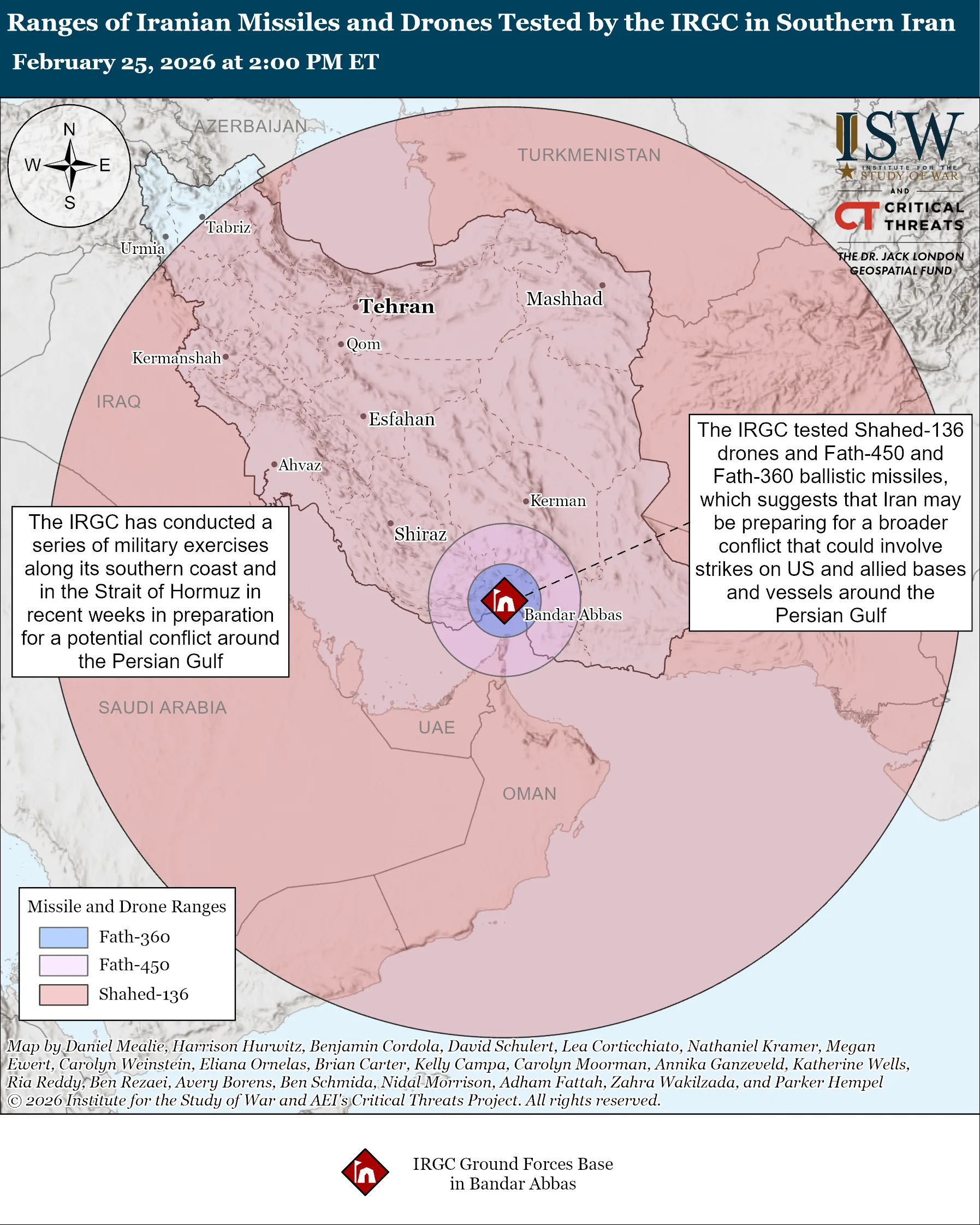
The Islamic Revolutionary Guards Corps (IRGC) has recently conducted a series of military exercises in the Strait of Hormuz and along Iran's southern coast in preparation for a potential conflict with the United States or Israel around the Persian Gulf.[22] The IRGC Ground Forces concluded a two-day exercise under the command of the Madinah ol Munawarah Operational Base in Bandar Abbas, Hormozgan Province, on February 25.[23] The Madinah ol Munawarah Operational Base is the IRGC Ground Forces’ closest regional headquarters to the Strait of Hormuz and oversees IRGC Ground Forces units in Fars, Bushehr, and Hormozgan provinces.[24] The exercise took place on unspecified Persian Gulf islands and along Iran's southern coast.[25] The IRGC Ground Forces reportedly used Rezvan loitering drones for reconnaissance and target acquisition and Shahed-136 drones to strike pre-designated targets during the exercise.[26] Rezvan loitering drones have a range of 20 kilometers, and Shahed-136 drones have a range of 1,500 kilometers.[27] Iranian media highlighted the IRGC Ground Forces’ use of Fath-450 ballistic missiles, which have a range of between 150 and 250 kilometers, and Fath-360 ballistic missiles, which have a range of between 30 and 120 kilometers.[28] Iranian media claimed that these systems have high strike accuracy, can resist electronic warfare, and can carry warheads capable of penetrating fortified positions.[29] Iranian media described the Fath-360 as capable of carrying a “bunker-busting” warhead.[30] This exercise comes after the IRGC Navy conducted an exercise in the Strait of Hormuz on February 16.[31] The recent exercises indicate that Iran is preparing for both a possible maritime conflict near the Strait of Hormuz as well as a possible broader conflict that could involve strikes on US and allied bases and vessels around the Persian Gulf. Four unspecified IRGC members and three senior Iranian officials told the New York Times on February 22 that Iran has positioned ballistic missile launchers along its southern shores within range of US bases and other targets in the region.[32]
Belgium-based outlet Army Recognition assessed that Iran's use of indigenous radars in its S-300 air defense systems would reduce the effectiveness of these systems.[33] Israel destroyed the engagement radar of an Iranian S-300 in April 2024 and rendered Iran's three remaining S-300 systems inoperable in October 2024.[34] An S-300 battery requires engagement radars, command-and-control centers, fire-control units, and launchers to operate as a functional surface-to-air missile system.[35] Army Recognition reported on February 23 that Iran has deployed at least one of its four S-300 systems near Tehran City and potentially deployed an indigenous Bavar-373 air defense system near Esfahan City, citing commercially available satellite imagery on February 16 and 19.[36] Iran previously displayed an S-300 with a “new, Iranian-designed” radar in February 2025.[37] Army Recognition noted that Iran's use of indigenous radars in its S-300 air defense systems would create “interoperability constraints and potential gaps in data link compatibility.”[38]
The Iranian regime is trying to limit disruptions to command-and-control and governance in the event of a potential US or Israeli decapitation campaign against senior Iranian leadership. The New York Times, citing six senior Iranian officials and three IRGC members, reported on February 22 that Supreme Leader Ali Khamenei has named four potential successors for each military and government post that he appoints.[39] Khamenei has also reportedly directed other officials to choose up to four successors and delegated authority to a trusted circle to make decisions if he cannot be reached or is killed. This report highlights Iranian officials’ immense paranoia about potential US or Israeli strikes targeting senior leadership. Israeli strikes targeting senior commanders during the June 2025 Israel-Iran War temporarily disrupted Iran's chain of command and delayed its initial retaliation.[40] Brigadier General Mohammad Reza Naghdi, who served as the IRGC Coordination Deputy during the war and currently serves as an adviser to IRGC Commander Mohammad Pakpour, stated in October 2025 that IRGC units requested authorization to strike Israel early on June 13, but that Khamenei delayed approval of the strikes until he had appointed new commanders to replace those whom Israel had killed earlier that day.[41]
Iranian university students held anti-regime protests for the fifth consecutive day on February 25.[42] CTP-ISW recorded 10 protests, including four large protests, at nine universities in three provinces on February 25. CTP-ISW defines large protests as protests with over 1,000 individuals.[43] CTP-ISW also recorded a protest at a school in Tehran City and a protest at a 40-day mourning period ceremony in Gorgan, Golestan Province.[44] Universities have summoned at least 180 students to disciplinary hearings and suspended numerous others for participating in the protests in Tehran City.[45] Plainclothes security personnel arrested three protesters at the University of Art in Tehran City on February 25.[46] Security forces deployed to Shiraz University in Fars Province on February 25. Iranian authorities have also confiscated the student identification cards of student protesters at Shiraz University.[47] Basij members and pro-regime students clashed with protesters at Shiraz University on February 23 and 24.[48] Two Iranian universities in Kurdistan and Zanjan provinces moved classes online, and another in Mazandaran Province is considering doing so in an effort to curb student protests.[49]
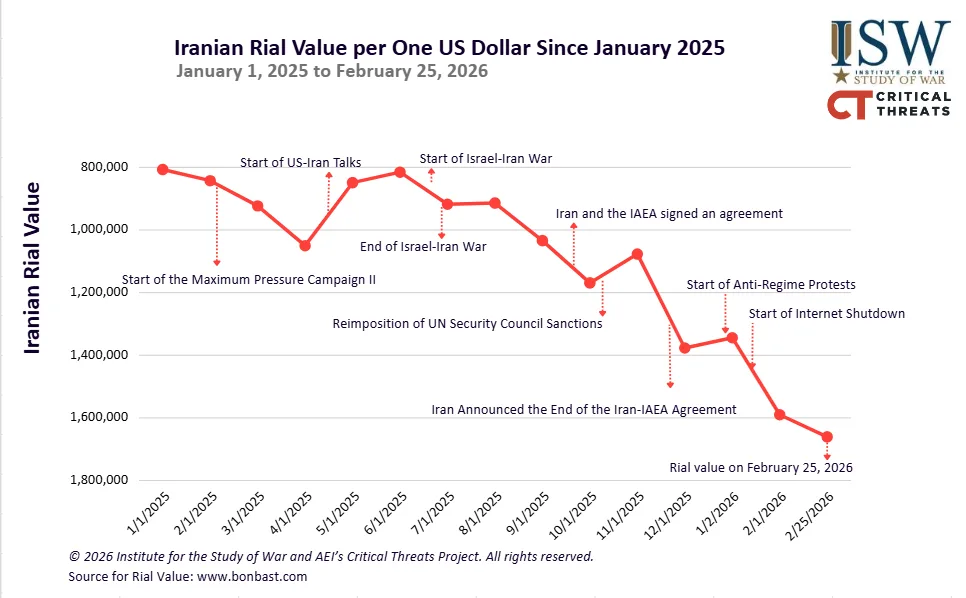
The economic conditions that triggered anti-regime protests in December 2025 continue to worsen. The Iranian currency has suffered a steep collapse since November 2025, which exacerbates economic instability. Iranian business owners have told Western media that they have experienced a substantial decline in sales following the regime's internet shutdown to suppress protests in early January 2026.[50] Both the Iranian public and parts of the regime itself have demonstrated a deep lack of trust in the regime's ability to reform or stabilize the economy. Iranian media reported on February 23 that investors are rapidly shifting their assets away from equities and into hard currency and gold, which indicates a widespread belief that the government cannot restore predictable market conditions.[51] US Treasury Secretary Scott Bessent and Israeli media previously reported that regime officials have transferred hundreds of millions of US dollars out of Iran in recent months, which likely reflects intra-regime concerns about economic stability.[52]
Senior Iranian officials met with Armenian Defense Minister Suren Papikyan in Tehran on February 24 and 25. Iranian Defense and Armed Forces Logistics Minister Brigadier General Aziz Nasir Zadeh and Armed Forces General Staff Chief Major General Abdol Rahim Mousavi held separate meetings with Papikyan and emphasized that the presence of extra-regional powers in the region will cause instability, likely referring to the United States and Israel.[70] Nasir Zadeh previously met with Papikyan in May 2025, which CTP-ISW assessed was likely part of a broader Iranian strategy to counter Israeli, Turkish, and Western influence in the South Caucasus.[71] President Masoud Pezeshkian and Supreme National Security Council Secretary Ali Larijani also held separate meetings with Papikyan on February 24 and 25 to discuss expanding bilateral cooperation.[72]
https://understandingwar.org/research/middle-east/iran-update-february-25-2026/
1,753
posted on
02/25/2026 11:27:10 PM PST
by
AdmSmith
(GCTGATATGTCTATGATTACTCAT)
1,754
posted on
02/25/2026 11:40:02 PM PST
by
AdmSmith
(GCTGATATGTCTATGATTACTCAT)
Iran Update, February 26, 2026
Iran is unlikely to accept reported US demands to destroy its nuclear facilities, send its highly enriched uranium to the US, and commit to a permanent deal. US officials have previously stated that the US would strike Iran if the two sides cannot reach a deal.[1] The United States and Iran held a third round of nuclear talks on February 26 in Geneva, Switzerland.[2] Omani Foreign Affairs Minister Badr al Busaidi stated that there was “significant progress” during the talks and that both sides will hold technical-level discussions in Vienna next week.[3] US officials’ accounts of the talks suggest that Iran is unlikely to accept reported US demands, however. US officials told the Wall Street Journal on February 26 that US negotiators demanded that Iran dismantle its Fordow, Natanz, and Esfahan nuclear facilities, deliver all of its enriched uranium to the United States, and agree to a permanent deal without sunset clauses.[4] The officials also said that US negotiators reiterated their zero-enrichment demand but ”could be open” to a scenario in which Iran can enrich a very low level of uranium “for medical purposes.”[5] These accounts are consistent with previous reporting that the US negotiators would consider a proposal that includes “token enrichment” if Iran credibly proved that it could not support building a nuclear weapon.[6] US negotiators reportedly offered only “minimal sanctions relief,” which contradicts Iranian demands for a more substantial relief package.[7] An unspecified Iranian source with knowledge of the discussions told CNN on February 26 that ending all US and UNSC sanctions is “key” in order to reach any deal.[8] The source added that Iran is not willing to destroy its nuclear facilities, enrich uranium in compliance with the UN International Atomic Energy Agency (IAEA) verification process, or ship enriched uranium out of the country.[9] US President Donald Trump warned Iran of “bad things” on February 24 if the two sides fail to reach a deal.[10]
The Iranian proposal does not meet core US demands. US officials told the Wall Street Journal that Iran's proposal would force Iran to reduce enrichment to as low as 1.5 percent, pause enrichment for a number of years, and process its enriched uranium through an Iran-based regional consortium.[11] Four unspecified Iranian officials told the New York Times on February 26 that Iran would also offer to dilute its 400 kg of 60 percent-enriched uranium in phases and allow IAEA inspectors to oversee all steps.[12] Diluting enriched uranium in Iran does not meet the stated US demand that Iran transfer all of its nuclear material to the United States. Iran has also previously refused to cooperate with IAEA inspections, which the United States supports to verify Iranian compliance with nuclear enrichment.[13] US Vice President JD Vance stated on February 25 that the Trump administration has “seen evidence” that Iran is trying to rebuild its nuclear weapons program.[14] US Secretary of State Marco Rubio separately stated on February 25 that Iran is “trying to rebuild elements” of its nuclear program.[15]
Iran is also trying to offer economic incentives that are unrelated to US demands in order to extract concessions from the United States. Unspecified sources told the Financial Times on February 26 that Iran will offer the United States investments in Iranian oil and gas reserves, mining rights, and critical minerals in an effort to convince US President Donald Trump to agree to a nuclear deal.[16] One of the sources added that Iran is examining Venezuela as a case study.[17] Iranian officials have publicly stated that Supreme Leader Ali Khamenei granted permission for Iranian negotiators to propose allowing American companies to enter Iran and that Iran's proposal to the United States would include a pledge to buy American goods.[18] These reports are consistent with a member of the Iranian negotiating team's description of US-Iran discussions on economic cooperation in the fields of oil, gas, and minerals at the first round of US-Iran nuclear talks on February 6.[19] Iran appears to calculate that the United States is more willing to focus solely on Iran's nuclear program or concede on its enrichment demand in the ongoing talks if Iran offers economic incentives.
Iran likely remains unwilling to discuss its ballistic missile program and support for its partners and proxies in the region with the United States. US officials told the Wall Street Journal on February 26 that the United States wants Iran to limit its ballistic missile program and support for proxies, but that the talks in Geneva will focus on the nuclear issue.[20] US Secretary of State Marco Rubio stated on February 25 that Iran's unwillingness to discuss ballistic missiles with the United States is a “big problem” and that talks would eventually need to expand beyond the nuclear program.[21] Iranian officials have repeatedly ruled out any negotiations on Iran's ballistic missile program.[22] Iran's ballistic missile program constitutes a fundamental part of Iran's defense and deterrence strategy. A Middle Eastern source with knowledge of the US-Iran negotiations told Fox News on February 20 that Supreme Leader Ali Khamenei has refused to allow Iranian negotiators to discuss any concessions on the ballistic missile program because any Iranian concessions on its missile program would be viewed within the regime as ”equivalent to losing a war.”[23]
US Secretary of State Marco Rubio stated on February 25 that Iran is “trying to achieve intercontinental ballistic missiles (ICBMs).”[24] The US Defense Intelligence Agency (DIA) released a public assessment in 2025 that Iran has the capability to develop an ICBM by 2035.[25] Rubio added that Iran has tried to launch satellites into space.[26] CTP-ISW assessed in July 2025 that Iran's efforts to develop its space program could support the development of ICBMs.[27]
Iran continues to undergo efforts to rebuild other aspects of its ballistic missile program.[28] Bloomberg identified on February 25 protective structures surrounding the Khojir Missile Production Complex in Hajarabad, Tehran Province, to prevent chain reactions from explosions.[29] Iran is also encasing a newly-built facility at Taleghan 2 at the Parchin Military Complex with a concrete “sarcophagus” to harden the facility against potential airstrikes, according to the Institute for Science and International Security.[30] Israel struck Taleghan 2 in October 2024 and Khojir during the June 2025 Israel-Iran War.[31]
Iranian-backed Iraqi militia Kataib Hezbollah threatened Iraqi Kurdistan's “security and future” if the Kurdistan Regional Government (KRG) supports a US or Israeli attack on Iran.[32] Kataib Hezbollah called on its members on February 26 to prepare for a “war of attrition that may be protracted” and threatened the United States with “irreparable” loss if it strikes Iran.[33] Kataib Hezbollah Spokesperson Abu Ali al Askari separately said on February 23 that the United States is preparing to attack Iran, which would include passing through Iraqi Kurdistan, and called on Iraqi Kurds to act “rationally.”[34] Askari’s statements are implied threats to attack the Kurdistan Region in the event of a war between the United States and Iran. The KRG issued a statement on February 23 that Iraqi Kurdistan will not be used as a “launchpad” to attack neighboring countries, in reference to Iran.[35] Iran and Iranian-backed Iraqi militias have both previously conducted attacks targeting Iraqi Kurdistan, including during the 2023-2025 Gaza War.[36] Iranian-backed Iraqi militias operating under the Islamic Resistance in Iraq moniker launched multiple drones and rockets targeting US forces based in Erbil from October 2023 to January 2024 in response to Israel's operations in the Gaza Strip.[37] Iran conducted a ballistic missile attack in Erbil in January 2024 in retaliation for an Israeli strike in Syria that killed three Islamic Revolutionary Guards Corps members in December 2023.[38] Iran claimed that the January 2024 strike targeted a Mossad facility. The KRG denied Iran's allegations.[39]
Kataib Hezbollah is the first major Iranian-backed Iraqi militia to threaten the United States over possible US strikes on Iran. Kataib Hezbollah is almost certainly one of the four Iranian-backed Iraqi militias in the Iraqi Resistance Coordination Committee that has reportedly decided to provide military support to Iran and “open fronts” in a potential conflict between Iran and the United States. A senior Iraqi Resistance Coordination Committee source told al Araby al Jadeed on February 22 that the militias’ participation would depend on “developments on the ground, the nature of the confrontation, and its scope.”[40] The Iraqi Resistance Coordination Committee includes Kataib Hezbollah, Asaib Ahl al Haq, Harakat Hezbollah al Nujaba, Harakat Ansar Awfiya, and Kataib Sayyid al Shuhada and an affiliated front group, according to the committee's last statement on January 4.[41] Kataib Hezbollah, unlike some other groups in the Shia Coordination Framework and the Iraqi Resistance Coordination Committee, is a member of both the framework and the coordination committee. Kataib Hezbollah appears to be prioritizing its relationship with Iran and its role in the broader Axis of Resistance over domestic political and economic considerations in Iraq. Kataib Hezbollah, unlike many of the Shia Coordination Framework factions, takes a much more transnational view of regional affairs, given its close relationship with Iran.
Kataib Hezbollah's threat supports CTP-ISW’s February 23 assessment that Iranian-backed Iraqi militias could target US forces in Iraqi Kurdistan in the event of a US or Israeli attack on Iran.[42] US-led international coalition forces redeployed from federal Iraq to Iraqi Kurdistan in late 2025 as part of the first phase of the planned US withdrawal from Iraq.[43] Iranian-backed Iraqi militias have long attacked US forces in Iraq in response to US or Israeli actions.[44] The militias would likely be more willing to target US forces in Iraqi Kurdistan than other US interests, such as the US Embassy in Baghdad, given that a strike on the latter could hurt the militias’ economic interests by deterring economic investment in Baghdad. This demonstrates that even some of the most ideologically motivated Iraqi militias still value their domestic economic and business dealings.
Iranians continued to hold anti-regime protests during the 40-day mourning ceremonies across the country. CTP-ISW recorded 11 protests at 40-day ceremonies across five provinces, including five large protests on February 26.[45] CTP-ISW defines large protests as protests that it estimates have over 1,000 individuals. The 40th day of mourning marks the end of the initial mourning period and is often observed with public commemorations and gatherings in Shia Islam. These 40-day ceremonies have served as catalysts for renewed demonstrations in recent weeks.[46]
CTP-ISW did not record any protests at Iranian universities on February 26, which is a sudden decline from the rate of campus protests in recent days.[47] CTP-ISW is considering several reasons that could explain the lack of observable university protest activity. Both Iranian security forces and university administrations have increased legal and academic pressure on students in recent days by conducting arrests, summoning students before disciplinary bodies, and issuing temporary suspensions.[48] Iran's academic schedule may also have contributed to a decline in campus protest activity on a Thursday, which is a weekend in Iran. Many students live in university dormitories and would therefore presumably still be able to organize protests on the weekend, however. Multiple Iranian universities have also moved instruction online until late March 2026, likely in an effort to reduce in-person participation and opportunities for protests.[49] Any of these individual factors or a combination of the above could explain the lack of campus protest activity on February 26, particularly given that protests continue at 40-day mourning ceremonies.
Iran security forces conducted counterterrorism operations against anti-regime Baloch militias in southeastern Iran between February 23 and 26. The Mobarizoun Popular Front (MPF)—a coalition of anti-regime Baloch militias formed in December 2025—announced on February 24 that Islamic Revolutionary Guards Corps (IRGC) forces killed six of its members the day prior in the vicinity of Saravan City, Sistan and Baluchistan Province.[50] The MPF has conducted several attacks against security personnel in Sistan and Baluchistan Province since the protests started in late December 2025.[51] The IRGC separately reported on February 25 that IRGC, provincial intelligence, and Law Enforcement Command (LEC) Border Guard forces engaged unspecified fighters along Iran's southeastern border, killing three fighters and arresting eight others.[52] Regime-affiliated media accused the involved fighters of killing security personnel at a checkpoint in Fahraj, Kerman Province, in December 2025.[53] Ansar al Furqan – an anti-regime Baloch that is not a member of the MPF – claimed responsibility for the December 2025 attack on a checkpoint in Fahraj as the group's second attack of 2025 as part of Ansar al Furqan’s ongoing operation targeting regime personnel.[54] LEC Border Guard forces also raided an unspecified “terrorist” hideout in Zabol, Sistan and Baluchistan Province, near the Iran-Pakistan border, on February 26 and discovered suicide vests and materials for improvised explosive devices.[55] The LEC Border Guard units are still searching for the fighters, who fled the scene of the raid.[56]
The United States sanctioned more than 30 individuals, entities, and vessels on February 25 for enabling illicit Iranian oil exports and supporting Iran's ballistic missile and drone programs.[57] The US Treasury sanctioned 12 vessels and multiple shipping companies linked to Iran's “shadow fleet” that generates revenue for the Iranian regime's domestic repression, regional proxy activities, and weapons programs, which include Iran's missile and drone procurement networks.[58] The US Treasury also sanctioned three Turkey-based firms for supporting ”sensitive machinery” procurement worth ”hundreds of thousands” of US dollars.[59] The US Treasury also sanctioned an Iran-based firm, a United Arab Emirates-based firm, and four individuals that are tied to Qods Aviation Industries, for the procurement of sodium perchlorate. Qods Aviation Industries is part of the Iranian Defense and Armed Forces Logistics Ministry, and sodium perchlorate is a key precursor for solid propellant for missiles.[60]
https://understandingwar.org/research/middle-east/iran-update-february-26-2026/
1,755
posted on
02/26/2026 9:52:55 PM PST
by
AdmSmith
(GCTGATATGTCTATGATTACTCAT)
To: nuconvert
Today: In response to security incidents and without advance notice, the U.S. Embassy may further restrict or prohibit U.S. government employees and their family members from traveling to certain areas of Israel, the Old City of Jerusalem, and the West Bank. Persons may wish to consider leaving Israel while commercial flights are available.
https://il.usembassy.gov/travel-advisory-february-27-2026/
1,756
posted on
02/27/2026 4:32:27 AM PST
by
AdmSmith
(GCTGATATGTCTATGATTACTCAT)
To: AdmSmith
Yup. Staff being told if they want to leave, they should do so now.
1,757
posted on
02/27/2026 5:23:54 AM PST
by
nuconvert
( Warning: Accused of being a radical militarist. Approach with caution.)
Iran Update, February 27, 2026
The International Atomic Energy Agency (IAEA) cannot verify whether Iran has suspended “all enrichment-related activities,” according to a confidential IAEA report seen by the Associated Press on February 27.[1] The report states that the IAEA does not know the location, size, or composition of Iran’s enriched uranium stockpile.[2] Iran had over 400 kilograms of uranium enriched up to 60 percent before the June 2025 Israel-Iran War.[3] The IAEA has observed “regular vehicular activity” around the entrance to the Esfahan Nuclear Technology Center (ENTC), where at least part of Iran’s enriched uranium is reportedly stored.[4] The United States and Israel struck the ENTC during the Israel-Iran War.[5] The Institute for Science and International Security reported on February 9 that Iran has covered the ENTC’s middle and southern tunnel entrances with soil to protect them from potential US or Israeli airstrikes.[6] The IAEA has also observed activity at Natanz and Fordow but cannot verify the purpose or nature of this activity, according to the February 27 IAEA report.[7] Iran has covered the anti-drone cage at the Pilot Fuel Enrichment Plant (PFEP) at Natanz with panels.[8] The Institute assessed in December 2025 that the panels indicate that Iran is attempting to explore the rubble at the site discreetly.[9] Iranian Foreign Affairs Minister Abbas Araghchi announced on February 26 that Iranian and IAEA officials will meet in Vienna on March 2 and that both sides are preparing documents for the meeting.[10] The upcoming Iran-IAEA meeting coincides with the start of the IAEA Board of Governors meeting on March 2.[11]
The IAEA report comes amid US officials’ concerns about Iran’s nuclear ambitions. US Vice President JD Vance stated on February 25 that the United States has “seen evidence” that Iran is trying to rebuild its nuclear weapons program.[12] Vance met with Omani Foreign Affairs Minister Badr al Busaidi in Washington, DC, on February 27 to discuss the US-Iran nuclear negotiations.[13] Busaidi stated after the meeting that Iran has agreed to dilute its enriched uranium stockpile to the “lowest level possible” and convert it into fuel.[14] US Secretary of State Marco Rubio separately stated on February 25 that Iran is “not enriching now” but is trying “to get to the point where [it] ultimately can.”[15]
Iranians continued to hold anti-regime protests during the 40-day mourning ceremonies across Iran. CTP-ISW recorded four protests, including two large protests, at 40-day mourning ceremonies across four provinces on February 27.[16] CTP-ISW defines large protests as protests with over 1,000 participants. The 40th day of mourning marks the end of the initial mourning period and is often observed with public commemorations and gatherings in Shia Islam. Numerous anti-regime protests have taken place at 40-day mourning ceremonies in recent weeks.[17]
CTP-ISW did not record any protests at Iranian universities or schools on February 27.[18] There are no classes at universities and schools on Fridays since Friday is part of the Iranian weekend, which may have contributed to the lack of protest activity on February 27. Many students live in university dormitories and would therefore presumably still be able to organize protests on the weekend, however. Multiple Iranian universities have also moved instruction online until late March 2026, likely in an effort to reduce opportunities for protests.[19]
https://understandingwar.org/research/middle-east/iran-update-february-27-2026/
1,758
posted on
02/28/2026 2:37:30 AM PST
by
AdmSmith
(GCTGATATGTCTATGATTACTCAT)
To: nuconvert; BeauBo
Live
Israel and US launch strikes on Iran as Tehran prepares retaliation
Summary
Several senior Revolutionary Guards commanders and political officials were killed in US-Israeli strikes, a source close to the Iranian establishment told Reuters.
Iran launched missile attacks toward Israel and across Persian Gulf states, with Bahrain, the UAE, Kuwait and Qatar reporting interceptions; one person was killed in Abu Dhabi.
The Pentagon named its mission “Operation Epic Fury,” while Israel dubbed its campaign “Lion’s Roar” and called up thousands of reservists.
Trump said the US had begun “major combat operations,” Netanyahu urged Iranians to rise against clerical rule, and Iran’s leadership vowed a “crushing response” while warning strikes could continue.
Blasts were reported in Tehran, Tabriz, Qom, Karaj, Khorramabad, Kermanshah, Ilam and other cities. Iran’s Supreme Leader’s office in Tehran was targeted, and Iran closed its airspace for six hours.
https://www.iranintl.com/en/liveblog/202602288143
1,759
posted on
02/28/2026 2:42:48 AM PST
by
AdmSmith
(GCTGATATGTCTATGATTACTCAT)
1,760
posted on
02/28/2026 3:32:44 AM PST
by
AdmSmith
(GCTGATATGTCTATGATTACTCAT)
Navigation: use the links below to view more comments.
first previous 1-20 ... 1,721-1,740, 1,741-1,760, 1,761-1,780 ... 2,321-2,328 next last
Disclaimer:
Opinions posted on Free Republic are those of the individual
posters and do not necessarily represent the opinion of Free Republic or its
management. All materials posted herein are protected by copyright law and the
exemption for fair use of copyrighted works.
FreeRepublic.com is powered by software copyright 2000-2008 John Robinson
