Skip to comments.
Iranian Regime tv Channel One hacked while it was airing Khamenie speech
various
| 10-8-22
Posted on 10/08/2022 1:05:38 PM PDT by nuconvert
Iranian Regime national tv Channel One hacked about an hour ago. During a broadcast of Khamenie speech, a red crosshair appeared over his face and chanting of Women. Life. Freedom. There was writing to the side saying "Rise up. Join us". Also 4 photos at the bottom of the screen of young people killed and additional writing: "The blood of our youth is dropping from your paws".
Also, there was a huge banner in the middle of Tehran highway today that read: We are no longer afraid of you. We will fight.
Also, attempted attack on IRI ambassador in Denmark. Her bodyguard was stabbed. Diplomatic Security intervened before the attacker could stab the ambassador.
TOPICS:
KEYWORDS: basij; deathtothemullahs; denmark; ebrahimrigi; erdogan; iran; iranprotests; iraq; irgc; iri; israel; khameini; khamenei; kurdistan; lebanon; mahsaamini; mullahloversonfr; mullahsmustbekilled; najisharifizindashti; protests; qudsforce; raisi; receptayyiperdogan; shahrammaroufmola; syria; turkey; yemen; zahedi
Navigation: use the links below to view more comments.
first previous 1-20 ... 1,701-1,720, 1,721-1,740, 1,741-1,760 ... 2,441-2,445 next last
Iran Update, February 7, 2026
The United States and Iran will hold a new round of talks sometime early in the week of February 8. Neither the United States nor Iran has changed their negotiating position, which makes a diplomatic breakthrough unlikely if their respective positions do not change.[1] Iran and the United States held talks in Muscat, Oman, on February 6 to establish a framework for future negotiations.[2] US President Donald Trump stated on February 7 that US Special Envoy to the Middle East Steve Witkoff and Iranian Foreign Minister Abbas Araghchi held “very good talks” and that they will meet again “early next week.”[3] Israeli media, citing two sources familiar with the matter, reported that the United States told Iran that it expects Iran to make a “tangible and significant concession” regarding its nuclear program in the next round of talks.[4] Trump told reporters that the ”consequences are very steep” if Iran does not make a deal.[5] Trump signed an executive order on February 6 that imposes a conditional 25 percent tariff on countries doing business with Iran.[6]
Recent statements by Iranian officials indicate that Iran is unlikely to compromise on limits to its ballistic missile program, support for its proxies and partners in the region, and enrichment levels. Araghchi stated to Al Jazeera on February 7 that Iran will keep its enriched uranium inside the country and set enrichment levels based on national needs.[7] Araghchi also dismissed discussing issues outside of the nuclear program with the United States and reiterated threats to US bases in the region if the United States attacks Iran.[8]
The Iranian regime is reportedly continuing to develop plans to restrict international internet access to only trusted regime supporters, which indicates that the regime continues to fear the spontaneous outbreak of new protests. A US media outlet reported on February 6 that the regime was planning since at least August 2025 to overhaul Iran's digital ecosystem by blocking foreign platforms, banning circumvention tools, and enforcing reliance on state-approved technology “at every level.”[9] US-sanctioned head of the Supreme Cyberspace Council Mohammad Amin Aghamiri reportedly received and approved this plan in August 2025.[10] The United States sanctioned Aghamiri in 2023 for his role in blocking news and communication platforms and harassing journalists and dissidents as head of the Supreme Cyberspace Council.[11] The outlet obtained the documents through a source in the Iranian technology community, who received the original copies from a government employee inside Iran.[12] These claims are consistent with a January 15 report from internet monitor FilterWatch, which reported that the Iranian regime is planning to provide international internet access only to individuals with “security clearance” and that “users’ access to international internet will never return to its previous form.”[13]
These plans suggest that the regime believes that the protests could reemerge and therefore must continue its efforts to securitize Iran's digital ecosystem. The regime's fears are presumably enhanced in the short term, given the continued frustration and anger among Iranians in the aftermath of the deadliest crackdown in the history of the Islamic Republic.[14]
https://understandingwar.org/research/middle-east/iran-update-february-7-2026/
1,721
posted on
02/08/2026 1:52:16 AM PST
by
AdmSmith
(GCTGATATGTCTATGATTACTCAT)
To: nuconvert; BeauBo; blitz128; gleeaikin
A man in Iran’s southern port city of Bushehr posted a video in English appealing to US President Donald Trump and Western governments to avoid any deal with Iran’s ruling government, before taking his own life.
https://www.instagram.com/reel/DUgENziET3o/
“America attacking Iran is the only hope we have right now,” said Pouria Hamidi, an Iranian man from Bushehr, adding, “We can’t fight this regime alone. Our people need foreign intervention.”
Hamidi delivered the remarks in a 10-minute English-language video addressed to Western leaders about protests and killings in Iran. He later took his own life.
https://www.iranintl.com/en/202602083545
1,722
posted on
02/08/2026 8:28:48 AM PST
by
AdmSmith
(GCTGATATGTCTATGATTACTCAT)
To: AdmSmith
That’s very sad. I think a joint US/israeli attack is close to happening. He won’t be alive to see it.
1,723
posted on
02/08/2026 10:07:29 AM PST
by
nuconvert
( Warning: Accused of being a radical militarist. Approach with caution.)
To: nuconvert; AdmSmith
Perhaps he was about to be captured and tortured to death? I’m sure the Secret police were looking for anyone who would make such a bold statement, and have considerable competence in such cruel endeavors.
1,724
posted on
02/08/2026 11:02:34 AM PST
by
gleeaikin
(Question Authority: report facts, and post their links in your message.)
Iran Update, February 8, 2026
US President Donald Trump and Israeli Prime Minister Benjamin Netanyahu will meet in Washington, DC, on February 11 to discuss Iran. Israeli media and officials stated on February 7 that Trump and Netanyahu will discuss the United States’ negotiations with Iran.[1] Israeli media reported on February 8 that Israeli defense officials told US officials that Iran's ballistic missile program poses an existential threat to Israel.[2] The Israeli officials noted that Israel is prepared to launch a unilateral attack against Iran to destroy its missile stockpiles and production facilities if Iran crosses an unspecified ”red line.“[3] Israeli officials have also consistently said that negotiations must include limitations on Iran's ballistic missile program.[4] The Israeli Prime Minister's office publicly announced that Netanyahu will travel to the United States at 1350 ET, hours after Trump said that a deal with Iran that ”only covers nuclear [issues]” would be acceptable to him.[5] No other US officials have repeated Trump's purported position that a narrower deal focused only on the nuclear issue would be acceptable.
Iran has not changed its negotiating position, which makes a diplomatic breakthrough in future talks unlikely unless the United States alters its negotiating position. Iran and the United States held talks in Muscat, Oman, on February 6 to establish a framework for future negotiations.[6] The United States has reportedly told Iran that it expects Iran to make tangible concessions on its nuclear program, according to two sources familiar with the matter who spoke to Israeli media.[7] Iran remains unlikely to compromise on limits to its ballistic missile program, support for its proxies and partners in the region, and enrichment levels. Iranian Foreign Minister Abbas Araghchi stated on February 8 that the issue of missiles and “the region” are off the negotiating table.[8] Araghchi added that Iran would never accept zero enrichment and reiterated that Iran has the “right“ to enrich uranium.[9] The United States and Iran will hold a new round of talks sometime early in the week of February 8.[10]
Islamic Revolutionary Guard Corps (IRGC)-affiliated Fars News reported on February 8 that Iran may target supply centers and ports in the region if the United States or Israel attacks Iran.[11] Fars News implied that Iran may specifically target the King Fahd Industrial Port in Jubail, Saudi Arabia, or similar facilities in the Persian Gulf.[12] The King Fahd Industrial Port in Jubail is one of the largest industrial ports in the Middle East, and it handles approximately 20 percent of Saudi trade throughput and approximately one-fifth of Saudi total transits.[13] The United States uses Saudi port facilities as a key logistics and prepositioning point for US forces in the region.[14] Fars News warned that an Iranian attack targeting a Persian Gulf port facilities such as the King Fahd Industrial Port, could cause the port to close, which would have significant economic impacts on oil exports and the global market.[15]
Iranian security forces seized weapons and arrested Kurdish militants in northwestern Iran on February 7. Kurdistan Province Border Guards arrested a weapon smuggler and seized five Kalashnikov rifles, 36 handguns, 729 rounds of ammunition, and seven smuggled handheld wireless devices in Sarvabad, Kurdistan Province, on February 8.[19] IRGC Ground Forces at the Najaf Ashraf base arrested 11 Kurdistan Free Life Party (PJAK) leaders in a separate incident on February 7 in Kermanshah Province.[20] IRGC Ground Forces reported that the PJAK leaders operated in two cells and were planning to carry out attacks in Iran.[21] PJAK seeks to establish an “autonomous Kurdish region within a federal political structure in Iran” and has previously targeted Iranian security forces.[22] Iran has previously accused Kurdish opposition groups of inciting protests in western Iran and cooperating with Israel to facilitate attacks in Iran.[23]
Iran reportedly deployed and tested the Khorramshahr-4 ballistic missile over the last week, likely to demonstrate and practice its capabilities ahead of a potential conflict with the United States. Regime-owned media reported on February 5 that the IRGC deployed the Khorramshahr-4 ballistic missile at an underground missile facility.[24] Iranian Armed Forces General Staff-affiliated media reported on February 8 that Iran recently conducted a launch test of the Khorramshahr-4 ballistic missile during the recent US-Iran negotiations.[25] Regime-affiliated media reported that the Khorramshahr-4 ballistic missile has a 1500-kilogram payload, a top speed of Mach 8 within the atmosphere, a 2,000-kilometer range, and a circular error probability of 30 meters.[26] Iranian defense officials view ballistic missiles as a critical piece of their defense strategy.[27]
https://understandingwar.org/research/middle-east/iran-update-february-8-2026/
1,725
posted on
02/08/2026 11:46:55 PM PST
by
AdmSmith
(GCTGATATGTCTATGATTACTCAT)
To: nuconvert; BeauBo; gleeaikin
On Friday, the Indian Coast Guard busted three sanctioned tankers allegedly engaged in a “smuggling racket” in the Arabian Sea. The agency identified and followed the three ships using surveillance and data analysis. Based on this information, it launched a coordinated raid and interdicted the three ships at a position about 100 nautical miles to the west of Mumbai - outside of Indian territorial seas and the ICG’s coastal-state jurisdiction.
ICG personnel boarded the three ships on the high seas and conducted “sustained rummaging” to look for evidence. Further examination of electronic data and interrogation of the crew produced clues on the ship's “modus operandi and a global handler network,” the ICG said.
The vessels in question are all under U.S. sanctions, according to TankerTrackers.com. The consultancy identified them as Al Jafzia (IMO 9171498; ex name Chiltern, broadcasting a Nicaraguan flag, formerly false-flagged in Guyana), Asphalt Star (IMO 9463528; falsely broadcasting a Malian flag, formerly false-flagged in Aruba) and Stellar Ruby (IMO 9555199; flagged in Iran).
https://maritime-executive.com/article/indian-coast-guard-busts-three-iran-linked-shadow-fleet-tankers
1,726
posted on
02/08/2026 11:55:04 PM PST
by
AdmSmith
(GCTGATATGTCTATGATTACTCAT)
Iran Update, February 9, 2026
Some Iranian regime elements are signaling that Iran may offer relatively insignificant, nuclear-only concessions, but only if the United States offers complete sanctions relief.[1] The concessions under discussion in the Iranian policy and media space are less significant than the concessions Iran offered in the 2015 nuclear deal, when it was relatively stronger compared to its position today. Iranian officials have not indicated any willingness to offer concessions beyond the nuclear program. The Iranian regime's official policy continues to assert that uranium enrichment is an inherent right and that Iran will not negotiate over its missile program. Some regime officials are now suggesting that Iran may be willing to dilute its enriched uranium from 60 percent to 20 percent, but only if the United States provides substantial, reciprocal concessions such as complete sanctions relief.[2] The 2015 nuclear deal forced Iran to cap its enrichment at 3 percent for a period of 15 years.
Iranian officials have floated these concessions publicly after US President Donald Trump said that he would be open to a deal limited to the nuclear program, although no other US official has said the same.[3] US Vice President JD Vance stated on February 9 that Trump will decide if the United States will allow limited uranium enrichment and where the United States will draw any “red line” in the negotiations with Iran.[4] Recent statements by Iranian officials nonetheless suggest that Iran is attempting to test whether it can trade limited nuclear steps for maximal sanctions relief without constraining its missile or regional activities.
Iranian Supreme National Security Council (SNSC) Secretary Ali Larijani will visit Oman on February 10, possibly to convey details about potential nuclear concessions to Omani interlocutors.[5] Iran has commonly used Oman as an interlocutor with the United States and Gulf countries.[6] Larijani has reportedly been attempting to shape Iran's negotiating position. He is officially meeting with Omani officials to discuss “regional developments.”[7] Larijani previously tried to convince Iranian leaders in August 2025 to reduce enrichment from 60 percent to 20 percent to avoid snapback sanctions and further US and Israeli strikes, according to a senior Iranian official speaking to the Telegraph. Larijani’s past efforts suggest that his Oman visit could be designed to float possible nuclear concessions to the United States.[8]
An agreement that lifts sanctions on Iran without seriously decreasing Iran's ability to expand its ballistic missile and drone program or its proxy networks would pose a long-term threat to US interests in the region by enabling Iran to reinvest in these capabilities and its proxy networks. Iran has repeatedly used its missiles and regional partners to threaten and attack the United States and its allies.[9] Iran has ordered or conducted attacks against US forces and interests in the region that have killed hundreds of Americans. More recently, Iran and its regional partners have previously targeted US forces in the region in response to perceived and real Israeli activity. Iranian-backed militias in Iraq began their attack campaign against US forces in Iraq and Syria during the October 7 War after a Palestinian militia rocket fell short and exploded at al Ahli Hospital in the Gaza Strip, an incident that the militias blamed on Israel. This escalation ultimately led to an attack by Iranian-backed proxy group Kataib Hezbollah on a US position in Jordan, which killed three US servicemembers.[10] Iran has also used ballistic and cruise missiles, either directly or via its partners, to strike US regional partners, such as Saudi Arabia and the United Arab Emirates.[11] Iran's ballistic missile program and its proxies and partners have long posed a threat to US assets and personnel in the region, not just Israel.
Russia is also engaging Oman to discuss mediation efforts and appears broadly supportive of an agreement that benefits Iran by lifting sanctions while limiting Iranian enrichment and having no effect on Iran's ballistic missile program and the Axis of Resistance. Russian Foreign Minister Sergei Lavrov held a phone call with Omani Foreign Minister Badr al Busaidi on February 9. Lavrov told Busaidi that Russia welcomes Oman's mediation efforts and noted that Russia is in “constant contact” with Iran.[12] Lavrov’s phone call is almost certainly related to Larijani’s visit to Oman (see above). Larijani met with Russian President Vladimir Putin on January 30 as part of a flurry of diplomatic efforts by Iranian officials to avert US military action against Iran.[13] Russia seeks a ”broadly acceptable agreement that supports regional security,” which indicates that Russia seeks to head off a potential US strike by promoting a negotiated outcome that reduces the risk of military escalation against Iran.
The Iranian regime is cracking down on Iranian reformists, which may be part of the regime's efforts to control the narrative about the recent Iranian protests. The regime has arrested several critical figures within the Iranian reformist front, including the head of the reformist front, Azar Mansouri, former Deputy Foreign Minister for American Affairs Mohsen Aminzadeh, and National Unity Party Central Council member Ali Shakouri Rad.[14] The regime also summoned several other reformists, including former Iranian diplomat Mohsen Armin and former Association of Iranian Journalists secretary Badrolsadat Mofidi. Several of these summoned and arrested figures made statements criticizing the regime's recent crackdown on protests.[15] Mansouri, for example, issued a statement on January 26, stating that the Reformist Front is disgusted and angry at those who “ruthlessly and recklessly“ killed the young people of Iran, likely referring to Iranian security forces.[16] The arrest of these reformists suggests that the Iranian regime could be temporarily escalating against these reformists in response to their inflammatory criticisms of the regime.
The regime's crackdown could be the beginning of a new level of censorship to silence any regime critics within Iran, however. These recent arrests, if broadened to include more Iranian reformists or moderates, could indicate that the regime is severely cracking down against any criticism of its response to the recent protests. The arrest also indicates that the regime is not receptive to any feedback or reform to address the public grievances that triggered the recent protest movement. The regime's refusal to address these underlying grievances could cause protests to resume.
Anti-regime militant activity has continued in southeastern Iran, which creates additional security challenges for the Iranian regime. Mobarizoun Popular Front (MPF), which is a coalition of Baloch organizations, fighters shot at a vehicle transporting a local judiciary official in Khash City, Sistan and Baluchistan Province, on February 9.[17] The attack injured two armed Law Enforcement Command (LEC) officers.[18] The Sistan and Baluchistan Province LEC Information Center announced that the LEC is conducting security operations in the surrounding area to find the perpetrators.[19] MPF later claimed responsibility for the attack on February 9 and claimed that the judiciary official played a role in repression efforts by the regime in Khash County.[20] The MPF, which was formed in December 2025, and Jaysh al Adl, the principal MPF predecessor organization, have also historically operated in Khash County.[21] MPF fighters conducted two other similar attacks against LEC personnel in Iranshahr and Dashtiari County, Sistan and Baluchistan Province, on January 7 and 11.[22]
The Islamic Revolutionary Guards Corps (IRGC) began to conduct missile launch tests in unspecified locations in central Iran (see map below) on February 9 at 7:30 am ET, amid Iranian concerns over a US and Israeli strike on Iran.[23] These tests will end on February 10 at 11:30 am ET. Iran issued a Notice to Airmen (NOTAM) on February 8 for an unspecified number of missile launches across Semnan, Esfahan, Yazd, and South Khorasan provinces.[24] An IRGC-attributed Telegram channel reposted the NOTAM on February 8, reporting that the IRGC Aerospace Force is conducting the launches on February 9.[25] Iranian regime-affiliated media confirmed that the IRGC deployed and conducted a launch test of the Khorramshahr-4 ballistic missile in an unspecified location on February 5 and 8.[26] The Khorramshahr-4 ballistic missile has a top speed of Mach 8 within the atmosphere, a 2,000-kilometer range, and a circular error probability of 30 meters.[27]
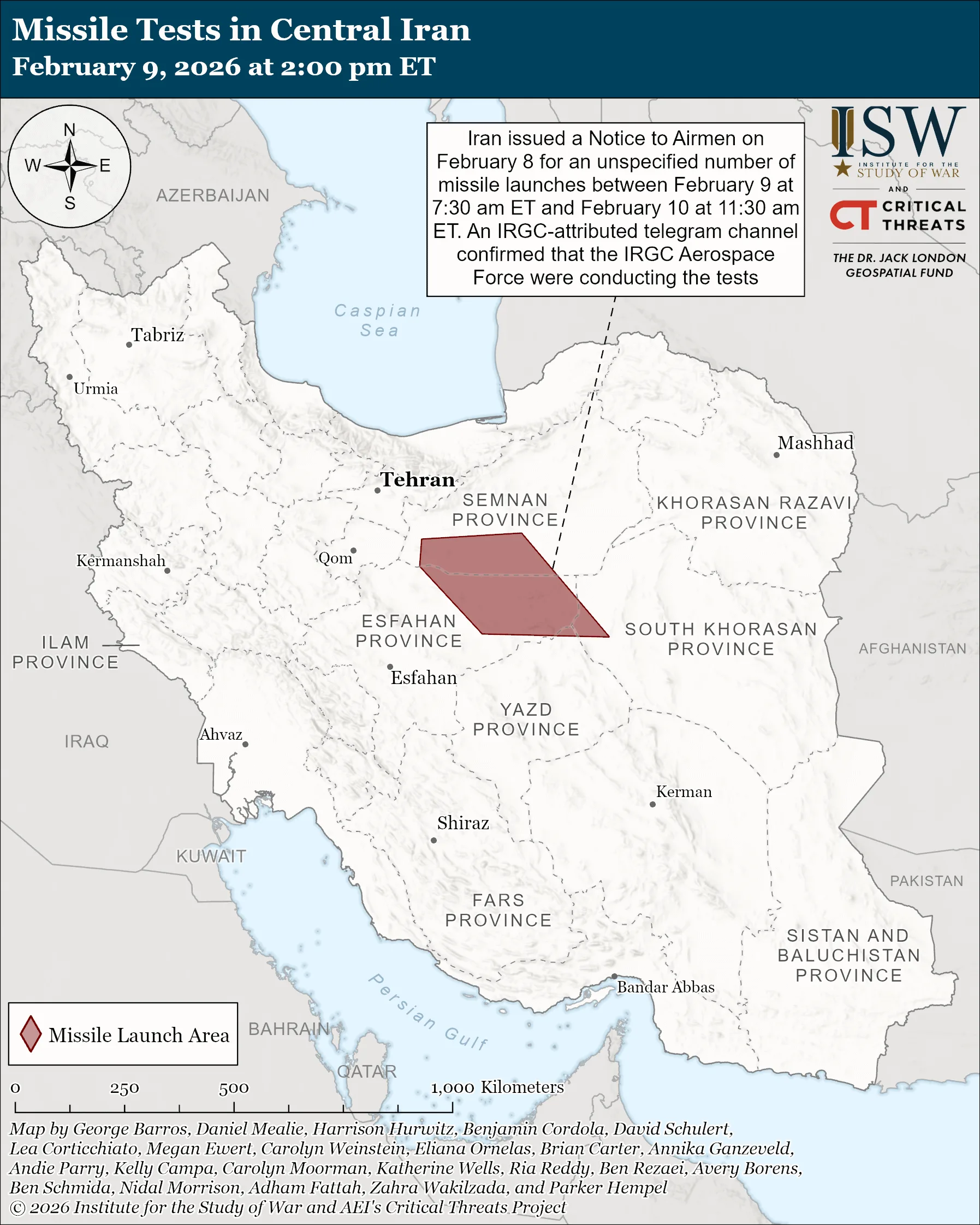
https://understandingwar.org/research/middle-east/iran-update-february-9-2026/
1,727
posted on
02/10/2026 12:19:32 AM PST
by
AdmSmith
(GCTGATATGTCTATGATTACTCAT)
To: nuconvert; BeauBo
10FEB2026 Over 80 military cargo flights by the U.S. Air Force linked to the transfer of air-defense equipment, including both C-17A Globemaster IIIs and C-5M Super Galaxies, have arrived at bases in the Middle East from hubs in the Indo-Pacific and the United States since mid to late January. Defensive preparations across the region for potential future military action against Iran are close to being finalized and will likely be mostly complete by Friday.
https://x.com/sentdefender/status/2021042741401018644
Thursday 19FEB2026 Ramadan start in Iran
1,728
posted on
02/10/2026 1:35:33 AM PST
by
AdmSmith
(GCTGATATGTCTATGATTACTCAT)
To: AdmSmith
Ramadan isn’t as big an issue in Iran as Arab states & other Muslim countries.
We need to just go ahead and attack as soon as possible. People who were arrested during the protests are being killed every day.
1,729
posted on
02/10/2026 5:40:14 AM PST
by
nuconvert
( Warning: Accused of being a radical militarist. Approach with caution.)
To: nuconvert
It’s like training dogs; you have to act immediately, otherwise the effect diminishes. The attack should have come a month ago to gain momentum.
1,730
posted on
02/10/2026 1:55:58 PM PST
by
AdmSmith
(GCTGATATGTCTATGATTACTCAT)
To: AdmSmith
We weren’t ready to attack a month ago
1,731
posted on
02/10/2026 2:46:54 PM PST
by
nuconvert
( Warning: Accused of being a radical militarist. Approach with caution.)
To: nuconvert
Iran Update, February 10, 2026
Any US-Iran deal that does not limit Iran's ability to develop its ballistic missile program and support the Axis of Resistance would harm US interests in the Middle East. Iranian officials have continued to insist that Iran will not negotiate on its ballistic missile program and support for the Axis of Resistance, which are key pillars of the Iranian regime's defense and deterrence strategies.[1] Iranian Supreme National Security Council Secretary Ali Larijani, who reportedly manages Iran's nuclear file and traveled to Oman on February 10, told Omani media on February 10 that Iran would consider expanding the scope of negotiations with the United States to include “other areas” if the current US-Iran talks are successful, but he did not specify which “areas” he was referring to.[2] Larijani claimed that the United States previously tied “missile and military issues” to the nuclear issue and that “military issues have nothing to do with the nuclear issue.“[3] Larijani separately met with the Oman-based Houthi spokesperson, Mohammad Abdulsalam, on February 10, likely to discuss regional events, such as developments in the Gaza Strip and potential US or Israeli military action against Iran.[4] Iranian regime media highlighted how Larijani’s meeting with Abdulsalam reflects Iran's continued support for its regional proxies and partners.[5] Iran possesses the capability to strike US interests in the Middle East using ballistic missiles and the Axis of Resistance, and it has previously demonstrated a willingness to do so even in the absence of direct US action against Iran.[6]
Iran's insistence on continuing to develop its ballistic missile program and support the Axis of Resistance comes as Israeli Prime Minister Benjamin Netanyahu will meet with US President Donald Trump on February 11, reportedly to urge Trump not to accept a deal with Iran that only addresses the nuclear issue.[7] Netanyahu will present Trump with Israeli intelligence about Iran's military capabilities, including an assessment that Iran could have 1,800-2,000 ballistic missiles within weeks or months, according to an Israeli source speaking to CNN on February 10.[8] This estimate differs from Israeli media reporting in December 2025 that Iran had already reconstituted its ballistic missile stockpile to 2,000 missiles.[9] Israeli media reported on February 9 that Jared Kushner and US Special Envoy to the Middle East Steve Witkoff seek to quickly reach a deal with Iran “with or without an Iranian commitment on the issue of ballistic missiles.”[10] Israeli media added that Netanyahu seeks to urge Trump to “act against the recommendation of” Kushner and Witkoff. Netanyahu's meeting with Trump comes after Trump suggested on February 7 that he could accept a deal that only addresses the nuclear issue.[11] Trump later told Israeli journalist Barak Ravid on February 10 that any deal with Iran must address Iran's ballistic missile program in addition to its nuclear program, however.[12]
The Iranian regime's exacerbation of its population's economic and sociocultural grievances increases the likelihood that protests will break out again. The regime is continuing to securitize Iranian society at the expense of Iranians’ economic well-being. Al Jazeera reported on February 10 that Iranian authorities have closed dozens of small- and medium-sized businesses, mostly in Tehran, in recent days that supported the protests by striking in December 2025.[13] Workers at one of Iran's largest gas refineries went on strike for the sixth consecutive day on February 10 due to poor employment and livelihood conditions.[14] The regime has also sustained its internet shutdown, which costs the Iranian economy about $37 million USD per day.[15] Internet monitor Filterwatch reported on February 3 that the regime plans to grant access to the international internet only to certain individuals, rather than all Iranians.[16] A system that only allows some Iranians to access the international internet may exacerbate Iranians’ frustration with the regime and create conditions for further unrest.[17]
The regime's ongoing securitization measures come as some Iranian university students have held demonstrations in recent days to protest Iranian security forces’ killing of university students during the recent protests and arrest of medical personnel who treated injured protesters. Iranian university students at a university in Fars Province and two universities in Khorasan Razavi Province held protests between February 2 and 9.[18] Students at Islamic Azad University in Mashhad, Khorasan Razavi Province, protested on February 3 the death of a student during the protests, while students at Ferdowsi University in Mashhad protested on February 9 against security forces’ killing of two students and the arrest of another student.[19] Medical students at Shiraz University in Fars Province held sit-ins between February 2 and at least February 7 to protest the killing of protesters and arrest of medical staff who treated protesters.[20] These limited protests highlight how the regime's repression of its population creates greater disaffection and anger toward the regime, which can in turn set conditions for further anti-regime activity, including protests.
Iran continues to reinforce and harden the Esfahan Nuclear Technology Center (ENTC)’s underground complex entrances against potential US or Israeli military action. The Institute for Science and International Security reported on February 9 that Iran has completely covered the ENTC’s middle and southern tunnel entrances with soil, according to satellite imagery from early February 2026.[43] The Institute added that Iran has backfilled the northern ENTC tunnel entrance.[44] Western media previously reported in June 2025 that US strikes during the Israel-Iran War blocked the tunnel entrances to the underground complex at the ENTC that reportedly stores part of Iran's enriched uranium stockpile.[45] The Institute assessed that Iran's efforts to protect the ENTC’s tunnel entrances would “help dampen” potential airstrikes and complicate any ground raid intended to seize or destroy any uranium at the complex.
https://understandingwar.org/research/middle-east/iran-update-february-10-2026/
1,732
posted on
02/10/2026 11:14:58 PM PST
by
AdmSmith
(GCTGATATGTCTATGATTACTCAT)
To: nuconvert
Iran Update, February 11, 2026
Iran may be floating the possibility of talks about Iran's ballistic missile program in an effort to delay possible US military action and extract concessions from the United States in nuclear negotiations. Israeli media, citing unspecified sources, reported on February 10 that Iran communicated to regional mediators that it is not willing to make any compromises on its ballistic missile program at this time but may be willing to discuss its ballistic missiles “in the future.”[1] Iranian Supreme National Security Council (SNSC) Secretary Ali Larijani separately told Omani media on February 10 that Iran could agree to expand the scope of its talks with the United States “to other areas” if the current nuclear negotiations are successful.[2] Iran's suggestion that it could discuss its ballistic missile program at an unspecified point in the future is consistent with Iranian officials’ statements that Iran will not negotiate on its ballistic missiles in the current talks. This signaling may also be intended to drag out the current talks by leaving open the possibility for discussions about other issues apart from the nuclear issue. Iran may calculate that continuing to reject any possibility of discussing its ballistic missile program with the United States could increase the risk of US or Israeli military action against Iran.
Iran appears to be conditioning the possibility of talks about its ballistic missile program on US concessions in the current nuclear talks. Larijani’s statement to Omani media suggests that Iran would only be willing to entertain the possibility of talks on its ballistic missiles in the event that the United States and Iran reach a nuclear agreement. Iran's nuclear-related demands include the United States recognizing Iran's “right” to enrich uranium and lifting sanctions in return for any Iranian concessions on its nuclear program.[3] Iran has thus far only offered limited concessions on its nuclear program. Some regime officials have suggested that Iran may be willing to dilute its enriched uranium from 60 percent to 20 percent, but only if the United States provides full sanctions relief.[4] This hypothetical deal would require a less significant concession from Iran than it agreed to in the 2015 deal, when Iran was relatively stronger compared to its position today. The 2015 nuclear deal made Iran cap its enrichment at 3.67 percent for a period of 15 years.[5] The deal also prompted the UN Security Council to impose an eight-year ban on Iran's long-range ballistic missiles and a five-year ban on conventional arms transfers, including missile systems, to Iran.[6]
Iran may calculate that prolonging the talks with the United States provides Iran with additional time to reconstitute its ballistic missile program, which Iran may calculate would raise the costs of US or Israeli military action against Iran. Two unspecified Israeli sources told CNN on February 10 that Israeli officials are concerned about Iran's rapid progress in restoring its ballistic missile stockpile and capabilities to their pre-Israel-Iran War levels.[7] The sources added that Iran could possess between 1,800 and 2,000 missiles “within weeks or months.”[8] CNN's report comes after other Israeli sources reported in December 2025 that the Iranian regime may only need one to two years to produce enough ballistic missiles to overwhelm Israeli air defenses, which is an estimate calculated based on Iran's ability to produce about 300 ballistic missiles per month.[9] Israeli Prime Minister Benjamin Netanyahu met with US President Donald Trump in Washington, DC, on February 11 to urge Trump to force Iran to agree to limit its ballistic missile program, according to Israeli and US officials.[10] The officials said that Netanyahu sought to convince Trump to launch a strike against Iran's ballistic missile production facilities if he cannot secure a diplomatic agreement that includes restrictions on Iran's missile program.[11] Iran's prolongment of the negotiations may be part of an attempt to buy more time to replenish its ballistic missile stockpile before another possible round of fighting between Iran and the United States or Israel. Iran launched multiple barrages of missiles at Israel during the Israel-Iran War and Iranian officials have repeatedly threatened to fire missiles at US bases in the region if the United States attacks Iran.[12]
Iran is also pursuing multiple diplomatic tracks to try to prevent a US strike. A Wall Street Journal journalist reported on February 11 that Larijani discussed Iran's highly enriched uranium with Omani officials during his February 10 trip to Moscow.[13] CTP-ISW assessed on February 9 that Larijani may have conveyed details about potential nuclear concessions during his visit to Oman.[14] Larijani’s trip to Oman followed his meeting with Russian President Vladimir Putin in Moscow on January 30 in which Larijani and Putin likely discussed the US-Iran talks and ways to prevent US military action against Iran.[15] Russia recently offered to store Iranian enriched uranium on February 4.[16] Russian Foreign Affairs Minister Sergei Lavrov called his Omani counterpart on February 9 to express support for Oman's mediation efforts, almost certainly in relation to Larijani’s visit to Oman.[17] Larijani is Iran's principal negotiator with Russia.[18] Larijani also met with Qatari Emir Sheikh Tamim bin Hamad al Thani and Prime Minister Sheikh Mohammad bin Abdulrahman al Thani on February 11 to discuss regional developments.[19] The Qatari Emir also held a phone call with Trump on February 11 to discuss “efforts for regional de-escalation.”[20] Larijani’s diplomatic efforts are taking place alongside Iranian Foreign Affairs Minister Abbas Araghchi’s diplomatic efforts. Araghchi is Iran's principal negotiator with the United States and led the Iranian delegation to Oman on February 6, after which he traveled to Qatar.[21]
US government officials have discussed seizing tankers involved in transporting Iranian oil but refrained from doing so due to concerns over Iran's “near-certain” retaliation and the impact that tanker seizures would have on international oil markets, according to unspecified US officials speaking to the Wall Street Journal on February 10.[22] Iranian officials, including Islamic Revolutionary Guards Corps (IRGC) Navy Commander Brigadier General Alireza Tangsiri, have previously threatened to target shipping transiting the Strait of Hormuz if the United States disrupts Iran's oil trade.[23] Iran has demonstrated its willingness and ability to disrupt regional maritime and energy security, such as by attacking oil tankers in the Persian Gulf and Saudi energy facilities in 2019 during US President Donald Trump's first term.[24] The US government previously considered seizing and inspecting tankers carrying Iranian oil in March 2025 in order to disrupt Iran's illicit oil trade, according to unspecified sources speaking to Reuters.[25] The US government ultimately did not adopt this strategy. The United States and Iran later started nuclear negotiations in April 2025.[26]
The IRGC, Law Enforcement Command (LEC), and intelligence agents dismantled a “terrorist cell” in Khash and Zahedan, Sistan and Baluchistan Province, on February 10, likely in response to a Mobarizoun Popular Front attack that injured two LEC officers on February 9.[27] Iranian Armed Forces General Staff (AFGS)-affiliated Defa Press reported that security forces killed four “terrorists,“ arrested several individuals affiliated with the cell, and seized several firearms.[28] Intelligence Minister Esmail Khatib stated on February 11 that counterterrorism forces, in cooperation with the IRGC and the LEC, also arrested and killed some “terrorists” in Kerman Province.[29] The Mobarizoun Popular Front is a coalition of anti-regime Baloch groups that formed in December 2025.[30] The Mobarizoun Popular Front conducted an attack in Khash on February 9 that injured two LEC officers.The Mobarizoun Popular Front also claimed that it attacked and destroyed vehicles belonging to a special forces unit in Iranshahr on February 11.[31]
Iranian Foreign Affairs Minister Abbas Araghchi spoke with Pakistani Foreign Minister Mohammad Ishaq Dar on February 10, likely to discuss anti-regime militancy in Sistan and Baluchistan Province[32] Iranian officials often discusses cross-border issues, including anti-regime militant activity, with Pakistani officials because anti-regime militant groups operate in the Iran-Pakistan border area..[33] Anti-regime militancy in Sistan and Baluchistan Province has long posed an internal security challenge for the Iranian regime. Jaish al Adl, which is part of the Mobarizoun Popular Front, and other Baloch groups frequently attack Iranian regime security forces and institutions in Sistan and Baluchistan Province.[34]
https://understandingwar.org/research/middle-east/iran-update-february-11-2026/
1,733
posted on
02/12/2026 12:16:12 AM PST
by
AdmSmith
(GCTGATATGTCTATGATTACTCAT)
Iran Update, February 12, 2026
Israeli Prime Minister Benjamin Netanyahu presented US President Donald Trump with evidence that the Iranian regime continued to kill protesters even after it told the United States that it would stop harming civilians and that Iran has never intended to discuss non-nuclear issues with the United States, according to Israeli media.[61] Netanyahu and Trump met at the White House on February 11.[62] AUS-based human rights organization has recorded a total of 7,002 deaths and over 52,000 arrests in the recent protests as of February 11.[63] Unspecified Iranian lawyers defending detained protesters in Iran separately told Western media on February 6 that the Iranian regime plans to execute “thousands” of Iranians who participated in the recent protests.[64] CTP-ISW cannot verify the reliability of this report. The Iranian judiciary conducted its first execution of a protester from the 2022-2023 Mahsa Amini protest movement in December 2022, two months after the start of the protest movement.[65]
Trump and Netanyahu also discussed the Iranian nuclear and ballistic missile programs.[66] Trump stated that he insisted that “negotiations with Iran continue” during his meeting with Netanyahu.[67] Netanyahu’s office stated that Netanyahu emphasized Israel’s security needs during the meeting.[68] Israeli media previously reported that Netanyahu sought to urge Trump not to accept a deal with Iran that does not address Iran’s ballistic missile program.[69]
The Iranian regime is unlikely to make any concessions on its ballistic missile program because it views its missile capabilities as an essential component of its defensive and deterrence strategies. Iranian Armed Forces General Staff (AFGS)-affiliated outlet Defa Press published an op-ed on February 12 in which it suggested that strengthening Iran’s defense readiness and missile capabilities could increase Iran’s leverage in negotiations with the United States.[70] Defa Press added that Iran can use its “military winning card,” likely referring to its ballistic missiles, to respond to any US actions.[71] Iranian officials have continued to insist that Iran will not negotiate on its ballistic missile program and support for the Axis of Resistance during the current US-Iran talks.[72] Iranian Supreme National Security Council (SNSC) Secretary Ali Larijani told Omani media on February 10 that Iran could agree to expand the scope of its talks with the United States “to other areas” if the current nuclear negotiations are successful. Larijani likely made this comment in an attempt to float the possibility that Iran may be willing to negotiate on its ballistic missile program to drag out the current talks and prevent US or Israeli military action against Iran.[73] Larijani did not state that Iran would be willing to make concessions on its ballistic missile program even if it agreed to “discuss” the issue with the United States, however. The Iranian regime is unlikely to make any concessions that would limit its ability to produce and maintain its ballistic missile stockpile due to the centrality of the missile program in Iranian defensive and deterrence strategies. Former Islamic Revolutionary Guards Corps (IRGC) Commander Mohammad Ali Jafari argued in October 2025 that Iran’s missile program is its main form of deterrence and that Iran deliberately prioritized developing its missile and drone capabilities over its air and ground forces to counter the superior capabilities of the United States and Israel.[74]
The Institute for Science and International Security assessed on February 11 that Iran is likely fortifying entrances at its Kolang Gaz La Mountain nuclear facility in Esfahan Province to protect the facility from future US or Israeli strikes.[90] The Institute published imagery that shows concrete-reinforced headworks, additional dirt overburdens, and heavy construction machinery at multiple tunnel portals.[91] The Institute reported that construction materials and heavy machinery suggest that the site is likely still not operational.[92] The Institute previously assessed that Iran could use the Kolang Gaz La facility to house an advanced centrifuge assembly plant or potentially a small undeclared enrichment plant.[93] The Institute has assessed in recent weeks that Iran is also hardening infrastructure at the Esfahan Nuclear Technology Center and Parchin Military Complex’s Taleghan 2 facility in preparation for possible future strikes.[94]
https://understandingwar.org/research/middle-east/iran-update-february-12-2026/
1,734
posted on
02/12/2026 10:43:32 PM PST
by
AdmSmith
(GCTGATATGTCTATGATTACTCAT)
To: nuconvert; BeauBo; gleeaikin
Watch: A Massacre in Iran - Part Two: The Hippocratic Oath
⚠️ Audience Advisory: This documentary contains extremely graphic and distressing content. Viewer discretion is strongly advised.
In the days following the January massacre of protesters in Iran, many doctors, nurses, and medical staff remained true to their oath. When hospitals became unsafe and dangerous, they risked their own safety to help wounded protesters.
The second episode of A Massacre in Iran includes footage and testimonies of wounded protesters being shot at close range inside hospitals, security forces storming medical centers, and injured demonstrators receiving treatment at home out of fear of arrest.
Watch on YouTube: https://www.youtube.com/watch?v=l9l6_gqELII
https://x.com/IranIntl_En/status/2022045555992801643
1,735
posted on
02/13/2026 8:03:38 AM PST
by
AdmSmith
(GCTGATATGTCTATGATTACTCAT)
To: AdmSmith
1,736
posted on
02/13/2026 1:08:30 PM PST
by
nuconvert
( Warning: Accused of being a radical militarist. Approach with caution.)
To: nuconvert
1,737
posted on
02/14/2026 5:33:18 AM PST
by
AdmSmith
(GCTGATATGTCTATGATTACTCAT)
Iran Update, February 13, 2026
Iranian officials are rejecting US offers to engage in negotiations over Iran's ballistic missile program amid increasing US threats. Iranian Defense Council Secretary Ali Shamkhani told al Jazeera on February 13 that Iran's missile capability is a “firmly established” element of Iran's defense doctrine and part of its deterrence mechanism.[1] Shamkhani argued that Iran's missile capabilities are thus included within Iran's “defense red lines,” and are not open for negotiation.[2] Shamkhani added that it is “natural” for the “fundamental defense components of states” to be outside the scope of political negotiations.[3] Iran has also not offered concessions on its nuclear program that are close to the US demand of zero enrichment or even close to the restrictions placed on the program under the 2015 nuclear deal.
Iranian officials are refusing to negotiate limits to Iran's ballistic missile program because the ballistic missile program forms an integral part of Iranian defense strategy. Any changes to this strategy would require a strategic rethink that would take months, if not years. Shamkhani’s remarks indicate that Iran is differentiating between negotiable issues related to the nuclear program and non-negotiable issues related to deterrence and Iran's military capabilities, rather than signaling future flexibility on missiles after a possible nuclear deal. Iran considers its missile program as its main form of deterrence because it allows Iran to impose costs on its adversaries and compensates for Iran's weak conventional air capabilities.[4] Former Islamic Revolutionary Guard Corps (IRGC) Commander Mohammad Ali Jafari argued in October 2025 that Iran deliberately prioritized missile and drone development over its air and ground forces to counter the superior capabilities of the United States and Israel, which underscores the reality that if Iran chose to limit its missiles, it would be agreeing to defang itself.[5]
Iran's continued refusal to negotiate over its ballistic missile program comes after US President Donald Trump warned on February 12 that Iran has roughly one month to reach a deal. [6] Trump added that the United States “ha[s] to make a deal with Iran” or it will be “very traumatic,” adding that Iran will face “a very difficult time” if the deal is not fair.[7] Trump told Fox Business on February 10 that an acceptable deal with Iran would mean “no nuclear weapons, no missiles.”[8] Trump also decided to deploy the USS Gerald R. Ford carrier strike group to the Middle East after he met with Israeli Prime Minister Benjamin Netanyahu on February 11, according to Axios.[9]
The United States smuggled 6,000 Starlink terminals into Iran during the recent protest wave in order to help protesters “circumvent internet shut-offs” and overthrow the regime, according to US officials speaking to the Wall Street Journal.[10] The regime imposed a nationwide internet shutdown on January 8, likely to inhibit protesters’ ability to coordinate gatherings and conceal the regime's brutal crackdown.[11] Starlink terminals allowed Iranian protesters to maintain internet access in order to communicate with each other and the international community. Iranian doctors used Starlink, for example, to tell The Times on January 17 that the regime‘s crackdown had killed 16,500 protesters and injured around 330,000 protesters.[12] Iranian security forces launched a massive operation on January 12, 2026, to search homes in several cities across Iran and seize Starlink terminal dishes, which indicates the degree of concern the regime has about the use of Starlink.[13]
The regime has taken extreme steps to stop protesters’ use of Starlink, including prior to this recent protest wave. Starlink enabled protesters to connect to the outside world when used during the Masha Amini protests, and protesters during the Mahsa Amini protest wave also demonstrated a significant degree of organization.[14] The Iranian parliament passed a law in late June 2025–after the Israel-Iran War–that criminalized the possession, use, and distribution of Starlink devices.[15] The regime's threats and efforts to hinder Starlink use indicate that the regime is greatly concerned with the ability of Iranians to coordinate protests and expose regime brutality, as well as the regime's desire to maintain the capability of imposing similar nationwide internet shutdowns in the future.
https://understandingwar.org/research/middle-east/iran-update-february-13-2026/
1,738
posted on
02/14/2026 6:09:47 AM PST
by
AdmSmith
(GCTGATATGTCTATGATTACTCAT)
To: AdmSmith
I meant, can’t watch it, because I have no desire to watch It.
1,739
posted on
02/14/2026 6:18:21 AM PST
by
nuconvert
( Warning: Accused of being a radical militarist. Approach with caution.)
To: nuconvert
We already know what it contains.
1,740
posted on
02/15/2026 5:22:48 AM PST
by
AdmSmith
(GCTGATATGTCTATGATTACTCAT)
Navigation: use the links below to view more comments.
first previous 1-20 ... 1,701-1,720, 1,721-1,740, 1,741-1,760 ... 2,441-2,445 next last
Disclaimer:
Opinions posted on Free Republic are those of the individual
posters and do not necessarily represent the opinion of Free Republic or its
management. All materials posted herein are protected by copyright law and the
exemption for fair use of copyrighted works.
FreeRepublic.com is powered by software copyright 2000-2008 John Robinson