A newly established coalition of anti-regime Kurdish organizations outlined its vision for administering Kurdish-majority areas of Iran if the Iranian regime collapses, which reflects the potential for Iran to fracture if the regime were to collapse. Anti-regime Kurdish groups established the “Coalition of Political Forces in Iranian Kurdistan” on February 22 with the stated objective of achieving self-determination.[1] The coalition includes the Kurdistan Freedom Party (PAK), the Democratic Party of Iranian Kurdistan (PDKI), the Kurdistan Free Life Party (PJAK), the Organization of Iranian Kurdistan Struggle, and the Komala of the Toilers of Kurdistan.[2] PDKI leader Mostafa Hejri told Iranian diaspora media on February 23 that the coalition created a “joint plan for administering” Kurdish-majority areas of Iran during the “transition period,” in reference to the period between the collapse of the current Iranian regime and the establishment of a new central government.[3] This statement highlights how Kurdish opposition groups are considering and planning for the potential collapse of the regime. Hejri added that citizens in Kurdish-majority areas would elect “the governing bodies of Kurdistan” to “take over the administration of the region” after the establishment of a new Iranian central government.[4] The coalition issued a joint statement on February 22 in which it similarly outlined its objective to establish a “democratic administrative system in Kurdistan.”[5] Various separatist and anti-regime militant groups operate within Iran, including in northwestern and southeastern Iran.[6] The collapse of the Iranian regime could create conditions for Iran to fracture if these groups tried to fill the power vacuum left behind by the regime.
Turkey is concerned about the impact that the Iranian regime's collapse would have on Turkish internal security. Bloomberg, citing “people familiar with the matter,” reported on February 24 that the focus of the North Atlantic Treaty Organization's (NATO) air surveillance in Turkey has shifted from Russia to Iran.[7] The sources stated that Turkey is concerned about the possibility of an influx of refugees from Iran to Turkey in the event of a “major conflict.”[8] The sources added that Turkey is considering setting up camps to house refugees near the Iran-Turkey border and deploying forces into Iran to prevent refugees from entering Turkey “in the case of a power vacuum in Iran.”
Turkey would also presumably oppose the possible administration of Kurdish-majority areas in northwestern Iran by Kurdish opposition groups, some of which have ties to the Kurdistan Workers’ Party. The newly formed “Coalition of Political Forces in Iranian Kurdistan” includes the Kurdistan Free Life Party (PJAK), which is the Iranian branch of the Kurdistan Workers’ Party (PKK).[9] The PKK announced in May 2025 that it would dissolve itself and “end its armed struggle,” but PJAK announced that it would not adhere to the PKK’s decision.[10] The PKK is designated as a terrorist organization by both Turkey and the United States.[11]
Iran reportedly offered Joint Comprehensive Plan of Action (JCPOA)-like concessions in its nuclear proposal to the United States. An unspecified Arab diplomat told Israeli media on February 25 that Iran is willing to reduce its uranium enrichment level from 60 percent to 3.6 percent, which is close to the 2015 JCPOA’s 3.67 percent uranium enrichment limit.[12] The diplomat added that Iran offered to suspend uranium enrichment for seven years but that the United States has demanded that Iran suspend enrichment for 10 years.[13] Diplomatic sources familiar with the US-Iran negotiations told a separate Israeli media outlet on February 25 that Iran “offered no flexibility on the central US demand for a complete halt to uranium enrichment on Iranian soil.”[14] Iran also rejected the United States’ demand to transfer its highly enriched uranium stockpile abroad, according to the Arab diplomat.[15] US Special Envoy to the Middle East Steve Witkoff suggested on February 22 that the transfer of Iran's highly enriched uranium stockpile, in addition to zero enrichment, is US President Donald Trump's “red line.”[16] Iran previously transferred 11,000 kilograms of enriched uranium to Russia under the 2015 nuclear deal.[17] The 11,000 kilograms included uranium enriched to 20 percent–Iran's most highly enriched uranium at the time.[18] Iran has since produced over 400 kilograms of uranium enriched to 60 percent, which is enough uranium, if enriched further, to produce at least 10 nuclear weapons.[19]
US President Donald Trump highlighted the threat of Iran's nuclear and ballistic missile programs in his State of the Union address on February 24. Trump stated that the United States warned Iran after the June 2025 Israel-Iran War not to attempt to “rebuild [its] weapons program, and in particular nuclear weapons,” but that Iran “want[s] to start it all over again and is at this moment again pursuing their sinister ambitions.”[20] Trump separately stated that Iran is developing missiles “that will soon reach the United States.”[21]
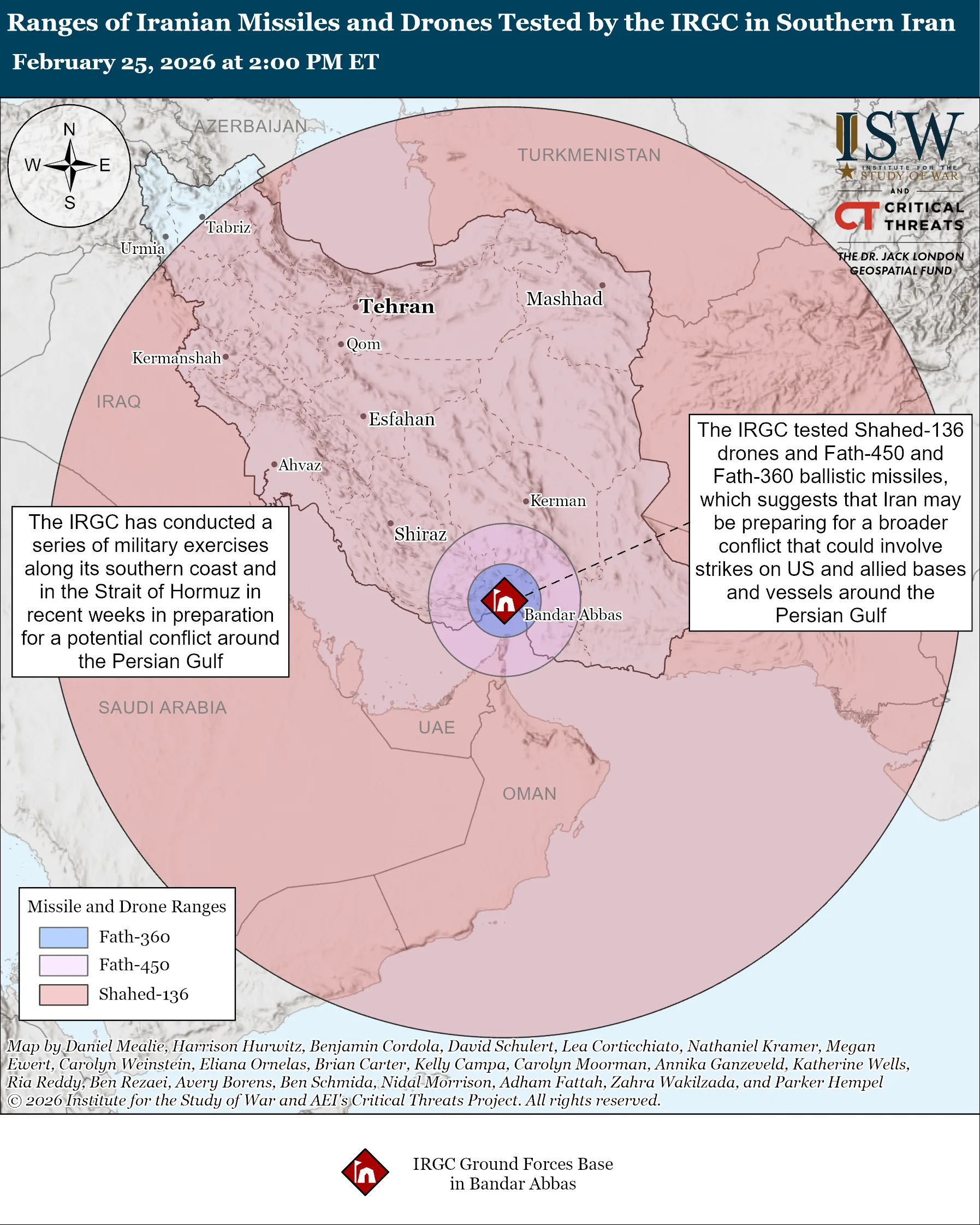
The Islamic Revolutionary Guards Corps (IRGC) has recently conducted a series of military exercises in the Strait of Hormuz and along Iran's southern coast in preparation for a potential conflict with the United States or Israel around the Persian Gulf.[22] The IRGC Ground Forces concluded a two-day exercise under the command of the Madinah ol Munawarah Operational Base in Bandar Abbas, Hormozgan Province, on February 25.[23] The Madinah ol Munawarah Operational Base is the IRGC Ground Forces’ closest regional headquarters to the Strait of Hormuz and oversees IRGC Ground Forces units in Fars, Bushehr, and Hormozgan provinces.[24] The exercise took place on unspecified Persian Gulf islands and along Iran's southern coast.[25] The IRGC Ground Forces reportedly used Rezvan loitering drones for reconnaissance and target acquisition and Shahed-136 drones to strike pre-designated targets during the exercise.[26] Rezvan loitering drones have a range of 20 kilometers, and Shahed-136 drones have a range of 1,500 kilometers.[27] Iranian media highlighted the IRGC Ground Forces’ use of Fath-450 ballistic missiles, which have a range of between 150 and 250 kilometers, and Fath-360 ballistic missiles, which have a range of between 30 and 120 kilometers.[28] Iranian media claimed that these systems have high strike accuracy, can resist electronic warfare, and can carry warheads capable of penetrating fortified positions.[29] Iranian media described the Fath-360 as capable of carrying a “bunker-busting” warhead.[30] This exercise comes after the IRGC Navy conducted an exercise in the Strait of Hormuz on February 16.[31] The recent exercises indicate that Iran is preparing for both a possible maritime conflict near the Strait of Hormuz as well as a possible broader conflict that could involve strikes on US and allied bases and vessels around the Persian Gulf. Four unspecified IRGC members and three senior Iranian officials told the New York Times on February 22 that Iran has positioned ballistic missile launchers along its southern shores within range of US bases and other targets in the region.[32]
Belgium-based outlet Army Recognition assessed that Iran's use of indigenous radars in its S-300 air defense systems would reduce the effectiveness of these systems.[33] Israel destroyed the engagement radar of an Iranian S-300 in April 2024 and rendered Iran's three remaining S-300 systems inoperable in October 2024.[34] An S-300 battery requires engagement radars, command-and-control centers, fire-control units, and launchers to operate as a functional surface-to-air missile system.[35] Army Recognition reported on February 23 that Iran has deployed at least one of its four S-300 systems near Tehran City and potentially deployed an indigenous Bavar-373 air defense system near Esfahan City, citing commercially available satellite imagery on February 16 and 19.[36] Iran previously displayed an S-300 with a “new, Iranian-designed” radar in February 2025.[37] Army Recognition noted that Iran's use of indigenous radars in its S-300 air defense systems would create “interoperability constraints and potential gaps in data link compatibility.”[38]
The Iranian regime is trying to limit disruptions to command-and-control and governance in the event of a potential US or Israeli decapitation campaign against senior Iranian leadership. The New York Times, citing six senior Iranian officials and three IRGC members, reported on February 22 that Supreme Leader Ali Khamenei has named four potential successors for each military and government post that he appoints.[39] Khamenei has also reportedly directed other officials to choose up to four successors and delegated authority to a trusted circle to make decisions if he cannot be reached or is killed. This report highlights Iranian officials’ immense paranoia about potential US or Israeli strikes targeting senior leadership. Israeli strikes targeting senior commanders during the June 2025 Israel-Iran War temporarily disrupted Iran's chain of command and delayed its initial retaliation.[40] Brigadier General Mohammad Reza Naghdi, who served as the IRGC Coordination Deputy during the war and currently serves as an adviser to IRGC Commander Mohammad Pakpour, stated in October 2025 that IRGC units requested authorization to strike Israel early on June 13, but that Khamenei delayed approval of the strikes until he had appointed new commanders to replace those whom Israel had killed earlier that day.[41]
Iranian university students held anti-regime protests for the fifth consecutive day on February 25.[42] CTP-ISW recorded 10 protests, including four large protests, at nine universities in three provinces on February 25. CTP-ISW defines large protests as protests with over 1,000 individuals.[43] CTP-ISW also recorded a protest at a school in Tehran City and a protest at a 40-day mourning period ceremony in Gorgan, Golestan Province.[44] Universities have summoned at least 180 students to disciplinary hearings and suspended numerous others for participating in the protests in Tehran City.[45] Plainclothes security personnel arrested three protesters at the University of Art in Tehran City on February 25.[46] Security forces deployed to Shiraz University in Fars Province on February 25. Iranian authorities have also confiscated the student identification cards of student protesters at Shiraz University.[47] Basij members and pro-regime students clashed with protesters at Shiraz University on February 23 and 24.[48] Two Iranian universities in Kurdistan and Zanjan provinces moved classes online, and another in Mazandaran Province is considering doing so in an effort to curb student protests.[49]
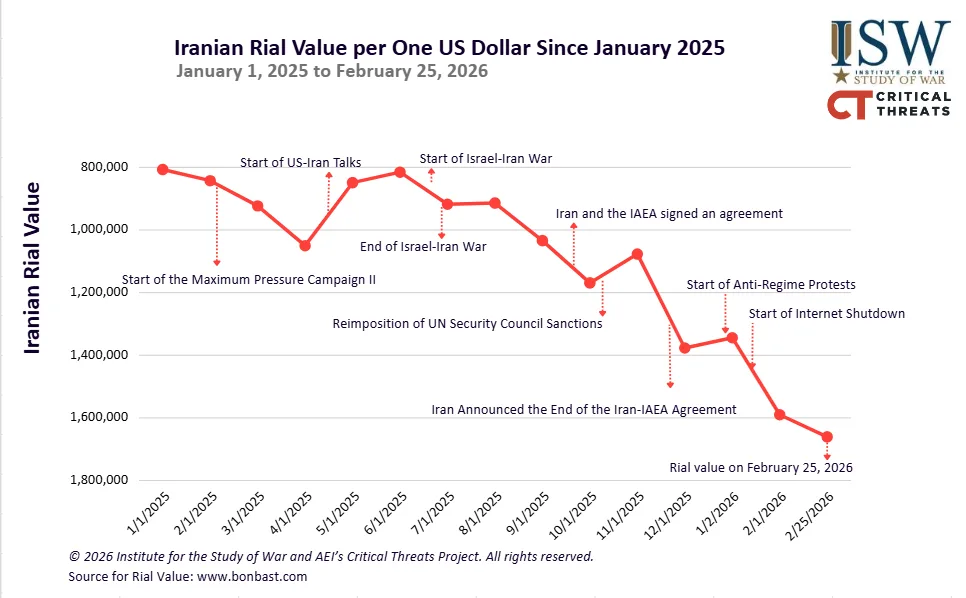
The economic conditions that triggered anti-regime protests in December 2025 continue to worsen. The Iranian currency has suffered a steep collapse since November 2025, which exacerbates economic instability. Iranian business owners have told Western media that they have experienced a substantial decline in sales following the regime's internet shutdown to suppress protests in early January 2026.[50] Both the Iranian public and parts of the regime itself have demonstrated a deep lack of trust in the regime's ability to reform or stabilize the economy. Iranian media reported on February 23 that investors are rapidly shifting their assets away from equities and into hard currency and gold, which indicates a widespread belief that the government cannot restore predictable market conditions.[51] US Treasury Secretary Scott Bessent and Israeli media previously reported that regime officials have transferred hundreds of millions of US dollars out of Iran in recent months, which likely reflects intra-regime concerns about economic stability.[52]
Senior Iranian officials met with Armenian Defense Minister Suren Papikyan in Tehran on February 24 and 25. Iranian Defense and Armed Forces Logistics Minister Brigadier General Aziz Nasir Zadeh and Armed Forces General Staff Chief Major General Abdol Rahim Mousavi held separate meetings with Papikyan and emphasized that the presence of extra-regional powers in the region will cause instability, likely referring to the United States and Israel.[70] Nasir Zadeh previously met with Papikyan in May 2025, which CTP-ISW assessed was likely part of a broader Iranian strategy to counter Israeli, Turkish, and Western influence in the South Caucasus.[71] President Masoud Pezeshkian and Supreme National Security Council Secretary Ali Larijani also held separate meetings with Papikyan on February 24 and 25 to discuss expanding bilateral cooperation.[72]
https://understandingwar.org/research/middle-east/iran-update-february-25-2026/