Posted on 12/29/2021 5:57:37 AM PST by Red Badger
A summary of decades of research on a rather 'out-there' idea involving viruses from space raises questions on just how scientific we can be when it comes to speculating on the history of life on Earth.
It's easy to throw around words like crackpot, rogue, and maverick in describing the scientific fringe, but then papers like this one, from 2018, come along and leave us blinking owlishly, unsure of where to even begin.
A total of 33 names were listed as authors on this review, which was published by Progress in Biophysics and Molecular Biology back in August 2018. The journal is peer reviewed and fairly well cited. So it's not exactly small, or a niche pay-for-publish source.
Science writer Stephen Fleischfresser goes into depth on the background of two of the better known scientists involved: Edward Steele and Chandra Wickramasinghe. It's well worth a read.
For a tl;dr version, Steele is an immunologist who has a fringe reputation for his views on evolution that relies on acquiring gene changes determined by the influence of the environment rather than random mutations, in what he calls meta-Lamarckism.
Wickramasinghe, on the other hand, has had a somewhat less controversial career, recognized for empirically confirming Sir Fred Hoyle's hypothesis describing the production of complex carbon molecules on interstellar dust.
Wickramasinghe and Hoyle also happened to be responsible for another space biology thesis. Only this one is based on more than just the origins of organic chemistry.
The Hoyle Wickramasinghe (H-W) thesis of Cometary (Cosmic) Biology makes the rather simple claim that the direction of evolution has been significantly affected by biochemistry that didn't start on our planet.
In Wickramasinghe's own words, "Comets are the carriers and distributors of life in the cosmos, and life on Earth arose and developed as a result of cometary inputs."
Those inputs, Wickramasinghe argued, aren't limited to a generous sprinkling of space-baked amino acids, either.
Rather, they include viruses that insert themselves into organisms, pushing their evolution into whole new directions.
The report, titled "Cause of Cambrian Explosion – Terrestrial or Cosmic?", pulls on existing research to conclude that a rain of extra-terrestrial retroviruses played a key role in the diversification of life in our oceans roughly half a billion years ago.
"Thus retroviruses and other viruses hypothesized to be liberated in cometary debris trails both can potentially add new DNA sequences to terrestrial genomes and drive further mutagenic change within somatic and germline genomes," the authors wrote.
Let that sink in for a moment. And take a deep breath before continuing, because that was the tame part.
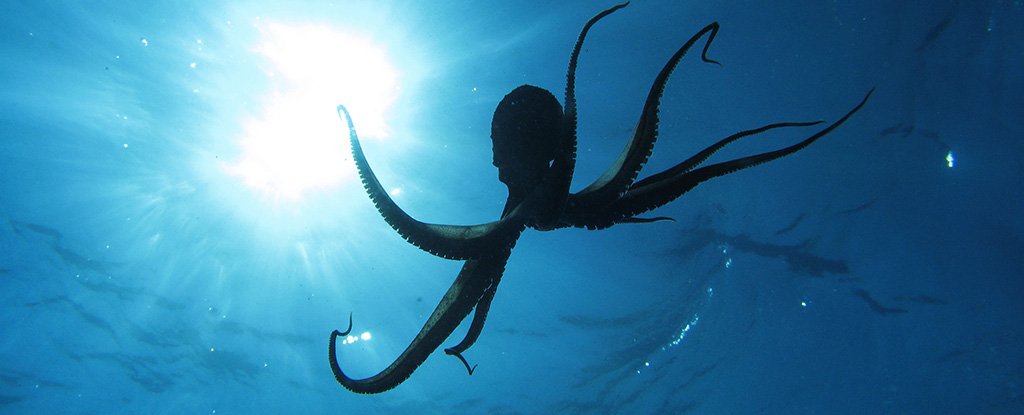
It was during this period that a group of mollusks known as cephalopods first stretched out their tentacles from beneath their shells, branching into a stunning array of sizes and shapes in what seemed like a remarkably short time frame.
The genetics of these organisms, which today include octopuses, squid, and cuttlefish, are as weird as the animals themselves, due in part to their ability to edit their DNA on the fly.
The authors of the paper make the rather audacious claim that these genetic oddities might be a sign of life from space.
Not of space viruses this time, but the arrival of whole genomes frozen in stasis before thawing out in our tepid waters.
"Thus the possibility that cryopreserved squid and/or octopus eggs, arrived in icy bolides several hundred million years ago should not be discounted," they wrote.
In his review of the paper, medical researcher Keith Baverstock from the University of Eastern Finland conceded that there's a lot of evidence that plausibly aligns with the H-W thesis, such as the curious timeline of the appearance of viruses.
But that's just not how science advances.
"I believe this paper justifies skepticism of the scientific value of stand alone theories of the origin of life," Baverstock argued at the time.
"The weight of plausible, but non-definitive, evidence, great though that might be, is not the point."
While the idea is as novel and exciting as it is provocative, nothing in the summary helps us better understand the history of life on Earth any better than existing conjectures, adding little of value to our model of evolution.
Still, with solid caveats in place, maybe science can cope with a generous dose of crazy every now and then.
Journal editor Denis Noble concedes that 'further research is needed', which is a bit of an understatement.
But given the developments regarding space-based organic chemistry in recent years, there's room for discussion.
"As space chemistry and biology grows in importance it is appropriate for a journal devoted to the interface between physics and biology to encourage the debates," said Noble.
"In the future, the ideas will surely become testable."
Just in case those tests confirm speculations, we recommend being well prepared for the return of our cephalopod overlords. Who knows when they'll want those eggs back?
This research was published in Progress in Biophysics and Molecular Biology.
A version of this article was first published in August 2018.
Got me. I have to go to Walmart: there’s a rumor of snow over the weekend.
Sally and Vlad are working on selling some of my books as a fundraiser to support their miserable lives, and they just got their first sale: $15 (after shipping) on a signed first edition of Hampton Sides’s “On Desperate Ground,” about the Chosen Reservoir battle. I got for $1 at the church sale.
They have 3 others listed on eBay right now, all with higher expected prices.
Congrats to the budding entrepreneurs.
We lost interwebs at about 1. They’re still working on the problem.
Unnngh. Vlad has been buying and selling Magic: The Gathering cards for a couple of years.
I’ve got stuff I don’t need, that people will buy, but I’m not willing to make any effort to sell it. If Sally and Vlad will do the work, they can have the money. Sally is required to pay off debt with her share.
G’orning, y’all.
Howya. We have a cold in the head here. Achoo!
Good morning. Howarya? We got up to 9 fs yesterday. Today is supposed to be warmer.
Good morning. Happy Humph Day!
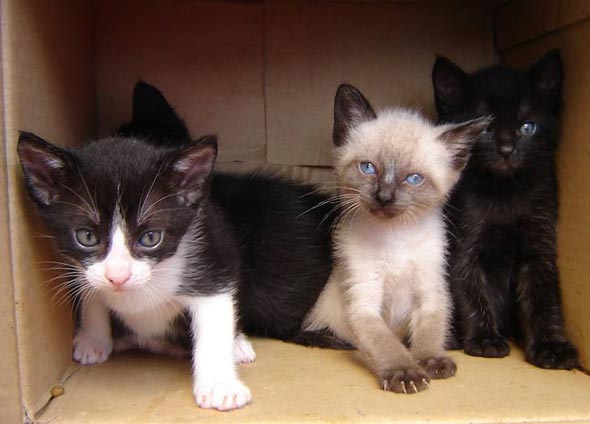
Anyone up for a box of kittens?
We have interwebs again. We’ll see for how long.
Congrats on your Interwebs. The kittens are in Brazil, where it is warmer.
Yes. Summer in Brazil.
I’ve always wondered why, with so much of the world’s population in summer in December, why snow defines Christmas.
Christmas traditions of the United States originated in Northern Europe, especially England and Germany. Christmas traditions of the United States have become international, even in countries with relatively few Christians.
The Undead Thread has been a little - dare I say it - dead lately.
Sometimes even the Undead have other things in life.
Oh, so sorry to hear. Prayers up for speedy recovery!
Yikes! The lowest it’s been here for the last few nights is 26fs or thereabouts. Just enough to keep a faucet dripping so that the pipes don’t burst. How does Puppy take to the lower temps?
Good thing those kittens are in Brazil—very unlikely that we’ll adopt one or several or.... Aiyeeeeeeee!!!
Do y’all happen to know what’s at the bottom of the interwebs outages? Service here has been up when down elsewhere, and versa vesa.
Thank you. I’m feeling much better now than I was this morning.
Thank goodness!
Disclaimer: Opinions posted on Free Republic are those of the individual posters and do not necessarily represent the opinion of Free Republic or its management. All materials posted herein are protected by copyright law and the exemption for fair use of copyrighted works.