Posted on 12/29/2021 5:57:37 AM PST by Red Badger
A summary of decades of research on a rather 'out-there' idea involving viruses from space raises questions on just how scientific we can be when it comes to speculating on the history of life on Earth.
It's easy to throw around words like crackpot, rogue, and maverick in describing the scientific fringe, but then papers like this one, from 2018, come along and leave us blinking owlishly, unsure of where to even begin.
A total of 33 names were listed as authors on this review, which was published by Progress in Biophysics and Molecular Biology back in August 2018. The journal is peer reviewed and fairly well cited. So it's not exactly small, or a niche pay-for-publish source.
Science writer Stephen Fleischfresser goes into depth on the background of two of the better known scientists involved: Edward Steele and Chandra Wickramasinghe. It's well worth a read.
For a tl;dr version, Steele is an immunologist who has a fringe reputation for his views on evolution that relies on acquiring gene changes determined by the influence of the environment rather than random mutations, in what he calls meta-Lamarckism.
Wickramasinghe, on the other hand, has had a somewhat less controversial career, recognized for empirically confirming Sir Fred Hoyle's hypothesis describing the production of complex carbon molecules on interstellar dust.
Wickramasinghe and Hoyle also happened to be responsible for another space biology thesis. Only this one is based on more than just the origins of organic chemistry.
The Hoyle Wickramasinghe (H-W) thesis of Cometary (Cosmic) Biology makes the rather simple claim that the direction of evolution has been significantly affected by biochemistry that didn't start on our planet.
In Wickramasinghe's own words, "Comets are the carriers and distributors of life in the cosmos, and life on Earth arose and developed as a result of cometary inputs."
Those inputs, Wickramasinghe argued, aren't limited to a generous sprinkling of space-baked amino acids, either.
Rather, they include viruses that insert themselves into organisms, pushing their evolution into whole new directions.
The report, titled "Cause of Cambrian Explosion – Terrestrial or Cosmic?", pulls on existing research to conclude that a rain of extra-terrestrial retroviruses played a key role in the diversification of life in our oceans roughly half a billion years ago.
"Thus retroviruses and other viruses hypothesized to be liberated in cometary debris trails both can potentially add new DNA sequences to terrestrial genomes and drive further mutagenic change within somatic and germline genomes," the authors wrote.
Let that sink in for a moment. And take a deep breath before continuing, because that was the tame part.
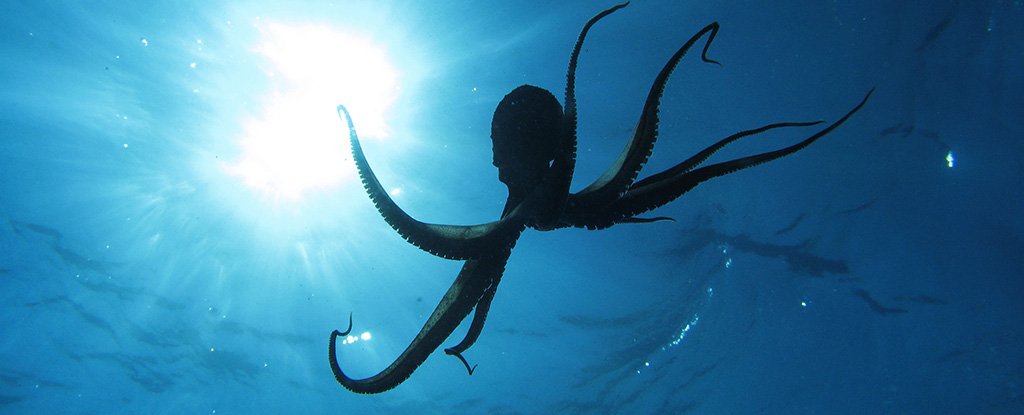
It was during this period that a group of mollusks known as cephalopods first stretched out their tentacles from beneath their shells, branching into a stunning array of sizes and shapes in what seemed like a remarkably short time frame.
The genetics of these organisms, which today include octopuses, squid, and cuttlefish, are as weird as the animals themselves, due in part to their ability to edit their DNA on the fly.
The authors of the paper make the rather audacious claim that these genetic oddities might be a sign of life from space.
Not of space viruses this time, but the arrival of whole genomes frozen in stasis before thawing out in our tepid waters.
"Thus the possibility that cryopreserved squid and/or octopus eggs, arrived in icy bolides several hundred million years ago should not be discounted," they wrote.
In his review of the paper, medical researcher Keith Baverstock from the University of Eastern Finland conceded that there's a lot of evidence that plausibly aligns with the H-W thesis, such as the curious timeline of the appearance of viruses.
But that's just not how science advances.
"I believe this paper justifies skepticism of the scientific value of stand alone theories of the origin of life," Baverstock argued at the time.
"The weight of plausible, but non-definitive, evidence, great though that might be, is not the point."
While the idea is as novel and exciting as it is provocative, nothing in the summary helps us better understand the history of life on Earth any better than existing conjectures, adding little of value to our model of evolution.
Still, with solid caveats in place, maybe science can cope with a generous dose of crazy every now and then.
Journal editor Denis Noble concedes that 'further research is needed', which is a bit of an understatement.
But given the developments regarding space-based organic chemistry in recent years, there's room for discussion.
"As space chemistry and biology grows in importance it is appropriate for a journal devoted to the interface between physics and biology to encourage the debates," said Noble.
"In the future, the ideas will surely become testable."
Just in case those tests confirm speculations, we recommend being well prepared for the return of our cephalopod overlords. Who knows when they'll want those eggs back?
This research was published in Progress in Biophysics and Molecular Biology.
A version of this article was first published in August 2018.
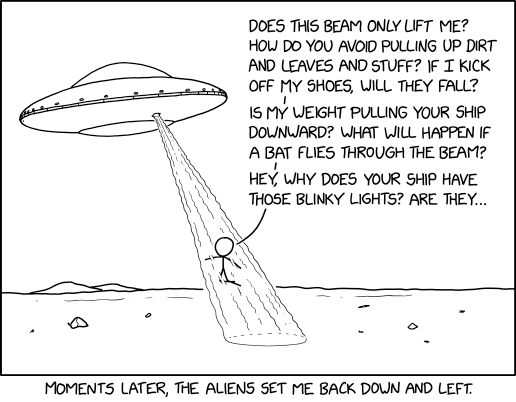

Yeah, no one likes a curiosity machine. But I wanna know the same things!
Good way to start the day, Nully! Thanks! ;o]
Lookit the sweet little face! It’ll be a beauty when it’s all growed up!
Good morning. I hope you slept well, what with all the driving adventures, the swimming and the riding lessons.
I had a miserable night but here I am, ready to face part of the day. I think.
It’s going to be almost 70° today, then drop to a high of 40° tomorrow. I was hoping Abbie’s birthday celebration would be a nice day, so we could spend time outside on their deck. They have a nice view and a hugh back yard!
But it is what it is, and I’ll go and have fun, just because she is so sweet.
PS: I re-sent it!
Good morning. Happy Friday!
Dasn’t be sad, kitteh. Iz Friday!
I got about an inch of ice-encrusted snow off half my f-i-l’s driveway yesterday. The other half will be late today or tomorrow.
I’m feeling old.
Wordle 237 5/6
⬜⬜⬜⬜🟨
⬜⬜⬜🟨⬜
🟩🟨⬜🟩⬜
🟩⬜⬜🟩🟩
🟩🟩🟩🟩🟩
Today is Make A Friend Day!
“They” didn’t say what to make the friend of, like something edible or something durable.
Maybe I should just go take my shower and shut up. ;o]
Good Friday morning!
Boy, do I know how that is. “The spirit is willing but the flesh is weak,” becomes more true as time passes.
There are still a few patches of ice on the northern sides of buildings, but the sidewalks and roads are clear. Who knew snow in the South could be so stubborn?
Good Wordle! I’ll do mine when I get out of the shower.
With friends like that, who needs enemas?
Yes, I had a pretty good night and I’m sorry you didn’t. We’re supposed to have high 60s this afternoon. There was going to be a science team outing to the Museum of York County SC, but that has been postponed, so there will probably be a Non-Optional Family Outdoor Excursion instead.
Make an animal friend today!
Today’s special animal friend is the Giant Antpitta, Grallaria gigantea. It’s a bird. I’d never heard of it, either. There are around 50 species of Antpittas in the Grallariidae family. Native to Central and South America, they are related to antbirds and gnatcatchers. The Giant Antpitta is found in Ecuador and Colombia.
The giant antpitta is about 11 inches high and can weigh over 10 ounces. It has sturdy legs, a very short tail, and stubby wings for its height, with a heavy, dark bill. Its head, back, and upper wings are a subdued, grayish green or brown, blending in with the cloud forest floor. Its throat and breast are bright chestnut or gold with distinguished black barring. These videos are from a forest preserve in Ecuador.
https://www.youtube.com/watch?v=EAh_MXcF35o
https://www.youtube.com/watch?v=09dRrCG2xwE
The giant antpitta feeds on earthworms, slugs, and beetle larvae on the forest floor. They have not been observed eating many ants or other adult insects. Because they are difficult to observe, not much is known about their reproduction. Other antpitta species build nests in trees, and both parents help to incubate the eggs and feed the nestlings.
The giant antpitta is considered Vulnerable by IUCN. The main threat is habitat loss and fragmentation. Commercial lumbering takes place in its range, as does forest clearance for agriculture, including coca farming. Puracé National Natural Park in Colombia is home to the largest population of giant antpittas. This population is well protected from logging, but it is located near a very active volcano, so maybe Boom one day.
Here is a video from the “Paz de los Aves,” “Peace for the Birds” refuge in Ecuador, where a locally famous conservationist, Angel Paz (Angel Peace) is close friends with the antpittas:
https://www.youtube.com/watch?v=PlnCzEYaMwc
Thanks, but I’ll survive. I don’t know what the deal was, but every so often sleep just will not come. I finally just gave up and came out here to listen to a couple of uplifting talks while I put some jigsaw puzzles together. Finally, around midnight, it had run its course and I was able to sleep. According to the beeber-like debice, it was light sleep for the duration. I’ll take it.
I love those Non-Optional (sounds better than “mandatory”) Family outdoor Excursions! What better way to get the youngsters off their duffs and away from their phones!
Now, I need to finish getting dressed and then get my letter written to Charlie. (The hot water felt so good this morning!)
Looks like a cross between a robin and a stork baby. How interesting! The guide was kinda cute, too. ;o]
Yes, a funny little bird.
LOL!
It sounds like almost every day is a busy one... that is a good thing!
Good Friday Morning!
Funny that, many things seem more difficult as time passes...
A real struggle and a lucky guess at the end:
Wordle 237 5/6
🟨⬛🟨⬛⬛
🟨⬛⬛🟩⬛
⬛⬛⬛🟩🟩
🟨⬛⬛🟩🟩
🟩🟩🟩🟩🟩
I didn’t get today’s word. Period. Probably because I didn’t sleep well last night so my brain has gone Walkabout. It shouldn’t have been that hard for me to get, but it was. Some days, it goes like that. And I’ll try again tomorrow. :o|
Sometimes I pause after a couple of rows, and come back to it later. I probably should have today, but I was pigheaded and plowed ahead...
I’ve done that. Today, I was dealing with gray lint for a brain. It happens. Tomorrow will be better!
Disclaimer: Opinions posted on Free Republic are those of the individual posters and do not necessarily represent the opinion of Free Republic or its management. All materials posted herein are protected by copyright law and the exemption for fair use of copyrighted works.