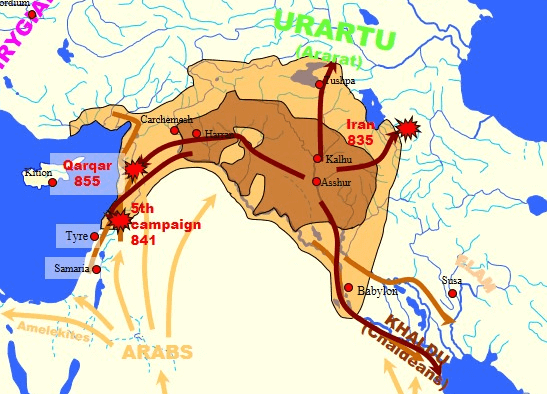
The Assyrians called the northern kingdom as the "House of Mori" (Bit-Humri)
For this battle Ahab provided 10,000 infantry and 2,000 chariots - the largest contingent of chariots in the campaign
Posted on 05/29/2026 11:25:00 AM PDT by Cronos
The Battle of Qarqar, fought in 853 BCE, stands as a landmark event in the annals of military history, notable for featuring the earliest documented military alliance among a coalition of twelve kingdoms. This confederation was assembled to counter the expansive ambitions of the Assyrian Empire under King Shalmaneser III. The battle, although not decisively conclusive in its military outcomes, offers profound insights into the geopolitical dynamics of the ancient Near East and the complexities of coalition warfare.
Background and Strategic Context During the early 9th century BCE, the Assyrian Empire, led by Shalmaneser III, was in a phase of aggressive territorial expansion. Assyria's military campaigns were directed towards consolidating control over trade routes and subjugating regions rich in resources. This expansionist policy inevitably brought Assyria into conflict with the states of the Levant, which were determined to resist Assyrian domination.
The strategic significance of Qarqar, located on the Orontes River in modern-day Syria, derives from its position as a crucial junction controlling access to the Mediterranean coast. The battle that unfolded there was precipitated by Assyria’s move to secure control over this pivotal region, prompting the formation of an unprecedented alliance among the kingdoms of the Levant.
The Grand Alliance The coalition, famously chronicled in the Kurkh Monolith—a stela inscribed with the annals of Shalmaneser III—comprised an array of twelve kings. This alliance included Hadadezer of Damascus, Ahab of Israel, Irhuleni of Hamath, and other rulers from the Aramean and Syrian states, as well as contingents from Egypt and possibly the remnants of the Hittite empire. The text claims that the combined forces amounted to a formidable count of more than 50,000 infantry and 4,000 chariots, a figure likely exaggerated by Assyrian scribes to glorify their military prowess.
This alliance is considered the first of its kind due to its scale and the diversity of the participating polities. It exemplifies a sophisticated level of diplomatic negotiation and military coordination among ancient states, each with its own interests and motivations for joining the coalition against a common adversary.
The Battle and Its Aftermath The battle itself was a massive engagement, with both sides deploying large forces in a confrontation that lasted the entire day. Assyrian records claim a victory, boasting of immense slaughter and a tactical retreat by the enemy. However, the lack of decisive Assyrian follow-up actions and their temporary halt of further advances into Levantine territories suggest a more ambiguous outcome. It appears that the coalition managed to check Assyria’s advance, preserving their autonomy for a time, despite not achieving a clear-cut battlefield victory.
The immediate aftermath of the Battle of Qarqar saw a temporary stabilization of borders but no lasting peace. Subsequent campaigns by Shalmaneser III over the following years indicate that the Assyrian threat persisted, leading to further conflicts in the region. Nevertheless, the alliance at Qarqar set a significant precedent for collective defense against imperial conquest, highlighting the potential of coordinated multi-state resistance.
Historical Significance and Legacy The Battle of Qarqar is a seminal example of ancient diplomacy and warfare. It illustrates the complexities of alliance warfare, where diverse political entities with varying capabilities and goals come together to confront a superior power. The battle underscores the importance of strategic geography and highlights the perennial struggle for control over vital trade routes and economic resources in the ancient world.
Moreover, the Qarqar alliance provides early evidence of the lengths to which communities will go to preserve their independence and identity in the face of overwhelming odds. This event not only offers a glimpse into the military tactics of the time but also into the diplomatic negotiations and alliances that have come to define much of human history.
In conclusion, the Battle of Qarqar and the alliance formed to contest Assyrian dominance mark a significant chapter in military history, embodying the earliest known instance of a large-scale coalition formed in response to the threats posed by imperial ambitions. This episode serves as a testament to the resilience and resourcefulness of the ancient states of the Near East, whose legacy of cooperation and conflict continues to inform our understanding of international relations and military strategy today.
The Assyrians called the northern kingdom as the "House of Mori" (Bit-Humri)
For this battle Ahab provided 10,000 infantry and 2,000 chariots - the largest contingent of chariots in the campaign
She had rings on her fingers and bells on her toes....
Too long. I will wait for the movie with black people.
“Assyria’s military campaigns were directed towards consolidating control over trade routes and subjugating regions rich in resources.”
Human nature and desires never change.
A legend showing the meaning of the light brown and darker brown areas would have been appreciated.
853 BC is also the year Ahab dies, in what is evidently a subsequent battle against the Syrians at Ramoth Gilead, within northern Israel territory bordering Syria.
The music group Tears for Fears had a song called Everyone One Wants to Rule the World.
Don’t forget a lesbian they/them Shalmaneser III
I apologize, I didn’t post the nap legend
the darker brown areas signify core Assyrians territories before Shalmaneser III and the light brown indicate territories added by him.
Sorry about not adding that
And the Assyrians invented the cross as means of execution, or so it’s been said.
The Kurkh Monolith and Black Obelisk | References to Ancient Israel in Assyrian Texts | Nathan Steinmeyer | November 25, 2022The Kurkh Monolith of Shalmaneser III. Courtesy Osama Shukir Muhammed Amin FRCP(Glasg), CC BY-SA 4.0, via Wikimedia Commons.
Like the Kurkh Monolith, the Black Obelisk is a victory record of Shalmaneser III. However, what makes this obelisk stand out is its possible artistic depiction of Jehu, the king of Israel (r. 841–814 BCE).The Black Obelisk of Shalmaneser III. Courtesy Osama Shukir Muhammed Amin FRCP(Glasg), CC BY-SA 4.0, via Wikimedia Commons.
119. The military chief who opposed Shalmanassar at Karkar was the governor of Megiddo Biridri (Biridia), one of the Pharaohs correspondents. The identification of Ben Hadad with Biridri is wrong.
99. The name of the city Ugarit (Ras Shamra) is probably the equivalent of Euagoras, the Carian-Ionian name of a number of Cyprian kings.
100. The name Nikmed of the Ras Shamra texts is the Ionian-Carian name Nikomed(es).
101. The city of Ras Shamra was destroyed in the days of the King Nikmed by Shalmanassar (in 856 BCE). Its destruction is recorded by Shalmanassar and the city is called "the city of Nikdem". A proclamation telling about the expulsion of Nikmed, found in the city, refers to the same event.Theses for the Reconstruction of Ancient History | Immanuel Velikovsky | 1945
From a biblical standpoint, on the other hand, Ahab was considered one of the most evil kings of the northern kingdom, called Israel, Samaria, or Ephraim. Through his evil wife Jezebel he promoted idolatrous worship of Canaanite gods and persecuted the prophets, most notably Elijah.
This should teach us that, though there may be leaders that seem to leading a nation to strength and prosperity, they do not always have God's favor and may even oppose him.
Thanks for the info,. I appreciate your old world postings.
Interesting stuff!
Didn’t Ahab also get called out by God warning him NOT to form alliances? A couple hundred years later was the exile to Babylon.
In general, Israel was warned not to form alliances with foreign nations because they were supposed to depend upon God alone. But you might be thinking of another king, Ahaz, king of Judah, who was warned to not form an alliance with Israel and Syria against Assyria in 2 Kings 16:1-20, 2 Chronicles 28:1-7, and Isaiah 7:1-9.
Disclaimer: Opinions posted on Free Republic are those of the individual posters and do not necessarily represent the opinion of Free Republic or its management. All materials posted herein are protected by copyright law and the exemption for fair use of copyrighted works.



