Skip to comments.
Catholic Caucus: Daily Mass Readings, 07-29-05, Memorial, St. Martha
USCCB.org/New American Bible ^
| 07-29-05
| New American Bible
Posted on 07/29/2005 7:40:10 AM PDT by Salvation
July 29, 2005
Memorial of Saint Martha
Psalm: Friday 33
Reading ILv 23:1, 4-11, 15-16, 27, 34b-37
The LORD said to Moses,
"These are the festivals of the LORD which you shall celebrate
at their proper time with a sacred assembly.
The Passover of the LORD falls on the fourteenth day of the first month,
at the evening twilight.
The fifteenth day of this month is the LORD's feast of Unleavened Bread.
For seven days you shall eat unleavened bread.
On the first of these days you shall hold a sacred assembly
and do no sort of work.
On each of the seven days you shall offer an oblation to the LORD
Then on the seventh day you shall again hold a sacred assembly
and do no sort of work."
The LORD said to Moses, "Speak to the children of Israel and tell them:
When you come into the land which I am giving you,
and reap your harvest,
you shall bring a sheaf of the first fruits of your harvest
to the priest, who shall wave the sheaf before the LORD
that it may be acceptable for you.
On the day after the sabbath the priest shall do this.
"Beginning with the day after the sabbath,
the day on which you bring the wave-offering sheaf,
you shall count seven full weeks,
and then on the day after the seventh week, the fiftieth day,
you shall present the new cereal offering to the LORD.
"The tenth of this seventh month is the Day of Atonement,
when you shall hold a sacred assembly and mortify yourselves
and offer an oblation to the LORD.
"The fifteenth day of this seventh month is the LORD's feast of Booths,
which shall continue for seven days.
On the first day there shall be a sacred assembly,
and you shall do no sort of work.
For seven days you shall offer an oblation to the LORD,
and on the eighth day you shall again hold a sacred assembly
and offer an oblation to the LORD.
On that solemn closing you shall do no sort of work.
"These, therefore, are the festivals of the LORD
on which you shall proclaim a sacred assembly,
and offer as an oblation to the LORD burnt offerings and cereal offerings,
sacrifices and libations, as prescribed for each day."
Responsorial PsalmPs 81:3-4, 5-6, 10-11ab
R. (2a)
Sing with joy to God our help.Take up a melody, and sound the timbrel,
the pleasant harp and the lyre.
Blow the trumpet at the new moon,
at the full moon, on our solemn feast.
R.
Sing with joy to God our help.For it is a statute in Israel,
an ordinance of the God of Jacob,
Who made it a decree for Joseph
when he came forth from the land of Egypt.
R.
Sing with joy to God our help.There shall be no strange god among you
nor shall you worship any alien god.
I, the LORD, am your God
who led you forth from the land of Egypt.
R.
Sing with joy to God our help.
GospelJn 11:19-27
Many of the Jews had come to Martha and Mary
to comfort them about their brother [Lazarus, who had died].
When Martha heard that Jesus was coming,
she went to meet him;
but Mary sat at home.
Martha said to Jesus,
"Lord, if you had been here,
my brother would not have died.
But even now I know that whatever you ask of God,
God will give you."
Jesus said to her,
"Your brother will rise."
Martha said to him,
"I know he will rise,
in the resurrection on the last day."
Jesus told her,
."I am the resurrection and the life;
whoever believes in me, even if he dies, will live,
and anyone who lives and believes in me will never die.
Do you believe this?"
She said to him, "Yes, Lord.
I have come to believe that you are the Christ, the Son of God,
the one who is coming into the world."
or
Lk 10:38-42
Jesus entered a village
where a woman whose name was Martha welcomed him.
She had a sister named Mary
who sat beside the Lord at his feet listening to him speak.
Martha, burdened with much serving, came to him and said,
"Lord, do you not care
that my sister has left me by myself to do the serving?
Tell her to help me."
The Lord said to her in reply,
"Martha, Martha, you are anxious and worried about many things.
There is need of only one thing.
Mary has chosen the better part
and it will not be taken from her."
TOPICS: Activism; Apologetics; Catholic; Charismatic Christian; Current Events; Eastern Religions; Ecumenism; Evangelical Christian; General Discusssion; History; Islam; Judaism; Mainline Protestant; Ministry/Outreach; Moral Issues; Orthodox Christian; Other Christian; Other non-Christian; Prayer; Religion & Culture; Religion & Politics; Religion & Science; Skeptics/Seekers; Theology; Worship
KEYWORDS: catholiccaucus; catholiclist; dailymassreadings; ordinarytime; stmartha
Navigation: use the links below to view more comments.
first 1-20, 21-36 next last
For your reading, reflection, faith-sharing, comments, questions, discussion.
1
posted on
07/29/2005 7:40:11 AM PDT
by
Salvation
To: nickcarraway; sandyeggo; Siobhan; Lady In Blue; NYer; american colleen; Pyro7480; sinkspur; ...
Alleluia Ping!
Please notify me via FReepmail if you would like to be added to or taken off the Alleluia Ping List.
2
posted on
07/29/2005 7:41:41 AM PDT
by
Salvation
(†With God all things are possible.†)
To: All
3
posted on
07/29/2005 7:42:39 AM PDT
by
Salvation
(†With God all things are possible.†)
To: All
From: Leviticus 23:1, 4-11, 15-16, 27, 34b-37
Celebration of the Sabbath
[1] The Lord said to Moses, [4] "These are the appointed feasts of the Lord,
the holy convocations, which you shall proclaim at the time appointed for
them."
Celebration of the Passover and the Feast of the Unleavened Bread
[5] "In the first month, on the fourteenth day of the month in the evening,
is the Lord's passover. [6] And on the fifteenth day of the same month is
the feast of unleavened bread to the Lord; seven days you shall eat
unleavened bread. [7] 0n the first day you shall have a holy convocation;
you shall do no laborious work. [8] But you shall present an offering by
fire to the Lord seven days; on the seventh day is a holy convocation; you
shall do no laborious work."
Celebration of the First Fruits
[9] And the Lord said to Moses, [10] "Say to the people of Israel, When you
come into the land which I give you and reap its harvest, you shall bring
the sheaf of the first fruits of your harvest to the priest; [11] and he
shall wave the sheaf before the Lord, that you may find acceptance; on the
morrow after the sabbath the priest shall wave it."
Celebration of the Feast of Weeks
[15] "And you shall count from the morrow after the sabbath, from the day
that you brought the sheaf of the wave offering; seven full weeks shall they
be, [16] counting fifty days to the morrow after the seventh sabbath; then
you shall present a cereal offering of new grain to the Lord."
Celebration of the Day of Atonement
[27] "On the tenth day of this seventh month is the day of atonement; it
shall be for you a time of holy convocation, and you shall afflict
yourselves and present an offering by fire to the Lord."
Celebration of the Feast of Tabernacles
[34b] "On the fifteenth day of this seventh month and for seven days is the
feast of booths to the Lord. [35] On the first day shall be a holy
convocation; you shall do no laborious work. [36] Seven days you shall
present offerings by fire to the Lord; on the eighth day you shall hold a
holy convocation and present an offering by fire to the LORD; it is a solemn
assembly; you shall do no laborious work."
[37] "These are the appointed feasts of the Lord, which you shall proclaim
as times of holy convocation, for presenting to the Lord offerings by fire,
burnt offerings and cereal offerings, sacrifices and drink offerings, each
on its proper day."
Commentary:
23:1-4. Some of the feats mentioned in this calendar are also to be found in
other books (cf. Ex 23:14-19; 34:18-26; Deut 16:1). It deals first with the
sabbath, which becomes the paradigm for all the other feasts, especially as
far as rest is concerned. Such importance was given to what could or could
not be done on the sabbath that all sorts of absurd and formalistic
exaggerations developed. More than once Jesus criticized the severe
interpretations devised by the scribes--a complicated and intolerable
casuistry (cf. Mt 15:1-9; 23:41 Acts 15:10).
23:5-8. The Passover is also dealt with in Exodus 12:1-14:21-28 and 13:3-10.
The first month was called Nisan; earlier on it was called Abib, "spring" or
"ears (of grain)". The feast began at sundown. Here it is depicted as a
preparation for the feast of the unleavened bread, which began the following
day, 15 Nisan, and lasted seven days, during which bread was eaten
unleavened. The religious assembly took place on the first day and the last.
During these assemblies various sacrifices were offered and a sacred meal
took place. We recall that it was during this feast that Jesus instituted
the Eucharist, doing so in the context of the passover supper. And it was
during the Passover that Jesus was sacrificed on the altar of the cross. St
John tells us that the sacrifice of Christ began at the sixth hour on the
day of Preparation, the exact time that the passover lambs were sacrificed.
This makes the beginning of a new Passover, in which a new victim is
sacrificed, the Lamb of God who takes away the sin of the world (cf. Jn
1:29, 36; 19:14).
23:9-14. The feast of the first fruits, although the date is not a fixed
one, is connected with the Passover. In the Jordan valley grain was already
ripe for harvest by this time (cf. Num 28:26-31). The offering of first
fruits is based on the conviction that everything comes from God. In
recognition of that divine sovereignty the first sheaf to ripen was offered
in sacrifice--a tradition which developed to the point that no one could eat
the crop without first making this offering to God. The "morrow" after the
sabbath was thought by some to have been the first sabbath after 14 Nisan.
Other scholars think that the sabbath was 15 Nisan and then the offering of
the first fruits took place on 16 Nisan. The "morrow" was the base day for
reckoning the start of feast of Pentecost, seven weeks later. The offering
of the first sheaves was accompanied by the sacrifice of a year-old lamb and
two tenths of an ephah of flour (cf. the note on Ex 29:38-46) that is,
approximately 4.2 liters, and a quarter of a hin of wine (approximately one
litre or two pints).
23:15-22. This feast, too, has elements connected with the grain harvest.
Later on it became linked with the giving the Law at Sinai. It was called
Pentecost because it came fifty days after Passover. In Hebrew it was called
Aseret, the "great convocation" or assembly. Another name for it is the
feast of Weeks (a reference to the seven weeks which had passed since the
Passover). The offering of the loaves of bread made from the first sheaf
expressed thanksgiving and joy for the harvest recently completed. The
various sacrifices were offered as a sign of repentance for and as an act of
adoration for the greatness of God who had blessed the work of his people.
From a Christian point of view, it is interesting that it was on the feast
of Pentecost that the Holy Spirit came down on the apostles. For one thing,
that Pentecost marked the start of a new stage with another Law, a much more
perfect one, written not on stones but in the depths of men's hearts (cf. 2
Cor 3:3). For another, because it also seems significant that it was at the
moment when the fruits of the earth were being harvested that the Church
should receive the most precious fruit of Christ's death on the cross, the
strength of the Spirit who purifies and sanctities men with his divine grace.
23:23-44. In the Bible the number seven had a sacred character; symbolizing
in some way the perfection of God. Therefore the seventh month, as also the
seventh year, had special significance in Israel. Thus, in the seventh month
(in Hebrew, Tishre) three feasts were held. The first was the feast of
Trumpets, which took place on the seventh day. It began with the sounding of
trumpets; hence its name. Trumpets were also used to greet the appearance of
the new moon. These details probably reflect traces of astral cults;
however, by becoming incorporated into the liturgy, they became purified and
raised to a new plane, to express at different times and different ways a
deep feeling of attachment to the Creator of heaven and earth.
On the tenth of the same month the day of atonement was celebrated--Yom
Kippur. It was a day of penance and expiation. It began at sundown, with the
start of the sabbath rest. The grave penalties imposed for transgressions
show the importance this day had, and still has today, in Jewish liturgy.
The other great feast is that of Tabernacles, celebrated over seven days,
beginning on 15 Tisre. In the Code of the Covenant it is called the feast of
ingathering (cf. Ex 23:16). The last of the harvest was saved around this
time, particularly the grape harvest. The feast marked the close of the
agricultural year; it was a most joyful least. It was also regarded as
preparation for the new period which would start immediately with the new
sowing. Prayers were offered for early rains, which were so crucial to
starting the work. This was why the rite of water was so much to the fore.
Water was borne in procession from the pool of Siloe and then poured round
the altar of the temple. In Jesus' time a bunch of myrtle and acacia
branches (from trees growing on the river bank) was shaken during the
procession, thereby invoking the divine blessing of rain. In the times of
Ezra and Nehemiah. in the middle of the 5th century BC, huts made from
branches of trees were set up on the terfaces of houses or in the
countryside, and the people camped in them over the days of the feast, in
memory of the pilgrimage of the people of Israel in the desert, when they
lived in tents. This custom still survives in the Jewish religion.
The Gospel of St John has much to say about this feast and about Jesus'
activity in connection with it (cf. Jn 7:2ff), including the, important
revelations our Lord made apropos of its rites: it was on this feast that
Jesus proclaimed that from his heart rivers of living water would flow, a
reference to "the Spirit, which those who believed in him were to receive"
(Jn 7:39).
Source: "The Navarre Bible: Text and Commentaries". Biblical text
taken from the Revised Standard Version and New Vulgate. Commentaries
made by members of the Faculty of Theology of the University of
Navarre, Spain. Published by Four Courts Press, Kill Lane, Blackrock,
Co. Dublin, Ireland.
4
posted on
07/29/2005 7:44:57 AM PDT
by
Salvation
(†With God all things are possible.†)
To: All
From: John 11:19-27
The Raising of Lazarus (Continuation)
[19] And many of the Jews had come to Martha and Mary to console them
concerning their brother. [20] When Martha heard that Jesus was
coming, she went and met Him, while Mary sat in the house. [21] Martha
said to Jesus, "Lord, if You had been here, my brother would not have
died. [22] And even now I know that whatever You ask from God, God
will give You." [23] Jesus said to her, "Your brother will rise
again." [24] Martha said to Him, "I know that he will rise again in
the resurrection at the last day." [25] Jesus said to her, "I am the
resurrection and the life, he who believes in Me, though he die, yet
shall he live, [26] and whoever lives and believes in Me shall never
die. Do you believe this?" [27] She said to Him, "Yes, Lord; I
believe that You are the Christ, the Son of God, He who is coming into
the world."
Commentary:
1-45. This chapter deals with one of Jesus' most outstanding miracles.
The Fourth Gospel, by including it, demonstrates Jesus' power over
death, which the Synoptic Gospels showed by reporting the raising of
the daughter of Jairus (Matthew 9:25 and paragraph) and of the son of
the widow of Nain (Luke 7:12).
The Evangelist first sets the scene (verses 1-16); then he gives Jesus'
conversation with Lazarus' sisters (verses 17-37); finally, he reports
the raising of Lazarus four days after his death (verses 38-45).
Bethany was only about three kilometers (two miles) from Jerusalem
(verse 18). On the days prior to His passion, Jesus often visited this
family, to which He was very attached. St. John records Jesus'
affection (verses 3, 5, 36) by describing His emotion and sorrow at the
death of His friend.
By raising Lazarus our Lord shows His divine power over death and
thereby gives proof of His divinity, in order to confirm His disciples'
faith and reveal Himself as the Resurrection and the Life. Most Jews,
but not the Sadducees, believed in the resurrection of the body.
Martha believed in it (cf. verse 24).
Apart from being a real, historical event, Lazarus' return to life is a
sign of our future resurrection: we too will return to life. Christ,
by His glorious resurrection through He is the "first-born from the
dead" (1 Corinthians 15:20; Colossians 1:18; Revelation 1:5), is also
the cause and model of our resurrection. In this His resurrection is
different from that of Lazarus, for "Christ being raised from the dead
will never die again" (Romans 6:9), whereas Lazarus returned to earthly
life, later to die again.
21-22. According to St. Augustine, Martha's request is a good example
of confident prayer, a prayer of abandonment into the hands of God, who
knows better than we what we need. Therefore, "she did not say, But
now I ask You to raise my brother to life again. [...] All she said
was, I know that You can do it; if you will, do it; it is for you to
judge whether to do it, not for me to presume" ("In Ioann. Evang.", 49,
13). The same can be said of Mary's words, which St. John repeats at
verse 32.
24-26. Here we have one of those concise definitions Christ gives of
Himself, and which St. John faithfully passes on to us (cf. John 10:9;
14:6; 15:1): Jesus is the Resurrection and the Life. He is the
Resurrection because by His victory over death He is the cause of the
resurrection of all men. The miracle He works in raising Lazarus is a
sign of Christ's power to give life to people. And so, by faith in
Jesus Christ, who arose first from among the dead, the Christian is
sure that he too will rise one day, like Christ (cf. 1 Corinthians
15:23; Colossians 1;18). Therefore, for the believer death is not the
end; it is simply the step to eternal life, a change of dwelling-place,
as one of the Roman Missal's Prefaces of Christian Death puts it:
"Lord, for your faithful people life is changed, not ended. When the
body of our earthly dwelling lies in death, we gain an everlasting
dwelling place in Heaven".
By saying that He is Life, Jesus is referring not only to that life
which begins beyond the grave, but also to the supernatural life which
grace brings to the soul of man when he is still a wayfarer on this
earth.
"This life, which the Father has promised and offered to each man in
Jesus Christ, His eternal and only Son, who 'when the time had fully
come' (Galatians 4:4), became incarnate and was born of the Virgin
Mary, is the final fulfillment of man's vocation. It is in a way the
fulfillment of the 'destiny' that God has prepared for him from
eternity. This 'divine destiny' is advancing, in spite of all the
enigmas, the unsolved riddles, the twists and turns of 'human destiny'
in the world of time. Indeed, while all this, in spite of all the
riches of life in time, necessarily and inevitably leads to the
frontiers of death and the goal of the destruction of the human body,
beyond that goal we see Christ. 'I am the resurrection and the life,
He who believes in Me...shall never die.' In Jesus Christ, who was
crucified and laid in the tomb and then rose again, 'our hope of
resurrection dawned...the bright promise of immortality' ("Roman
Missal", Preface of Christian Death, I), on the way to which man,
through the death of the body, shares with the whole of visible
creation the necessity to which matter is subject" ([Pope] John Paul
II, "Redemptor Hominis", 18).
Source: "The Navarre Bible: Text and Commentaries". Biblical text
taken from the Revised Standard Version and New Vulgate. Commentaries
made by members of the Faculty of Theology of the University of
Navarre, Spain. Published by Four Courts Press, Kill Lane, Blackrock,
Co. Dublin, Ireland.
5
posted on
07/29/2005 7:46:42 AM PDT
by
Salvation
(†With God all things are possible.†)
To: All
Friday, July 29, 2005
St. Martha (Memorial) |
|
|
6
posted on
07/29/2005 7:47:40 AM PDT
by
Salvation
(†With God all things are possible.†)
To: Salvation
The Old Testament reading reminded me of an observation about a significant but often overlooked distinction between the Old Covenant and the New. Under the Law of Moses, the Sabbath was observed on the seventh day after all the work was done, that is, Saturday. Under the New Covenant - and grace - we observe the Sabbath on the first day, Sunday, before any work is done.
I think this symbolizes the fact that we don't earn salvation through our own efforts or observances, but rather, simply accept the gift of salvation already earned for us and then go on about our work.
To: Emmett McCarthy
And all the rules there in Leviticus!
8
posted on
07/29/2005 7:54:34 AM PDT
by
Salvation
(†With God all things are possible.†)
To: All
Catholic Culture

|
Collect:
Father, your Son honored St. Martha by coming to her home as a guest. By her prayers may we serve Christ in our brothers and sisters and be welcomed by you into heaven, our true home. We ask this through our Lord Jesus Christ, your Son, who lives and reigns with you and the Holy Spirit, one God, for ever and ever. |
|
 |
July 29, 2005    Memorial of St. Martha, virgin
Jesus liked to stay at the house of Martha, Mary and Lazarus, his friends at Bethany, when he was in Judea. One of these visits has ever remained dear to Christian memory. On that occasion Martha, busily serving the Master, asked Him to persuade Mary to help her. Without in any way reproaching Martha, Jesus explained to her that certain souls, called by God, should choose a better part still — the primary duty of listening to Him and contemplating Him.
St. Martha
Martha was born of noble and wealthy parents, but she is still more illustrious for the hospitality she gave to Christ our Lord. After His Ascension into heaven, she was seized by the Jews, together with her brother and sister, Marcella her handmaid, and Maximin, one of the seventy two disciples of our Lord, who had baptized the whole family, and many other Christians. They were put on board a ship without sails or oars, and left helpless on the open sea, exposed to certain shipwreck. But God guided the ship, and they all arrived safely at Marseilles.  This miracle, together with their preaching, brought the people of Marseilles, of Aix, and of the neighborhood to believe in Christ. Lazarus was made Bishop of Marseilles and Maximin of Aix. Magdalen, who was accustomed to devote herself to prayer and to sit at our Lord's feet, in order to enjoy the better part which she had chosen, that is, contemplation of the joys of heaven, retired into a deserted cave on a very high mountain. There she lived for thirty years, separated from all human intercourse; and every day she was carried to heaven by the angels to hear their songs of praise. This miracle, together with their preaching, brought the people of Marseilles, of Aix, and of the neighborhood to believe in Christ. Lazarus was made Bishop of Marseilles and Maximin of Aix. Magdalen, who was accustomed to devote herself to prayer and to sit at our Lord's feet, in order to enjoy the better part which she had chosen, that is, contemplation of the joys of heaven, retired into a deserted cave on a very high mountain. There she lived for thirty years, separated from all human intercourse; and every day she was carried to heaven by the angels to hear their songs of praise.
But Martha, after having won the love and admiration of the people of Marseilles by the sanctity of her life and her wonderful charity, withdrew in the company of several virtuous women to a spot remote from men, where she lived for a long time, greatly renowned for her piety and prudence. She foretold her death long before it occurred; and at length, famous for miracles, she passed to our Lord on the fourth of the Kalends of August. Her body which lies at Tarascon is held in great veneration. The Liturgical Year, Abbot Gueranger O.S.B. Patron: Butlers; cooks; dietitians; domestic servants; homemakers; hotel-keepers; housemaids; housewives; innkeepers; laundry workers; maids; manservants; servants; servers; single laywomen; travellers. Symbols: Water pot and asperge; cooking utensils; ladle or skimmer; broom; bunk of keys at her girdle; two asperges; dragon bound with a girdle (symbolizing temptation resisted); torch (symbolizing enlightenment and zeal); censer (symbolizing prayer and worship); boat; covered table with cloth, cups, pitcher and bowl containing fruit. Things to Do:
- Take note of our special project Family and Friends of Jesus Scrapbook Album, which has materials directly related to the feast of St. Martha:
From St. Martha one basic lesson learned is that there is both active and contemplative work. Some vocations require more of one, but we all need to stop and experience quiet to pray, meditate, contemplate. Parents' time allotted for prayer is shorter than unmarried singles or religious, but time should be set aside. Children need to learn to start putting time aside for personal prayer and spiritual reading. This will help to develop good life-long prayer habits. Another lesson to learn is that we serve Christ our Brother when we serve others through our work, whether it be the daily duty of household chores or other charitable work outside the home. In serving others we serve our Brother Christ. - Since St. Martha is the patron of cooks, today would be a good day to honor and thank the person (usually Mom!) for all her meals she has prepared. Surprise her/him by cooking a special meal or take her/him out to dinner.
- An excellent book for meditation called Praying While You Work: Devotions for Use of Martha Rather Than Mary by Dom Hubert Van Zeller. The book has been reprinted by Sophia Institute Press under the name:Holiness for Housewives: And Other Working Women
|
9
posted on
07/29/2005 7:59:42 AM PDT
by
Salvation
(†With God all things are possible.†)
To: Salvation
10
posted on
07/29/2005 8:01:15 AM PDT
by
Ciexyz
(Let us always remember, the Lord is in control.)
To: Salvation
Praises offered up to the Lord for his healing mercies. Thank you, Lord, for the doctors, nurses, EMS workers, and medical employees who carry out their healing tasks. God is an ever-present help in times of medical problems.
11
posted on
07/29/2005 8:33:09 AM PDT
by
Ciexyz
(Let us always remember, the Lord is in control.)
To: Salvation
bump in the hope that someone who never before entered this thread, will open it up now
12
posted on
07/29/2005 8:35:43 AM PDT
by
Ciexyz
(Let us always remember, the Lord is in control.)
To: Salvation
A hymn for the Gospel of the Day (John 11).
This hymn is all the more appropriate on the Fifth Sunday in Lent, Cycle A, when this Gospel is also used.
"Christ, the Life of All the Living"
by Ernst C. Homburg, 1605-1681
Translated by Catherine Winkworth, 1829-1878
1. Christ, the Life of all the living,
Christ, the Death of death, our foe,
Who, Thyself for me once giving
To the darkest depths of woe,--
Through thy sufferings, death, and merit
I eternal life inherit:
Thousand, thousand thanks shall be,
Dearest Jesus, unto Thee.
2. Thou, ah! Thou, hast taken on Thee
Bonds and stripes, a cruel rod;
Pain and scorn were heaped upon Thee,
0 Thou sinless Son of God!
Thus didst Thou my soul deliver
From the bonds of sin forever.
Thousand, thousand thanks shall be,
Dearest Jesus, unto Thee.
3. Thou hast borne the smiting only
That my wounds might all be whole;
Thou hast suffered, sad and lonely,
Rest to give my weary soul;
Yea, the curse of God enduring,
Blessing unto me securing.
Thousand, thousand thanks shall be,
Dearest Jesus, unto Thee.
4. Heartless scoffers did surround Thee,
Treating Thee with shameful scorn,
And with piercing thorns they crowned Thee.
All disgrace Thou, Lord, hast borne
That as Thine Thou mightest own me
And with heavenly glory crown me.
Thousand, thousand thanks shall be,
Dearest Jesus, unto Thee.
5. Thou hast suffered men to bruise Thee
That from pain I might be free;
Falsely did Thy foes accuse Thee,--
Thence I gain security;
Comfortless Thy soul did languish
Me to comfort in my anguish.
Thousand, thousand thanks shall be,
Dearest Jesus, unto Thee.
6. Thou hast suffered great affliction
And hast borne it patiently,
Even death by crucifixion,
Fully to atone for me;
Thou didst choose to be tormented
That my doom should be prevented.
Thousand, thousand thanks shall be,
Dearest Jesus, unto Thee.
7. Then, for all that wrought my pardon,
For Thy sorrows deep and sore,
For Thine anguish in the Garden,
I will thank Thee evermore,
Thank Thee for Thy groaning, sighing,
For Thy bleeding and Thy dying,
For that last triumphant cry,
And shall praise Thee, Lord, on high.
The Lutheran Hymnal
Hymn #151
Text: Matt. 26:64-67
Author: Ernst C. Homburg, 1659, ab.
Translated by: Catherine Winkworth, 1863, alt.
Titled: "Jesu, meines Lebens Leben"
Tune:
"Jesu, meines Lebens Leben" 1st Published in: _KirchengesangbuchTown: Darmstadt, 1687
13
posted on
07/29/2005 9:29:13 AM PDT
by
lightman
(The Office of the Keys should be exercised as some ministry needs to be exorcised.)
To: Salvation
And a hymn for the optional Gospel of the Day, (Luke 10).
Although the source is listed as "unknown" it is widely believed that the hymn was written by Bernard, Abbott of Clairvaux.
"Jesus, the Very Thought of Thee"
by Unknown Author, 12th century
Translated by Edward Caswall, 1814-1878
1. Jesus, the very thought of thee
With sweetness fills the breast;
But sweeter far Thy face to see
And in Thy presence rest.
2. Nor voice can sing, nor heart can frame,
Nor can the memory find
A sweeter sound than Thy blest name,
O Savior or mankind!
3. O Hope of every contrite heart,
O Joy of all the meek!
To those who fall, how kind Thou art,
How good to those who seek!
4. But what to those who find? Ah! this
Nor tongue nor pen can show;
The love of Jesus, what it is,
None but His loved ones know.
5. Jesus, our only Joy be Thou
As Thou our Prize wilt be!
Jesus, be Thou our Glory now
And through eternity.
Hymn #350
The Lutheran Hymnal
Text: Song of Solomon 1:3
Author: Unknown author, 12th century, cento
Translated by: Edward Caswall, 1849, alt.
Titled: "Iesu dulcis memoria"
Composer: Herman A. Polack, 1910
Tune:
"Clairvaux"
14
posted on
07/29/2005 9:33:43 AM PDT
by
lightman
(The Office of the Keys should be exercised as some ministry needs to be exorcised.)
To: Salvation

Prayer to the Holy Spirit
Breath into me Holy Spirit, that my thoughts may all be holy. Move in me, Holy Spirit, that my work too, may be holy. Attract my heart, Holy Spirit, that I may love only what is holy. Strengthen me, Holy Spirit, that I may defend all that is holy. Protect me, Holy Spirit, that I always may be holy.
|
15
posted on
07/29/2005 10:29:38 AM PDT
by
Smartass
(Si vis pacem, para bellum - Por el dedo de Dios se escribió)
To: Salvation
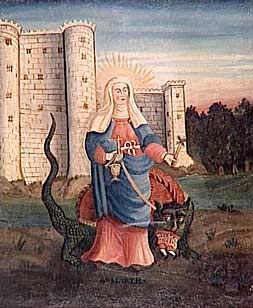
There is a delightful story about St Martha from the Golden Legend in which she tames a ferocious dragon.
Here followeth the Life of Saint Martha.
Saint Martha, hostess of our Lord Jesu Christ, was born of a royal kindred. Her father was named Syro and her mother Encharia. The father of her was duke of Syria and places maritime, and Martha with her sister possessed by the heritage of their mother three places, that was, the castle Magdalen, and Bethany and a part of Jerusalem. It is nowhere read that Martha had ever any husband ne fellowship of man, but she as a noble hostess ministered and served our Lord, and would also that her sister should serve him and help her, for she thought that all the world was not sufficient to serve such a guest. After the ascension of our Lord, when the disciples were departed, she with her brother Lazarus and her sister Mary, also Saint Maximin which baptized them, and to whom they were committed of the Holy Ghost, and many others, were put into a ship without sail, oars, or rudder governail, of the paynims, which by the conduct of our Lord they came all to Marseilles, and after came to the territory of Aquense or Aix, and there converted the people to the faith. Martha was right facound of speech, and courteous and gracious to the sight of the people.
There was that time upon the river of Rhone, in a certain wood between Arles and Avignon, a great dragon, half beast and half fish, greater than an ox, longer than an horse, having teeth sharp as a sword, and horned on either side, head like a lion, tail like a serpent, and defended him with two wings on either side, and could not be beaten with cast of stones ne with other armour, and was as strong as twelve lions or bears; which dragon lay hiding and lurking in the river, and perished them that passed by and drowned ships. He came thither by sea from Galicia, and was engendered of Leviathan, which is a serpent of the water and is much wood, and of a beast called Bonacho, that is engendered in Galicia. And when he is pursued he casts out of his belly behind, his ordure, the space of an acre of land on them that follow him, and it is bright as glass, and what it toucheth it burneth as fire. To whom Martha, at the prayer of the people, came into the wood, and found him eating a man. And she cast on him holy water, and showed to him the cross, which anon was overcome, and standing still as a sheep, she bound him with her own girdle, and then was slain with spears and glaives of the people. The dragon was called of them that dwelled in the country Tarasconus, whereof, in remembrance of him that place is called Tarasconus, which tofore was called Nerluc, and the Black Lake, because there be woods shadowous and black. And there the blessed Martha, by licence of Maximin her master, and of her sister, dwelled and abode in the same place after, and daily occupied in prayers and in fastings, and thereafter assembled and were gathered together a great convent of sisters, and builded a fair church at the honour of the blessed Mary virgin, where she led a hard and a sharp life. She eschewed flesh and all fat meat, eggs, cheese and wine; she ate but once a day. An hundred times a day and an hundred times a night she kneeled down and bowed her knees.
16
posted on
07/29/2005 10:40:08 AM PDT
by
sassbox
To: sassbox
St Martha and the Tarasque
17
posted on
07/29/2005 10:41:03 AM PDT
by
sassbox
To: Salvation
Reprinted from NewsMax.com Health Benefits of Prayer
Armstrong Williams
Friday, July 29, 2005
Is any among you sick? Let him call for the elders of the church, and let them pray over him. (James 5:14)
Prayer heals. So say thousands of Americans who use prayer to improve their health. According to a study by Dr. Anne McCaffrey of the Harvard Medical School, one-third of Americans use prayer to facilitate physical healing. Sixty-nine percent of the 2,000 people surveyed said prayer greatly improved their health.
Additional studies have linked prayer to positive health outcomes with high blood pressure, asthma, heart attacks, headaches and anxiety. "It's not a fringe thing," says McCaffrey. "I think very mainstream Americans are using prayer in their daily lives."
Though Western medicine, with its focus on scientifically quantifiable results, tends to eschew the links between prayer and healing, the Old and New Testament have long espoused the healing power of prayer. A prayer for the sick is a regular part of Catholic and Jewish religious services. Members of Muslim congregations often conclude daily services by asking the imam to offer a special prayer for those who are sick.
'This is the most ancient, widely practiced therapy on the face of the earth," said Dr. Mitchell Krucoff, a professor of medicine and cardiology at Duke University Medical Center
Patients describing the benefits of prayer often talk about how it provides a sense of well-being. Makes sense. When we accept God, we achieve a spirituality that connects us to the significance of life and provides an immutable foundation from which to judge right and wrong.
This foundation is not transient like the vain and materialistic trappings of life. It is eternal. Even during the worst hardships, when the other things in our lives seem to fall apart, we can still find peace in the eternal love of God.
People who understand this will feel God's love reflected back. That is to say, a person cannot love God without loving himself. How could a belief system designed to bring about such a sense of peace not have positive general health benefits?
Of course, none of this means that spiritual health is a substitute for traditional medicine, or that prayer will ensure physical well-being. After all, many saints suffered from a laundry list of physical maladies. We are only human.
But what's telling about the Harvard study is that it reveals just how critical a component prayer is in most Americans' lives. Doctors cannot and should not ignore that. Traditional medicine needs to explore this critical component of patients' lives to better understand their response to illness and recovery. "Doctors need to realize that we don't have the market on what people are doing to make themselves feel better," says McCaffrey.
Of course, it is difficult to test the effects of prayer. You cannot reduce spirituality to a quantifiable figure. You can't measure its effects in a beaker. Perhaps that's why physicians are loath to discuss the matter with patients. But the fact that prayer is a critical component in most people's lives tells us that spirituality – when combined with traditional medicine – should be embraced as an integral part of the health-care process.
www.armstrongwilliams.com
Editor's note:
 Doctor: Natural ‘Medicine' Reduces Cholesterol
Doctor: Keep Your Heart Healthy! Find Out How
Doctor: Hospital Visits Can Kill You – Click Here Now
104
18
posted on
07/29/2005 11:24:19 AM PDT
by
Smartass
(Si vis pacem, para bellum - Por el dedo de Dios se escribió)
To: Smartass
19
posted on
07/29/2005 1:50:31 PM PDT
by
Salvation
(†With God all things are possible.†)
To: sassbox
20
posted on
07/29/2005 1:54:08 PM PDT
by
Salvation
(†With God all things are possible.†)
Navigation: use the links below to view more comments.
first 1-20, 21-36 next last
Disclaimer:
Opinions posted on Free Republic are those of the individual
posters and do not necessarily represent the opinion of Free Republic or its
management. All materials posted herein are protected by copyright law and the
exemption for fair use of copyrighted works.
FreeRepublic.com is powered by software copyright 2000-2008 John Robinson