Transcript
In London’s British Museum, the galleries are full of glorious personal items that show how people adorned themselves through the ages. Across the country, the occasional lucky detectorists find such artifacts, and the next step is to bring them for expert evaluation. Today, the British Museum’s portable antiquity scheme is holding a find surgery deep in the shop countryside. And in attendance is one of the scheme’s top finders, retired engineer Bob Greenway.
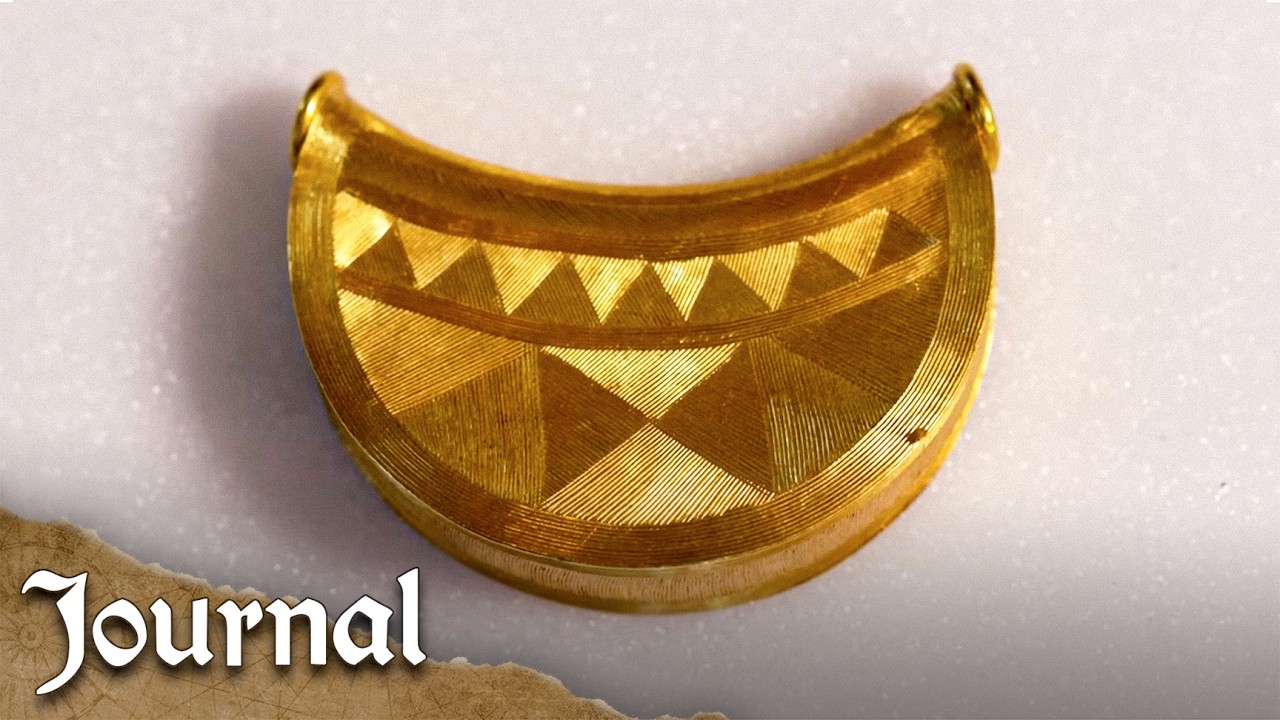
Well, I found the Shropshire Sun pendant. That’s my claim to fame, but I’ve been finding some axes as well in the same area. That’s a bucket list there for me. Is it? Yeah. The Shropshire Sun Pendant is one of the most exquisite examples of Bronze Age jewelry ever found. Its shimmering surfaces are etched with semicircles and geometric motifs that depict the sun, and its condition belies its age of 3,000 years. The pendant was recorded, declared treasure, and is now under research at the British Museum.
Bob unearthed the sun pendant in these fields, an area known as the Shropshire Marches. The exact location is a closely guarded secret. The day I found the shops sun pendant, I started working my way down towards the pete. As I came down here, I got a good positive signal. So, I put the spade in and gently pulled it towards me, and the soil parted, and there was the gold sun pendant. It just glistened. It was as bright as sunlight. I’d never seen anything like it. And to be honest, at the time I didn’t really know what it was.
Bob has been discovering many other artifacts in these same fields and suspects it must be a ritual site where ancient people came to make offerings. This was probably all underwater in the Bronze Age where I’m standing now. And they came down the high ground, lent over, and pushed it into the water. The sun pendant related to the rays of the sun. Were they putting it in the ground hoping the weather was going to improve and that their crops wouldn’t fail anymore? Why they chose this spot? We’ll never know, but obviously, it meant a great deal to them.
Bob’s gained quite the reputation for delivering remarkable finds to his local finds liaison officer, Peter Reville. He’s a journey sod really. He’s finding some absolutely amazing objects. And most archaeologists would give their hind teeth to find a site like this. He already has Bronze Age and Iron Age hordes recorded.
Right. I got a few bits to show you. Yeah. And I’ve been working on the hordes that you brought in beforehand. It’s an amazing group. One of the two hordes includes metalwork from an Iron Age chariot. So, we’ve got this absolutely fantastic lynchpin terminal. And of course, we’re missing this piece over here. This is one of the star pieces of the horde. There would be a wheel on a chariot, and this bit sits down on the top of that wheel and locks it in place. So without this, the wheel falls off.
Well, I’ve got a nice surprise for you. What’s that? Oh my goodness. Those two pieces go together, don’t they? Oh my goodness. Yes. Look at that. Look, they fit. Yeah, that’s absolutely gorgeous. It would have been that bright bronze color. So it’s not the green we see now. It would have been a golden object spinning around on the axle of a chariot. Yeah. That’s made the day already, as it were.
We talked about the Iron Age. Yeah. But we both know that in the same field we’ve also got this Bronze Age horde. The relationship between the two of them is really interesting because it means that where you’re detecting is a really special place for at least 800,000 years. The reason we’re so excited about this is because this is the same farm that has produced the sun pendant, which is absolutely stunning.
Bob is keen to get confirmation from an expert like Peter about his theory of a ritual site. One of the things that we think about this period is they’re putting all of this really important metalwork into the ground as some form of offering. Whether that’s to control the landscape and to control the weather, because I know in the late Bronze Age the weather was very wet, wasn’t it? Yeah. And I just wonder whether it was like it was asking the river not to encroach any further on the land.
While Bob and Peter have their own theories on the sun pendant story, the British Museum scientists are putting it under the microscope to determine its metallic composition and unlock its secrets in the process. Bob wants to leave no stone unturned in these fields, so he has adopted his very own meticulous method of metal detecting.
Right now, you can see the two flags are perfectly in line. So, as I walk down the field, I’ll make sure they stay in line. And that means I’m walking in a straight line. When I get to the next flag, I’ll move it 2 yards over, but the last flag I’ll move four yards. So, off I go. I’m starting to detect now. I think it’s the most accurate and simplest way of making sure you don’t miss anything because I can’t see the point in coming in this field and detecting over it for two or three weeks and missing a gold coin there because I didn’t walk over that spot. So, this way I make sure I don’t miss anything.
What on earth is that? It’s obviously got a real sharp edge. That is interesting. It’s almost certainly agricultural or something, but I’ve never seen anything like it before. Metal detecting is a patience game. It took me 14 years before I found my first axe. That would have been thousands of thousands of holes. And it’s just finding the right spot where ancient people walked and either dropped something or deposited it. There’s an old door handle. How that got in the field, I shall never know. Could be Victorian. Quite decorative. Probably the find of the day.
Bob can afford the odd off day as at the British Museum, his incredible sun pendant continues to shed new light on Bronze Age Shropshire, and the scientists there are almost ready to share their findings with him. Around 1,300 treasure finds are conserved, studied, and valued at the British Museum every year, but few attract as many admirers as Bob Greenway’s Bronze Age sun pendant and so forth.
I was like, “This can’t be real. This is pristine.” Scientist Lara Peruketi has been studying the object for over a year. Such beautiful objects. So well preserved. I’m so used to, you know, looking at objects full of corrosion and damage. Today, Lara has invited Bob to her lab so that he can view his dazzling discovery under the microscope. I haven’t seen it for at least 12 months. Every time I see it, it’s even more beautiful. And he’s hoping it might reveal how such an intricate artifact could possibly have been crafted by hand some 3,000 years ago.
Look at the scale. This is 1 mm. Yeah, this is amazing. I mean, the lines are all at the same distance. It’s incredible. But I can already notice that there is overlap. So those lines on the bottom were done first. Precisely. We are looking at the order in which things were done. First of all, this one. Yeah. Then all the triangle patterns without making any kind of error. Is it? No. A lot are absolutely perfect. To produce such accurate lines, a skilled craftsman would have used an engraving tool to press into the surface of the gold. The detail on the bottom is even finer. Yeah. So, how many are there to the mill? Five lines something like this. It’s the same pressure applied, you know they are very even both in the distance and in the pressure. It’s microns, isn’t it? It is.
Look at here. Yeah. Can you see like they made a mistake here? It’s a wobbly line. Nevertheless, the pendant is near perfect. And under closer examination, Lara is able to determine how the Bronze Age craftsman fashioned it into the shape of the rising sun. So you have a sheet of metal, you bend it, you then join it, join another sheet of metal here, and then you join this kind of rings. They’re soldered on like and they are soldered. How they were able to do this just with their eye.
Finally, the pendant is subjected to X-ray fluorescence revealing that alongside trace elements of other metals, its composition is 15% silver and 80% gold. The person that has made it knew very well what he was doing. So he knew mixing together some kind of gold, silver, and copper, the object would have a particular color, a particular shine, and also looking at the way in which it has been worked. He knew very well how much pressure he could operate on the object. This item is a masterpiece.
Lara’s findings will be shared with the British Museum’s curators and will help determine what happens next to Bob’s Sun Pendant. As an immaculate testament to Bronze Age craftsmanship, the Treasure Valuation Committee has deemed the Shropshire Sun Pendant to be worth £250,000, and the British Museum itself has acquired it.
Thanks very much, Bob, for coming in today. But the head of the portable antiquity scheme, Michael Lewis, and senior treasure registrar Ian Richardson know that the historical value of the pendant and all the other ancient artifacts Bob’s been finding is greater than any price tag. You’ve made some amazing discoveries. Just wanted to say thanks for the contribution that you’ve made to the portable antiquity scheme, and it makes a massive contribution when people like yourself, you know, record their finds.
Well, it’s given me a lot of pleasure as well. That’s great to hear. The sun pendant will now take a starring role in a special exhibition at Shrewsbury Museum that recognizes the importance of all Bob’s prehistoric shop finds, including these two exquisite gold lock rings. They’re also believed to be Bronze Age jewelry and wrapped in lead to enable them to be dropped to the bottom of the same ritual waters as the pendant.
It must be a really special feeling to have this material that you’ve discovered be on display for everyone to enjoy and learn from. Yeah, I think it’s important that we record our history. Obviously, we don’t want it left in the ground or get it broken up by a plow. So, it’s lovely to get it out and let people see how skillful people were 3,000 years ago and what they were capable of achieving.
When the exhibition in Shrewsbury ends, the Sun Pendant will return to the British Museum and take pride of place in its Bronze Age collection. Finding the Shropshire Sun Pendant is probably the most important thing that’s ever happened to me in my life. You always hope you’re going to find something good, but I never expected to find anything like this.