Space Mysteries Podcast Transcript
Chapter 1: Introduction and Sponsorship
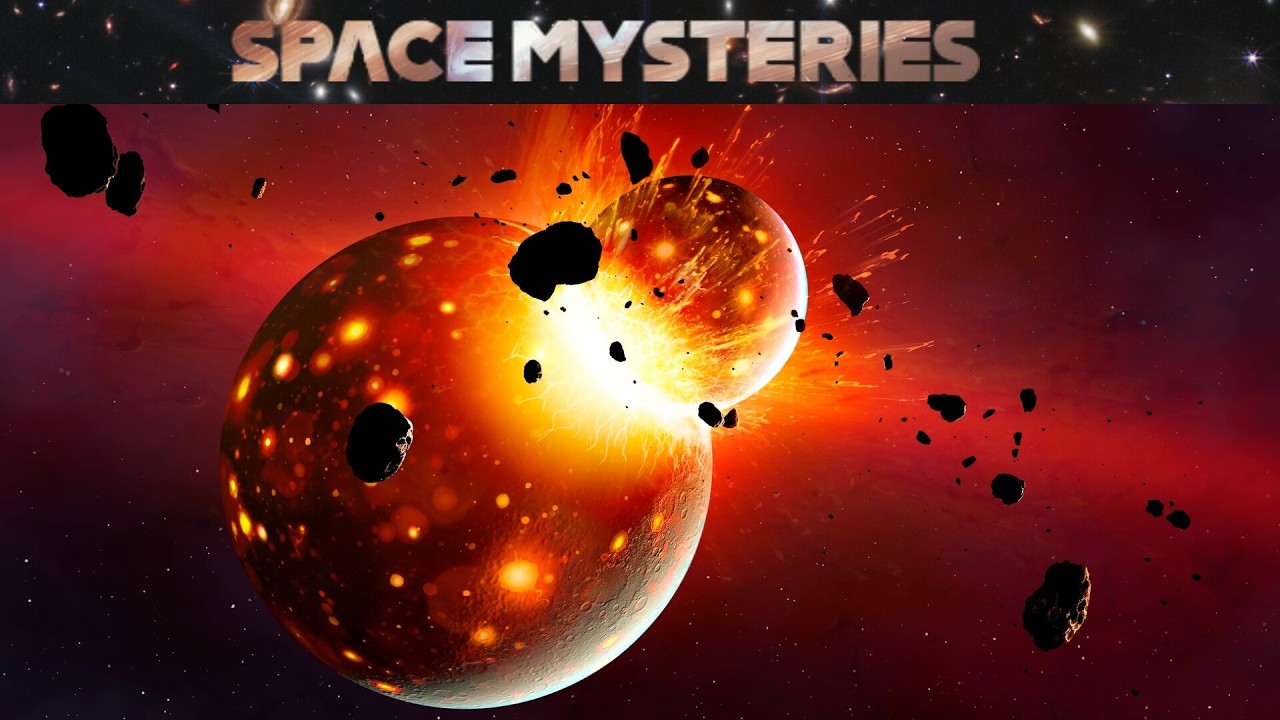
Hey out there, space fans. Welcome back to another week of space mysteries where each week we dive into some of the unanswered, unsolved questions in astronomy and space flight. This week we’ve got a really cool one where we’re looking at a theory that says the moon was created when a planet-sized body smashed into Earth. As always, I’m joined by my co-host, author, podcaster, editor, journalist Micah Hanks.
Hey Brett, how you doing?
Doing very well. It’s beautiful outside. We got a fun mystery to discuss. Life is good.
Absolutely. They’re all mysteries, aren’t they?
They are. [ad text redacted]
Chapter 2: The Theia Hypothesis
Now, back to this week’s mystery. Micah, tell me, was the moon created by an ancient impact with a planet-sized object?
Well, that kind of gives it away there, doesn’t it? I’ll tell you this, the moon has always been a mystery. And, you know, since ancient times, you know, I love archaeoastronomy. Uh, you know, the fact that we know that ancient people looked at the sky and they also were very aware of celestial phenomena, things that were happening, you know, the movement of stars and planets. And we see, you know, celestial alignments, archaeological sites and things along these lines. But arguably there was, I mean, obviously, in fact, there was no single feature in the night sky more obvious and more enigmatic uh than the moon. And that remains true to this day.
And so, one of the probably most pressing questions that we have about the moon as we prepare to go up there, you know, build lunar bases under the Artemis Initiative, try and find a nice moon cave, a lava tube that we can put a moon base in. We still want to know what are the origins of the moon? How long has it been there? What gave rise to its formation? And we have some clues. You know, we can see the magma fields on the moon. We can also see certain similarities and also certain differences between the composition of lunar regolith and also stone from the moon and geological features here on Earth. But an intriguing hypothesis began to emerge and really I think it took hold. It dropped anchor we might say back in the 1980s. This is that a protoplanet-sized object might have collided with Earth long, long ago maybe sometime in the first 100 million years of our solar system’s existence. Now uh the idea I actually found goes much further back. If we go back to 1946 geologist Reginald Aldworth Daly was probably the first to say an impact event might have actually caused the moon’s formation. But the modern science seems to look at an idea along the lines of this protoplanet crashing into Earth.
Uh portions of that object would have been subsumed by the Earth itself. But then the material that was ejected gave rise to the formation of the moon. And this theory nowadays is known as the Theia hypothesis or the impact hypothesis for the moon’s formation.
Chapter 3: Impact Mechanics and Evidence
Yeah. So, Theia was is this hypothetical, this proposed Mars-sized, you know, planetoid, this object that slammed into Earth, blew off a bunch of chunks of the early Earth that then they coalesced, some theories say within a matter of hours into the moon. And I understand that the structure of the moon’s core, like the thickness of its core and the composition of its core, offer some clues that suggest this hypothesis might be true. Is that right?
That is true. And again, actually one of the clearest indications for how the moon was formed are things that we see right here on Earth. You know, there’s been a lot of geological evidence in recent decades that’s suggestive of this impact and again the remnants of this object actually having been subsumed into the Earth at the time. But again, keep in mind this is so far back in Earth’s history that uh you know the evidences of this are not obvious apart from that one of course you know ever-present outlier the moon itself. You mentioned that uh some of these theories hold that the moon the formation of the actual satellite itself could have happened within hours. This is one of the most fascinating aspects of all this because the idea is essentially that the heavier more dense material uh from this ancient Mars-sized planetoid or you know planet-sized object that would have remained here on Earth that would have been collected by our own planetary body and subsumed the lighter material would have been ejected and that within a period of maybe as little according to some theories as 5 hours the moon maybe not exactly as it appears today certainly not with its cratered surface that we all know and it’s so familiar to us now. But the moon as we know it essentially would have taken shape within that short amount of time.
Imagine the cataclysmic cosmic forces that would have to be present for that to occur. And this is just mind-numbing stuff. But when you dig into the data, more and more evidence seems to be suggesting that’s actually what happened.
Yeah, that’s wild.
Chapter 4: Isotope Analysis
I know there’s another uh body of evidence about stable isotope ratios which means you look at pairs of isotopes that are found here on Earth and a pair of isotopes found on the moon let’s say carbon 12 and carbon 13 and the ratios of those two isotopes here on Earth compared to the ratio of those same two isotopes on the moon are basically the same and I think a lot of geologists planetary scientists say right the only way that can happen is if those the material that formed both bodies started out as the same. Very astute observation. Yes, indeed.
That is the leading hypothesis. And again, I love that because when we think about, you know, how do we find evidence? Let’s say for instance, Brett, just to get fun here for a minute, it’s close to Halloween after all. You know, if a spaceship from another world landed on Earth or crashed here, and we wanted to take metallic debris from said spaceship and really determine where it came from, one way we’d be able to know if it came from a distant region in the cosmos is its isotopic arrangement. We could look at its isotopic arrangement of the material that the craft was built from and pretty quickly determine, okay, this is not from Earth. So that geological point that you make about the similarities and I’d mentioned this earlier some of the similarities and differences the key similarity I would say is that isotopic ratio and the consistency we find between lunar material and earthly material there’s one very simple obvious explanatory mechanism for that and to me that suggests as it does to many geologists and planetary scientists hey common origin it has to have some sort of continuity it’s fascinating you know I know some of the scientists you spoke to said, “We the moon who’ll be able to collect samples who’ll be able to analyze them right on the moon.” Uh so maybe we’ll know the answer to this mystery pretty soon.
Chapter 5: Future Research and Conclusion
That’s right. Eric Asfog from the University of Arizona was one of those very researchers and one of the co-authors on a new paper. Um and he is one of the most confident that I spoke to. uh the lead researcher on that paper, Aden Denton from Southwest Research Institute, you know, she also is confident that this data is significantly advancing our understanding of the proposed Theia hypothesis. But where I found that these researchers tend to I wouldn’t say maybe disagree, but I think that they all come at this from slightly different perspectives is when exactly in Earth’s early history this impact would have occurred. If it was a late stage impact, if it was an early stage, that seems to be the one kind of factor that is still undergoing interpretation and modeling.
But to your broader point, as Eric, Aden, and the other researchers I spoke with indicated, we’re pretty significantly advancing our understanding, we pretty confidently think that this is a good model, this impact hypothesis to explain the moon. And yeah, like you said, within the next decade or so, the definitive answers to this long-standing space mystery may finally be at hand.
There you go, space fans. Think about that the next time you’re outside looking at the moon. It could be a broken-off chunk of Earth and an ancient planet that doesn’t even exist anymore.
Well, that’s been this week’s space mysteries. As always, join us next week. Thanks, Micah.
Looking forward to it, Brett.
No! The Moon did not come from the Earth! Everybody knows that...
In a development that has left planetary scientists both baffled and mildly offended, new evidence suggests the Moon was not formed by a dramatic collision with a Mars-sized body, but by Earth getting feedback on a sculpture it made during the Late Heavy Bombardment.
According to a paper published today in the journal Astrophysical Absurdities, researchers analyzing lunar samples discovered what appears to be a tiny, perfectly preserved artist’s signature etched into a basalt rock: “Earth, 4.5 billion BCE — first draft.” Nearby, they found what looks like a cosmic sticky note reading, “Too round. Try again. Love, the Solar System.”
“We always assumed the Moon was debris from a violent impact,” said Dr. Lila Moonbeam, lead author of the study and a self-described “frustrated potter.” “But the isotope ratios match Earth’s mantle almost perfectly, and the surface shows clear signs of being hastily smoothed with a metaphorical thumb. This wasn’t a crash. This was a do-over.”
The leading theory now holds that early Earth, still molten and going through what geologists are calling its “avant-garde phase,” attempted to form a second, smaller planet as a companion piece. After receiving notes from neighboring protoplanets (who reportedly described the work as “derivative of Mercury but with less commitment”), Earth simply detached the unfinished piece and set it in orbit “to think about it.”
Witness accounts are sparse, given the timeline, but one surviving asteroid fragment contains what appears to be graffiti: “Saw the Moon. Mid.”
NASA has declined to comment, though an anonymous source inside the agency said the discovery explains why the Moon always looks like it’s giving Earth the side-eye. “It’s not tidally locked,” the source said. “It’s just still mad about the critique.”
Further analysis is ongoing. Researchers are particularly interested in a dark region on the lunar far side that appears to contain the words “revised version” in very small letters. If confirmed, this would make the Moon the oldest known unfinished art project in the Solar System — and the only one that regularly gets blamed for tidal flooding.
In related news, Mars has reportedly begun drafting a strongly worded response after learning it was once considered as Earth’s “backup sculpture.”