Skip to comments.
The Phoenicians Were Stranger Than You Think (No AI) [41:12]
YouTube ^
| September 21, 2026
| Nils
Posted on 09/28/2026 6:35:32 AM PDT by SunkenCiv
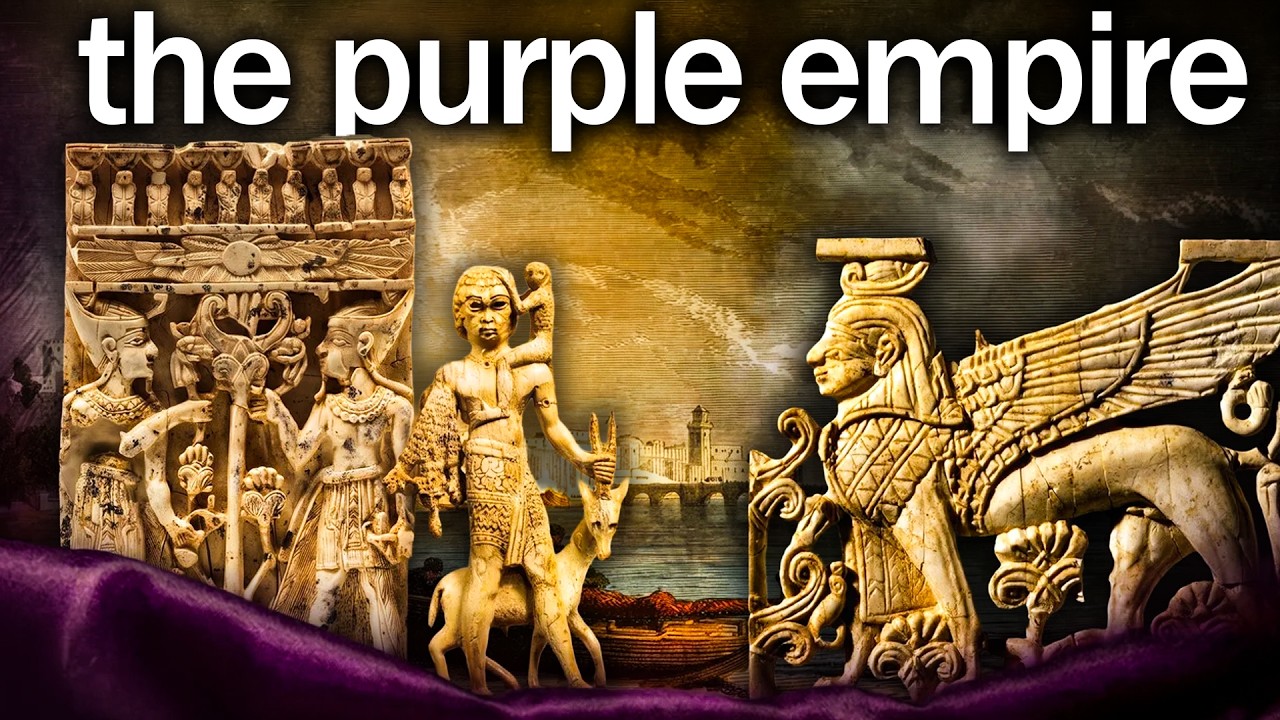
Who were the Phoenicians, really? Let’s look at the civilization behind the ancient Mediterranean’s most mysterious seafaring culture. The Phoenicians Were Stranger Than You Think (No AI) | 41:12
Nils | 47.6K subscribers | 353,198 views | September 21, 2026
(Excerpt) Read more at youtube.com ...
TOPICS: History; Science; Travel
KEYWORDS: ancientnavigation; godsgravesglyphs; murex; phoenicians
Message from Jim Robinson:
Dear FRiends,
We need your continuing support to keep FR funded. Your donations are our sole source of funding. No sugar daddies, no advertisers, no paid memberships, no commercial sales, no gimmicks, no tax subsidies. No spam, no pop-ups, no ad trackers.
If you enjoy using FR and agree it's a worthwhile endeavor, please consider making a contribution today:
Click here: to donate by Credit Card
Or here: to donate by PayPal
Or by mail to: Free Republic, LLC - PO Box 9771 - Fresno, CA 93794
Thank you very much and God bless you,
Jim
Navigation: use the links below to view more comments.
first previous 1-20, 21-35 last
To: Opinionated Blowhard
But I guess trading empires are boring.THE PHANTOM MENACE was based on trading empires, so yes.
21
posted on
09/28/2026 7:41:50 AM PDT
by
Rinnwald
To: SunkenCiv
I don’t think the “best guess” is Canaanite. They were Canaanite. Calling them Phoenician just introduces mystery where there isn’t any. Their language was Canaanite, mutually intelligible with Hebrew.
22
posted on
09/28/2026 7:58:57 AM PDT
by
marron
To: Carry_Okie
23
posted on
09/28/2026 8:01:44 AM PDT
by
ansel12
To: SunkenCiv
Cool video subject. Thanks for posting.
24
posted on
09/28/2026 8:02:02 AM PDT
by
WhoisAlanGreenspan?
(With malice toward none with charity for all with firmness in the right as God gives us to see)
To: SunkenCiv
Rhyme from grade school =>
“Phoenician sailors crossed the seas,
And taught the Greeks their ABCs.”
25
posted on
09/28/2026 8:24:59 AM PDT
by
Ken H
(FReeper #240 - Dec 05, 1997)
To: Colt1851Navy
26
posted on
09/28/2026 8:29:36 AM PDT
by
Jamestown1630
("A Republic, if you can keep it.")
To: SunkenCiv
The “city of thieves” should be “the city of Thebes.”
To: SunkenCiv
That was interesting.
CV, would you happen to know Nils credentials? I ask because I’m automatically skeptical of anyone cursed with that much youth who has such detailed knowledge of ancient history (especially when he editorializes).
To: SunkenCiv
29
posted on
09/28/2026 9:03:20 AM PDT
by
imardmd1
(To learn is to live; the joy of living: to teach. Fiat Lux! )
To: SunkenCiv
Thank you for posting this subject. While I’m wary of YouTube stuff I did a search on Gemini for what might be quality YouTube shows on the subject. I haven’t had a chance to watch the one you have posted but... Ha, yeah I know trust Gemini? Anyway, this is a print of what Gemini’s response was.
Because the Phoenicians wrote primarily on perishable papyrus and parchment rather than clay tablets or stone, very little of their own internal literature survived. Much of what we know comes filtered through their rivals—principally the Greeks, Romans, and biblical authors—or pieced together through epigraphy (inscriptions on stone, coins, and stelae) and material archaeology.
When looking on YouTube, academic institutions, museum lecture series, and specialized ancient history channels offer the most rigorously sourced content:
Top University & Museum Lectures
* Prof. Carolina López-Ruiz – University & Institute Lectures
* Where to search on YouTube: “Carolina López-Ruiz Phoenicians” or search through the Institute for the Study of Ancient Cultures (ISAC, formerly the Oriental Institute, University of Chicago) channel.
* Notable lectures: “The Phoenicians and the Making of the Mediterranean” and “Towards a Reconstructed Phoenician Identity”.
* Why watch: Dr. López-Ruiz (University of Chicago / Ohio State) is one of the world’s leading authorities on Phoenician religion, maritime colonization, and intercultural exchange with the Greeks and Tartessians in Iberia. She directly addresses the historiographical problem of piecing together their world without native narrative histories.
* Dr. David Schloen – In the Wake of the Phoenicians: Makers of the Mediterranean
* Channel: The Institute for the Study of Ancient Cultures (ISAC)
* Why watch: A comprehensive scholarly presentation covering Levantine maritime trade, the emergence of city-states like Tyre, Sidon, and Byblos, and how archaeological excavations illuminate their colonial network across North Africa and the western Mediterranean.
* Prof. Josephine Quinn – Oxford Lectures & Talks on Phoenician Identity
* Where to search on YouTube: “Josephine Quinn Phoenicians” or “Josephine Quinn In Search of the Phoenicians”.
* Why watch: Author of In Search of the Phoenicians (Princeton University Press), Dr. Quinn presents a critical, modern historiographical argument: that “the Phoenicians” as a unified nation never existed, but rather was an exonym used by outsiders for fiercely independent city-states. Her talks are invaluable for understanding how scholars read between the lines of Greek and Roman bias.
Deep-Dive Documentaries Grounded in Academic Scholarship
* Fall of Civilizations – Episode 17: Carthage - Empire of the Phoenicians
* Channel: Fall of Civilizations (hosted by Paul Cooper)
* Why watch: Although a documentary series rather than a formal podium lecture, Paul Cooper is an archaeologist and historian whose scripts rely directly on primary source analysis and recent field excavation data. This 3+ hour episode explores Phoenician Levantine origins, cedar trade, maritime navigation technology, and the founding of Western colonies, explicitly tackling the challenge of reconstructing an empire whose libraries were largely destroyed.
* The Ancients (History Hit)
* Where to search on YouTube: “The Ancients Phoenicians” or “The Ancients Carthage”
* Format: Long-form interviews hosted by Tristan Hughes featuring active field excavators, classical historians, and archaeologists discussing specific artifacts, shipwreck finds (like the Uluburun and Bajo de la Campana wrecks), and Phoenician religion.
Tips for Searching Scholarly Channels
When sifting past AI-generated or clickbait overviews on YouTube, prioritize these academic channels:
* The Institute for the Study of Ancient Cultures (ISAC)
* Penn Museum
* Archaeological Institute of America (AIA)
* Brown University (Joukowsky Institute for Archaeology)
30
posted on
09/28/2026 9:31:21 AM PDT
by
jcon40
(Most Leftist and Marxist protesters are really just Unwitting Globalists )
Transcript pt 8
So that’s the good century. Phoenicians have ships everywhere. Colonies are everywhere. And of course, money everywhere, which is exactly the kind of thing that attracts attention from rather greedy and rather aggressive enemies. If you watch my video on the Assyrians, you already know who’s about to walk into the story, and you already know that this is not going to be fun. In case you didn’t, here’s a quick reminder.
Assyria spent the 8th and 7th centuries BC turning the entire ancient Near East into different provinces. The idea was that you would annex the kingdom, delete the kingdom, install a governor, and then move the population somewhere else. The Phoenician cities got a rather different deal because Assyria had worked something out about these people fairly quickly. A Phoenician city under direct occupation is a port with a garrison in it. However, a Phoenician city left semi-independent, paying enormous tribute is an army that goes out into the Mediterranean, makes money in places that Assyrian soldiers cannot reach, and then brings a percentage of that home. They were more valuable running away than they actually were being captured. So, Assyria let them keep trading, and then they took a percentage of it. Capitalism at its finest.
Assyria siphoned off a serious share of everything the Phoenicians earned at sea and spent the 7th century repeatedly trying to get full control over the island cities. Anyway, for example, in 701 BC, Sennacherib comes west to put down a revolt. And I mentioned in passing that the king of Sidon took one look at the approaching Assyrian army and then he ran. And Sennacherib’s own phrasing into the midst of the sea and that this turned out to mean Cyprus where he died in exile. That’s Luli, the king of Sidon. And from the Assyrian side, he’s, you know, a coward. But from this side, he’s a Phoenician leader doing the one thing a Phoenician leader can always do, which is get the heck on a ship and get the heck out of there. He fled along his own trade network to a Phoenician community on Cyprus that already existed because his city had literally put it there. He still died out there.
But Tyre, unfortunately, kept gambling over and over. They wanted their cake and they wanted to eat it, too, because Tyre is an island. That’s the whole basis of this foreign policy. It’s offshore and well fortified. And for centuries, the answer to, well, what happens if we say no to the people who want to conquer us was nothing. They can’t touch us. So Tyre would submit, pay tribute, and then the moment Assyria was distracted somewhere else, well, Tyre would conveniently support whoever was fighting Assyria at the time.
So in the 670s, the king of Tyre, Um-Baal, which is just a hilarious name for him and not to be confused with the god Baal, allies with Taharqa, the Kushite Pharaoh running Egypt against the Assyrian king Ashurbanipal. Then come 671 BC. And if that year rings a bell, it’s because 671 is the year that Ashurbanipal takes Egypt. That’s the whole peak of the Assyrian Empire. What I didn’t mention in that video is what Ashurbanipal did on the way. He stopped at Tyre and pretty much laid the groundwork for a siege. Went on to Egypt, took Memphis, and then came back and all of Tyre watching his Egyptian ally get absolutely dismantled did the math and was just like, “Oh crap.”
Then came a rather hefty tribute back payments on everything that he owed Ashurbanipal and the loss of his mainland territory. And of course, Ashurbanipal celebrated the whole trip with a set of victory stelae, showing himself holding two figures with rope-like things. One of them is Taharqa’s captured son. The other is Baal, king of Tyre. Then Ashurbanipal dies. Ashur-Banipal takes over. And in 668, the king of Tyre, Byblos, and Arwad all show up with tribute and offer naval support for the new king’s Egyptian campaign. Very supportive, model vassals, lovely people. And within a few years with Assyria bogged down in Egypt again, well, Tyre rebels. That one doesn’t work. Ashur-Banipal blockades the city by land because you can’t starve an island by sea if the island has a better navy. But you can cut off everything that it eats. And then Baal surrenders. The city survives. The king survives. Tyre’s entire mainland empire gets taken away. And by 640 BC, the territory Hiram bought from Solomon 300 years earlier is now an Assyrian province.
And then within about 30 years, Assyria simply dies off between civil war and ruinous wars with Elam, Babylon, and the Medes. And by 612, Nineveh is on fire. And by 609, there’s really no Assyrian state at all. Yet Tyre is still there. And that’s kind of the pattern with these people and why they lasted as long as they did because they lost basically every war that they were ever in, but they just kept not dying because the thing that they actually owned wasn’t land. And you can’t burn a trade network.
So, Egypt moves back in a few decades and then Babylon shows up. Nebuchadnezzar takes Jerusalem in 587 and comes for the coast and the whole cycle just starts again now with a new owner. So, the Phoenicians survive everything that everyone throws at them for 600 years, which makes it worth asking what their neighbors were actually saying about them the whole time.
31
posted on
09/28/2026 10:26:23 AM PDT
by
SunkenCiv
(TDS -- it's not just for DNC shills and jihadists anymore -- oh, wait, yeah it is.)
Transcript pt 9
One of, if not the biggest accusation or thing about the Phoenicians and the Carthaginians for that matter is this child sacrifice. Clay Tarcus, a Greek historian writing in the early 3rd century BC, says the Carthaginians were, um, or would promise one of their children to the god Kronos, which is the Greek translation of the Carthaginian god Baal Hammon, in exchange for a great favor. He describes a bronze statue of a god with its hands held out over a fire pit in a child placed in the arms and rolling forward into the fire. Plutarch adds that childless couples would buy children from poor families to offer instead of their own and that the sacrifices were done to the sound of flutes and banging drums which were there to drown out the noise that the family was making and the screams of the child.
Diodorus tells a slightly different version that this was treated as an emergency during the siege of Carthage by the Sicilian tyrant Agathocles. He says that the Carthaginian aristocracy concluded that their god was angry because they had been cheating, namely buying commoners’ children and substituting them for their own. So to make it right, they offered up 200 children of their own noble families. Pliny and Silius Italicus say that it happened annually.
Now, every single one of those authors is Greek or Roman. And then Greeks and Romans had pretty good reason to make the Carthaginians look like monsters. So, I don’t know. Is there something more going on here? What exactly is going on here? Well, archaeologists working across the central Mediterranean of North Africa, Sicily, and Sardinia have found a specific kind of site out in the open kind of with like walled enclosures outside the city limits containing the cremated young remains of children buried in terracotta urns packed into pits cut into the bedrock. The word for these sites is tophit and that itself comes from the Hebrew Bible from a burning place in the valley of Ben Hinnom outside Jerusalem where the prophets say that Israelite children were burned. Jeremiah spends a whole lot of time condemning the practice in the exact same centuries that the Carthaginian areas were in use.
The one at Carthage is enormous. They excavated this since like the 1920s and they found densely packed burials layered on top of each other in a streak from the late 8th century BC to 146 BC. Only part of it has ever been dug. And in the 4th and 3rd centuries BC alone, the estimate is something like 20,000 urns. The remains inside are infants, um, from newborns up to about 3 years old. Some, um, appear to be born premature. There’s usually one per urn, sometimes with a lamb or a kid or a small bird alongside of it. So that’s a lot of dead babies in a religious place.
(imho, blah blah blah follows)
So what’s the argument here? The skeptical case goes something like this. Infant mortality in the ancient world was rather catastrophic. A very large number of children died at birth or in the first few weeks. And a large share of the tophit remains are newborn or premature, which is exactly the population that dies naturally. And infants are almost always entirely absent from ordinary Carthaginian adult cemeteries, which means that they were being buried separately somewhere. So what if a tophit is just that, a dedicated infant cemetery in ground that was consecrated to a god where the family could put a baby who died and knew it was somewhere holy?
And the Greeks and Romans who already thought that these people were monsters looked at a walled field full of burnt infants and drew the worst possible conclusion. Maybe. But here’s the case against it. First, the stelle themselves. The grave markers in these areas have inscriptions on them. And from about the late 7th century onward, they use a rather specific vocabulary. They talk about the quote mulch offerings to balam in tenant. And they use the word ndr or I don’t know how to say it, but which means vow. So, plainly speaking, these are not the words that you you would find on ordinary gravestones.
So if this is a cemetery for infants who die naturally, the parents are describing it in the language of a transaction with a god or like a ritual. Secondly, the areas themselves act like sacred sites and not like graveyards. We know that because ordinary Punic cemeteries could be picked up and moved. For example, the one at uh Matia was relocated from the island to the mainland when they needed the space. Tofetts never move. And thirdly, there’s an inscription found at this place called um Inuri in southern Turkey dating to the late 8th century BC.
In it, a Tyrion priest is advising a local king who’s got a plague in his camp. And the advice is to perform a mulch offering of a lamb and then to offer his own son or grandson. That’s a Phoenician prince writing in Phoenician telling a king to burn his own child in the Phoenician homeland in the same century that the Carthage Topet opens. So where does that leave it? Evidence suggests an organized religious practice centered on Bel Haman in Tanit, mostly initiated by individual families and practiced by people we can identify from inscriptions as merchants and priests and magistrates or the upper end of society.
However, one major analysis of the skeletal remains argues that the age range fits a natural mortality and just as easily a response arguing right back that it actually doesn’t. What I would say is this. The practice, whatever exactly it was, outlived the people who were accused of it because Rome banned it and then it kept going away. In Tunisia, the second biggest of these sites, there’s evidence of use into the first century AD and possibly later.
32
posted on
09/28/2026 10:30:34 AM PDT
by
SunkenCiv
(TDS -- it's not just for DNC shills and jihadists anymore -- oh, wait, yeah it is.)
Transcript pt 10
So, that’s the idea behind child sacrifice. But what happens when one of the world’s greatest conquerors knocks on your doorstep? What do you do? Well, it’s 332 BC and Alexander the Great comes down the Levant and the Phoenician cities have a decision to make and they do not all make the same one. Arwad surrenders, Byblos surrenders. The Phoenician and Cypress fleets, the actual naval power of the whole coast, just like defect. And Sidon throws the gates open and welcomes him in.
You see, 10 years earlier, the Persian king Adoraxis had put Sidon down so brutally that the city was still recovering from that. And when the man showed up who was clearly about to end the Persian Empire, Sidon was the first in queue to open the door. But then there’s Tyre. Tyre, of course, is an island. That is the beginning and the end of Tyre’s entire attitude towards the world. Good luck conquering us. So, Tyre just says, “No, you’re not welcome here.”
And Alexander, who is 24, who has just taken Egypt, and who is, um, constitutionally impeccably incapable of being told no, decides that if the city is going to exist on being an island, he’ll fix that. He has no plan to go around it, nor wait it out, nor come back with more boats. He is going to remove the water. He builds practically a road out into the sea that is laid across open water from the mainland toward the city while the people on the walls were shooting at the men doing it.
This whole project takes like seven months and then Tyre fights the whole way and fights rather well. The walls on the seaside were, uh, enormous. The ancient descriptions of Tyre’s ramparts on the eve of this siege are the reason that we know how good Phoenician masonry was. They had the latest siege engineering of the period. They had their own engineers and then they absolutely used all of it. They sent fire ships into the road and burned them. They came out and raided.
And when Alexander built towers, they conveniently knocked them down. What finally beat them wasn’t the causeway, as it was called on its own, that like road. It was that the rest of, uh, Phoenicia had already given up. The combined Phoenician and Cypress fleets, the Sidonian ships, Byblos, and the navies of their own neighbors and cousins were now under Alexander’s command. And then they blockaded Tyre by sea while the Macedonians came down.
Tyre spent 600 years surviving empires because nobody could get a fleet at it. And in the end, it was killed by the only fleet in the world that could, which was the one belonging to the other Phoenicians, funnily enough. So, a lot of the population had already been evacuated to Carthage or up the coast to Sidon. And so, in mid-July of 332, the walls come crumbling down. And Alexander, who has spent over half a year on a city that he expected to walk into, makes an example out of it. 6,000 of the survivors are executed. 30,000 are sold into slavery. And as payback for Macedonian prisoners that the Tyrians had killed during the siege, well, 2,000 men are impaled and left along the shoreline.
Tyre eventually recovers from this commercially. Cities like that usually do, but it never gets back quite to being what it used to be. And over the next couple of centuries, it becomes a thoroughly Greek city adopting Greek customs, Greek language, and the Greek gods with different Phoenician names. And yeah, the causeway is still there today. It’s like you can see a photo of it. You can go there and know that, yeah, Alexander the Great built this. Pretty much what happened is sand and silt built up against it over centuries and then it widened. Tyre is now a peninsula and it has been attached to the mainland for 2,300 years because one extremely stubborn young man refused to accept the local geography. So, that’s Tyre. And what about everyone else?
There’s no dramatic ending to the Phoenicians. That’s kind of sort of the whole point of them. After Alexander, the coast gets passed around like a piece of meat with the Ptolemies out of Egypt and then the Seleucids from 198 BC. Then a brief run of independence and then Rome takes the whole region in 64 BC and then holds it for 600 years until the Arab conquest in the 7th century AD. And through all of that, the cities just kept on going. They kept on trading. They stay prosperous, which is very on brand for them. Byblos, Sidon, and Tyre are all still there. Still today, Lebanese cities you can go and visit. Nobody exterminated the Phoenicians. They just kind of stopped being Phoenicians over time.
The language they have gets displaced by Greek and then Aramaic and then the gods get Greek names. Melqart becomes Heracles, um, which he would have hated. The temples get rebuilt in a Greek style. And at some point across a few unremarkable generations, the last person who thought themselves as a Tyrian in the old sense died. And nobody wrote that down because, like, who would? There’s no last stand here. Nobody makes a rousing speech. They just end the way a small business ends, which is one day it’s under new management and then the sign out front is different.
Carthage, however, went the other way. Rome burned it to the ground in 146 BC after the Third Punic War. And that’s where the western half of this civilization ends. We don’t know what they called themselves. The best guess that we have is Canaanite. We don’t know if they thought that they were one people at all or just four rival port cities who happened to speak the same language and got lumped together by Greeks.
We don’t even have their histories. We don’t really have their mythology specifically to the Phoenicians. We don’t have a single manuscript. We don’t even have their fabric or textiles, the most famous thing that they were making. We know their kings. Yet, we cannot tell you what any of them did or when outside of, you know, the occasional secondhand stuff. And that’s what’s left of a civilization that ran the Mediterranean for 600 years.
Except look at the name of the middle city, Byblos. That’s the Greek name for it. And the Greeks use the same word “biblion” for papyrus, the writing material that came through that port by, you know, by the shipload, which is where they got “biblon,” meaning a scroll or a book, which is where we get the word “Bible.” More or less, the bestselling book in human history is named after a Lebanese port town because, well, that’s where the paper came from. And that’s not even the big one.
You’re reading their letters or hearing me speak it or anytime you read something right now on whatever you’re looking at, 22 signs of letters that came across a strip of a coast smaller than most American states that got handed to a Greek by a Phoenician whose name that nobody knows and then to the Romans and then to everyone else and then to you. And the people who worked out how to write anything at all in a form simple enough that ordinary people could use it never got to tell us who they were. Their enemies wrote it all down instead. And the enemies’ version is what survived, of course, because their enemies’ libraries didn’t happen to burn. But the point is, we’re still using the letters.
So, thank you so much for watching. If you enjoyed this video, please consider hitting the subscribe button. It really does help out the channel more than what you’d think. And as always, I will see you in the next video.
33
posted on
09/28/2026 10:30:58 AM PDT
by
SunkenCiv
(TDS -- it's not just for DNC shills and jihadists anymore -- oh, wait, yeah it is.)
To: Colt1851Navy
34
posted on
09/28/2026 11:58:03 AM PDT
by
caver
( )
To: Carry_Okie
Neither the Phoenicians nor the Carthaginians would have been squat without Lebanese cedar. That plant shaped the ancient world. Neither would the Egyptians. The Lebanese were sometimes vassals of the Pharoes.
35
posted on
09/28/2026 3:49:30 PM PDT
by
Sawdring
Navigation: use the links below to view more comments.
first previous 1-20, 21-35 last
Disclaimer:
Opinions posted on Free Republic are those of the individual
posters and do not necessarily represent the opinion of Free Republic or its
management. All materials posted herein are protected by copyright law and the
exemption for fair use of copyrighted works.
FreeRepublic.com is powered by software copyright 2000-2008 John Robinson