Skip to comments.
BREAKING STUDY: Nattokinase Breaks Down SPIKE PROTEIN, AMYLOID MICROCLOTS, BLOOD CLOTS, and SHRINKS ARTERIAL PLAQUE (includes GROK summary)
X.com ^
| September 22, 2026
| Nicolas Hulscher, MPH @NicHulscher
Posted on 09/22/2026 9:15:42 AM PDT by ransomnote
Nicolas Hulscher, MPH
@NicHulscher
·
1h
BREAKING STUDY: Nattokinase Breaks Down SPIKE PROTEIN, AMYLOID MICROCLOTS, BLOOD CLOTS, and SHRINKS ARTERIAL PLAQUE
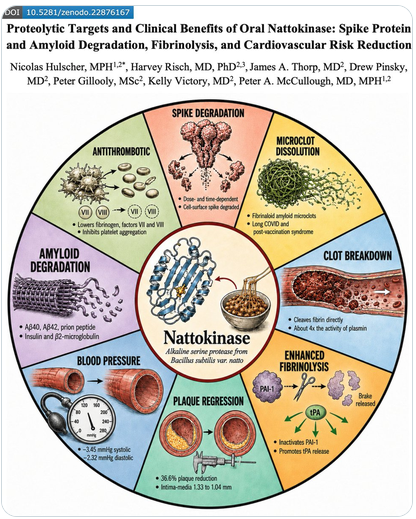
We assembled DECADES of evidence to uncover the powerful MULTI-TARGET EFFECTS of nattokinase:
- Degrades spike protein
- Breaks down harmful amyloid proteins
- Dissolves abnormal amyloid microclots
- Breaks down fibrin blood clots
- Boosts the body’s natural clot-dissolving system
- Shrinks arterial plaque
- Lowers blood pressure
- Reduces blood-clotting factors and platelet clumping
Our new paper, “Proteolytic Targets and Clinical Benefits of Oral Nattokinase: Spike Protein and Amyloid Degradation, Fibrinolysis, and Cardiovascular Risk Reduction,” was produced through a collaboration between The Wellness Company and the McCullough Foundation.
It represents one of the most comprehensive evaluations of nattokinase to date, uniquely integrating its proteolytic, cardiovascular, pharmacokinetic, amyloid, and spike-protein literature into a single paper.
After oral dosing, nattokinase-related activity shows up in human blood and changes clotting and clot-breakdown markers within hours.
Three independent labs have now shown that nattokinase-related enzymes can BREAK DOWN SPIKE PROTEIN in vitro—including purified nattokinase itself.
At higher doses, human imaging studies reported about a 36% SHRINKAGE in carotid artery plaque—suggesting the effective range may begin around 6,000 FU/day.
Randomized human trials also show modest BLOOD-PRESSURE reductions with nattokinase, with pooled decreases of about 3.5 mmHg systolic and 2.3 mmHg diastolic.
And in long-term population studies, higher natto intake was associated with a 25% LOWER RISK of cardiovascular death and a 32% LOWER RISK of stroke death.
Nattokinase has been well tolerated across human studies, with no notable adverse events reported across six randomized trials. Even 10,800 FU/day for 12 months was used in a large observational cohort without reported excess bleeding.
This inexpensive, orally available enzyme holds immense promise for cardiovascular risk reduction in the post-COVID era.
It now deserves large-scale clinical testing for cardiovascular risk reduction and other post-vaccination injury applications.
We plan to launch some of these studies shortly.
@twc_health
@McCulloughFund
@P_McCulloughMD
@DrHarveyRisch
@DrKellyVictory
@jathorpmfm
@drdrew
@PeterGillooly
September 22, 2026
GROK Summary:
- The X post by epidemiologist Nicolas Hulscher announces a new review paper on Zenodo synthesizing evidence for nattokinase, a serine protease from fermented soybeans, claiming it degrades spike protein and amyloids in vitro, dissolves fibrin clots, reduces arterial plaque, and lowers blood pressure.
- Peer-reviewed lab studies, including a 2022 Molecules paper, confirm nattokinase breaks down SARS-CoV-2 spike protein in a dose- and time-dependent manner in cell cultures, while human trials show modest systolic/diastolic BP reductions of ~3.5/2.3 mmHg and up to 36% carotid plaque shrinkage at higher doses like 6,000+ FU/day.
- The review, co-authored by McCullough Foundation affiliates, highlights nattokinase's fibrinolytic activity and safety profile across studies but notes the spike protein and microclot benefits remain primarily preclinical, calling for larger clinical trials in post-COVID contexts.
TOPICS: Miscellaneous
KEYWORDS: bloodclots; bloodthinner; nattokinase; plaque; supplements; treatment
Message from Jim Robinson:
Dear FRiends,
We need your continuing support to keep FR funded. Your donations are our sole source of funding. No sugar daddies, no advertisers, no paid memberships, no commercial sales, no gimmicks, no tax subsidies. No spam, no pop-ups, no ad trackers.
If you enjoy using FR and agree it's a worthwhile endeavor, please consider making a contribution today:
Click here: to donate by Credit Card
Or here: to donate by PayPal
Or by mail to: Free Republic, LLC - PO Box 9771 - Fresno, CA 93794
Thank you very much and God bless you,
Jim
Navigation: use the links below to view more comments.
first 1-20, 21-40, 41-45 next last
To: ransomnote
Quick search… the beans themselves (natto) are pricy. Trendiness or production costs?
2
posted on
09/22/2026 9:21:27 AM PDT
by
No.6
To: No.6
The pills are quite cheap on Amazon. I’ve been taking it for about a year.
3
posted on
09/22/2026 9:23:38 AM PDT
by
ClearCase_guy
(Some people want to control their own life, others want to control the lives of others. )
To: ransomnote
I can hear the rustling of big pharma agents moving towards congress as we speak.
4
posted on
09/22/2026 9:25:35 AM PDT
by
dljordan
(Where's th"e rest of the Epstein files hmmmm?)
To: dljordan
That political body should be hyphenated...CON-gress.
5
posted on
09/22/2026 9:28:09 AM PDT
by
who knows what evil?
(Hospitals are the most dangerous place on Earth! Dr. David Williams)
To: ransomnote
Thanks! It is nice to see some actual scientific, clinical data regarding things like this.
6
posted on
09/22/2026 9:33:06 AM PDT
by
DennisR
(Look around - God gives countless clues that He does, indeed, exist.)
To: ransomnote
A couple of months ago I switched to Lumbrokinase made from earthworms, while natto comes from soybeans. They basically do the same things, just a bit different. I’m interested to see the results from lumbro. Ck it out. I got the Double Wood 150 mg. AI says it’s made in the USA.
7
posted on
09/22/2026 9:33:26 AM PDT
by
ryderann
To: ClearCase_guy
Have you seen any noticeable effects?
8
posted on
09/22/2026 9:33:56 AM PDT
by
DennisR
(Look around - God gives countless clues that He does, indeed, exist.)
To: ClearCase_guy
That’s good. Natto itself is revolting.
9
posted on
09/22/2026 9:36:05 AM PDT
by
Jamestown1630
("A Republic, if you can keep it.")
To: DennisR
Blood pressure is down and I’m off one of my prescriptions now. Could be for other reasons, but maybe the Nattokinase deserves some credit.
10
posted on
09/22/2026 9:41:42 AM PDT
by
ClearCase_guy
(Some people want to control their own life, others want to control the lives of others. )
To: AdmSmith; AnonymousConservative; Arthur Wildfire! March; Berosus; Bockscar; BraveMan; cardinal4; ...
The rest of the Nattokinase keyword, sorted:
11
posted on
09/22/2026 9:41:46 AM PDT
by
SunkenCiv
(TDS -- it's not just for DNC shills and jihadists anymore -- oh, wait, yeah it is.)
To: ransomnote
So why hasn’t my doctor told me about this instead of pushing statins?
12
posted on
09/22/2026 9:43:59 AM PDT
by
Freedom_Is_Not_Free
(America -- July 4, 1776 to November 3, 2020 -- R.I.P.)
To: ransomnote
I think Doctors McCullough and Pinsky were talking about nattokinase a year ago.
13
posted on
09/22/2026 9:45:16 AM PDT
by
Tench_Coxe
(The woke were surprised by the reaction to the Bud Light fiasco. May there be many more surprises)
To: ransomnote
No agent has been shown to rapidly “break down” plaque in the way this nattokinase advertising implies; however, intensive LDL lowering—particularly statin-based therapy with a PCSK9 inhibitor (evolocumab) when appropriate—has shown modest coronary plaque-volume regression in large, blinded, placebo-controlled imaging trials.
14
posted on
09/22/2026 9:53:31 AM PDT
by
Oystir
( )
To: ransomnote
No agent has been shown to rapidly “break down” plaque in the way this nattokinase advertising implies; however, intensive LDL lowering—particularly statin-based therapy with a PCSK9 inhibitor (evolocumab) when appropriate—has shown modest coronary plaque-volume regression in large, blinded, placebo-controlled imaging trials.
15
posted on
09/22/2026 9:53:34 AM PDT
by
Oystir
( )
To: All; anyone
Another AI source claims Aged Garlic Extract (AGE) supplements are a better and safer option than Nattokinase.
Question:
Is NATTOKINASE or AGED GARLIC EXTRACT better at clearing soft plaque from arteries and reducing progression of calcified plaque in arteries, and which supplement has the best proof of its helpfulness in quality trials on humans?
AI response:
Aged Garlic Extract (AGE) has significantly more rigorous, consistent proof and better clinical data than nattokinase when it comes to reducing soft plaque and slowing the progression of calcified arterial plaque.
While both supplements have generated interest for cardiovascular health, their performance in high-quality, human clinical trials differs substantially.
____________________________________________________
DIRECTLY COMPARING THE SCIENTIFIC PROOF
AGED GARLIC EXTRACT (AGE)
Soft Plaque Impact: Proven Regression: Lowers low-attenuation (soft/vulnerable) plaque by ~30%.
Calcified Plaque Impact: Proven Slowing: Consistently delays the progression of coronary artery calcification (CAC).
Highest Quality Human Proof: Multiple double-blind, placebo-controlled, randomized trials using advanced cardiac imaging (CCTA).
NATTOKINASE
Soft Plaque Impact: Inconsistent / Dose-Dependent: Weak at standard doses; large reductions only seen in questionable mega-dose trials.
Calcified Plaque Impact: No Evidence: Zero reliable clinical data showing an effect on calcification or calcium scores.
Highest Quality Human Proof: One major 3-year randomized controlled trial showed no effect at standard retail doses.
____________________________________________________
DETAILED BREAKDOWN OF THE TRIALS
1. AGED GARLIC EXTRACT (AGE)
AGE has been evaluated by researchers at institutions like Los Angeles Biomedical Research Institute in multiple robust human trials.
The Soft Plaque Proof:
In randomized, double-blind, placebo-controlled trials of patients with metabolic syndrome, taking 2,400 mg of AGE daily for one year significantly reduced low-attenuation plaque (vulnerable soft plaque). AGE actually demonstrated plaque regression, meaning the soft plaque shrank compared to the placebo group.
The Calcified Plaque Proof:
A systematic review evaluating interventions to slow down cardiovascular calcification found that AGE was the most promising supplement studied, demonstrating a significant slowing of coronary calcium progression (roughly a 65% inhibition rate over placebo) across multiple trials.
2. NATTOKINASE
The enthusiasm surrounding nattokinase largely stems from its strong ability to dissolve fibrin (blood clots) in laboratory settings. Its record against hard and soft arterial plaque in humans is far less stable:
The Failure at Standard Doses:
In the highly rigorous, 3-year Nattokinase Atherosclerosis Prevention Study (NAPS), 265 adults took a standard retail dose of 2,000 FU daily. The trial found no difference in arterial thickness, plaque progression, or stiffness compared to a placebo.
The Mega-Dose Contradiction:
A separate 2022 clinical trial utilizing a massive dose of 10,800 FU daily did report a 36% reduction in carotid plaque size over 12 months. However, medical experts approach this study with caution because it was an unblinded trial with a weaker design than standard placebo-controlled studies. Furthermore, nattokinase has no mechanism or evidence for altering calcium deposits.
____________________________________________________
IMPORTANT SAFETY WARNING
Both supplements act as mild blood thinners. AGE impacts platelet aggregation, while nattokinase degrades clotting factors. If you are already taking prescribed anticoagulants (like warfarin), antiplatelet medications (like aspirin), or have an upcoming surgery, you must consult your physician before starting either supplement to avoid dangerous bleeding risks.
____________________________________________________
Question: Is nattokinase or aged garlic extract more likely to cause too much blood thinning in the doses found effective in the clinical trials cited above?
AI response:
Nattokinase is significantly more likely to cause excessive blood thinning and serious bleeding complications at the effective dose cited (10,800 FU/day) than Aged Garlic Extract (AGE) at its effective dose (2,400 mg/day).
The primary reasons for this difference relate to how they work in the body and the sheer magnitude of the doses evaluated in those specific trials.
____________________________________________________
The Contrast in Mechanisms and BLEEDING RISKS
1. NATTOKINASE (At 10,800 FU/day) — HIGHER RISK
Aggressive Mechanism:
Nattokinase is a fibrinolytic enzyme. Instead of just making blood cells less sticky, it actively cuts and digests fibrin, the main mesh-like protein structure that physical blood clots are made of. It also triggers the release of the body’s natural clot-dissolving agents (tissue plasminogen activator) and decreases fibrinogen.
The Mega-Dose Impact:
The standard retail dose for nattokinase is 2,000 FU per day. The trial showing a 36% plaque reduction used 10,800 FU daily—more than 5 times the standard amount. At this extreme dose, its clot-dissolving potential is exponentially magnified, significantly increasing the danger of spontaneous bruising, internal bleeding, or severe hemorrhaging if you are cut or injured.
Clinical Precedent:
Even at lower doses, medical literature has documented serious adverse events, including a case of intracranial hemorrhage (bleeding in the brain) when nattokinase was taken alongside an aspirin.
2. AGED GARLIC EXTRACT (At 2,400 mg/day) — LOWER RISK
Gentler Mechanism:
AGE does not dissolve existing blood clots. Instead, it behaves as a mild antiplatelet agent, meaning it temporarily reduces the “stickiness” of blood platelets so they are less likely to clump together and form a new blockage.
Proven Safety Margin:
The 2,400 mg/day dose used in the plaque-reduction trials is a standard, commercially available therapeutic dose.
Warfarin Safety Studies:
Highly unique to AGE, human clinical trials have specifically tested 2,400 mg of AGE alongside prescription Warfarin (Coumadin), a powerful blood thinner. Even when stacked with a prescription anticoagulant, closely monitored patients taking AGE did not experience a significant increase in hemorrhagic episodes or bleeding side effects.
____________________________________________________
THE ULTIMATE TAKEAWAY
While both supplements carry medical instructions to stop taking them prior to a dental or surgical procedure due to bleeding risks, nattokinase at 10,800 FU represents a much more volatile blood-thinning profile. At that extreme dose, it moves out of the territory of a gentle “wellness supplement” and functions closer to a potent, unmonitored medical intervention.
To: ransomnote
A Q for those more in-the-know than me.
I take an 81 mg baby aspirin. Don’t wanna give it up and desire to add Natto to my routine (have 2 stents). The large study stated several of the participants took both with no ill effects. But what i read, you shouldn’t mix the two. So, does anybody have any information, facts, suggestions on taking both? I am kinda scared to without more info
..thx
17
posted on
09/22/2026 9:56:40 AM PDT
by
Deepeasttx
(Where oh where is McCarthy at?)
To: All; anyone
How does nattokinase compare to aged garlic extract in its effects on spike proteins?
AI response:
Nattokinase directly cleaves and degrades SARS-CoV-2 spike proteins in laboratory settings, whereas aged garlic extract focuses on suppressing the downstream inflammatory signaling and microvascular damage triggered by those proteins.
While both are popular choices for post-viral or cardiovascular wellness, they function through entirely separate biological mechanisms...
... Vascular Integrity: AGE protects the blood vessel lining from the oxidative stress and damage caused by circulating spike proteins, minimizing vascular inflammation.
Clinical Context
While the direct “spike-shredding” ability of Nattokinase is compelling in cell cultures, human clinical data confirming it safely clears spike proteins inside the live human bloodstream is still developing.
However, both compounds are highly regarded for their combined synergistic cardiovascular support—nattokinase tackling the clotting risks and AGE stabilizing the arterial walls.
To: ransomnote
I've talked about nattokinase a few times here. I've been taking nattokinase for many years as my body can't dissolve clots. It's probably the safest blood thinner/clot cleaner than anything else. You need to take 10800 fibrin units on an empty stomach.
According to Amazon, I've purchased the following product 44 times:
nattokinase
It definitely works for me.
19
posted on
09/22/2026 10:05:14 AM PDT
by
scripter
("You don't have a soul, you are a soul. You have a body" C.S. Lewis)
To: ransomnote
questions that I have:
1) normally intact proteins are “digested” in the gut and do not get absorbed into the blood stream. How does a serine protease (protein) bypass this mechanism. I don’t think that taking massive amounts can overwhelm the digestive process.
2) if the protein does get into the blood stream, wouldn’t it typically illicit an immune response after repeated doses?
Guess I may have to read the original paper to get the answers.
20
posted on
09/22/2026 10:12:04 AM PDT
by
pghkevin
(Where have the principles of the founding fathers gone?)
Navigation: use the links below to view more comments.
first 1-20, 21-40, 41-45 next last
Disclaimer:
Opinions posted on Free Republic are those of the individual
posters and do not necessarily represent the opinion of Free Republic or its
management. All materials posted herein are protected by copyright law and the
exemption for fair use of copyrighted works.
FreeRepublic.com is powered by software copyright 2000-2008 John Robinson