Skip to comments.
Revisiting Lotus 1-2-3: The Spreadsheet That Changed Everything
3 Fingered Salute ^
| October 19, 2025
| N/A
Posted on 09/05/2026 5:32:43 PM PDT by DoodleBob
Introduction
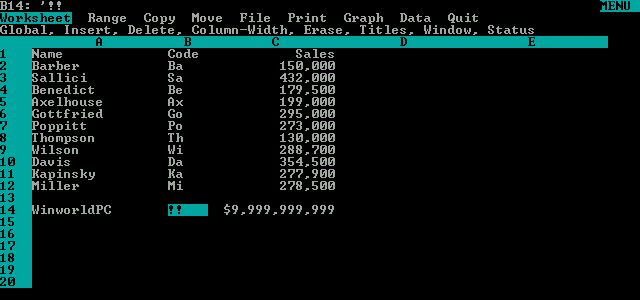
In the early 1980s, spreadsheets were still a nascent idea. VisiCalc had proven the concept and created the market, but it was Lotus 1-2-3 that turned spreadsheets into a business phenomenon. Launched in 1983 by Lotus Development, 1-2-3 combined raw speed, integrated graphing, rudimentary database features and programmable macros into a single, keyboard-driven package that ran well on the IBM PC. The result was an application that not only dominated office automation for a decade but also shaped how people thought about end-user computing.
This article revisits Lotus 1-2-3: what it introduced, why it mattered, and how its ideas echo in modern spreadsheet tools like Microsoft Excel and Google Sheets.
The state of play before Lotus 1-2-3
VisiCalc (late 1970s) is rightly credited with inventing the electronic spreadsheet as a killer app for microcomputers; it showed managers they could replace manual ledgers with interactive, recalculating models. But VisiCalc had limits: it was slow on larger data sets, lacked built-in charting, and offered limited programmability.
When Lotus 1-2-3 arrived in 1983 it addressed many of those shortcomings at once. The company behind it - Lotus Development, co-founded by Mitch Kapor and with key technical work by Jonathan Sachs - delivered a product engineered for the constraints of early PCs while offering features that anticipated how business users actually worked.
References: see the histories of Lotus 1-2-3 and VisiCalc.
What made Lotus 1-2-3 innovative
Lotus 1-2-3 was not just a faster VisiCalc clone. Several design and engineering choices made it stand out:
Performance-first engineering - Lotus 1-2-3 was written in optimized code for DOS and the IBM PC’s hardware, which made recalculations and navigation much faster than competitors on the same machines. That speed mattered for larger worksheets and complex models.
Integration of spreadsheet, charting and rudimentary database operations - Rather than forcing users to switch applications for graphing or data manipulation, 1-2-3 bundled those capabilities. This integration reduced friction and made it possible to build reports end-to-end in one package.
Macro and automation support - Lotus introduced programmable macros that automated repetitive tasks and enabled complex workflows. This was an early, powerful form of end-user programming that let business users extend the application to their needs.
Command-centric, keyboard-optimized UI - In an era before mice and graphical interfaces were widespread, 1-2-3’s keyboard-driven commands (and memorable command keys) made data entry and model navigation fast for experienced users.
File and worksheet organization - Features such as multiple worksheets per file, print formatting controls, and modest database-like functions supported the kinds of multi-sheet financial models that analysts needed.
These features together created a step-change in what spreadsheets could do and how quickly professionals could do it.
For a deeper look at Lotus’s technical and business rise, see the Computer History Museum collection and archival notes on spreadsheet history.
Business impact: adoption and cultural change
Lotus 1-2-3 accomplished two things that amplified each other: it convinced businesses the IBM PC was a viable platform for serious work, and it gave end users a tool that let them build models, forecasts and reports faster than before.
Driving PC purchases - Companies bought PCs to run Lotus 1-2-3. The application became a de facto reason to invest in personal computers and raised expectations of what office software should deliver.
Democratizing analysis - Accountants, financial analysts and managers could build complex models themselves rather than rely exclusively on dedicated programming teams. That shift helped fuel the broader movement of “end-user computing.”
Creating an ecosystem - Because 1-2-3 files stored the business logic, many organizations standardized on Lotus file formats and workflows. Consulting firms and software vendors produced templates, macros and add-ins tailored to Lotus users.
The market dominance that followed also made Lotus a major software company almost overnight, but dominance proved hard to sustain as platforms and interfaces evolved.
The technical legacy in modern spreadsheets
Many conventions and expectations in modern spreadsheet software can trace lineage back to Lotus 1-2-3-either directly or as reactions to what it introduced.
Functional spreadsheet model - The concept of cell-based formulas, immediate recalculation and grid-based modeling are core to all spreadsheet tools that followed.
Automation and macros - Lotus’s macro support showed both the power and peril of embedded end-user programs in spreadsheets. Microsoft eventually built a much more sophisticated automation environment (VBA) in Excel, but the idea that spreadsheets are programmable objects started with early macro systems such as Lotus’s.
Integrated visualization - 1-2-3’s built-in charting foreshadowed the importance of integrated visualization - today’s Excel charting and Google Sheets charts follow the philosophy that data and its graphical representation should live together.
Keyboard-centric efficiency and shortcuts - Even in graphical spreadsheet environments, many keyboard conventions were designed to preserve the speed that 1-2-3 users appreciated.
File and model portability issues - As with any dominant format, Lotus-created file formats and behaviors shaped compatibility issues, interoperability debates and litigation related to program interfaces and look-and-feel. These debates influenced how later vendors approached compatibility and standards.
For an overview of how spreadsheets evolved into powerful analysis and BI tools, compare Lotus’s role with the later growth of Microsoft Excel.
Lessons from 1-2-3’s rise-and its fall
Lotus 1-2-3’s history carries several lessons that remain relevant for software designers and product managers:
Solve a real pain with great performance - Lotus succeeded because it made spreadsheets faster and more capable than the incumbent, and because speed mattered to users.
Integration reduces friction - Combining spreadsheet, charts and basic data tools in one product created a powerful one-stop workflow. Modern SaaS suites echo this integration strategy.
Design for extensibility - but manage risk - Macros extended users’ power but also introduced complexity and risk (bugs, errors, maintainability issues). Today’s spreadsheet ecosystems still wrestle with balancing user programmability and safety.
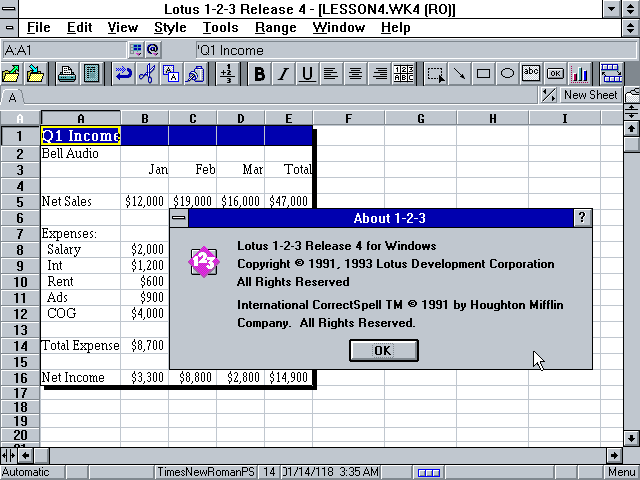
Platform transitions can be fatal - The shift from DOS to graphical Windows environments and later to collaborative cloud-native apps rewarded vendors who adapted quickly. Lotus’s slower transition to GUI and networked, collaborative paradigms allowed competitors to gain ground.
User habits persist - Many keyboard shortcuts, formula conventions and interaction patterns established in early spreadsheets persisted long after the original product faded.
The darker side: errors, governance and the spreadsheet as code
One of the underappreciated impacts of spreadsheets is their role as an informal programming environment. Studies since the 1990s have documented how spreadsheets frequently contain errors and how these errors can propagate into business decisions (Raymond Panko’s work is a good entry point).
Lotus 1-2-3 helped normalize building complex, mission-critical logic inside spreadsheet files. That democratization was powerful but it also created systemic risks: fragile models, undocumented macros, and difficulty auditing calculations. Addressing these risks has driven features like version control, auditing tools, formula inspection, and safer scripting models in modern spreadsheet platforms.
From Lotus 1-2-3 to cloud-native collaboration
Fast-forward to today and spreadsheets are collaborative, cloud-hosted, often integrated with APIs and other apps. Google Sheets, Excel Online and various BI tools inherit architectural concepts first popularized by desktop products like 1-2-3 (grid model, formulas, charts) while adding real-time collaboration, permissions, and programmatic APIs.
The philosophical throughline is that spreadsheets remain the simplest, most flexible general-purpose business programming environment - which is exactly what Lotus 1-2-3 unlocked for a generation of users.
Why revisit Lotus now?
Revisiting Lotus 1-2-3 is useful not just as nostalgia but as a way to understand how much of our modern productivity stack grew from design decisions made under tight technical constraints. It highlights how software can alter hardware markets, how products can create new job practices (end-user programming), and how early design patterns can persist for decades.
If anything, the 1-2-3 story is a reminder that software that fits into real workflows, is fast and integrated, and exposes useful extensibility will shape broad adoption - but vendors must also evolve interfaces, safety and collaboration paradigms as platforms change.
TOPICS: Business/Economy; Computers/Internet; History
KEYWORDS: lotus123; spreadsheets
Navigation: use the links below to view more comments.
first 1-20, 21-40, 41-46 next last
The greatest spreadsheet ever.
Accountants, financial analysts and managers could build complex models themselves rather than rely exclusively on dedicated programming teams.
It’s been said that the 1980s, Reagan-era growth was fueled by finance. Lotus 123 undoubtedly was a key tool in driving the advent of leverage buyouts and high-yield bonds, and with that a revamping of American industry.


1
posted on
09/05/2026 5:32:43 PM PDT
by
DoodleBob
To: DoodleBob
I still use lotus 123. still works with windows 11
2
posted on
09/05/2026 5:38:25 PM PDT
by
PeterPrinciple
((Thinking Caps are no longer being issued, but there must be a warehouse full of them somewhere))
To: DoodleBob
I still use lotus 123. still works with windows 11
3
posted on
09/05/2026 5:38:25 PM PDT
by
PeterPrinciple
((Thinking Caps are no longer being issued, but there must be a warehouse full of them somewhere))
To: DoodleBob
I found out about a state agency in Connecticut that used DOS Lotus 1-2-3 like for a critical database on a fast 286.
1-2-3 was fast because it was written in assembler, and it stored the whole spreadsheet in main memory, not on floppies or even hard drives. So, when the department’s database got too big, they added more RAM. When it ran out again, they added more. And more. When they hit the hard OS limit of 16 MB, it broke the file. They lost everything. (I hope they had an earlier backup).
4
posted on
09/05/2026 5:40:23 PM PDT
by
Dr. Sivana
("Whatsoever he shall say to you, do ye." (John 2:5))
To: DoodleBob
It was so much easier to have print macros with multiple exhibits on one tab.
To: alternatives?
Quattro Pro
Wordstar
CP/M
Those were the Days
To: DoodleBob
I snagged a pirate copy of VisiCalc for my Commodore 64, but couldn’t figure out what it was for.
7
posted on
09/05/2026 6:07:51 PM PDT
by
E. Pluribus Unum
(Israel First. America... who cares?)
To: PeterPrinciple
I still use LOTUS 123. If I remember Visicalc, does that make me OLD? :)
8
posted on
09/05/2026 6:41:01 PM PDT
by
NEMDF
To: PeterPrinciple
I used Lotus 123 to project the income of the Price Club’s photo processing wholly owned subsidiary. Then I used Lotus 123 macros to do the same for their hamburger subsidiary.
I then became an expert in Excel 2.0, and could share a lot of interesting stories about Excel add-ins and projects.
But it all started when I read an an article on 10 tips for using Lotus 123 in the product’s magazine.
To: DoodleBob
I’m so old I remember learning Lotus 1 2 3, WordStar and dBase III.
10
posted on
09/05/2026 7:17:07 PM PDT
by
AlaskaErik
(There are three kinds of rats: Rats, Damned Rats, and DemocRats.)
To: AlaskaErik
>I’m so old I remember learning Lotus 1 2 3, WordStar and dBase III
Ditto, And Foxbase+ (better than dBase III)
To: DoodleBob
DOS Lotus was the best. So much better than Excel.
12
posted on
09/05/2026 7:38:32 PM PDT
by
MayflowerMadam
(In the end, we will remember not the words of our enemies, but the silence of our friends.)
To: nevadapatriot
My cousin worked for Foxbase. Became part of Microsoft when Foxbase was acquired by Microsoft. Did *very* well working at Microsoft.
13
posted on
09/05/2026 8:15:21 PM PDT
by
FreedomPoster
(Islam delenda est)
To: DoodleBob
Before Microsoft bundled MS Office with Windows 95, Lotus 1-2-3 was the dominant spread sheet software and Word Perfect was the dominant word processing software. Because Microsoft was able both to adapt the software to the changed operating system and then bundle it with, the competition couldn’t keep up. Microsoft did the same and more with its Internet Explorer and gave it away for free. Other web browsing software couldn’t compete with free.
14
posted on
09/05/2026 8:28:56 PM PDT
by
Dr. Franklin
("A republic, if you can keep it." )
To: Dr. Franklin
When that bundling happened is when I told people that Bill Gates is the anti-Christ.
I must’ve been prescient. Look what he’s up to now.
15
posted on
09/05/2026 8:31:17 PM PDT
by
MayflowerMadam
(In the end, we will remember not the words of our enemies, but the silence of our friends.)
To: AlaskaErik; DoodleBob
To: George from New England
Oh my stars!
Lotus,
DOS 5 vis basic,
Word Star,
MS Works,
and then came that lovely Mac 475 with the medium pizza box and Sony Trinitron monitor.
Latter, rescued by Win 3.0 ad nauseum.
To: MayflowerMadam
There were still quite a few dial-up BBSs around when the software bundling became common. Many of those sysops had similar opinions of Bill Gates.
It would've been different if the application software that MS was pushing was as good or better than the targeted competition, but it never was. Heck, even some of the pre-Windows office suite software packages, like Symantec's Q&A, were better than what MS eventually forced on everyone.
18
posted on
09/05/2026 8:56:52 PM PDT
by
Charles Martel
(Progressives are the crab grass in the lawn of life.)
To: George from New England
Quattro Pro
Wordstar
CP/M
Those were the Days
************************************
Add:
Borland Turbo C and C++ - Still available, no support though. Used it to write a receiver test setup for a set of digital elint receivers and the test equipment to drive and read them.
Still have DOS3.3 around here somewhere, and an old T40 with a floppy drive plug-in.
19
posted on
09/05/2026 9:05:47 PM PDT
by
dagunk
To: AlaskaErik
I’m so old I remember learning Lotus 1 2 3, WordStar and dBase III. Same here. I used dBase to set up a catalog of everything being auctioned off for a huge factory that was being shut down. File stored on 8" floppy. Used to print reports on an old printer that used typewriter hammers and ribbon to print - took forever to print anything. Also used an Apple II to set up a database of calibrated equipment, but dBase would have done a much better job.
20
posted on
09/05/2026 9:08:56 PM PDT
by
Some Fat Guy in L.A.
(Still bitterly clinging to rational thought despite its unfashionability)
Navigation: use the links below to view more comments.
first 1-20, 21-40, 41-46 next last
Disclaimer:
Opinions posted on Free Republic are those of the individual
posters and do not necessarily represent the opinion of Free Republic or its
management. All materials posted herein are protected by copyright law and the
exemption for fair use of copyrighted works.
FreeRepublic.com is powered by software copyright 2000-2008 John Robinson