Transcript
The man known to history as Emperor Vespasian was born as Titus Flavius Vespasianus in the village of Falacrine to the north-east of the city of Rome in central Italy on the 17th of November in the year 9 AD. His father was Titus Flavius Sabinus, a member of the gens Flavia, an equestrian family which had been of relatively minor status for several centuries of Roman history, but which had become more powerful from the late second century BC onwards, with a member thereof claiming the consulship, the highest political office in the Roman Republic, in 104 BC. However, the family later suffered demotion within Roman society in the transition from the republic to the empire, largely because Vespasian’s grandfather had fought on the wrong side of the civil war between Julius Caesar and Pompeius Magnus between 49 BC and 46 BC, and faced sanctions along with many other Pompeians in its aftermath.
As a result, Vespasian’s father functioned primarily as a tax collector in the province of Asia in what is now western Turkey and later as a moneylender amongst the Helvetii north of Italy in modern-day Switzerland, hardly a distinguished career for the father of a future Roman Emperor. However, Vespasian’s mother was Vespasia Polla; she came from a more prominent equestrian family. Her father, for instance, was a prefect of the camp, the third most senior rank within a Roman legion, while her brother eventually became a Roman senator. Both Vespasia’s family and the gens Flavia were equestrian families, the second highest class within Roman society, being equivalent to the gentry or knightly class in later times but below the patrician class, the Roman aristocracy.
As such, while Vespasian hailed from what might be termed an upper middle-class family, his background certainly did not suggest that he would rise to the station in life which he eventually did, the top of Roman society. Vespasian was educated at Cosa, a town in southwestern Tuscany overlooking the Tyrrhenian Sea. His tutoring was overseen primarily by his paternal grandmother, Tertulla, whose estate was in the Tuscan countryside. The schooling she provided him with would doubtlessly have focused on the core subjects of the Roman curriculum in ancient times, such as rhetoric, grammar, philosophy, as well as the classic texts of Roman literature including Vergil’s Aeneid, produced some years before Vespasian was born and which presented a classic synthesis of Rome’s foundation myth, one which traced the city’s lineage back to Prince Aeneas of Troy.
Vespasian evidently had fond memories of his childhood here and in later years he would often visit Cosa, even long after his grandmother’s passing. Little else is known about Vespasian’s early life, although his education would have ended in the early 20s AD as Roman children were deemed to enter adulthood around the age of 14, teenagehood being a relatively modern concept. Coming from a middling equestrian background, he entered the Roman military with a view to becoming an officer, an avenue which was seen as a springboard to a political career in Roman times.
Vespasian grew up during a period of transition in Roman history. Rome had emerged as a significant power in the Western Mediterranean in the fourth and third centuries BC and then expanded to dominate the Eastern Mediterranean in the second and first centuries BC. Consequently, by the mid-first century BC the city of Rome ruled huge amounts of territory, but it was not yet an empire in terms of its constitution and political arrangement. Rather, Rome was a republic throughout these centuries, one primarily ruled by the Senate and a number of magistrates such as the consuls, aediles, praetors, and quaestors who were elected for set terms.
However, the republic’s constant expansion made the generals of Rome’s armies increasingly powerful and in the first century BC a series of civil wars occurred in the republic as figures like Cornelius Sulla, Gaius Marius, Julius Caesar, and Pompeius Magnus sought to dominate the Roman state. Eventually, one of these figures, Octavian, emerged victorious and in 27 BC he established a new constitutional position for himself. Renaming himself Caesar Augustus, he also adopted the title of ‘Princeps’, or ‘First Citizen’ of Rome, though he is more usually known by one of his other titles, ‘Imperator’, meaning ‘Commander’, from which the modern word ‘Emperor’ is derived.
While these events had occurred decades before Vespasian was born, they are significant to his life story, for Vespasian’s later ascent as Emperor of Rome himself was brought about owing to the fact that the ability of a Roman general to claim absolute power within the Roman state never disappeared. And the possibility that a Roman general might usurp the imperial title was made more plausible by the apparent problems with Caesar Augustus’s successors. He died in August 14 AD, when Vespasian was just four years old. His immediate successor was his stepson Tiberius, who is generally viewed as a poor ruler who absented himself from Rome for many years and handed over far too much power to Sejanus, the prefect of the Praetorian Guard, the only military soldiers allowed in the Italian Peninsula.
Tiberius is even viewed as becoming tyrannical in the final years of his reign in the 30s AD, a problem which was compounded by his successor, Caligula, who became emperor in 37 AD and is known, amongst other things, for his sadism, sexual deviancy, and planning to make his horse Incitatus a consul. While the historical accuracy of these depictions of Caesar Augustus’s descendants, the Julio-Claudian dynasty, as they are known, by later Roman writers is certainly open to question, the general view is that the failure of Augustus’s heirs to live up to the standard of leadership he had shown weakened the dynasty’s claim to power and in doing so opened the window during Vespasian’s lifetime to a fresh civil war and the ascent of a new dynasty. Vespasian and his sons would be the great beneficiaries of these developments.
Vespasian’s early career in the Roman military was one of gradual promotion through the ranks of the Roman war machine. He served in Thrace in what is now European Turkey and Bulgaria as a tribune of the soldiers, a middling officer rank which placed him in charge of a few hundred men within a legion, each of which consisted of between five and six thousand men when all soldiers and auxiliary staff were taken into account. From there he was promoted to the rank of quaestor in the province of Crete and Cyrenaica, the Roman name for Libya. As quaestor he was in charge of the province’s military garrisons, but Crete and Cyrenaica was a relatively poor province with a small garrison, most of which was stationed in desert forts in Cyrenaica to prevent Berber raiders attacking the Roman settlements along the Mediterranean coast.
Though this was an inauspicious position, it qualified him to stand for election to become an aedile and after several failed attempts he finally obtained that office in 38 AD. This position placed him in charge of managing public buildings and events at Rome and allowed him to cultivate greater contacts amongst the Roman patrician class and the central government in the late 30s AD. Therefore, he was able to gain election as a praetor in either 39 or 40 AD, the second senior most magistracy in the Roman political world, junior only to the office of consul and obviously the emperor himself. Vespasian was possibly serving as praetor when in January 41 AD the Praetorian Guard, with the connivance of many senators and court officials, murdered Caligula and placed his uncle, Claudius, on the throne.
During these years of ascent, Vespasian also married and started a family. Sometime between 37 and 38 AD, when he was nearing his thirtieth year, he married Flavia Domitilla, the daughter of Flavius Liberalis, a quaestor’s clerk from Ferentium in Italy. She came from a very humble background, and the family may even have been descended from free slaves. As such, this was not a political marriage which Vespasian aimed to gain from socially and politically. They eventually had three children together. A son, Titus, was born in the last days of 39 AD. A daughter named Domitilla for her mother was born some years later, perhaps around 45 AD, though the exact date and even year is unclear, while a second son followed after a good many more years in October 51 AD.
Vespasian was also involved during these years in a contubernium relationship with Antonia Caenis, a freed slave woman. Such contubernium relationships in Roman times were generally between slaves or else a free citizen and a slave, in this case, a rising Roman magistrate and a recently freed slave. Crucially, Antonia Caenis was a secretary and aide to Antonia Minor, the mother of the new Emperor Claudius. This facilitated Vespasian’s rise even further under the new emperor.
Vespasian was involved in the 40s AD in one of the most significant episodes of the reigns of Augustus’ successors. The founder of the Julio-Claudian Dynasty had left instructions for Tiberius that future emperors should try to consolidate the vast Roman Empire after two centuries of rampant expansion rather than trying to conquer new territory. Tiberius had followed that advice to a large extent, but Caligula had been preparing an invasion of Britain when he was killed, and Claudius determined to follow through with it. This was perhaps because he was disabled, having a limp and being partially deaf. In an effort to prove his martial prowess in spite of his physical limitations, Claudius decided to continue with his nephew’s proposed campaign and decided to invade Britain in the early 40s AD.
Julius Caesar had visited Britain in the mid-50s BC, but had not undertaken a major military campaign there, while Augustus had planned several invasions, but none of these had come to fruition and Britain remained outside of imperial control. Yet extensive trade was carried out with the people of these distant lands, and the Romans of the first century AD were well aware that there were extensive tin mines in the West Country, a valuable resource to the Romans if they could conquer southern England. Now at last, after a century of flirting with the idea by various Roman generals and rulers, Claudius launched an invasion of Britain in 43 AD. The exact scale of the Roman army involved is unknown, but it is most likely numbered between 35,000 and 40,000 legionaries made up of four Roman legions and another 15,000 to 20,000 auxiliary troops.
Vespasian was central to this. While Aulus Plautius commanded the overall invasion, with Claudius stationed in northern Gaul waiting to cross the English Channel when the invasion was sufficiently advanced, Vespasian, who only recently had served as a praetor, was appointed as a legate and placed in charge of one of the legions which was involved in the campaign, the Legio II Augusta. The armies crossed to southern England on hundreds of transport ships, though the exact landing site is unknown. Thereafter, they headed north to secure the site on the shores of the River Thames where central London lies today and where the Celtic Britons who inhabited Britain in ancient times had a settlement. There, Vespasian was involved in a major battle against the Celtic tribes of the region such as the Artrebates, Trinovantes, and Catuvellauni.
Following the establishment of Roman control here, Plautius continued north-east to secure control of the foremost Celtic oppida or hill fort town in southern England, Colchester. Vespasian was sent south-west to secure control of the tin and silver mines in Cornwall and Somerset. Along the way, he conquered over a dozen Celtic oppida and occupied the Isle of Wight before establishing his headquarters in what is now Exeter. Such was the speed of the initial conquest in 43 AD that Claudius was quickly able to proceed across the Channel later that year and received the submission of eleven British kings of southern Britain. The emperor then returned to Rome to celebrate his military triumph while Vespasian and the other generals remained in England into the second half of the 40s AD, gradually consolidating the conquest and extending the borders into the English Midlands and southern Wales.
Vespasian finally ascended to the most powerful political office in the Roman Empire in 51 AD when he was elected as consul. There were two consuls elected each year, and in the days of the republic prior to the creation of the imperial office by Caesar Augustus, the consuls had been the most powerful figures in Rome for the year that they held office. The office of consul was particularly prized because after the consul served his term in office, he was usually appointed as governor of one of the Roman provinces. A governorship came with the ability to enrich oneself at the expense of the subjects there, though within reason. Some limited corruption was considered a perquisite of office, but governors who were too avaricious could face prosecution back in Rome if they lined their pockets too extravagantly during their tenure of office.
However, Vespasian did not enjoy this privilege of the consulship immediately following his year in office, for the simple reason that in the early 50s AD he fell out of favour with Claudius and, in particular, his wife Agrippina, who incidentally was also his niece and increasingly the power behind the throne in the latter years of Claudius’s reign. When Claudius died in 54 AD, it was widely suspected that Agrippina had poisoned him. Her son from an earlier marriage, Nero, became emperor. His reign would form the backdrop to Vespasian’s own ascent as emperor.
Vespasian had largely retired from public life following his consulship in 51 AD owing to his falling out of favour with Claudius and Agrippina, and he remained out of public life for the remainder of the 50s AD. However, in 59 AD, Nero, who is depicted by the Roman historians of the early empire as growing tyrannical and unstable as his reign went on, is believed to have had his mother, Agrippina, killed owing to the influence of his soon-to-be wife Poppaea. Vespasian’s political rehabilitation ensued, and in 63 AD he was finally granted the governorship of the province of Africa, approximating to modern-day Tunisia and parts of western Libya.
His rule here seems to have been unpopular, and on one occasion, the denizens of the province pelted him with turnips. His biographer Suetonius, who we will hear more about later, suggests that he failed to acquire the riches which he would have expected to while serving in Africa and, as a result, ended up selling mules when he returned to Italy, an occupation which earned him the title ‘the Muleteer,’ though Suetonius’s account in this respect seems a little too colourful to be true.
These years also saw changes in Vespasian’s marital situation. His first wife, Domitilla, died at some stage in the second half of the 60s AD, following which his relationship with Antonia Caenis became more sustained. Despite Suetonius’s claims that Vespasian had become a mule trader after returning from his time as governor of Africa, in the autumn of 66 AD, Vespasian was selected to accompany Emperor Nero in a planned tour of Greece, an honour he would surely not have been granted had he not retained a certain status in Roman society. This was a dubious honour by 66 AD. If the Roman historians who wrote about his reign are to be believed, Nero had become increasingly unhinged by 66 AD.
For instance, it was suggested that he had intentionally started the Great Fire of Rome, which burnt down a huge portion of the city in 64 AD, with the goal of clearing land to build himself a vast new palace. He had also become obsessed with Greek culture, games, and gladiatorial contests at the expense of governing effectively. The imperial tour of Greece commenced in the autumn of 66 AD, with the court largely residing at Corinth, the provincial capital. The most noteworthy event of the tour seems to have been Nero’s participation in the Olympian Games, during which he unsurprisingly won every event. In the course of the tour, Vespasian appears to have offended the emperor by falling asleep during one of his musical performances and was briefly banished to outside of Corinth to atone for his sin.
Vespasian’s rise to power as Emperor of Rome would not have happened were it not for events which were occurring in the province of Roman Judaea right around the time that Nero’s tour of Greece commenced in 66 AD. Judaea, which approximates with southern Israel and Palestine today, had variously been conquered by the Babylonians, Persians, and Macedonians between the sixth and fourth centuries BC, but in the second century BC a religious leader named Judas Maccabeus led the Jews in a revolt against the Seleucid Empire, one of the successor states to the empire of Alexander the Great. Maccabeus successfully re-established an independent Jewish state in the Holy Land, one which was ruled by his descendants for decades to come and the history of which is the subject of Maccabees 1 and 2 in the Old Testament. However, this Jewish state, like all the other powers of the Eastern Mediterranean, soon faced Roman expansion in the region. Accordingly, in the mid-first century, the Kingdom of Judaea was effectively turned into a client kingdom of Rome, which was ruled by King Herod I as a vassal of the Romans. The Herodian Dynasty managed to retain some autonomy under Herod himself, but following his death around 4 BC, the Romans began consolidating their control of the region and in 6 AD the region was made into a new imperial province called Roman Judaea, although Herod’s descendants were allowed to remain as puppet rulers.
Roman rule was always uneasy in Judaea. The Jews were monotheists who worshipped what they believed to be the one true God as they perceived it, an unusual scenario in the Roman world, where the Romans themselves and many of their subjects such as the Greeks, Egyptians, Celts, and Germanic tribes were all polytheists, with pantheons of scores of gods who might have held different names in different regions, but which were all broadly similar to each other. For instance, the Greek king of the gods, Zeus, had a directly comparable god amongst the Romans called Jupiter. The unusual religious situation in Judaea, as well as the fractious activity of dozens of messianic preachers across the province in the first century AD, ensured that Roman rule in Judaea was already tense by the 60s AD, but they declined further following the appointment of Gessius Florus as the Roman governor of the province in 64 AD. Florus severely agitated the situation in Judaea by allowing sacrifices to the Roman and Greek gods to be carried out at the temple in Jerusalem, the most sacred place for the Jews, as well as synagogues across the province. He also increased taxation throughout the province and stripped a massive amount of gold and silver from the temple authorities. This led many senior members of the Jewish community in Jerusalem to protest to Florus, but his response was heavy-handed in the extreme, having some flogged and others crucified. These events precipitated the beginnings of a Jewish revolt in the city of Caesarea in 66 AD, one which quickly spread across the province and resulted in the swift capture of Jerusalem after an insurrection there.
Vespasian was not immediately involved in the suppression of the Jewish Revolt. Instead, the legate of the province of Syria to the north of Judaea, Cestius Gallus, was dispatched southwards to suppress it; however, his efforts failed and so Nero, who was in Greece, recalled Vespasian from his exile outside Corinth for having offended the emperor and his musical abilities to lead the suppression of the Jewish Revolt. He was duly dispatched to Roman Syria with two Roman legions, the Legio X Fretensis and the Legio V Macedonica. He landed with these at Ptolemais, the ancient name for the city of Acre, in April 67 AD. There he was joined by forces sent by King Herod Agrippa II, the Roman puppet king of Judaea, who had fled the province when Jerusalem fell to the rebels. Agrippa contributed several thousand loyalist Jewish troops to Vespasian’s forces. Thus, with two Roman legions and thousands of auxiliary troops, Vespasian invaded Judaea from the north in the early summer of 67 AD. In tandem, his son Titus, who had been preparing at Alexandria in Egypt for some months, marched into the south of the province with the Legio XV Apollinaris. Between the three legions, the auxiliaries, and their native allies, Vespasian and Titus commanded over 50,000 troops.
The campaign quickly resulted in successes. Vespasian largely pacified the northern part of the province, Galilee, that summer, following the successful sieges of Yodfat and Tarichea, while other major towns such as Tiberias and Sepphoris surrendered without a fight in the face of the advancing Roman army. The fall of Yodfat was particularly significant, as one of the leaders of the Jewish forces there was one Josephus, a member of one of the most prominent families of Jerusalem. This highly learned Jewish rebel subsequently ended up as part of Vespasian’s entourage and experienced a complete ideological about-turn. From being a leader of the Jewish Revolt in 66 and 67 AD, in the years that followed, Josephus became an ardent supporter of Roman rule in Judaea. He subsequently became a free Roman citizen in later years and even adopted the name Flavius Josephus in deference to his patron. He also began working as Titus’s translator. But he is most famous for his scholarly work when he went to live in Rome in 71 AD. A few years later, he completed The Jewish War, the most comprehensive account of the Jewish Revolt composed by a witness to it and one of the most detailed accounts of any ancient war ever written. His other works, Jewish Antiquities and Against Apion, offered accounts of Jewish history, culture, religion, law, and philosophy and are some of the most important texts written in Roman times. Josephus would not have produced these works had it not been for the patronage he was provided by Vespasian and Titus following his capture in 67 AD.
Following the pacification of Galilee in 67 AD, Vespasian began preparing during the winter for a spring offensive further south towards Jerusalem, while also securing the Mediterranean coastline and linking up with Titus’s forces from the south. This was a brutal campaign of suppression and even Josephus, who was writing about his own brethren, didn’t shy away from stating that as many as 100,000 Jews were either killed or enslaved in the pacification of Galilee and the coastal region. Meanwhile, in Jerusalem, various factions had begun fighting amongst each other, leading some to leave the city and reinforce sites such as Masada, an ancient hilltop fortification in southern Judaea. Vespasian and Titus recommenced their campaigning in the spring of 68 AD and over the next year captured many towns across the province in preparation for a major assault on Jerusalem. These included Jaffa, Hebron, and Ephraim. However, before Vespasian could begin besieging Jerusalem in 69 AD, events on the other side of the empire led him to change course.
While Vespasian was overseeing the pacification of Galilee and preparing for his military drive toward Jerusalem in 67 and 68 AD, plans were afoot to bring Nero’s reign to an end back in Rome. The emperor remained in Greece until the early winter of 67 AD and it was the following January before he returned to Rome itself. Just weeks later, the governor of northern Gaul, Gaius Julius Vindex, revolted against Nero’s rule. He was quickly defeated and subsequently killed himself, but his revolt set off a chain reaction whereby other powerful parties indicated their unwillingness to serve Nero any longer. The most significant of these was Servius Sulpicius Galba, a member of a powerful and wealthy senatorial family who was then the governor of Hispania Tarraconensis, a province which covered much of western Iberia. Galba had a significant military force under his command and his background ensured that many parties began to support his cause once he rebelled. Nero’s cause became desperate when the head of the Praetorian Guard, the elite troops stationed in the environs of Rome, Gaius Nymphidius Sabinus, also indicated his support for Galba, following which the Senate proclaimed the Spanish governor as the new emperor. Realizing that his grip on power had collapsed, Nero killed himself the following day.
Had Galba managed to restore order and consolidated his rule following Nero’s demise, Vespasian would doubtlessly have remained in the Eastern Mediterranean pacifying Judaea. But events did not end in June 68 AD. Within days, many others were scheming to replace the new ruler of Rome. One of these was Vitellius, a general whom Galba had just appointed to command the legions on the northern border in Germania. Vitellius repaid him for this promotion by taking these legions and marching on Rome. But before he could get there, a former ally and close friend of Nero’s, Marcus Otho, ascended as emperor in Rome after the Praetorian Guards murdered Galba in January 69 AD. He took the title Nero on the urging of the people of Rome, a development which casts into doubt the depiction of the original Nero as a maniacal tyrant. Why would Otho have tried to cast himself as a new Nero if the emperor from 54 AD to 68 AD had been so unpopular?
Otho then gathered an army and headed north to confront Vitellius and his legions from Germania. At the Battle of Bedriacum near Cremona in northern Italy on the 14th of April 69 AD, Vitellius won an overwhelming victory. Otho killed himself two days later and Vitellius proceeded to Rome as the third emperor to have reigned already in 69 AD. But there would be one more in what has become known as the Year of the Four Emperors. In the east, Vespasian and Titus were watching events far to the west with interest. Because they were in the process of suppressing the only major revolt underway against Roman rule at the time, Vespasian had the largest army anywhere in the empire under his control. As such, there was a great possibility that if he entered the civil war as a contender to become emperor, he could emerge victorious. He made the decision to do so in the early spring of 69 AD, most likely once news of Galba’s assassination reached Judaea. Yet he did not move immediately. Instead, he began soliciting the support of the governors and generals of the provinces in the east. Key here was Gaius Licinius Mucianus, the governor of Syria, the wealthiest and most powerful province in the region around Judaea. With Mucianus’s support assured, Vespasian was proclaimed as emperor by the legions under his command in early July. Thereafter, the governors of several provinces in the Balkans and in Egypt proclaimed their support for Vespasian, effectively making him ruler of the entire east of the empire and ensuring he had greater military forces and resources available to him than did Vitellius back in Rome. But Vitellius still controlled the Eternal City.
The civil war which followed between Vespasian and Vitellius was shorter than many at the time would have expected. Vespasian’s own actions certainly indicate that he was preparing for a lengthy struggle. Instead of heading directly for Italy with his legions, many of which had been sent westwards already under Mucianus, Vespasian headed for Egypt. His goal in doing so was to ensure maximum control of this province on which Rome and Italy were dependent for much of their food supply, Egypt being the bread-basket of the empire from which huge supplies of grain arrived every year to Rome. In the event of a lengthy conflict, Vespasian could cause huge damage to Vitellius’s cause if the food supply was cut off. But this would not prove necessary.
While Vespasian was consolidating his control over Egypt, Mucianus and another general who supported Vespasian, Marcus Antonius Primus, led his forces through the Balkans and towards northern Italy. In the end, it was Antonius Primus who oversaw the campaign against Vitellius’s forces in northern Italy, and after gaining several decisive victories, marched on Rome. Vitellius attempted to abdicate at this point in favor of Vespasian, but his supporters refused to accept this, and a bitter siege of Rome commenced. Eventually, Antonius Primus secured the city for Vespasian, but not before many of the great temples and other buildings on the Capitoline Hill in the center of the city were destroyed. Vitellius was captured and duly executed on the 20th of December 69 AD. Vespasian was now the undisputed Emperor of Rome.
Vespasian needed to move quickly to ensure that further unrest did not lead to the emergence of a new rival for power. He was aided by the fact that his younger son, Domitian, was in Rome and able to manage affairs there, while neither Antonius Primus nor Mucianus decided to use the forces under their command or their proximity to Rome to try and claim the imperial title themselves. When news reached Egypt of the defeat of Vitellius, Vespasian quickly ordered the dispatch of huge cargoes of grain to Italy to end the blockade of Rome he had imposed. Curiously, he stayed in Egypt for long enough to be formally hailed as emperor at a ceremony in the hippodrome in Alexandria, the second largest city in the empire. Here he was proclaimed as pharaoh, the ancient title granted to the rulers of Egypt since the late fourth millennium BC. Once this was done, he left for Rome, where he arrived by the early summer of 70 AD. There he consolidated his control over the empire by increasing taxation on Rome and the provinces and using the extra finances to make payments to the legions, which ensured their loyalty and blocked another rival from emerging.
The first few years of Vespasian’s rule are somewhat peculiar, in that he effectively seems to have had a co-ruler during this time. The governor of Syria, Gaius Licinius Mucianus, had been Vespasian’s foremost supporter during the civil war with Vitellius, and without his aid and, most importantly, the troops he supplied, it is possible that Vespasian would have been unable to defeat his western adversary and claim the position of emperor himself. Such was his role in Vespasian’s ascent to power that he is believed to have stated sometime after the end of the civil war that he had, “bestowed the sovereignty upon Vespasian,” i.e., made him emperor. Perhaps unsurprisingly then, we find that Mucianus held an extremely powerful position in the first years of the new reign, one which has led some classical scholars to suggest he was effectively a co-ruler. For instance, while Vespasian was in Egypt after Vitellius’s defeat, Mucianus was effectively governing the western provinces from Rome. Furthermore, he was appointed as consul, the most powerful political office in the empire, in 70 AD and again in 72 AD. He largely disappears from the record thereafter, and it is likely that he died in the mid-70s AD, suggesting that until his illness and death, this powerful political figure may have been an unofficial co-ruler with Vespasian and a major power behind the throne.
Of course, while Vespasian had been engaged in the latter stages of the civil war, the Jewish Revolt had still been smoldering in Judaea. While the victories he and Titus had in Galilee and Samaria in 67 and 68 AD, as well as the infighting between various Jewish factions in Jerusalem, had ensured that there was no momentum for the leaders of the revolt to try to retake any towns or cities in 69 AD while Vespasian was occupied elsewhere, they still held Jerusalem, along with extensive parts of the east and southeast of the province. Until these were secured, the revolt was not over. For that reason, Vespasian had left Titus in command of a reduced military contingent in Judaea when he himself left for Egypt and Mucianus proceeded northwest with the bulk of their legions. Titus subsequently continued to regain control of other parts of the province, and by late 69 AD, only Jerusalem and a number of other isolated strongholds such as Masada remained in Jewish hands. Then, three days before the Passover in 70 AD, his armies arrived in Jerusalem and laid siege to the city. This would continue for nearly five months, with the city crammed with people who had fled there in the wake of the Roman advance.
The siege became an enormously bloody affair, with many dying of starvation before the Roman capture of the city led to massive casualties. Josephus presented the wildly exaggerated claim that over a million people died in the siege, but while this can be safely discounted as the kind of embellishment that was typical of ancient historians, the death toll nevertheless must have numbered in the tens of thousands. Most strikingly, the great temple of Jerusalem, the center of the Jewish religious and cultural world, was destroyed in the final days of the siege, thus bringing the Second Temple Period in Jewish history, which had commenced when the temple was rebuilt in the sixth century BC after the Babylonian Captivity, to an end.
The fall of Jerusalem did not bring a complete end to the Jewish Revolt. There were still some isolated pockets of resistance to be dealt with. These included the hilltop fortress of Masada, where the Sicarii, a Jewish sect, had moved to and made their base of operations after a falling out with the authorities in Jerusalem in 68 AD, as well as Herodium in what is now the West Bank and Machaerus in modern-day Jordan. Titus, though, would not oversee the final stages of the revolt. Instead, he left the Legio X Fretensis in Judaea to carry out these operations and left the east, along with Josephus, to join his father in Rome. Because of the reduced forces left behind in Judaea and because of some inertia on the part of the Romans who realized that the isolated pockets of resistance in eastern Judaea did not pose any sort of wider threat, it eventually took until 73 AD to complete the full suppression of the revolt when Masada was captured after a long siege, in the closing stages of which the Sicarii killed each other rather than face capture and enslavement by the Romans. A great proportion of their co-religionists were not as lucky, and tens of thousands of Jews were enslaved following the fall of Jerusalem and other engagements during the suppression of the
Thus, while Civilis did manage to defeat and nearly destroy two Roman legions in battle in 69 AD, Vespasian quickly sent an army of eight legions north under his son-in-law, Quintus Petillius Cerialis. With this massive force, which outnumbered the entire Batavian population, Civilis crushed the revolt and a legion was stationed permanently at Noviomagus thereafter, the site of the modern-day city of Nijmegen.
There are a number of difficulties in evaluating Vespasian’s rule. There are a number of multiple detailed histories written by Roman historians who lived during his reign. The primary ones are the Histories of Tacitus, a Roman senator of the late first century AD, and Suetonius, the author of the Lives of the Caesars, who grew up in the 70s AD and later became an imperial archivist and secretary in the early second century AD. Tacitus’s Histories covers the period from the civil war of 68 to 69 AD down to the end of the Flavian Dynasty which Vespasian founded in 96 AD. Suetonius’s Lives presents biographies of all the Caesars from Julius Caesar and Octavian down to the end of the Flavian Dynasty as well. In both instances, they were eager to present Vespasian as a model emperor who had restored order to the empire after the civil war and years of alleged tyranny under Tiberius, Caligula, and Nero. Yet they were clearly biased. Tacitus belonged to an old Roman noble family that had fallen on hard times under the Julio-Claudian emperors, but which was restored to prominence during Vespasian’s reign. Moreover, his father-in-law had been appointed as Governor of Britain by Vespasian and he had clear reasons for presenting the first Flavian emperor in as positive a light as possible. Similarly, Suetonius’s methodology was to present the Julio-Claudian emperors who followed Augustus as tyrants and to present the idea of a non-hereditary imperial office in the best light possible, given that his employers in the early second century AD, the Emperors Trajan and Hadrian, had both been selected by their predecessors to succeed them, not on the basis of family ties, but purely their merit as individuals. These biases aside, Tacitus and Suetonius, along with Josephus, are still the most important sources we have for Vespasian’s time as emperor.
Suetonius is a particularly useful source for his reflections on the personality and character of the emperors whose lives he studied. Vespasian, as he depicts him, was a ruler who never forgot his humble roots, remaining amiable and down to earth throughout his reign and avoiding the excessive behaviour which had apparently characterised the reigns of Tiberius, Caligula, and Nero, each of whom had grown up as part of the imperial family. He was charitable and this extended in particular to providing financial aid to old impoverished Roman families from the patrician and equestrian classes. This latter trait may have been why he was so favourably depicted by Tacitus, Suetonius, and others, who were members of or had connections to the senatorial and political classes in Rome. Moreover, unlike his predecessors, Vespasian is understood not to have developed the predilection for having people killed for upsetting him over rather trivial matters. One area, though, where he was repressive was in his intolerance towards philosophers, especially those who questioned the wisdom of imperial rule and the hierarchical structure of society. In line with this, he revived certain laws which punished talk of restoring the republic. The impression overall is of a stable, but conservative ruler.
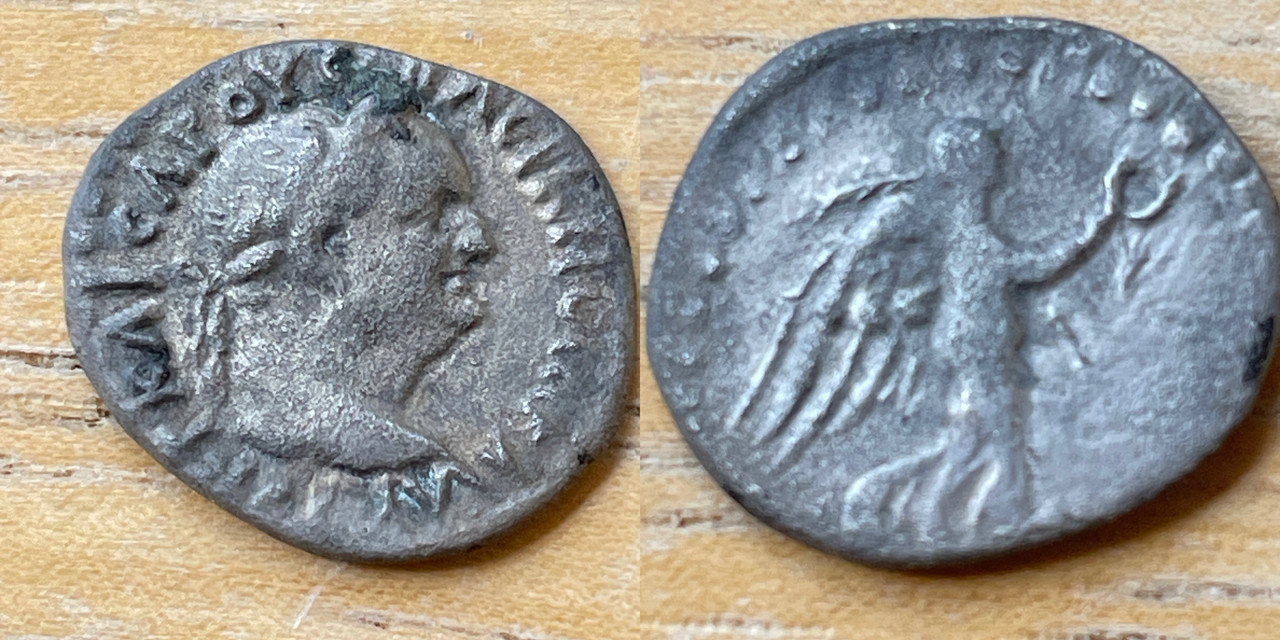
While many aspects of Vespasian’s reign are obscure or quickly passed over by the main accounts of his reign of Tacitus, Suetonius, or the later Greco-Roman historian, Cassius Dio, it is clear that he did engage in concerted efforts to promote his reign through propaganda of various kinds. As we will see, much of this focused on his building programme, but other measures were also taken. For instance, Vespasian manipulated the Roman coinage to present himself as the unchallenged new emperor. More coins on average for the length of his reign were issued bearing Vespasian’s profile than were for emperors such as Tiberius, Claudius, and Nero, while there was also a concerted effort to remove the coins which had been issued by Otho and Vitellius with their profiles from circulation. Given that for many Roman subjects in the wayward provinces of the empire coins were the most direct engagement they would ever have with a distant emperor, this was a significant move. This practice was followed by his sons in the subsequent reigns.
Vespasian also publicised certain divine omens which were presented as evidence of divine favour towards him becoming emperor. The Romans took such divine omens very seriously and the success of Vespasian’s efforts to promote them is clear from the fact that details of them are related not just by contemporaries such as Suetonius, but also by Cassius Dio who was writing more than a century after Vespasian’s reign.
Vespasian was also a major patron of education and the arts. In contrast to his persecution of philosophers, he gave financial and other bequests to eminent poets and artists who lived in Rome and beyond, while set salaries were established for many teachers of Latin, Greek, and other subjects such as rhetoric. His motives in doing so were most likely to foster the growth of a professional bureaucracy which would begin to administer the Roman provinces and the central government in Rome itself in a more efficient manner, with tens of thousands of officials needed empire-wide to run the provincial administrations, collect taxes, uphold Roman law, and manage the military from an administrative perspective. A number of the ancient world’s most substantial scholars also worked during Vespasian’s reign and the emperor patronised them. Quintilian, a brilliant Spanish rhetorician whose abilities in ancient times were deemed to be second only to those of Cicero, established a school of rhetoric in Rome in the late 60s AD which flourished during Vespasian’s rule. The emperor was clearly a supporter of Quintilian who was made consul in the 70s AD. Tacitus possibly spent time here, as well as Pliny the Elder, who in the 70s AD was compiling his famous Natural History, one of the foremost encyclopaedias of knowledge compiled in Roman times. Pliny was also made a procurator by the emperor as early as 70 AD.
A major aspect of Vespasian’s reign was the manner in which he expanded Roman rule in Britain, where thirty years earlier he had been central to the first establishment of Roman rule in the south of the island. This had been expanded northwards into the Midlands and southern Wales in the intervening period, but Vespasian desired to go further. In 77 AD he appointed Gnaeus Julius Agricola as governor of Britain and charged him with expanding into northern Wales and even further northwards in Britain itself. There is an unusually large amount of information on this campaign because Tacitus composed an historical biography of Agricola who was his father-in-law. In 78 AD the new governor initiated a new campaign against the Ordovices, the tribe which dominated the bulk of northern Wales and the island of Anglesey. The Ordovices had been campaigned against in previous years, but had remained only partially subdued. By the end of the year Agricola had largely completed the conquest of Wales, bringing forces onto their island stronghold of Anglesey and forcing the tribe to accept peace terms. He subsequently headed north-east, campaigning with his legions into the Scottish Lowlands. Hence, although he would not live to see it, Vespasian’s directives to Agricola set in motion chain events which saw the Roman Empire extended into northern England and southern Scotland for the first time.
Back in Rome, the emperor was becoming known for an altogether more peculiar policy. In ancient times and indeed until as recently as the sixteenth and seventeenth centuries in some parts of Europe, urine was used for numerous industrial processes, including dying clothes, tanning, wool production, and as detergent to wash clothes as the ammonia in it removes stains. Consequently, as disgusting as it might seem to the modern mind, urine from the public bathrooms across the city of Rome was collected and sold to various people involved in clothes-washing and manufacturing. Nero appears to have been the first to introduce a tax on urine which those who used it for these purposes had to pay, but according to both Suetonius and Cassius Dio it was more systematically imposed by Vespasian. Alternatively, the urine tax might be misunderstood and it may have been a simple tax on using the public bathrooms which were built across the city. In any event, Vespasian became so famous for introducing this ‘urine tax’ that when the municipal governments of cities like Paris and Rome first began introducing public bathrooms in their cities in the nineteenth century they were called ‘vespasiennes’ and ‘vespasiano’.
Urine taxes aside, Vespasian’s greatest contribution to the civic life of the city of Rome was the building programme which that he oversaw. A vast proportion of the city had been destroyed during the Great Fire of 64 AD, and it still had not been re-developed by the time Vespasian came to the throne, if the sources are to be believed, because Nero had planned on taking over a vast part of the city centre and building his new palace across it. His downfall and the civil war further stalled any plans to rebuild the city, and so it fell to Vespasian to oversee this work in the 70s AD. Suetonius credits him with the restoration of the city by allowing anyone who had been left homeless in 64 AD and who had subsequently left the city to return and build on any vacant lots in a move which seems utopian when contrasted with modern bureaucratic inertia when attempting to build anything.
Vespasian also began the redevelopment of the Capitoline Hill, one of the seven hills on which Rome was built. Here he erected a Temple of Peace alongside the Forum. More significantly, he rebuilt the Temple of Jupiter Optimus Maximus, which had suffered damage in both the Great Fire and during the civil war and was reputedly the oldest major temple in the city, built hundreds of years earlier. This was where the triumphal parades of Roman generals and emperors ended and was an iconic site in the city’s history. Over on the Caelian Hill, he also erected a temple in honour of Claudius, during whose rule Vespasian’s public profile had become significant enough to allow him to later claim the office of emperor.
As significant as these other building projects were, Vespasian is primarily remembered today from an architectural standpoint for building the Flavian Amphitheatre, or as it is more commonly known today, the Colosseum. There had been gladiatorial games and other spectacles held in Rome for centuries by the time of Vespasian’s rule, but these had no fixed home, with different amphitheatres, often built of wood, being used over the decades. Vespasian decided to rectify this and turned over land which Nero had earmarked for his vast palace for the purposes of building such a stadium. Building work on the amphitheatre, which initially could hold an audience of over 50,000 people, was commenced around 72 AD using money which had been acquired by plundering Judaea as the Jewish Revolt was suppressed.
Built with slave labour and out of travertine limestone, volcanic rock, and Roman concrete, the resulting edifice was laid out in three tiers which would be filled according to one’s social class in Rome, while at nearly fifty metres high it was probably the tallest building in the Roman world when finished. However, Vespasian would never live to see it completed. In the end, it was not until 80 AD, the year after his death, that the Flavian Amphitheatre was finished. It would subsequently be expanded to hold upwards of 80,000 people in future decades. The great amphitheatre was nearing completion by the time that Vespasian died. His reign in the end lasted nearly exactly ten years from when he was first proclaimed by his legions in Egypt back in 69 AD. His demise came in the countryside to the northeast of the city of Rome, near where he was born almost seventy years earlier. There is some dispute over whether this occurred on the 23rd or the 24th of June 79 AD.
His death was described as follows by Suetonius, whose account is worth quoting at length:
“During his ninth consulship he suffered a slight illness when in Campania and, having at once returned to the city, he set off for Cutilae and the countryside of Reate, where he used to spend every summer. There, despite the fact that his illness was exacerbated by an intestinal disorder caused by excessive use of cold baths, he continued to perform his usual imperial duties just as before, even hearing embassies as he lay in bed. Suddenly stricken with an attack of diarrhoea so severe that he almost fainted, he said that an emperor should die on his feet. As he was struggling to rise, he died in the arms of those helping him, on the ninth day before the Kalends of July, at the age of sixty-nine years, one month and seven days.”
Vespasian was quickly deified, a Roman tradition whereby deceased emperors were deemed to have become gods in death. Following his death, Vespasian was succeeded by his eldest son Titus. Owing to his role in ending the Jewish Revolt in Judaea after his father had headed west to wage war on Vitellius, and the fact that he had held many prominent offices himself in Rome during the 70s AD, Titus was well-known to the Roman people when he ascended. He was apparently a popular ruler, one who benefited in terms of the public perception of him from presiding over the inaugural games which were held to commemorate the completion of the Flavian Amphitheatre shortly after he became emperor. Consequently, Suetonius and others presented positive assessments of his reign, but it was all too brief. He died of a fever in September 81 AD when just 41 years of age. As he did not have any sons or a designated heir, he was succeeded by his brother, Domitian. This younger Flavian reigned for 15 years and is generally understood today to have been an efficient, but autocratic ruler, one who clashed with the Senate and the Roman aristocracy. He was assassinated in 96 AD by a group of court officials, an act which brought the Flavian Dynasty which Vespasian had founded to an end. In his place, the Senate chose Nerva as the new emperor, an elderly and respected Roman magistrate and senator.
Henceforth for the next century, the empire was ruled by a succession of rulers known today as the Five Good Emperors, each of whom chose their successor on the basis of their merits as a potential ruler, rather than familial or hereditary considerations.
Vespasian’s reign as emperor is in some ways difficult to assess. His rise was extremely fortuitous and came about only because he was in command of a large Roman army in the Eastern Mediterranean in 68 AD, one which was tasked with suppressing the Jewish Revolt, when the civil war broke out back west. He was consequently able to use these military forces to wage war on Vitellius and become emperor himself. In the process, he brought stability to the empire and established a new dynasty which would rule it for nearly three decades. His accomplishments thereafter were substantial. He suppressed the Batavian Revolt, expanded the Roman presence in Britain, and undertook a major building programme, which included one of the most famed buildings in Roman history, the Colosseum.
Yet, there are black marks against his name. The suppression of the Jewish Revolt was brutal, although admittedly much of it was carried out by Titus, while the roots of Anti-Semitism are in many ways traceable to policies he enacted against the Jewish people following the revolt. But beyond these issues, it is difficult to assess Vespasian. Overall, he seems to have provided a period of general peace and prosperity after the alleged tyranny of Nero’s reign. But whether Vespasian’s qualities as an emperor and the contrasting chaos of Nero’s reign were inventions of Tacitus and Suetonius in their histories and biographies may never be fully known.