Skip to comments.
Who Were the Sea Peoples? Exploring references in Christopher Nolan's The Odyssey
Biblical Archaeology Review ^
| July 27, 2026
| Zachary Thomas
Posted on 07/27/2026 8:49:09 PM PDT by SunkenCiv
In Nolan's new adaptation of the Odyssey, Homer's epic poem about Odysseus's struggle to return to his kingdom in Ithaca after the Trojan War, the "People of the Sea" hang over the plot like a dark cloud -- a rumor of coming destroyers and harbingers of a dark age mentioned by multiple characters along the way... Let's clear up one thing first: No ancient text refers to this group by the name "Sea Peoples." This is a scholarly term popularized by the 18th-century Egyptologist Gaston Maspero to refer to a collection of groups that threatened New Kingdom Egypt... It was once common to read that the Sea Peoples were responsible for destroying towns and cities around the eastern Mediterranean at this time, especially in texts associated with Ramesses III. While there is clear evidence that some destruction happened, more recent analyses suggest that widespread devastation was far less extensive than once thought... the great Hittite capital Hattusha was indeed burned, but archaeologists now believe this was only after it had been abandoned. The city of Ugarit in modern Syria, capital of the kingdom of the same name, is not directly named by Ramesses III but actually was violently attacked and burned, with excavations finding weapons from the battle left in its streets. Yet at neither Ugarit nor practically any other site that was destroyed do we find clear evidence that the Sea Peoples were responsible.
(Excerpt) Read more at biblicalarchaeology.org ...
TOPICS: History; Science; Travel
KEYWORDS: bar; christophernolan; godsgravesglyphs; hollywood; odyssey; peopleofthesea; theodyssey; ugarit; zacharythomas
Navigation: use the links below to view more comments.
first previous 1-20, 21-37 last
To: higgmeister
Not really.
The movie is good that it raises how people feared the “sea peoples” - kinda like people later feared Vikings or Barbary slavers.
But the movie does not tell you anything real about the sea peoples who were not really from that time period but slightly later.
A good book to start off on the sea peoples is “The sea peoples’ by Charles river Editors — purely as a starting point.
For more in-depth, I recommend:
1. 1177 BC - the year civilization collapsed by Eric H cline
2. the Philistines and Aegean migration at the end of the bronze age - by Assaf Yasur-Landau
Based on the many white papers etc out there and on the carvings by the only Bronze-age civilization that survived (well, limped on) - the Egyptian, we can say that:
1. the sea peoples were NOT a concerted invasion by one people - rather it was a number of different peoples from different places at different times invading different places
2. Climate change played a massive role - both in compelling the ‘sea peoples’ to leave their lands and in the collapse of the bronze age super-powers
3. the bronze age MEDITERRANEAN super-powers: Middle kingdom Egypt, the hittites, the myceneans, the minoans, the Assyrian empire in the Middle east — were centralized, almost “communist-like” (to use an anachronistic parallel) with a big boss on top and trade happening between palaces. The religion was purely a give-and-take kind of religion with the gods and secular authorities merged. This world depended heavily on inter-trade for bronze, goods etc. further afield, the Harappan civilization doesn’t seem to have much centralized religious or political authority, but it also traded heavily with egypt, sumeria, akkad etc. — yes, there was globalization in 1600 BC :)
4. the Sea-peoples referred to by the Egyptians had names that seem to indicate that the different peoples came from Sardinia, from Sicily (these are pre-Greek and highly likely pre-Italic i.e. pre-Indo-european peoples) as well as Pelasgians from what is now Greece - they were probably Greekified :) locals who were originally pre-Indo-European.
21
posted on
08/21/2026 3:04:28 AM PDT
by
Cronos
(Strange women lying in ponds distributing swords is no basis for a system of government.)
To: Reily; Jan_Sobieski
Jan + Reilly — both of you are correct that the Philistines had a clearly proto-Greek core but were an “amalgam” of the various “Sea peoples” — While the core elite or cultural instigators carried an Aegean genetic footprint, they traveled and raided alongside people from western Anatolia, Cyprus, and various Mediterranean islands. After analyzing the ancient DNA of 10 individuals buried at a Philistine archaeological site, an international team of researchers found that the Philistines descended from people in Greece, Sardinia or even Iberia (present-day Spain and Portugal). These ancestors migrated across the Mediterranean during the late Bronze Age or early Iron age, about 3,000 years ago. From a 2019 Ashkelon DNA study found that early Iron Age Philistine skeletons possessed roughly 25% to 70% European-related ancestry (best matching Greece, Crete, Sardinia, or Iberia). However, the population was highly heterogeneous from the very beginning. Within just two generations, that European genetic signature completely washed out. They heavily intermarried with the local Levantine/Canaanite population, culturally melting into their new home
We have no surviving blocks of text in the original Philistine language, as they rapidly adopted the local Canaanite (Semitic) language and script within a couple of centuries. However, trace remnants point to an Indo-European framework that was likely non-Greek or a mix of Aegean and Anatolian tongues - A significant portion of Philistine loanwords and titles point directly to Luwian, an Indo-European language spoken in western and southern Asia Minor (modern Turkey). The Philistines did not have kings; they were ruled by five lords called seren. Linguists used to link this to the Greek word tyrannos (tyrant), but modern consensus heavily leans toward it being a direct borrowing of the Luwian royal title tarwanis.
The “Philistines” melted into the Canaanite population pretty quickly - like the originally Germanic “Rus” melted into the East Slavic population. The descendants of those Philistines are found among all Levantine populations - including people who are Jews, Samaritans, Christian Arabs, Muslim Arabs, Druze, etc. etc.
22
posted on
08/21/2026 3:05:01 AM PDT
by
Cronos
(Strange women lying in ponds distributing swords is no basis for a system of government.)
To: Berosus
23
posted on
08/21/2026 3:09:22 AM PDT
by
dennisw
("If they make something really good, they will inevitably stop making it." - Robert Quine)
To: Cronos
I just read and reread a few times a fascinating National Geographic article about the neglected Hittites. They took on the Egyptian Pharaoh’s armies in a great chariot battle that was fought to a draw.
24
posted on
08/21/2026 3:13:02 AM PDT
by
dennisw
("If they make something really good, they will inevitably stop making it." - Robert Quine)
To: Cronos
25
posted on
08/21/2026 4:57:36 AM PDT
by
Jan_Sobieski
(Sanctification;)
To: dennisw
Yes, the
Hittites were entirely forgotten except for sporadic mentions in the Hebrew Bible. Early biblical interpretations, such as those found in the Book of Judges (compiled long after the empire's collapse), frequently made readers consider them just another minor local Canaanite tribes like the
Jebusites. However, 19th-century archaeological excavations completely shattered this assumption.
The discovery and excavation of their massive capital, Hattusa
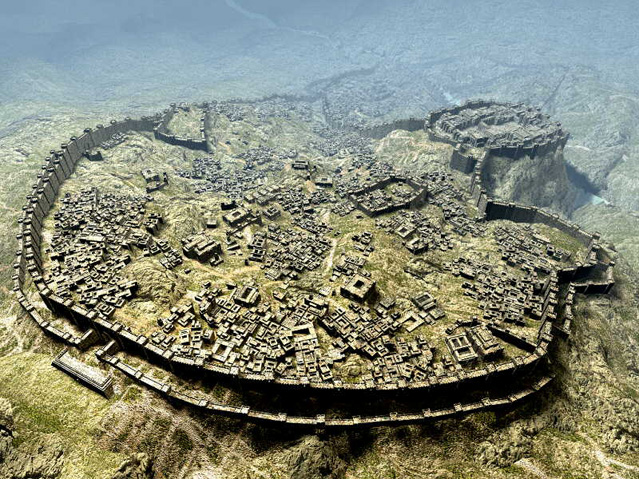
proved that the Hittite Empire was not a minor tribe, but a colossal Bronze Age superpower. At its peak, it rivaled New Kingdom Egypt and Assyria, projecting dominant military and geopolitical power across Anatolia and the northern Levant.

What is fascinating to me is that they spoke an Indo-European tongue - not a Semitic or Sumerian or Caucasian language. Older historical linguistics models used to tell us about a neat, simultaneous split of the Proto-Indo-European (PIE) speech community into simple eastern (indo-Iranian) and western (germano-Italo-Celtic, greek, albanian, armenian, balto-slavic) trajectories. Modern scholarship rejects this binary layout. Instead, current models favor a multi-phased wave or pulsed expansion model stemming from the Pontic-Caspian steppe (frequently identified with the Yamnaya Culture)

Under this framework, successive circular pulses or waves of pastoralist migrations left the Urheimat (homeland) at different sequential eras:
- Wave 1 (The Anatolian Split): The absolute earliest group to detach from the PIE core, migrating south into the Balkans and Anatolia around 4000–3500 BCE. This wave gave rise to Hittite, Luwian, and Palaic.
- Wave 2 (The Early Horizon): The migration that birthed the enigmatic Tocharian languages, pushing drastically eastward across Central Asia.
- Wave 3 (The Western/Late Horizon): Massive subsequent waves spreading west and northwest into Europe. This late-stage PIE cluster eventually fractured into the familiar European branches: Celtic, Germanic, Italic, Balto-Slavic, Hellenic (Greek), Albanian, and Armenian.
- Wave 4 (The Indo-Iranian Horizon): A highly dynamic, later wave moving east and south, splitting into the Iranian and Indo-Aryan branches (the historical "Aryans"). This wave carried advanced chariot warfare technology into Central and South Asia.
When Bedřich Hrozný deciphered Hittite cuneiform tablets in 1915, it upended the linguistic world. Hittite did not fit neatly into common Indo-European paradigms because it split from the root tree before many defining features of late Proto-Indo-European ever evolved.
This fundamental divergence is highlighted by severe structural differences between the Anatolian branch and standard Indo-European branches:
- The Laryngeal Consonants: Hittite famously preserves laryngeal sounds (written as ḫ). These sounds were entirely lost in all other surviving Indo-European branches, though their historical existence had been mathematically predicted by Ferdinand de Saussure.
- Absence of Grammatical Gender (Masculine/Feminine): While standard Indo-European languages utilize a three-gender system (masculine, feminine, neuter), Hittite possesses only a two-gender system: animate (common) and inanimate (neuter). It split away before the masculine/feminine distinction developed in late PIE.
- Simplified Verbal System: Hittite lacks complex grammatical moods like the subjunctive or optative, and misses the highly developed aspect/tense systems found in Vedic Sanskrit, Classical Greek, or Latin.
To fully understand the madness fo these ancient migration pulses, we need to far to the east to the Tocharians (Tocharian A and B). Settled deep in the Tarim Basin of modern Xinjiang, China, the Tocharians represent another archaic, highly isolated early wave of Indo-Europeans.
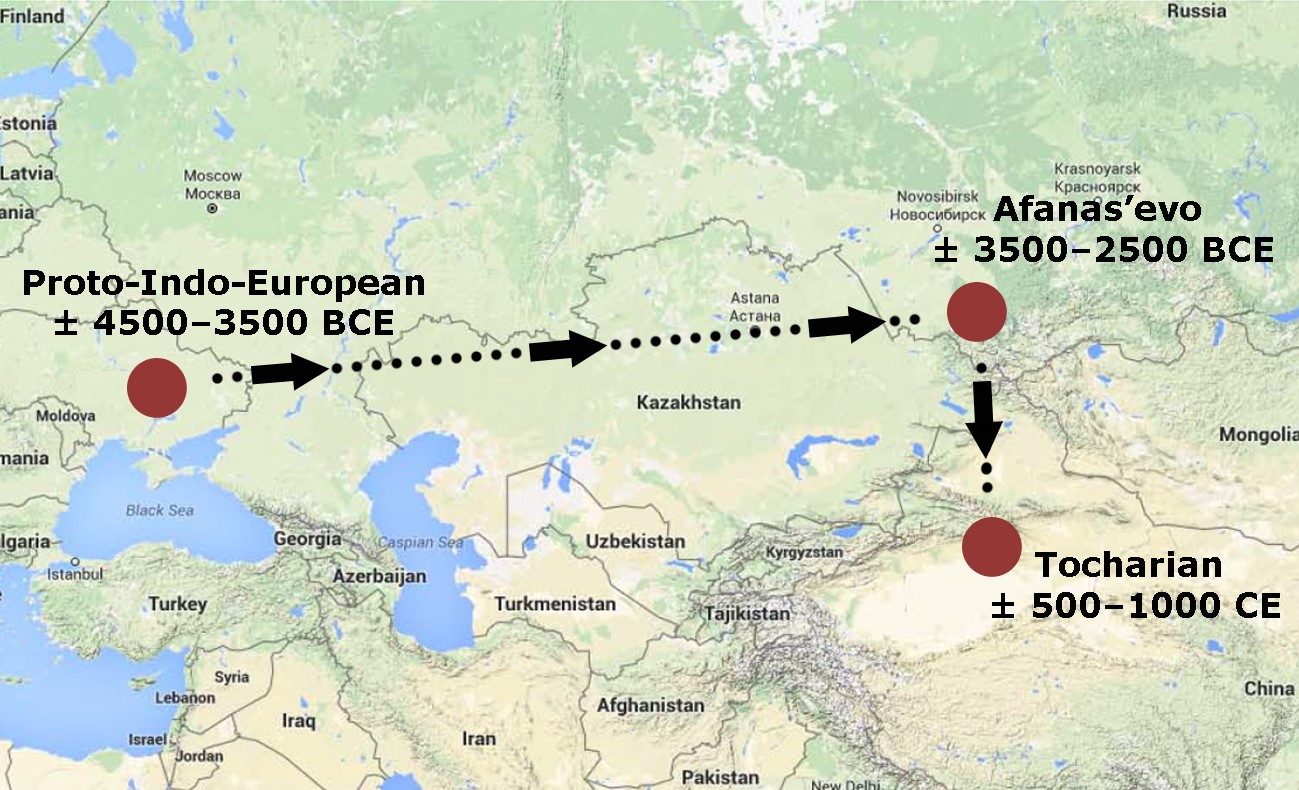
Intriguingly, despite their deep geographic positioning in the Far East, Tocharian is classified phonologically as a Centum language (grouping structurally with Western European branches like Celtic and Germanic regarding the evolution of velar consonants) rather than a Satem language (like the neighboring Indo-Iranian branch). This proves they split off and migrated eastward independently, completely separate from the later Indo-Iranian expansions.
In addition, the Mitanni Empire was another Indo-european power that operated concurrently with the Hittites in northern Mesopotamia, but their internal societal layout was fundamentally different as they had Indo-European rulers fully integrating, absorbing, and dominating native Anatolian (Hattic) and local cultures rather than the other way around -- it was a native, non-Indo-European population ruled over by a highly distinct, minority Indo-Aryan warrior elite who were closely tied to the late-wave, nomadic Indo-Iranian branch, specifically pre-dating the compilation of the Indian Rigveda. they had Chariot-riding noble warriors known as the Maryannu (a term directly cognate with the Sanskrit word marya, meaning young warrior). The Mitanni elite did not leave full-length texts in an Indo-European language. Instead, they left an unmistakable Indo-Aryan linguistic superstrate embedded directly within Hurrian administrative and technical texts. This includes specific chariot-training manuals featuring Sanskrit numbers (e.g., aika, tera, panza for 1, 3, 5) and distinctly Indo-Aryan royal names (such as Artatama and Tushratta).
The religious records of these Near Eastern empires clearly expose their deep Indo-European cultural lineage through their pantheons. The best piece of evidence comes from an international diplomatic treaty signed circa 1380 BCE between the Hittite king Suppiluliuma I and the Mitanni king Shattiwaza.

In the cuneiform text of this treaty, the Mitanni elite invoked their solemn oath-gods. These deities are explicitly identical to the fundamental gods of the Vedic Hindu pantheon:
- Mitra-asli (The Vedic Mitra — God of Covenants and Alliances) - note that this guy was far different in characteristics from the much-later Roman "Mithras" and also slightly different from the later Persian Mitra
- Uruwana-assil (The Vedic Varuna — God of Cosmic Order and Sky) - Wiatr in Slavic
While the Mitanni swore directly to these late-wave Vedic gods, the Hittites experienced intense religious syncretism. They integrated their own storm-god concepts with the indigenous, non-Indo-European deities of the land, eventually boasting of a "Pantheon of a Thousand Gods."
26
posted on
08/21/2026 8:30:18 AM PDT
by
Cronos
(Strange women lying in ponds distributing swords is no basis for a system of government.)
To: Cronos
Not really what?
The casting was an intentional abomination to destroy our Western Civilization. I don't need to know anything about this filth beyond that.
27
posted on
08/21/2026 9:42:34 AM PDT
by
higgmeister
(In the Shadow of The Big Chicken! )
To: Cronos
You are a scholar on the Hittites! Here is the National Geographic article on them>>> https://archive.ph/9A0Bq#selection-6543.109-6543.126 They placed their capital far away from invaders, with rough terrain for invaders too.
Lucky me, I have the actual magazine
28
posted on
08/21/2026 4:05:11 PM PDT
by
dennisw
("If they make something really good, they will inevitably stop making it." - Robert Quine)
To: Cronos
Check out the illustration of the chariot battle they had with the great Egyptian empire. The two made peace after that battle.
29
posted on
08/21/2026 4:07:54 PM PDT
by
dennisw
("If they make something really good, they will inevitably stop making it." - Robert Quine)
To: higgmeister
Not really as in watching the movie is not going to give you any clear idea about the Sea peoples.
However, it did encourage a lot of people to look up who the sea peoples were!
30
posted on
08/21/2026 5:05:20 PM PDT
by
Cronos
(Strange women lying in ponds distributing swords is no basis for a system of government.)
To: dennisw
Far from a scholar, but I just like the connection to the wider indo European peoples
31
posted on
08/21/2026 5:06:08 PM PDT
by
Cronos
(Strange women lying in ponds distributing swords is no basis for a system of government.)
To: Cronos
32
posted on
08/21/2026 5:12:20 PM PDT
by
Bratch
To: SunkenCiv
Actually, it was the philodendrons...
33
posted on
08/21/2026 7:43:24 PM PDT
by
tet68
("We would not die in that man's company that fears his fellowship to die with us." Henry V.)
To: higgmeister
Hollywood doesn’t make documentaries.
34
posted on
08/21/2026 9:55:27 PM PDT
by
SunkenCiv
(TDS -- it's not just for DNC shills anymore -- oh, wait, yeah it is.)
To: AdmSmith
He’s using the conventional pseudochronology, and is just plain wrong about a Greek dark age, and the modern-mythical sea peoples.
35
posted on
08/21/2026 9:58:02 PM PDT
by
SunkenCiv
(TDS -- it's not just for DNC shills anymore -- oh, wait, yeah it is.)
To: Cronos; Reily; Jan_Sobieski
They didn't exist per se; the idea that a mighty storm of unknown belligerents arose from out of nowhere and everywhere, destroyed the Bronze Age polities, and left no writing, no burials, no characteristic weapons, no structures, and oddest of all, no ships (on the sea floor of course) is absurd. They are a result of the conventional pseudochronology of New Kingdom Egypt. The Peleset weren't the Philistines, they were the Persians, even the headware matches in the surviving bas reliefs (Egypt and Persia).
36
posted on
08/21/2026 10:01:41 PM PDT
by
SunkenCiv
(TDS -- it's not just for DNC shills anymore -- oh, wait, yeah it is.)
To: SunkenCiv
Pre diluvian civilization.
They were here created.
Intentional cover up
37
posted on
08/21/2026 10:02:30 PM PDT
by
Varsity Flight
( "War by 🙏 the prophesied set before you." ) I Timothy 1:18. Nazarite warriors. 10.5.6.5 These Days)
Navigation: use the links below to view more comments.
first previous 1-20, 21-37 last
Disclaimer:
Opinions posted on Free Republic are those of the individual
posters and do not necessarily represent the opinion of Free Republic or its
management. All materials posted herein are protected by copyright law and the
exemption for fair use of copyrighted works.
FreeRepublic.com is powered by software copyright 2000-2008 John Robinson