The discovery and excavation of their massive capital, Hattusa
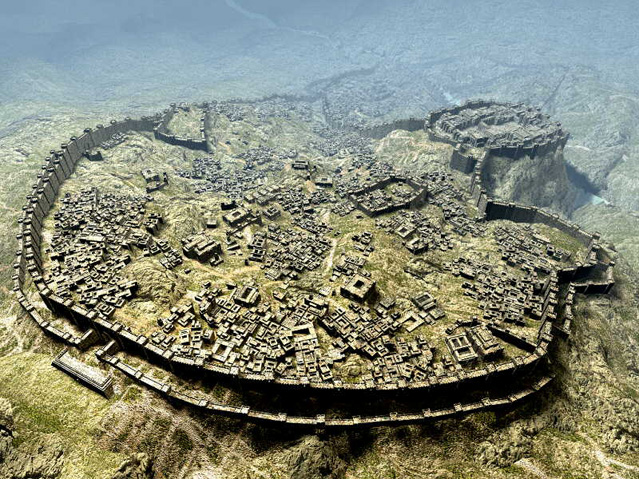
proved that the Hittite Empire was not a minor tribe, but a colossal Bronze Age superpower. At its peak, it rivaled New Kingdom Egypt and Assyria, projecting dominant military and geopolitical power across Anatolia and the northern Levant.

What is fascinating to me is that they spoke an Indo-European tongue - not a Semitic or Sumerian or Caucasian language. Older historical linguistics models used to tell us about a neat, simultaneous split of the Proto-Indo-European (PIE) speech community into simple eastern (indo-Iranian) and western (germano-Italo-Celtic, greek, albanian, armenian, balto-slavic) trajectories. Modern scholarship rejects this binary layout. Instead, current models favor a multi-phased wave or pulsed expansion model stemming from the Pontic-Caspian steppe (frequently identified with the Yamnaya Culture)

Under this framework, successive circular pulses or waves of pastoralist migrations left the Urheimat (homeland) at different sequential eras:
- Wave 1 (The Anatolian Split): The absolute earliest group to detach from the PIE core, migrating south into the Balkans and Anatolia around 4000–3500 BCE. This wave gave rise to Hittite, Luwian, and Palaic.
- Wave 2 (The Early Horizon): The migration that birthed the enigmatic Tocharian languages, pushing drastically eastward across Central Asia.
- Wave 3 (The Western/Late Horizon): Massive subsequent waves spreading west and northwest into Europe. This late-stage PIE cluster eventually fractured into the familiar European branches: Celtic, Germanic, Italic, Balto-Slavic, Hellenic (Greek), Albanian, and Armenian.
- Wave 4 (The Indo-Iranian Horizon): A highly dynamic, later wave moving east and south, splitting into the Iranian and Indo-Aryan branches (the historical "Aryans"). This wave carried advanced chariot warfare technology into Central and South Asia.
When Bedřich Hrozný deciphered Hittite cuneiform tablets in 1915, it upended the linguistic world. Hittite did not fit neatly into common Indo-European paradigms because it split from the root tree before many defining features of late Proto-Indo-European ever evolved.
This fundamental divergence is highlighted by severe structural differences between the Anatolian branch and standard Indo-European branches:
- The Laryngeal Consonants: Hittite famously preserves laryngeal sounds (written as ḫ). These sounds were entirely lost in all other surviving Indo-European branches, though their historical existence had been mathematically predicted by Ferdinand de Saussure.
- Absence of Grammatical Gender (Masculine/Feminine): While standard Indo-European languages utilize a three-gender system (masculine, feminine, neuter), Hittite possesses only a two-gender system: animate (common) and inanimate (neuter). It split away before the masculine/feminine distinction developed in late PIE.
- Simplified Verbal System: Hittite lacks complex grammatical moods like the subjunctive or optative, and misses the highly developed aspect/tense systems found in Vedic Sanskrit, Classical Greek, or Latin.
To fully understand the madness fo these ancient migration pulses, we need to far to the east to the Tocharians (Tocharian A and B). Settled deep in the Tarim Basin of modern Xinjiang, China, the Tocharians represent another archaic, highly isolated early wave of Indo-Europeans.
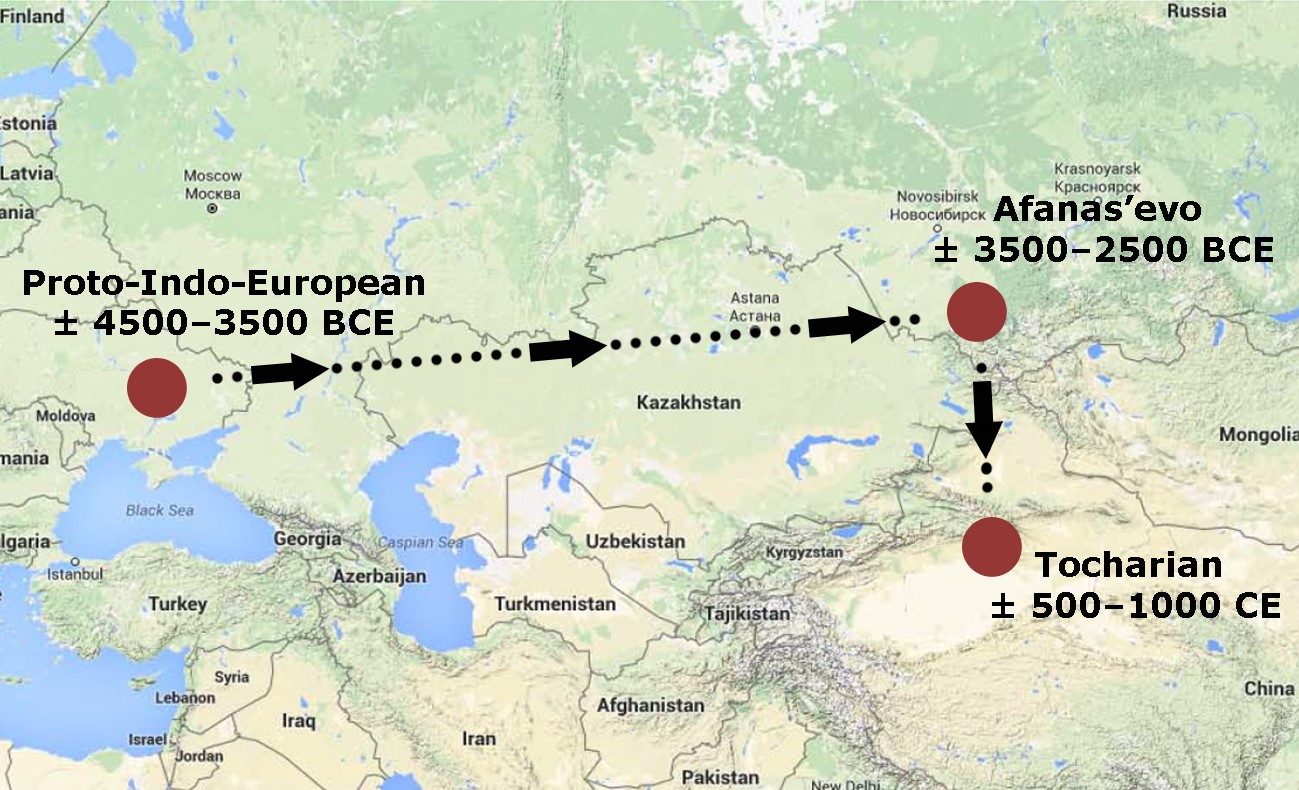
Intriguingly, despite their deep geographic positioning in the Far East, Tocharian is classified phonologically as a Centum language (grouping structurally with Western European branches like Celtic and Germanic regarding the evolution of velar consonants) rather than a Satem language (like the neighboring Indo-Iranian branch). This proves they split off and migrated eastward independently, completely separate from the later Indo-Iranian expansions.
In addition, the Mitanni Empire was another Indo-european power that operated concurrently with the Hittites in northern Mesopotamia, but their internal societal layout was fundamentally different as they had Indo-European rulers fully integrating, absorbing, and dominating native Anatolian (Hattic) and local cultures rather than the other way around -- it was a native, non-Indo-European population ruled over by a highly distinct, minority Indo-Aryan warrior elite who were closely tied to the late-wave, nomadic Indo-Iranian branch, specifically pre-dating the compilation of the Indian Rigveda. they had Chariot-riding noble warriors known as the Maryannu (a term directly cognate with the Sanskrit word marya, meaning young warrior). The Mitanni elite did not leave full-length texts in an Indo-European language. Instead, they left an unmistakable Indo-Aryan linguistic superstrate embedded directly within Hurrian administrative and technical texts. This includes specific chariot-training manuals featuring Sanskrit numbers (e.g., aika, tera, panza for 1, 3, 5) and distinctly Indo-Aryan royal names (such as Artatama and Tushratta).
The religious records of these Near Eastern empires clearly expose their deep Indo-European cultural lineage through their pantheons. The best piece of evidence comes from an international diplomatic treaty signed circa 1380 BCE between the Hittite king Suppiluliuma I and the Mitanni king Shattiwaza.
In the cuneiform text of this treaty, the Mitanni elite invoked their solemn oath-gods. These deities are explicitly identical to the fundamental gods of the Vedic Hindu pantheon:
- Mitra-asli (The Vedic Mitra — God of Covenants and Alliances) - note that this guy was far different in characteristics from the much-later Roman "Mithras" and also slightly different from the later Persian Mitra
- Uruwana-assil (The Vedic Varuna — God of Cosmic Order and Sky) - Wiatr in Slavic
While the Mitanni swore directly to these late-wave Vedic gods, the Hittites experienced intense religious syncretism. They integrated their own storm-god concepts with the indigenous, non-Indo-European deities of the land, eventually boasting of a "Pantheon of a Thousand Gods."