Posted on 07/09/2026 11:14:36 AM PDT by Red Badger
Studying old paintings can give us a surprising glimpse of historic natural history.
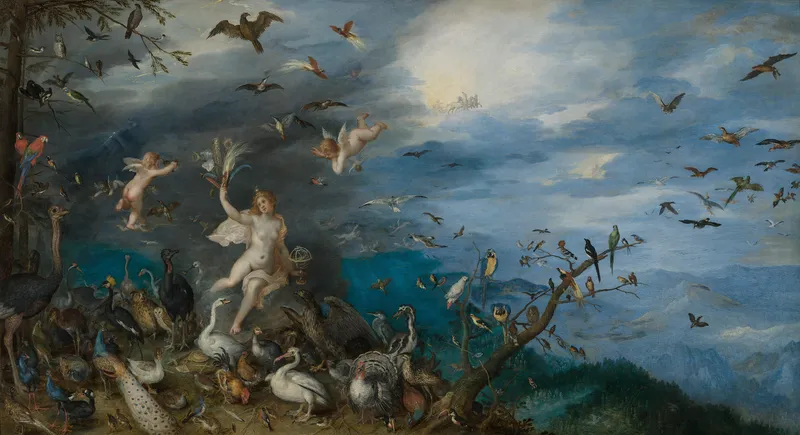
In 1611, the Flemish painter Jan Brueghel the Elder finished his epic allegorical painting Air. In it, he depicted the Muse of Astronomy, Urania, reclining on a cloud as a menagerie of feathered birds surrounds her.
But while studying the animals in the picture, one researcher spotted something far more intriguing: in the top right corner, there appeared to be a bat carrying a bird in its mouth.
For most people, this might not mean much. But for the ecologist Pedro Romero-Vidal it set his mind racing, because the predatory behavior of bats catching and eating birds in mid-flight had only been officially recorded in 2025.
It turns out that people have known about this rather unexpected behavior for a lot longer than that.
From cave paintings to Roman mosaics, for thousands of years humans have been recording the natural world around them in their art. This has provided an incredible record of what animals and plants past civilizations knew about, but one that has been historically overlooked.
“Everything that wasn’t created from inside the natural history academy has been overlooked historically,” Miguel Clavero, a researcher at Estación Biológica de Doñana and co-author of the study looking at the painting, told IFLScience.
“We assume there are no records about animal distributions prior to the 1950s because there were no scientists recording them. But you go to a geographical dictionary, and you have literally hundreds of thousands of records that you can use to model distributions and so on.”
“So we’re learning to get information from those overlooked sources, and for sure artworks are one of the important ones.”
This is where paintings such as Air come in. Brueghel is known to have paid great attention to the animals and plants he depicted, with many species easily recognizable. And this gives an amazing snapshot of the 1600s.
For example, the painting shows European species, such as swans, pelicans, and hoopoes, but also African grey parrots and grey crowned cranes, Indian peacocks, the Southeast Asian Raggiana bird-of-paradise, and Central and South American turkeys and macaws.
This can be used to highlight just how extensive trade was between all these far-flung locations and Europe. It can also be used as a record of past knowledge of animal behaviors. This is where the bats come in.
Based on the accuracy of the birds, the researchers can be fairly confident in the identity of the bat in the painting, which they’ve identified as a greater noctule bat. This is the exact same species that was the subject of the modern paper describing the bird-eating behavior for the first time.
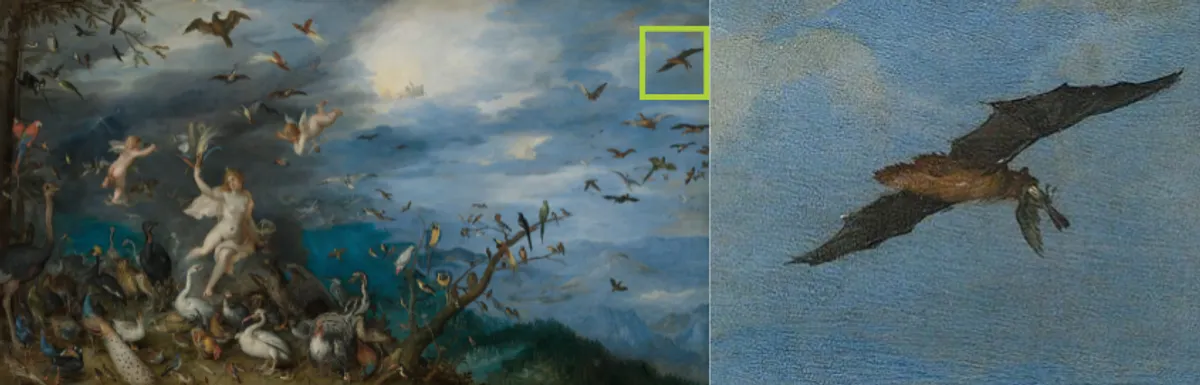
t's not easy to spot, but if you zoom in on the painting, the bird is clearly visible in the bat's mouth. Image credit: Musée des Beaux-Arts de Lyon via Wikimedia Commons (CC BY-SA 4.0); modified by IFLScience But the main question that hangs over many of these interpretations of historic paintings is how much the artists actually knew, and how much was artistic license. In this case, it's actually slightly more complicated.
“It is it is not straightforward, because in this particular case we are quite sure that it is artistic license because the painter could not have observed a bat carrying a bird in its mouth, because bats do not do that,” says Clavero. “The bats have to produce echolocation with their mouth to fly, so if they cannot produce the sound, they cannot fly.”
“We don’t know how Brueghel made the connection between noctule bats eating birds, but he didn't paint any bat. He painted exactly the bat species that does this.”
It seems likely then that when Brueghel traveled to Italy, he heard about this behavior, or at least saw the feathered remains of a bird on the floor, and decided to add it to the painting he was working on.
“This is absolutely fascinating work to do and fascinating discoveries to make,” says Clavero. “When you make them, it is so exciting.”
The study is published in the journal PNAS.
PinGGG!.................
They just discovered that bats capture and eat bats.
How can they be certain that bats can't fly without echolocation?
I don’t think the author is correct.
Bats aren’t stupid. They are also not blind.
And I’m pretty sure they have a built-in compass as most animals do, to find their way home.
Bat’s radar is for finding prey, not finding their home.........
Why would that be so surprising? Bats are mammals and therefore, carnivores or omnivores.
If a Bat came across a nestling or sleeping songbird, he just found his breakfast.
We could try asking Urania about it, but she was a mere
Muse, not a Zoologist.
Amusing..................
Tits
I consider myself an art aficionado. But I had never seen that painting. I guess it’s no wonder since it’s hanging in flint MI, for crying out loud.
Flint Michigan the Florence of America!................
ICWUDT !!
Yeah, well, I guess they both have fouled up water.
Notice that there is a TURKEY front and center!.............
Yeah, I guess I could have said fowled up water.
Given the new things being discovered about bat intelligence- at least in one species from Egypt- they cannot be sure bats cannot fly without echolocation.
Bats in this study are able to remember fruit trees , when they are worth visiting or not, and if you can remember and think in advance about a given location like a fruit bearing tree, it would be surprising to me that they couldn’t fly by memory alone.
In addition, bats aren’t necessarily blind. They have eyes. Some species can see, and how well probably varies by species.
They may also have senses as birds do for detecting the electromagnetic field, etc. Some birds can actually navigate by the stars and position of the sun. We know so little about bats relative to birds that a person would be foolish to say they are sure of everything these animals are capable of.
😁.......................
Modern science seems highly prone to condescension regarding what was “known” in the past.
That could be by scent.
Follow the money...
Jan Brueghel the Elder, the famous Flemish Baroque painter, shares deep historical and artistic connections with the Medici family.
Thanks!
[When] Chimpanzees were first discovered in Africa, the Romans believed that they were genuine satyrs, the mythological beings who were half man and half goat. There were also man-size apes called tityrus with round faces, reddish color and whiskers. Pictures of them appear on vases and they were apparently orangutans, imported from Indonesia. As far as I know, the Romans never exhibited gorillas although these biggest of all apes were known to the Phoenicians, who gave them their present name which means 'hairy savage'.-Daniel Pratt Mannix (1911-1997)
'Those about to die' (1958) p 148
Errhhh... deer and cattle, etc., would have a word with you...
Disclaimer: Opinions posted on Free Republic are those of the individual posters and do not necessarily represent the opinion of Free Republic or its management. All materials posted herein are protected by copyright law and the exemption for fair use of copyrighted works.
