Posted on 06/29/2026 8:05:04 PM PDT by Red Badger
Lava. Ash. Horrifying death.
All are known and expected outputs from an active volcano.
But one volcano deep in the farthest, frozen reaches of our planet marches to the beat of a slightly different drum.
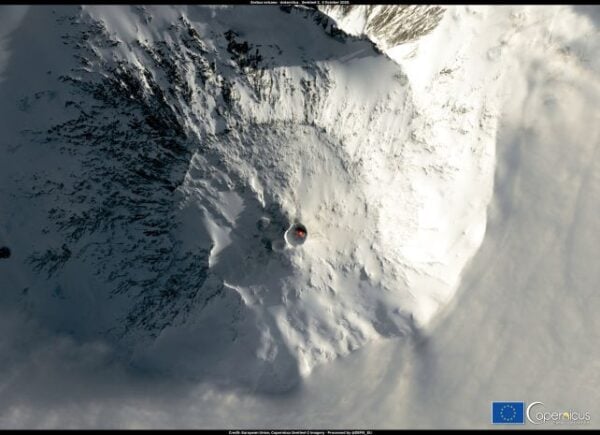
On Ross Island in the Ross Sea, a deep bay in Antarctica, Mount Erebus fumes about 1,350 kilometers (840 miles) from the Geographic South Pole. The world's southernmost active volcano, it bubbles with a permanent lake of blazing lava.
And in the gas constantly pouring forth from this gate to the underworld, scientists found microscopic particles of crystalline, elemental gold.
According to a 1991 research paper, published in Geophysical Research Letters, Erebus belches out about 80 grams (2.8 ounces) of microscopic gold dust per day, scattering it as far as 1,000 kilometers away – maybe even farther.
A satellite image of Mount Erebus showing its permanent lake of lava. (European Union, Copernicus Sentinel-2 imagery)
======================================================================================
To date, it's the only volcano in the world known to spew forth crystalline elemental gold particles.
The real mystery, though, is how the gold escapes the magma in the first place.
Actually, gold in volcanic emissions isn't all that unusual.
Trace gold has been detected chemically in samples from Kīlauea in Hawai'i, Etna in Italy, Augustine in Alaska, and El Chichón in Mexico.
Later theoretical work has suggested that gold can be transported in hot volcanic fluids, and likely gases too.
It makes sense. A volcano is basically a hole in Earth's crust, through which molten material from deep below the ground seethes upward.
Many elements, such as copper, silver, mercury, arsenic, selenium, and sulfur, as well as gold, are all thrown together in a glorious, literal melting pot, where they can join with other elements to form compounds.
VIDEO AT LINK...............
From there, the gold isn't evaporating like water from a kettle – the boiling point of pure gold is far hotter than volcanic temperatures. Instead, it is thought to hitch a ride in volatile chlorine- or sulfur-bearing compounds that can exist in the hot volcanic gases.
But according to a team led by geochemist Kimberly Meeker of the New Mexico Institute of Mining and Technology in the US, the Erebus gold is doing something not seen in any other volcano.
As part of their investigation of Mount Erebus's emissions, the researchers collected samples from the snow around the volcanic crater, from the plume of gas coming from the lava lake, and from the Antarctic troposphere up to 1,000 kilometers from the volcano.
In all three sample sets, they found micron-scale particles of pure gold.
Under an electron microscope, the particles appeared as intricate, faceted, almost perfectly geometric crystals rather than irregular specks, some measuring up to about 60 micrometers across.
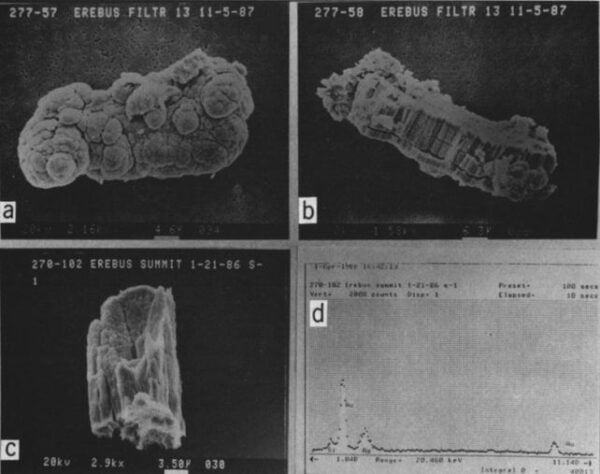
Particles of gold found in snow from Fang Glacier, 4 kilometers from the volcano (a and b), and in an air sample from the volcano's plume (c). A typical X-ray spectrum from the sampled particles is shown in the bottom right (d). (Meeker et al., Geophys. Res. Lett., 1991)
==================================================================================
The estimated daily output of 80 grams was actually somewhat smaller than that reported for some other volcanoes. Based on measurements available at the time, Kīlauea emitted an estimated 500 to 800 grams of gold per day, while estimates for Etna reached as high as 2.4 kilograms.
But there's something unique about Erebus that allows the gold to separate from the compounds that held it in the volcanic emissions.
One model the researchers proposed is that gold is carried out of the lava in volatile chlorine-bearing compounds. As the gases cool, the gold crystallizes out of these compounds before eventually coming to rest on the Antarctic ice.
One difficulty with that model is that the gas contains very little gold; under those conditions, the spontaneous nucleation of beautifully formed crystals in the air is very difficult.
Another scenario later proposed by volcanologist Philip Kyle of the New Mexico Institute of Mining and Technology, a member of the research team, is that the gold forms more gradually in a crust on the surface of the lava lake before being borne aloft by rising gases.
It's been more than 30 years since the discovery, however, and we still don't have a concrete answer.
Something about Mount Erebus – whether it's the chemistry, the ambient temperature, the geology, or something else – appears to give it a unique ability to sprinkle the snow with gold dust like a mischievous pixie.
Any geochemists up for a trip?
You can read the 1991 paper in Geophysical Research Letters.
Very cool. Thanks for posting this.
You had me at gold.
Sounds like the mountain is puking.............
.
.
Can I stake a claim?
Crystal & Clover ....
The mountain is a BOP, and is proven that be under rated for the pressure it has to contain.
Despite the remote location and harsh climate, someday, someone use new technologies to drill holes into that volcano to find the likely source of the gold and determine if it can be successfully and economically mined.
Red...Well....If I am going to prospect I prefer to do it in the summer on some shallow stream that consolidates the gold and deposits it in little pockets for me! I think that some people prospect on the shores of Lake Superior, but just in the summer!
Yukon Cornelius: Oh, well, now I’m off to get my life-sustaining supplies: cornmeal and gun powder and hamhocks and guitar strings.
After these stars landed on each other the resulting splash of neutron star mass was flung out into space at nearly the speed of light. As the unstable material broke apart with radioactive decay it is estimated that 3 Earth masses of Gold were produced in the aftermath.
They should call it Mount Trump...
Don’t eat the yellow/gold snow.
Um, to be clear this is an article about a 1991 research paper with no reference whatsoever to current day research.
Very weird. Smacks of clickbait.
A quick search revealed more useful info (2024, unrelated to latest clickbait):
https://explorersweb.com/mount-erebus-spews-solid-gold-research/
I must be inhaling a lot of it because I’m feeling heavier and heavier as 5ime goes on
I saw Mt. Erebus (up close) -back in the day- from McMurdo. Drove to Scott Base (NZ) and took a chopper ride to the Dry Valleys, then spent a year (one day...LOL) at SPA (the Pole). Returning in November (Spring), I enjoyed a ice-level trip down part of Beardmore Glacier.
Fantastic experience!
Needed is how to collect this gold without being fried.
Disclaimer: Opinions posted on Free Republic are those of the individual posters and do not necessarily represent the opinion of Free Republic or its management. All materials posted herein are protected by copyright law and the exemption for fair use of copyrighted works.