Skip to comments.
Oldest Christian artefact north of the Alps unearthed in Germany
Christian Today ^
| 12/13/24
| Duncan Williams
Posted on 06/13/2026 8:32:09 AM PDT by mac_truck
Archaeologists in Germany have confirmed the discovery of a 1,750-year-old amulet containing a silver scroll, now recognised as the oldest physical evidence of Christianity north of the Alps.
The extraordinary artefact was first uncovered in 2018 during excavations of a Roman-era grave in Frankfurt and was formally announced in a press release from the City of Frankfurt am Main on 11 December.
The grave, dated to between 230 and 270 AD, contained the amulet, inside which archaeologists noticed a small silver scroll. However, its fragility posed significant challenges for researchers attempting to read its contents.
Initial efforts to unroll the scroll by hand were abandoned to prevent damage. Subsequent attempts using X-rays and microscopes made little progress.
Eventually, a 3D X-ray method known as computed tomography was employed, enabling experts to digitally "unroll" the scroll without physically handling it. This process revealed 18 lines of Latin text, which linguists spent months deciphering.
The inscription consists of sentences praising Jesus Christ, including the words: "Holy! Holy! Holy! In the name of Jesus Christ, Son of God... Protect the man who surrenders himself to the will of the Lord Jesus Christ, Son of God, since before Jesus Christ every knee bows."
(Excerpt) Read more at christiantoday.com ...
TOPICS: Religion
KEYWORDS: 3rdtopic; amulet; artejohnson; christian; earlyprotestant; epigraphyandlanguage; frankfurt; germany; godsgravesglyphs; romanempire; romangermany
Navigation: use the links below to view more comments.
first previous 1-20, 21-40, 41-47 last
To: Jacquerie
I don’t hate Catholics, Catholic bigot.
I fervently believe they just don’t know what the Bible clearly states, because the leadership of the Catholic church is thoroughly corrupted.
41
posted on
06/13/2026 4:36:17 PM PDT
by
ConservativeMind
(Trump: Befuddling Democrats, Republicans, and the Media for the benefit of the US and all mankind.)
To: mac_truck
Thank you for posting this. Love this. Very interesting.
42
posted on
06/13/2026 5:08:17 PM PDT
by
TianaHighrider
(God moved David to STAND Up to Goliath ❣)
To: ConservativeMind
The funniest proto religion is the anglican.
Founded by that paragon of virtue Henry VIII. LOL.
Oh, and the current head is a muslim!!!
Can’t make this stuff up.
43
posted on
06/13/2026 6:22:10 PM PDT
by
Jacquerie
(ArticleVBlog.com)
To: Honorary Serb
At this date, the entire Church was Orthodox. The Orthodox Church venerated (not worshipped) the Theotokos and other Saints at this date, and still does, up to the present!
All Christian are called to be Saints. But no real Saint considers himself or herself to be a saint while he or she is alive!
Good points...and St. Titus mentioned in the inscription was the first Bishop of Crete, which is Orthodox to this day.
44
posted on
06/13/2026 7:01:39 PM PDT
by
mac_truck
(aide toi et dieu t'aidera)
To: mac_truck
45
posted on
06/14/2026 11:15:47 AM PDT
by
Honorary Serb
(Kosovo is Serbia! Free Srpska! Abolish ICTY!)
To: nwrep; mac_truck; ConservativeMind
250 AD is not that early.
Frankfurt was in the borderlands of the Roman empire (which in 250 AD viewed Christianity suspiciously, but was more concerned with the "3rd century chaos" of multiple imperators than to be bothered with persecutions - until Diocletian)This region was part of "Agri Decumates"
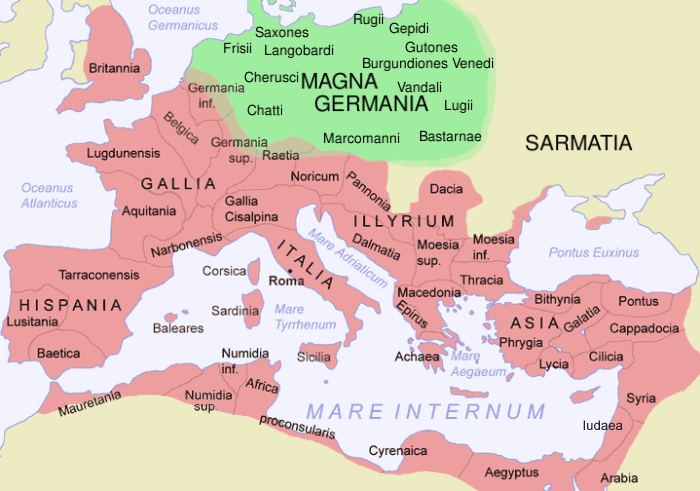
And remember that Christians were traveling all over - by 70 AD there were Christian communities already in what is now Spain, Portugal, the UK, Tunisia, Syria, Ethiopia, Yemen, Iran, India, uzbekistan and possibly even further afield. As to Europe - the Amber road had been in place for quite some time already - I think already 1000 years by 250 AD (need to cross check that) - during the 3rd century, Frankfurt sat right along the Limes Germanicus—the fortified frontier border of the Roman Empire. While Christianity was actively spreading through the Mediterranean, North Africa, and major urban hubs like Rome or Lyon, the northern military frontiers were still with very few Christians.
FInding a Christian community might be unusual but not impossible as Christians did travel or trade or fight there or were enslaved. the owner took a traditional, mainstream Roman practice—wearing a protective amulet—and completely Christianized the text inside it to invoke the protection of Jesus.
ConMind - he didn't live "before the Catholic Church" - the Catholic Church is mentioned in Acts 9:31 - ἡ ἐκκλησία καθ' ὅλης (he ekklesia kath'holes) and in the letters by pope Clement (the 4th Pope), by Ireneaus of Lyons, Ignatius of Antioch, Justin Martyr - all in the period 90 AD to 160 AD). Ignatius of Antioch used the term in writing around 110 AD. By the time this amulet was buried (mid-200s AD), church fathers like Cyprian of Carthage were heavily using the term "Catholic Church" to distinguish the mainstream Christian network from various regional sects or gnostic groups.

this artifact dates from c 250 AD - so ~200 years after the foundation of the Catholic Church at Pentecost in 33 AD
the church of the 200s AD was the early Catholic Church, sharing direct continuity in bishops, scripture, and sacraments.
btw, Co-Redemptrix is not official Catholic dogma and never has been
AND, ConMind - The oldest known written prayer to Mary, the Sub Tuum Praesidium ("Under your protection we seek refuge..."), was discovered on an Egyptian papyrus dating to around 250 AD - the exact same window of time as the German amulet.

The amulet is an exorcistic text - even today in the Catholic Church, formal exorcisms are strictly performed in the name and power of Jesus Christ - the name of Jesus has power
46
posted on
06/15/2026 12:45:58 AM PDT
by
Cronos
(Strange women lying in ponds distributing swords is no basis for a system of government.)
To: ConservativeMind; Claud
The Marian request for prayer is contemporary with this artifact thus belying your statement that there was no Marian devotion at this point in time, conservative Mind
47
posted on
06/15/2026 1:54:02 AM PDT
by
Cronos
(Strange women lying in ponds distributing swords is no basis for a system of government.)
Navigation: use the links below to view more comments.
first previous 1-20, 21-40, 41-47 last
Disclaimer:
Opinions posted on Free Republic are those of the individual
posters and do not necessarily represent the opinion of Free Republic or its
management. All materials posted herein are protected by copyright law and the
exemption for fair use of copyrighted works.
FreeRepublic.com is powered by software copyright 2000-2008 John Robinson