Skip to comments.
The Most IMPOSSIBLE Sculpture EVER Created [8:56]
YouTube ^
| May 6, 2026
| Marmoreo
Posted on 06/08/2026 9:34:12 AM PDT by SunkenCiv
Michelangelo's Pietà showcases a level of artful mastery that beggars belief, especially considering he was only 24. This piece pushes the boundaries of amazing skills, making us question the very nature of human creativity. Join us as we explore this incredible work and what it reveals about the artist's genius, offering a unique perspective on art history.
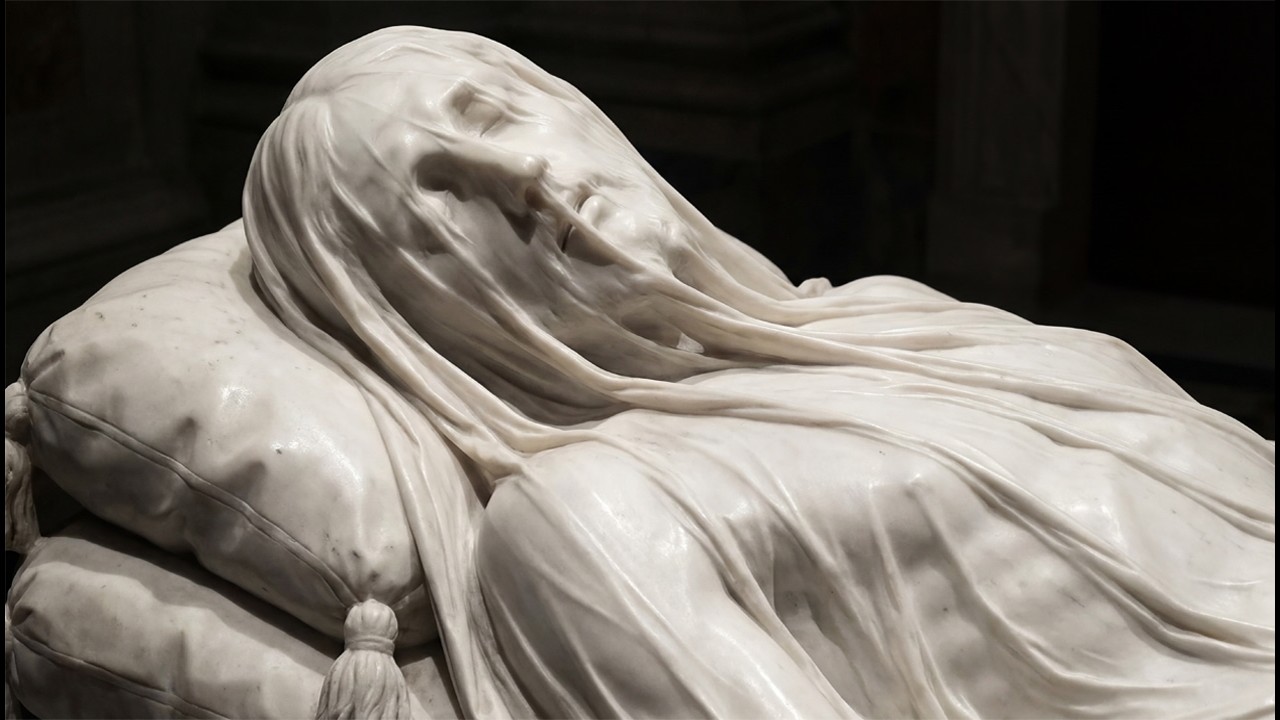
Giuseppe San Martino crafted this marble masterpiece in 18th-century Naples, challenging viewers to distinguish stone from fabric. While legends suggest alchemical secrets behind its creation, historical records offer a different perspective. Marmoreo explores the artistic techniques and theological questions surrounding this profound work of art. The Most IMPOSSIBLE Sculpture EVER Created | 8:56
Marmoreo | 7.12K subscribers | 646,837 views | May 6, 2026
(Excerpt) Read more at youtube.com ...
TOPICS: Arts/Photography; History; Science; Travel
KEYWORDS: art; giuseppesanmartino; godsgravesglyphs; italy; naples; renaissance
Navigation: use the links below to view more comments.
first 1-20, 21-36 next last
s/b "The Least Possible".
1
posted on
06/08/2026 9:34:12 AM PDT
by
SunkenCiv
2
posted on
06/08/2026 9:35:11 AM PDT
by
SunkenCiv
(TDS -- it's not just for DNC shills anymore -- oh, wait, yeah it is.)
To: StayAt HomeMother; Ernest_at_the_Beach; 1ofmanyfree; 21twelve; 24Karet; 2ndDivisionVet; 31R1O; ...
3
posted on
06/08/2026 9:35:33 AM PDT
by
SunkenCiv
(TDS -- it's not just for DNC shills anymore -- oh, wait, yeah it is.)
4
posted on
06/08/2026 9:36:51 AM PDT
by
SunkenCiv
(TDS -- it's not just for DNC shills anymore -- oh, wait, yeah it is.)
To: SunkenCiv
5
posted on
06/08/2026 9:37:13 AM PDT
by
Jamestown1630
("A Republic, if you can keep it.")
To: SunkenCiv
I watched this a couple weeks ago. This is art.
6
posted on
06/08/2026 9:37:23 AM PDT
by
packrat35
(“When discourse ends, violence begins.” – Charlie Kirk, and they killed him anyway)
To: SunkenCiv
Somewhere along the line we lost the skill and tenacity to create these beautiful objects....................
7
posted on
06/08/2026 9:39:56 AM PDT
by
Red Badger
(Iryna Zarutska, May 22, 2002 Kyiv, Ukraine – August 22, 2025 Charlotte, North Carolina Say her name)
To: SunkenCiv
It's hard to believe that a human created that sculpture.
Today we are offered Jackson Pollock and Warhol as the epitome of American art.
8
posted on
06/08/2026 9:41:03 AM PDT
by
Governor Dinwiddie
( O give thanks unto the Lord, for He is gracious, and his mercy endures forever. — Psalm 106)
To: packrat35
This popped up in the recommended vids while I was cruising YouTube for ancient sightseeing (Told in Stone, Darius Arya, etc). Looks like this "on deck" file is from the 3rd, which is likely when I watched it. Stunning work.
9
posted on
06/08/2026 9:42:50 AM PDT
by
SunkenCiv
(TDS -- it's not just for DNC shills anymore -- oh, wait, yeah it is.)
To: SunkenCiv
Trompe L’oeil (”deceive the eye.”) in stone almost-
10
posted on
06/08/2026 9:44:53 AM PDT
by
Bob434
(Time flies like an arrow, Fruit flies like a banana)
To: E. Pluribus Unum
11
posted on
06/08/2026 9:51:52 AM PDT
by
E. Pluribus Unum
(If it ain't fun, you ain't doin' it right.)
To: SunkenCiv
Dayum, Civ. That was awesome.
Transcript
There is a point where skill becomes so extreme that people stop calling it skill and start calling it something else: magic, alchemy, the impossible. And when a work of art crosses that line, something strange happens. The artist disappears and the explanation becomes the story. In 1753, a young sculptor in Naples crossed that line. And nearly three centuries later, no one has fully come back from it.
The sculpture is called the Veiled Christ. It sits in the center of the San Seo Chapel in Naples, a life-size figure of Christ after the crucifixion, lying on a marble bed with two pillows beneath his head. His body is covered by a shroud. The shroud is marble. The body beneath it is marble. The pillows are marble. The pliers, shackles, and crown of thorns resting at his feet are marble. Everything you are looking at was carved from a single block of Carrara stone by a 32-year-old sculptor named Giuseppe San Martino. And every part of it looks like something other than what it actually is.
Start with the veil itself because that is where every conversation about this sculpture begins and none of them end. The shroud does not sit on top of Christ’s body the way fabric sits on a table. It clings. It follows the contours of the rib cage, the hollow of the throat, the ridge of the collarbone. It pulls in the spaces between the fingers. And the effect is not simply that you can see the body through the cloth. It is that the cloth appears to be a separate material entirely.
Your brain registers stone, fabric, and flesh as three different substances even though your eyes are looking at one. A study published in Scientific American examining a later veiled sculpture by Giovani Stratza found that sculptors working in this tradition do not actually carve a continuous thin layer of stone over the features beneath. Instead, they selectively render the face and body as if the veil is not there. Then insert narrow ridges and subtle texture shifts to suggest the presence of cloth.
Your brain does the rest, filling in the transparency that is not physically present in the marble. Whether San Martino used this same perceptual shortcut or achieved something beyond, it remains an open question. What is not in question is the result.
The man who commissioned this sculpture was Ryondo Dangro, prince of Sanso. And understanding him is essential to understanding why the veil became a legend. Daisangro was the grandmaster of the Neapolitan Masonic Lodge. A practicing alchemist and an inventor whose creations bordered on performance art. He built a carriage with cork horses that drove across the Bay of Naples on paddle wheels. He developed fireworks that detonated with the sound of birdsong. In the basement of this same chapel, he kept two human skeletons wrapped in an arterio system so detailed that for centuries, people believed he had injected living servants with a substance that metalized their blood. A 2008 analysis by University College London researchers confirmed the circulatory systems were artificial silk, wax, and wire over real human bones. And so the story took hold. The prince had taught San Martino a secret chemical process for transforming real linen into crystalline marble. Visitors believed it for decades. Some believe it now.
The problem is that the documentary record says otherwise. A payment receipt dated December 16th, 1752, preserved in the historical archive of the Bank of Naples, records 50 ducats paid to San Martino for a statue of Christ covered by a veil also of marble. The prince himself, in separate correspondence, confirmed the veil was carved from the same block as the figure. The evidence is clear. The legend persists anyway because the alternative is harder to accept: that a young man with a chisel did this by hand from a solid block of stone with no tricks and no chemistry. San Martino was not even supposed to make it.
The prince originally commissioned Antonio Coredini, a Venetian sculptor who had spent his entire career perfecting the art of veiled marble. Coredini’s statue of modesty, which still stands in the same chapel, is itself a technical marvel: a fully veiled female figure whose body is visible through carved stone drapery. But Coredini died in 1752, leaving behind only a small terra cotta sketch of his planned Christ. The commission passed to San Martino, who, according to the Sano Chapel Museum, paid little heed to the older sculptor’s model. He threw out the plan and started from scratch. The backup artist ignored the blueprint and produced what Antonio Kenova, arguably the most celebrated sculptor in Europe at the time, later called a work he would give 10 years of his life to have created. Kenova visited Naples, tried to buy the sculpture, and was refused.
If you look closely at the forehead, you will notice a single vein, swollen and raised, visible through the veil. The chapel’s own description calls it still pulsating.
Consider what that detail requires. San Martino had to carve the anatomical accuracy of a vein beneath skin and then carve the illusion of transparent fabric on top of that from the same piece of stone. Now look at the feet where the instruments of the passion are scattered: pliers, shackles, the crown of thorns. These objects have a different surface texture than the veil or the body. San Martino needed you to perceive at least three distinct materials: metal, fabric, and flesh. And he achieved all three from a single slab of marble.
The art historian Rudolph Witkau, writing in the Pelican History of Art, dismissed the Veiled Christ as a hypertrophic effort, pure technical showmanship, virtuosity for its own sake. But Ruth Lockheart, in her research at University College Dublin, read the veil differently. In Christian iconography, a veil represents the boundary between the human and the divine, the visible and the invisible, presence and absence. By that reading, the marble veil is not a parlor trick. It is a theological threshold, the point where your physical reality meets the representation of the sacred. And this leads to a genuine fork in how you experience the sculpture. If the veil is a burial shroud, then it functions as a final act of mercy, covering the ravaged body, hiding the wounds from view. But look at what the veil actually does.
It makes every wound more visible, every rib more defined, every trace of suffering more legible than if the body were shown bare. The covering reveals more than nakedness ever could. So is the veil concealing Christ or exposing him? If you see concealment, you see compassion. If you see exposure, you see something far more unsettling: a shroud that strips away dignity rather than preserving it. The Veiled Christ still sits in the center of that chapel in Naples, and it still forces you to choose. Do you trust the documents or do you trust your eyes? Because they are telling you two very different things.
13
posted on
06/08/2026 9:59:31 AM PDT
by
SunkenCiv
(TDS -- it's not just for DNC shills anymore -- oh, wait, yeah it is.)
To: SunkenCiv
Check out their next 2 videos. Stunning workmanship that no one now could replicate.
14
posted on
06/08/2026 10:13:58 AM PDT
by
packrat35
(“When discourse ends, violence begins.” – Charlie Kirk, and they killed him anyway)
To: SunkenCiv
Wonder if he used human model(s)?
Wonder if he knew his work, most likely, will be treasured for millenia?
15
posted on
06/08/2026 10:14:45 AM PDT
by
Theophilus
(I'm all out of attention to this matter...)
To: SunkenCiv
.. difficult, but not impossible with the sort of skill Michelango had. However, what I do find impossible is Roman cage glass.
16
posted on
06/08/2026 10:18:55 AM PDT
by
PUGACHEV
To: PUGACHEV
17
posted on
06/08/2026 10:21:39 AM PDT
by
SunkenCiv
(TDS -- it's not just for DNC shills anymore -- oh, wait, yeah it is.)
To: ComputerGuy
Dayum, day ay ay um. Leavin’ for Naples as I check out of Rome.
18
posted on
06/08/2026 10:23:22 AM PDT
by
SunkenCiv
(TDS -- it's not just for DNC shills anymore -- oh, wait, yeah it is.)
To: Theophilus
Not only did they use live human models they also studied cadavers. Check out close ups of the back of David’s hand on the 17’ high sculpture in Florence. The detail of veins, tendons, bones is incredible.
Especially when you consider he produced that at age 24. Without CAD. Without a computer. With a hammer and chisel. Out of one piece of marble.
To: Governor Dinwiddie
I saw shredded fed-ex boxes taped back together and labeled art a while back in the MOMA. I made comments out loud laughed so hard I had to leave before getting ejected.
Navigation: use the links below to view more comments.
first 1-20, 21-36 next last
Disclaimer:
Opinions posted on Free Republic are those of the individual
posters and do not necessarily represent the opinion of Free Republic or its
management. All materials posted herein are protected by copyright law and the
exemption for fair use of copyrighted works.
FreeRepublic.com is powered by software copyright 2000-2008 John Robinson
