Posted on 05/22/2026 9:03:06 PM PDT by Red Badger
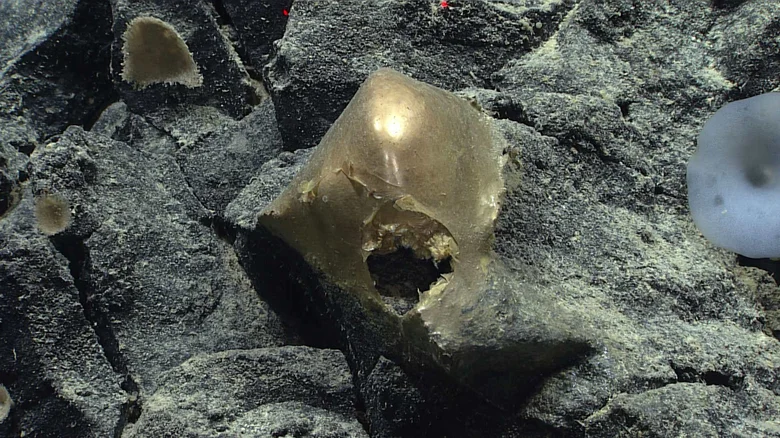
As scientists study Earth's oceans, they come across some intriguing mysteries. Among them are some of the strangest deep-sea discoveries, including a "golden orb" measuring about 4 inches in diameter in the Gulf of Alaska in 2023. Referred to as a "yellow hat" by one of the videographers at the time, researchers were stumped about what it could be; coral, an egg casing, or a dead sponge attachment were some of the initial guesses. Since then, they've been able to determine that it's dead cell remains from a huge deep-sea anemone.
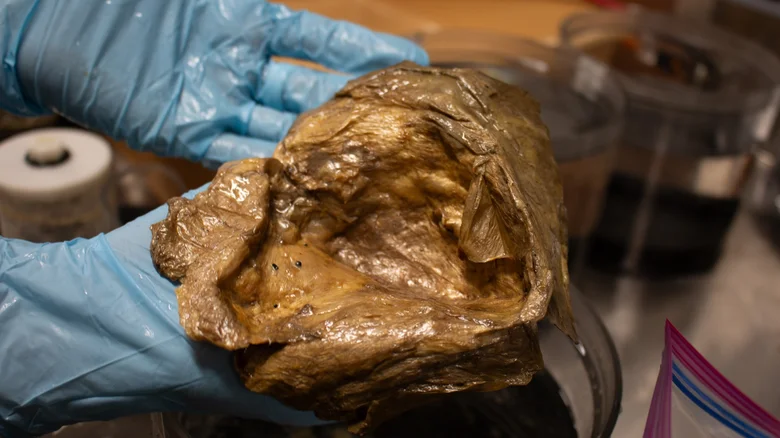
The golden specimen was found about 2 miles beneath the water during the NOAA Ocean Exploration's Seascape Alaska 5 expedition. The researchers were able to retrieve the anemone remains using the Deep Discoverer, a remotely operated vehicle equipped with a suction sampler. Then, it was transported to the Smithsonian National Museum of Natural History for further study and identification. It took more than two years, but they determined that it's a relic of Relicanthus daphneae, and preprinted the finding in bioRxiv. One of the physical characteristics of sea anemones is that they can vary greatly in size, and the R. daphneae is a giant example commonly seen on the East Pacific Rise with diverse microscopic inhabitants.
NOAA Ocean Exploration acting director Capt. William Mowitt noted in a press release that they often find captivating mysteries like this one in the deep ocean. Being able to solve them "is why we keep exploring — to unlock the secrets of the deep and better understand how the ocean and its resources can drive economic growth, strengthen our national security, and sustain our planet."
How the scientists solved the golden orb mystery
NOAA Fisheries
The golden orb specimen was found in August 2023, but it took until April 2026 for researchers to identify it. Because of the steps and procedures for conducting scientific research, it's normal for studies to take multiple years. This case was particularly complex, and involved a team of scientists from the NOAA Fisheries and the Smithsonian. NOAA Fisheries' National Systematics Laboratory director and zoologist Allen Collins explained that the researchers are used to working with hundreds of samples, "but this turned into a special case that required focused efforts and expertise of several different individuals. This was a complex mystery that required morphological, genetic, deep-sea and bioinformatics expertise to solve."
As outlined in the preprint, the now-identified R. daphneae remnant was preserved at room temperature in 95% ethanol, and the same was done for an extra tissue subsample stored in cryogenic tubes. The scientists used light microscopy, photography, and scanning electron microscopy to create a morphological characterization. Initial inspection didn't reveal the typical anatomy of an animal but, instead, a fibrous material loosely accumulated together and covered with a smooth surface full of cnidarian spirocysts, sticky organelles found on anemone tentacles. These characteristics are similar to specimens collected from the central Pacific in 2021 by the Schmidt Ocean Institute.
Additionally, the researchers used DNA barcoding that ended up being inconclusive. They were able to use whole-genome sequencing to get a better look, confirming that the sample had animal DNA and plenty of genetic material from the R. daphneae. By sequencing the mitochondrial genomes, the scientists determined that the 2021 and 2023 specimens were practically identical to the reference genome for the anemone, putting the mystery to rest.
https://freerepublic.com/focus/f-chat/4306494/posts
How much did they spend in time and money to find it was a giant deep-sea anemone body part?
A left over from somethings lunch?
Do get me wrong but why bother?
IT WAS DEAD JIM..............dead like bio waste.....
Some people follow sports. Others study the law. Some study birds and collect them. Others love building things and go into construction.
Well, some people like to discover and learn about everything in our world, or perhaps just some parts of it. Doing so is interesting (to them), and it often produces useful information for the rest of us as well.
That's why bother.
and involved a team of scientists from the NOAA Fisheries and the Smithsonian. NOAA Fisheries’ National Systematics Laboratory director and zoologist Allen Collins explained that the researchers are used to working with hundreds of samples, “but this turned into a special case that required focused efforts and expertise of several different individuals. This was a complex mystery that required morphological, genetic, deep-sea and bioinformatics expertise to solve.”
Not “some people”; It was done by us, using taxpayer $$’s.
The study of spider silk led to this, and much more:
The development of methods to mass-produce spider silk led to the manufacturing of military, medical, and consumer goods, such as ballistic armour, athletic footwear, personal care products, breast implant and catheter coatings, mechanical insulin pumps, fashion clothing, and outerwear.[89] —- wikipedia
The study of horseshoe crabs and their unique blue blood led to medical practices saving hundreds of thousands of lives.
As I recall, studies of sea anemone excretions which they use to hold fast to rock underwater lead to synthesis of super strong weather resistant adhesives and sealants used in several industries and the US space program. Might have been some other sea critter but research almost always pays for itself over and over, often in unexpected, unpredictable ways.

There is a picture of it here: https://www.amnh.org/explore/news-blogs/marine-organism-sea-anemone
Not to be a wise guy, but how did this study help our economy and/or strengthen our national security?
This particular study? I don't know offhand; I'm not in that field and don't have the familiarity required to properly answer your question. My comment was more about research in general than this particular study.
Aside: Who could have predicted that the American space program would launch a breakfast drink? (NASA didn't invent Tang, but made it famous, and its continued use by astronauts to this day has kept the product popular.). Of course, whether you consider Tang a benefit to our national security is a separate issue. :-)
You don't have a clue about how our technology developed, do you?
Which technology?
All technologies. Almost everything you think of as technology came first from observations of Nature. If all were as curious as you we’d still be living without fire.
Wasn’t this on Venture Brothers?
And yet I bet that any competent oceanographer and or marine biologist had already hypothesized that it was a part of a deep-sea anemone body part...fish sushi.
It was and is a waste of time and effort. If you spend you life identifying garbage. Garbage is all you see.
I also smelled a bit of grant time money grubbing in the original news article. That’s why they recycle stories about the aglet and the egress.
Publish trash, just publish, got to get that grant money....
On July 21, 1969, Neil A. Armstrong took his first step on the lunar surface and discovered...Tang.
Do you actually object to the study of sea life? Do you actually reject scientific curiosity? Have you failed to notice that discovering things in Nature have been very important to mankind through the ages?
This is certainly true for people have no curiosity or knowledge of history and the development of technology. What do you do for enlightenment, drink beer and belch?
No, I do not.
My comment concerned the notion that it was just some rando folks on a lark looking at the ocean like some distaff Gallileos...
Disclaimer: Opinions posted on Free Republic are those of the individual posters and do not necessarily represent the opinion of Free Republic or its management. All materials posted herein are protected by copyright law and the exemption for fair use of copyrighted works.