This is what you get with a top notch contractors and free labor.
Posted on 05/22/2026 3:38:26 PM PDT by nickcarraway
The mystery of how Egypt’s pyramids survived thousands of years of earthquakes may partly come down to smart engineering, according to a new study that examined how the Great Pyramid of Giza responds to seismic vibrations.
Researchers found that the Pyramid of Khufu has a natural vibration frequency that differs sharply from the surrounding ground, helping reduce the risk of dangerous resonance during earthquakes.
The study, led by Mohamed ELGabry and published in Scientific Reports, analyzed ambient seismic noise recorded inside the 4,600-year-old pyramid. Researchers said the findings may explain why the structure has survived centuries of earthquakes with little serious damage.
The pyramids endured centuries of seismic activity The Great Pyramid, built during Egypt’s Old Kingdom for Pharaoh Khufu, has faced several major earthquakes over thousands of years. Researchers noted that one of the strongest known events struck near El-Fayoum in 1847 with an estimated magnitude of 6.86.
Another earthquake in 1992 caused some casing stones to fall from the pyramids, but the main structure remained stable.
Researchers measured vibrations inside the pyramid
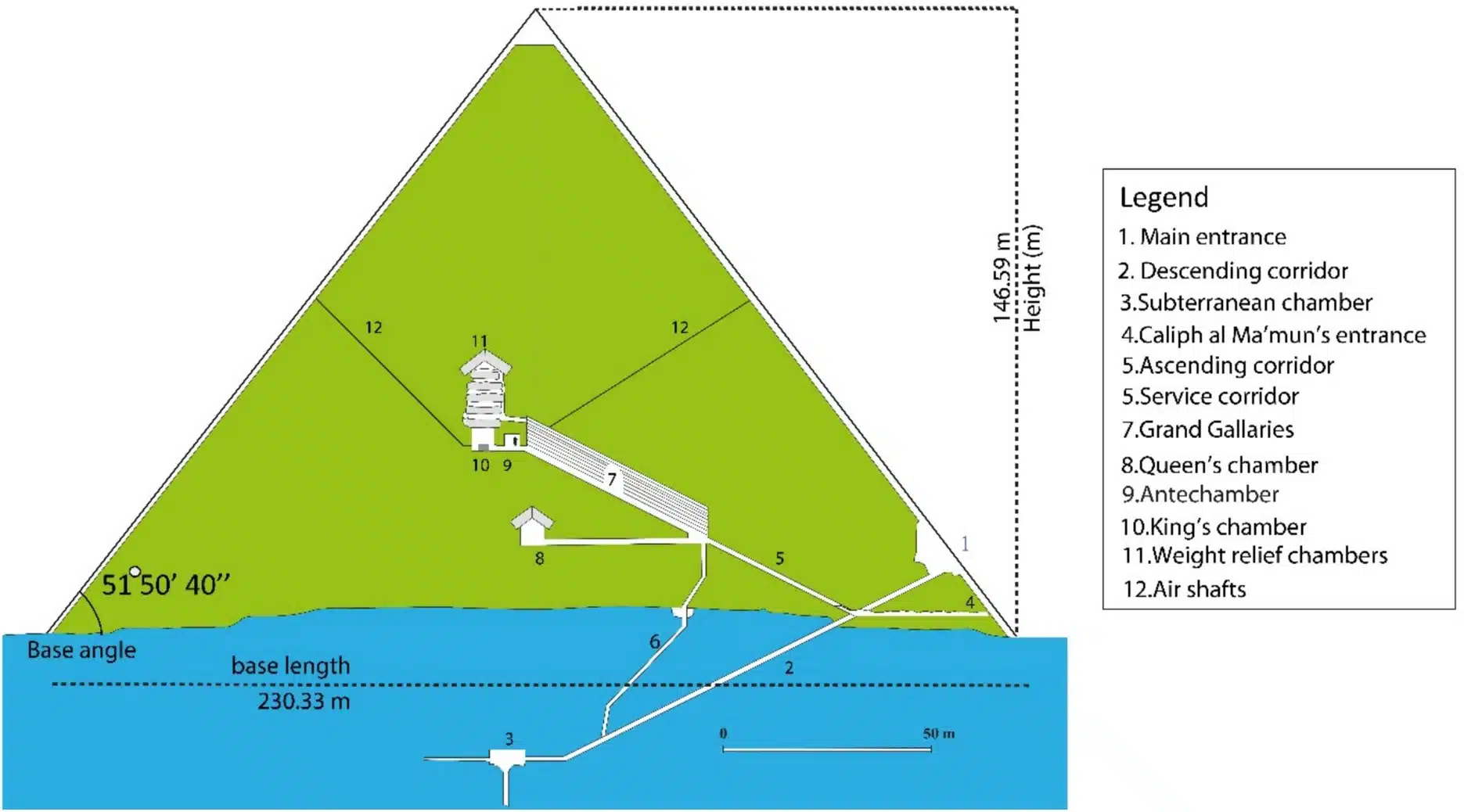
The team carried out 37 measurements inside different parts of the pyramid, including the King’s Chamber, Queen’s Chamber, underground passages, and pressure-relieving chambers above the King’s Chamber. They used sensitive seismic equipment to detect low-level natural vibrations known as ambient noise.
The pyramid and the ground vibrate at different frequencies Researchers found that most parts of the pyramid shared a similar fundamental frequency between 2.0 and 2.6 hertz, with an average around 2.3 hertz. The surrounding ground, however, showed a much lower frequency near 0.6 hertz.
That gap is important because resonance happens when a building and the ground vibrate at similar frequencies during an earthquake. Such resonance can greatly increase structural damage.
Researchers said the mismatch between the pyramid’s vibration frequency and the surrounding soil likely reduced resonance effects over centuries of seismic activity.
Shape and mass distribution may have improved stability
The study also pointed to several engineering features that may have strengthened the pyramid against earthquakes. Most of the pyramid’s mass sits near the ground, while the structure gradually narrows toward the top. Researchers said this design improves balance and reduces the risk of overturning.
The pyramid’s symmetrical shape and dense base also help distribute stress more evenly during seismic shaking. Researchers added that the structure was built directly on hard limestone bedrock, which likely improved stability further.
Researchers avoid claims of intentional seismic design The study stopped short of claiming that ancient Egyptians intentionally designed the pyramid to resist earthquakes. Researchers said there is no direct evidence proving ancient builders understood seismic engineering in the modern sense.
Still, the findings suggest the Great Pyramid’s geometry and construction methods naturally reduced seismic risks. Researchers said the monument remains “a testament to ancient seismic engineering principles” that could still inform modern heritage preservation efforts.
This is what you get with a top notch contractors and free labor.
Alien anti earthquake technology from Atlantis
I don’t understand the question at all: Obviously, the pyramids were built up and installed as one big pointed block.
Then, subsequent earthquakes broke them up into the big piles of small, irregular blocks we see now.
The Great Pyramid blocks were installed (or with the bulk of them mixed like concrete), but during construction there was a bad quake which left the corbels at the top of the Grand Gallery hanging on at one end a mere fraction of an inch.
It was at that point the relieving chambers were accessed (a small tunnel was chewed through) to inspect the damage. Those slabs were cracked, but as the pyramid was nearly complete (or was complete) nothing could be done. They bet right, it’s still there.
Jean-Pierre Houdin and his consultants attributed the cracking to softer strata under one side of the foundation level, if memory serves.
I visited it some years back and was able see the Kings Chamber.
The corners are built on sockets. The builders knew what they were doing and where to build it to make it last. They also knew about true North.
Syriad is Egypt and the word Border = Giza
“In that day shall there be an altar to the Lord in the midst of the land of Egypt, and a pillar at the border thereof to the Lord.” - Isaiah 19:19
“And have ye not read this scripture; The stone which the builders rejected is become the head of the corner: This was the Lord’s doing, and it is marvellous in our eyes?” - Mark 12:10-11
The capstone was rejected.

Those aliens are culturally appropriating from the Israelites.
This is the music you want to listen to, if you are forced to build pyramids.
They were built were earthquakes don’t happen? Who would have thought that?
I remember when that was in the Top 40!...........
The Homeowner’s Warranty is about to expire..........
We are the aliens ?.
The builders also did a great job resisting earthquakes in Peru.
Disclaimer: Opinions posted on Free Republic are those of the individual posters and do not necessarily represent the opinion of Free Republic or its management. All materials posted herein are protected by copyright law and the exemption for fair use of copyrighted works.
