
Posted on 05/21/2026 8:17:32 PM PDT by Red Badger
The Pegasus team from the Aris student space initiative has generated a stable detonation wave with its engine. Robin Wyss / Aris Space
=========================================================================
Students in Switzerland have recently tested an experimental rocket engine that is capable of generating 20,000 detonation waves per second, the same propulsion concept explored by NASA and Japanese researchers for future space missions.
The so-called rotating detonation rocket engine (RDRE) is powered by propane and liquid oxygen. It was built by the Pegasus team, a student project within the ARIS (Academic Space Initiative Switzerland) at ETH Zurich.
The third-year students spent nearly a year developing and refining the engine, which runs through continuous rotating explosions in a circular chamber. These controlled detonations generate extremely high pressure and temperatures and allow more efficient usage of fuel energy.
They have now successfully validated the technology, which has drawn significant attention from NASA and Japanese aerospace programs. Researchers believe the engine could significantly reduce launch costs while increasing payload capacity for future space missions.
A new rocket engine
The team conducted the trial at nighttime at the Dübendorf Air Base in early April, 2026. The site is located northeast of Zurich. It features a single 7,730-foot runway and is run by the Swiss Armed Forces.
During the tests, the student-built engine produced stable detonation waves after an earlier failed attempt just one week earlier. “You don’t need to be exceptionally talented to develop a rocket engine after two years of study,” Mattia Röösli, 21, a student who developed the engine’s injector, said. “You go step by step and help each other.”
According to the team, the firing shook the control hut as a long stream of flame burst from the copper engine. The team monitored pressure readings and high-speed camera footage in real time, at the same time.
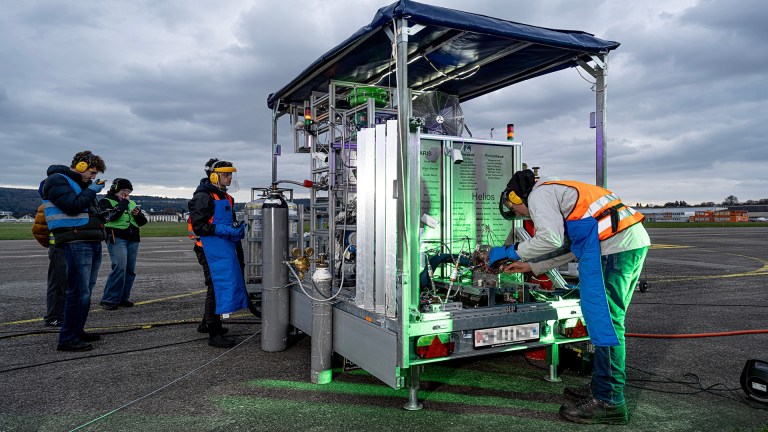
Final preparations on the test stand. The engine is located above the license plate. Credit: Daniel Winkler / ETH Zurich
The achievement places the Swiss students among a small global group that has successfully tested liquid-fueled rotating detonation rocket engines. Only around a dozen countries have managed similar demonstrations.
Meanwhile, the technology has gained growing attention as even small efficiency gains can significantly impact rocket launches. Fuel typically accounts for 80 to 90 percent of a rocket’s launch weight. This means that a more efficient engine could either reduce costs or allow spacecraft to carry heavier payloads into orbit.
Rocket engine passes trials
Inside an RDRE, detonation waves can travel through the combustion chamber up to 20,000 times every second. The extreme conditions place tremendous stress on materials and components, while demanding highly precise fuel injection systems that can operate in less than a millisecond.
Röösli noted that the injector, one of the most critical parts of the propulsion unit, had to precisely mix propane and liquid oxygen, and prevent destructive pressure waves from traveling backward into the supply lines.
VIDEO AT LINK...............................
The students used metal 3D printing to manufacture several engine components, including the compact copper combustion chamber. The project was integrated into ETH Zurich’s Focus Project program.
On how the students handled the complexity of the project after just two years of study, Röösli elaborated that the work relied more on teamwork and persistence. “The first thing you do is make sketches and discuss them as a team,” Röösli said in a press statement. “You break big problems down into smaller ones until they become solvable.”
Ping!.....................
🎶…Said Wehrner von Braun!🎶
Sounds like a variant of the pulse jet engine.
Let me know when it can power Starship.
Otoh, once a vehicle is lifted to orbit or injected into a planetary course, such a small, efficient engine might prove useful.
Sweet.
“Und I’m learning Chinese.”
Methinks Mattia has not met a lot of other 21 year olds in the world ... and that's a good thing for Mattia and the world! LOL
“Sounds like a variant of the pulse jet engine.”
That is literally like comparing a fire cracker with black powder to tnt.
Pulse jet pulses are rapid burning (subsonic wave propagation) properly called deflagration vs a supersonic shock wave process properly detonation. Orders of magnitude different.
This is the air breathing version of this type of combustion process.
Shockwave compression and detonation.
That is a crazy looking flux capacitor. I wonder what happens when the rocket gets to 88 mph. In all seriousness, congrats to the students.
Well Von Braun took steps…V1, V2…
Interesting timing on this. My son is an aerospace engineer who “pilots” maneuverable satellites. He was telling me about how they use micropulses to change the orbit. Just yesterday this popped into my mind about how the pulse has to be minimal fractions of a second.
This might be some great technology.
I agree! …S-IV, SV…
Disclaimer: Opinions posted on Free Republic are those of the individual posters and do not necessarily represent the opinion of Free Republic or its management. All materials posted herein are protected by copyright law and the exemption for fair use of copyrighted works.