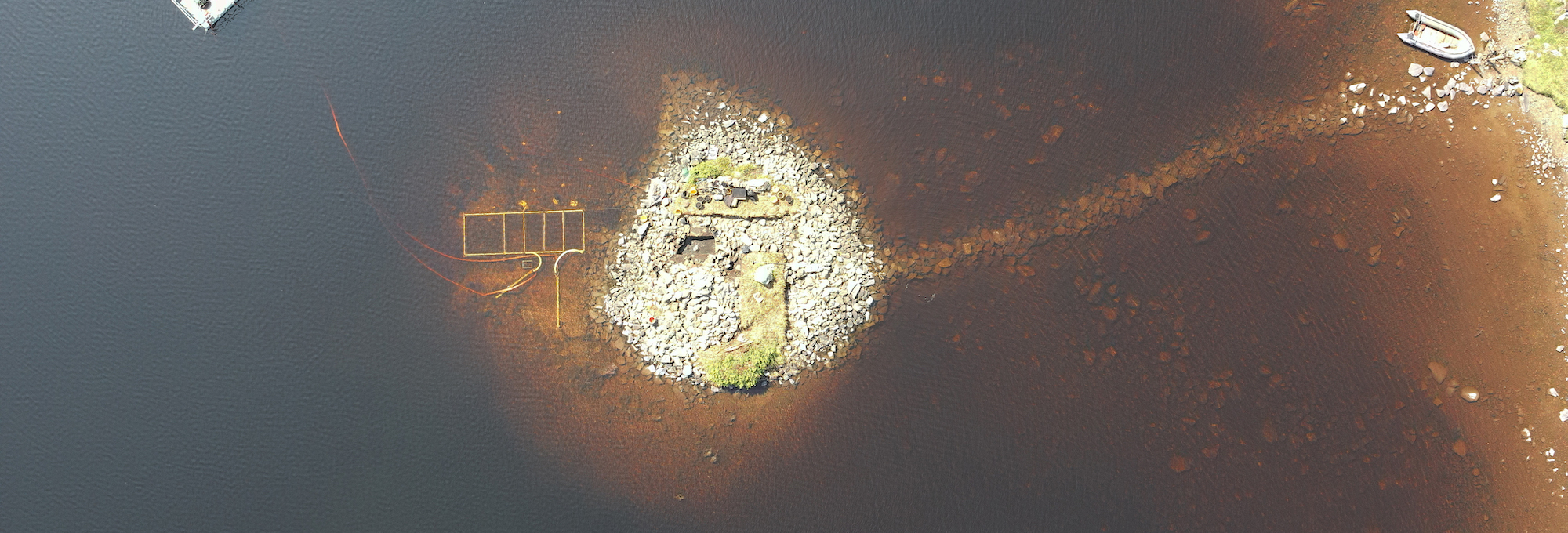
Crannog at Loch Bhorgastail, ScotlandUniversity of Southampton
Posted on 05/13/2026 11:47:38 AM PDT by SunkenCiv
According to a statement released by the University of Southampton, a crannog in shallow waters in Loch Bhorgastail on Scotland's Isle of Lewis has been evaluated by researchers from the University of Southampton and the University of Reading with a technique called stereophotogrammetry, which involves stitching together photographs taken at different angles to create a high-resolution 3D model. The study determined that the structure began as a circular wooden platform, measuring about 75 feet in diameter, that was topped with brushwood. Neolithic pottery was also discovered in the area surrounding the crannog, enabling archaeologists to date this first construction of the island to about 5,000 years ago. Some 2,000 years later, during the Middle Bronze Age, another layer of brushwood and stone was added to the crannog. Then, during the Iron Age, about 1,000 years later, a stone causeway was built to connect the artificial island to the loch shore. This causeway is now underwater. "While crannogs were long thought to have been built, used, and reused, mainly between the Iron Age and the post-medieval period, we now know that some were first constructed much earlier, during the Neolithic, between 3800 and 3300 B.C.," said Stephanie Blankshein of the University of Southampton. The presence of pottery around the crannog suggests that it may have been used for communal activities involving cooking and feasting, Blankshein explained. Read the original scholarly article about this research in Advances in Archaeological Practice. To read more about crannogs, go to "Worlds Apart."
(Excerpt) Read more at archaeology.org ...
Crannog at Loch Bhorgastail, ScotlandUniversity of Southampton
Crannog. There’s a word you don’t often hear come up in casual conversation.
So ... an atificial island. Like Venice? Or Xochimilco?
Crannog....
also Scottish slang for a boggy Colleen.
Apparently the most shallow spot would be picked, then bit by bit stones would be hauled over and dropped in until there was something that could be built on. I suspect the fortifications would have been wood palisades or something like that. After one thought of it, such things probably caught on fast, and after perhaps just a few generations the practice fell off, along with the supporting stones woich would slide down one by one.
See, I should read more:
https://www.bbc.com/news/articles/c0e2w31wedqo
An ancient artificial island in a loch on the Isle of Lewis was built entirely on a wooden platform, archaeologists have discovered.
From above, the Neolithic island - or crannog - in Loch Bhorgastail appears to be made of stone, though it was known that there was some timber underneath it.
However, researchers from the University of Southampton carried out an excavation and have revealed that wood was used to support the whole structure.
The group dated their findings between 3500 and 3300 BC - around the early Bronze Age - and said the technique would have been used at other nearby sites throughout the Outer Hebrides.
Disclaimer: Opinions posted on Free Republic are those of the individual posters and do not necessarily represent the opinion of Free Republic or its management. All materials posted herein are protected by copyright law and the exemption for fair use of copyrighted works.