Posted on 05/05/2026 7:49:03 PM PDT by Red Badger
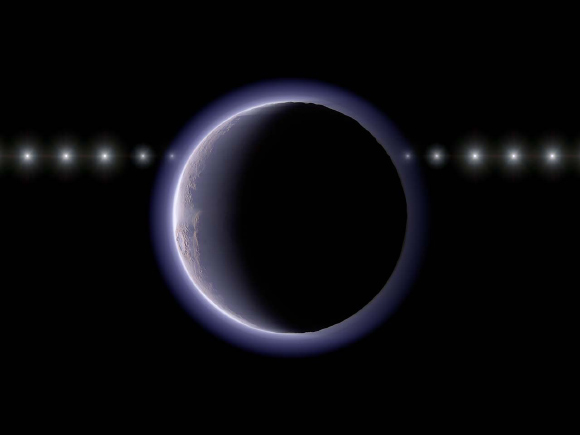
A team of astronomers in Japan has detected a thin atmosphere around (612533) 2002 XV93, a trans-Neptunian object about 500 km in diameter — an object far too small and cold to retain one.
An artist’s conception of the trans-Neptunian object 2002 XV93. Image credit: NAOJ.
“In the cold reaches of the outer Solar System lie thousands of small objects known as trans-Neptunian objects (TNOs) because they lie outside the orbit of Neptune,” said Dr. Ko Arimatsu from Ishigakijima Astronomical Observatory and colleagues.
“A thin atmosphere has been observed around Pluto, the most famous TNO, but studies of other TNOs have yielded negative results.”
“Most TNOs are so cold, and their surface gravity so weak, that they are not expected to retain atmospheres.”
The astronomers observed the trans-Neptunian object 2002 XV93 using a stellar occultation, measuring how it briefly dimmed the light of a background star as it passed in front of it.
“2002 XV93, has a diameter of approximately 500 km. For reference, Pluto’s diameter is 2,377 km,” they explained.
“The orbit of 2002 XV93 is such that, as seen from Earth, it passed directly in front of a star on January 10, 2024.”
“As the star disappears behind 2002 XV93, it might gradually fade, indicating that the light is being attenuated as it passes through a thin atmosphere; or it might suddenly wink out as it slips behind the solid surface of the TNO.”
The researchers found that the observations are best explained by a thin atmosphere surrounding 2002 XV93.
Their calculations indicate that such an atmosphere would dissipate in less than 1,000 years unless it is somehow replenished.
That means it must have formed — or been replenished — relatively recently.
“Observations by the NASA/ESA/CSA James Webb Space Telescope show no signs of frozen gases on the surface of 2002 XV93 that might sublimate to form an atmosphere,” the authors said.
“One possibility is that some event brought frozen or liquid gases from deep inside the TNO to the surface.”
“Another possibility is that a comet crashed into 2002 XV93, releasing gas that formed a temporary atmosphere.”
“Further observations are needed to distinguish between these two scenarios.”
“This discovery shows that even a few-hundred-kilometer TNO can host, at least transiently, an atmosphere, challenging standard volatile-retention scenarios,” they concluded.
“Our findings suggest that a fraction of distant icy minor planets can exhibit atmospheres, potentially sustained by ongoing cryovolcanic activity or produced by a recent impact of a small icy object.”
The team’s paper was published in the journal Nature Astronomy.
_____
K. Arimatsu et al. Detection of an atmosphere on a trans-Neptunian object beyond Pluto. Nat Astron, published online May 4, 2026; doi: 10.1038/s41550-026-02846-1
Space Ping!...........
Another theory:
Aliens have taken up vaping after visiting Earth.........
Its still a planet to me, and always will be.
Planet farts. Wasn't that the name of a 70s rock album?
That’s no moon.
Are you refferring to Pluto?
Pluto’s diameter is 2,377 km... By comparison our moon's diameter is about 3,474 km. Yes, our moon is larger than little Pluto. Hard to call it much of a planet when you think about that.
If you call Pluto a planet then there are 1000's of other bodies in orbit around our sun that would also qualify as planets. When Pluto was discovered they could barely detect it with the telescopes of the day. Now with modern ones they have found many more out there that, like Pluto are really too small to be a real planet.
At least this thread is not about “that” planet.
😉
Hmmmm, thinking...
Ah, I've got it...
Melmac!
We’ve almost run out of names of old gods and goddesses and their offspring.
Time to start using names from Science Fiction movies, Novels and Video Games..........
How about Mongo, the planet from which the villain Ming the Merciless hailed in Flash Gordon films?
That’s as good as any.
Or maybe we can start selling ‘Name a planet after your loved ones’ like those stupid Star Registry commercials every Christmas!............
Even in science we have to hear about trans stuff.
Uranus most certainly is surrounded by an atmosphere.
(Yes, I went there!)
Our own moon is coated in dust that can be electrostatically levitated, by sunrise and cosmic winds.
Lots of work is being done to figure out how to deal with it.
Pluto....
Award winning science fiction writer Clifford D. Simak wrote “Construction Shack” published in 1973.
Amusing. Was a Hugo Award nominee.
“The first manned expedition to Pluto, which discovers the planet is actually a manufactured, hollow metal sphere—a cosmic “construction shack” for the solar system. The crew uncovers blueprints indicating the solar system was designed differently, implying that planet-building is an ongoing, somewhat botched alien project.”
How Levitating Dust Shapes Airless Worlds
https://youtu.be/Y-NGUOI6tP0
I could name one after my MIL, but my selection might put me, figuratively, in dark matter.
A fine mist of used motor oil would be cheaper. :D
Disclaimer: Opinions posted on Free Republic are those of the individual posters and do not necessarily represent the opinion of Free Republic or its management. All materials posted herein are protected by copyright law and the exemption for fair use of copyrighted works.