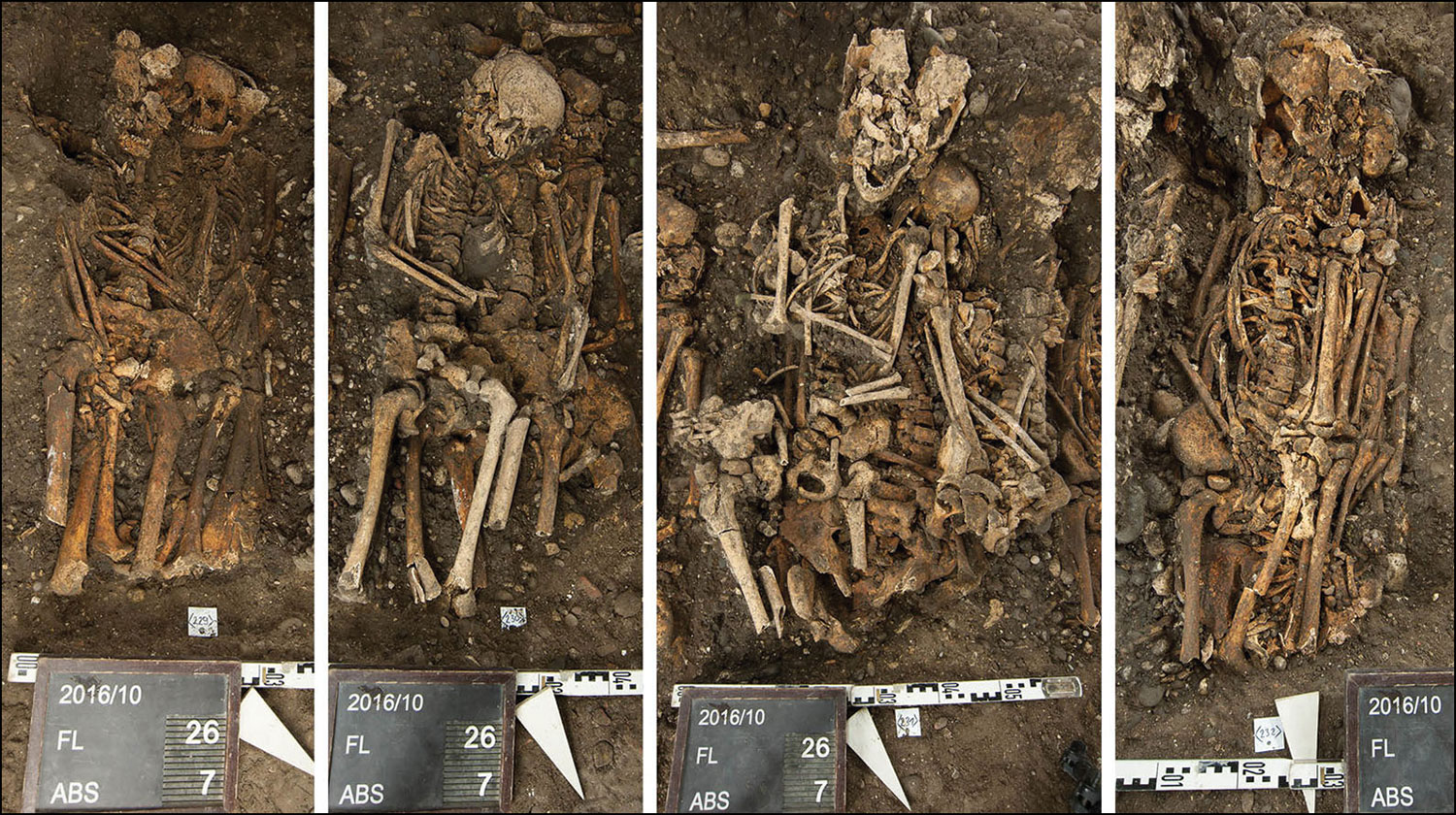
Graves during excavation, Basel, SwitzerlandFigure © Archäologische Bodenforschung Basel-Stadt/Photographs by A. Jost
Posted on 05/04/2026 7:41:11 PM PDT by SunkenCiv
According to a statement released by Antiquity, analysis of skeletal remains recovered from a seventeenth-century hospital cemetery in Basel, Switzerland, suggests that young laborers were the people most likely to die during an outbreak of plague. As a trade center that drew people in from abroad, the city of Basel was vulnerable to the spread of Yersinia pestis bacteria and outbreaks of plague. The last recorded outbreak of the disease in Basel occurred between 1665 and 1670. Researchers led by osteoarchaeologist Laura Rindlisbacher of the University of Basel examined skeletal remains recovered from the hospital cemetery dated to this period, and were able to detect the presence of Y. pestis in five of the individuals who died within a short time span. On average, these five were about 17 years of age at the time of death. Their bones showed signs of degenerative diseases brought on by physically demanding work as well. "Work strain was of particular interest for us, as this represents one of the most important factors for vulnerability during a pandemic," Rindlisbacher said. "If somebody can't forego work to survive, even the danger of contracting a deadly disease cannot stop these people from working," she explained. Individuals could have also been affected by access to social networks that provided care to the sick, the researchers suggest. "It was striking to observe the extent to which young lives were cut short by the plague, especially the lives of disadvantaged lower-class youths already subject to hard and frequent labor in Early Modern Basel," Rindlisbacher concluded. Read the original scholarly article about this research in Antiquity. To read about a mass grave discovered beneath a French supermarket, go to "A Parisian Plague."
(Excerpt) Read more at archaeology.org ...
Graves during excavation, Basel, SwitzerlandFigure © Archäologische Bodenforschung Basel-Stadt/Photographs by A. Jost
The grave diggers............
Though Spanish Jesuits are often credited with discovering quinine, indigenous communities knew of it long before Europeans arrived [/caption]
In France, quinine was used to cure intermittent fevers of France's King Louis XIV at the court of Versailles. In Rome, the powder was tested by the Pope's private physician and distributed for free by the Jesuit priests to the public. But in Protestant England, the drug was met with some scepticism, as some doctors labelled the Catholic-promoted concoction a "papal poison". Oliver Cromwell allegedly died of malarial complications after refusing "Jesuit Powder". Nevertheless, by 1677, cinchona bark was first listed by the Royal College of Physicians in its London Pharmacopoeia as an official medicine used by English physicians to treat patients.
To fuel their cinchona craze, Europeans hired locals to find the precious "fever tree" in the rainforest, scrape its bark with a machete and take it to cargo ships awaiting in Peruvian ports. Increased demand for cinchona quickly led the Spanish to declare the Andes "the pharmacy of the world", and as Canales explained, the cinchona tree soon become scarce.The Tree That Changed the World Map
Vittoria Traverso | 28 May 2020
Whoops. That sidebar was supposed to go into the topic I haven’t posted yet. My day is ruined. 😜
So... the COVID inventors used the plague as a blueprint for murdering young people?
I tend to follow real social distancing these days.
None of that 6 ft. kr@P.
mY MAIL BOX IS ABOUT 300 FT. FROM THE HOUSE.
I rarely go into any small air volume stores/offices.
The ‘net will help you live!
YMMV
Eh, there is only an hour or so to go.
But to answer the question in the headline, I would say...everybody?
The ones who got sick, the ones who died, the ones who got better and the ones who did not get sick.
Everybody suffered.
I was in a job (now retired, and the place closed down about a year later, apparently I really was indispensible) where I was exposed to cases of it. Never had a positive test. Got used to someone drilling up into my nose with a long swab. By contrast, a lifelong liberal colleague tested positive every couple of months, and we sat perhaps 30 inches from each other. I wonder if I have this mutation?
https://freerepublic.com/focus/chat/4204100/posts
https://freerepublic.com/focus/news/1360367/posts
Smart move! Back during the dreaded pandemic [/rimshot!] I was at home most of the time, and would order stuff from Amazon about once a week, just to see someone on the five days I wasn’t working. Some of them were apparently about their trucks, because they didn’t come more than halfway up the driveway then would try to sneak to the back door.
p
Disclaimer: Opinions posted on Free Republic are those of the individual posters and do not necessarily represent the opinion of Free Republic or its management. All materials posted herein are protected by copyright law and the exemption for fair use of copyrighted works.