Posted on 04/19/2026 11:09:24 AM PDT by MtnClimber
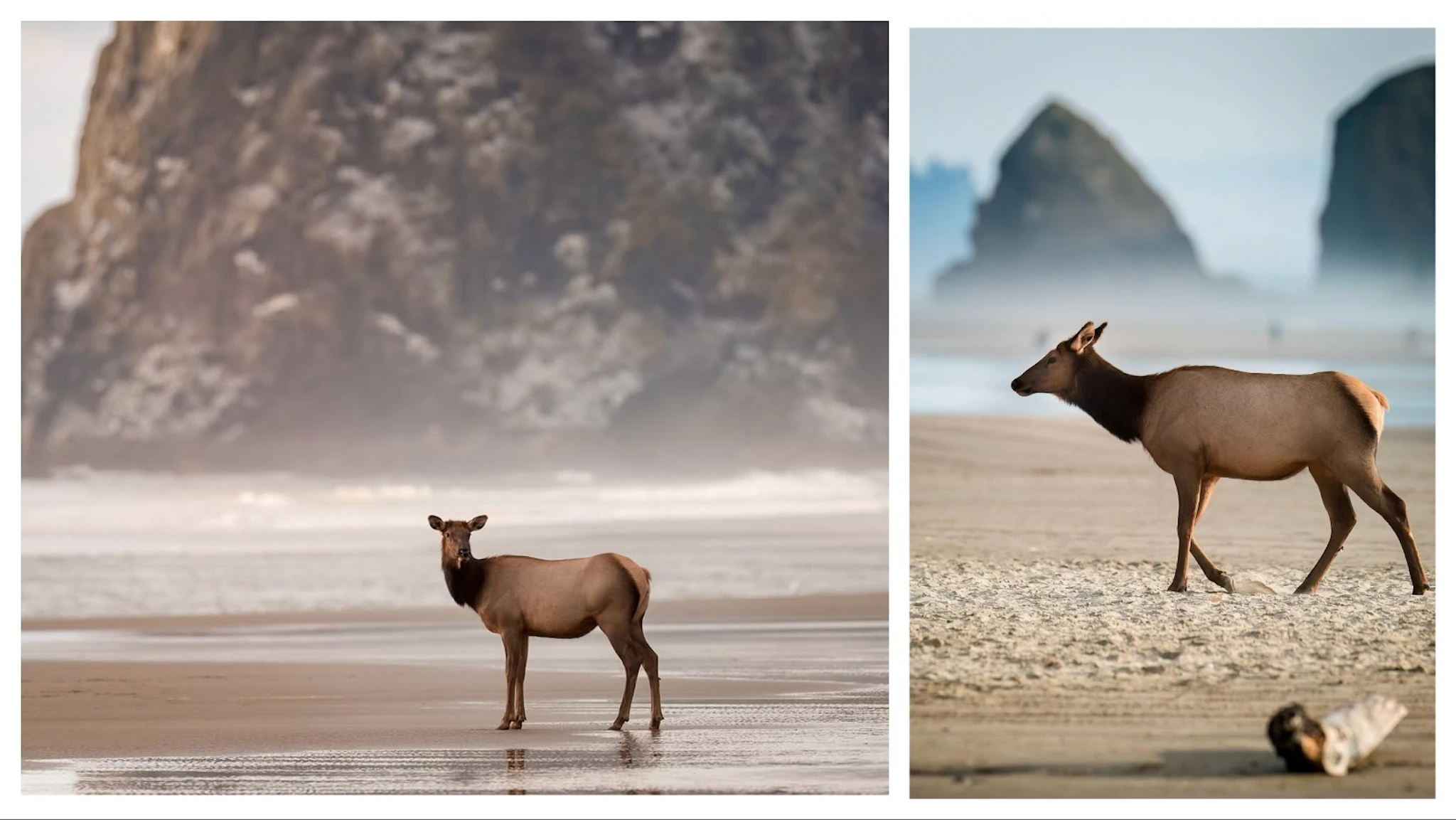
As herds of elk have overtaken a beach in a small Oregon coastal town, tourists have tried to put their children on them to ride and others attempt to feed them carrots. “We have visitors who don't know elk are wild animals,” said the local chamber.
It’s a sight most in Wyoming would consider extremely odd: herds of elk lounging around the beach.
That’s what’s happening in the small Oregon coastal town of Cannon Beach, where elk are taking over the beaches, looking completely out of context in the sand and surf.
And as in Yellowstone National Park, Estes Park, Colorado and other places where people and elk are in close proximity, some people behave stupidly, said James Paino, executive director of the local chamber of commerce.
“We have a lot of visitors who just don't think that it (an elk) is a wild animal,” he said. "I’ve seen people try to put their kids on an elk’s back, or walk up and feed them carrots."
The elk could possibly drawn to the beach seeking saltwater therapy for biting pests.
“It’s not uncommon to see elk going out into saltwater. It’s commonly thought to be therapeutic for external parasites, such as fleas,” said Paul Atwood, a district wildlife biologist for the Oregon Department of Fish and Wildlife.....SNIP
Competing for a Darwin Award.
A society that is supposed to be so concerned about the environment, nature and saving the world. But really they are absolutely ignorant about nature.
Horrific school systems.
These are not Rocky Mountain elk.
These are Roosevelt elk. Big bulls the size of a horse.
Are they native elk or transplants from the Rockies?
I’ll take ‘How to get killed’ for $500, Alex...
Imagine going surf-fishing and an elk comes over a sand dune and eats your bait.
An Elk bit my sister once.
Or was it a Moose?
Important to note that any elk who allows tourists close enough to do this is the first recipient of the stupid award.
I took this picture.
Imagine landing an elk on a fly rod.

Play stupid games, you win stupid prizes.
They have imported elk into North Carolina starting with the National Park; the introduced species is spreading out from there.
I guess bears need something to eat.
It is common in Estes Park, CO. I once came face to face with a bighorn sheep on a sidewalk in Estes Park. I also took this photo from my car of an elk on a sidewalk.

https://biologyinsights.com/can-you-ride-an-elk-the-biological-reasons-why-not/
Can You Ride an Elk? The Biological Reasons Why Not
December 3, 2025
The question of riding an elk requires an examination of the animal’s fundamental biology and evolutionary adaptations. Elk (Cervus canadensis) are large members of the deer family (cervids) whose physical structure and instincts are optimized for life in the wild, not for carrying a concentrated load. The answer is definitively no, due to the incompatibility of elk biology with the demands of a riding animal.
The Unsuitable Skeleton: Load Bearing and Spine Structure
The elk’s skeletal design is engineered for speed, agility, and evading predators, not for supporting the vertical weight of a human rider. The structure of its thoracic and lumbar vertebrae is the primary physical reason it cannot be ridden without severe risk of injury to the animal. A horse’s spine, selectively bred over millennia, features long, prominent dorsal spinous processes in its thoracic region, which form the withers. This specialized bony structure acts as a fulcrum to distribute the concentrated pressure of a saddle and rider across a broad, muscular surface.
The elk spine lacks this specialized weight-bearing architecture, instead possessing a relatively flat, flexible back designed for explosive acceleration and agile movement through dense terrain. Placing a saddle and rider on an elk concentrates a significant amount of weight onto a small area of the back’s softer musculature and vertebrae. This concentrated pressure could easily cause severe soft tissue damage, ligament tears, or even fracture the delicate spinous processes. The biomechanics of the elk’s gait—a powerful, bounding run—are simply incompatible with the unnatural stresses imposed by a rider’s weight.
Untamed Temperament: Instincts and Flight Response
Beyond the physical limitations, the elk’s neurological programming as a prey animal makes it fundamentally unsuitable for riding. Elk possess a highly developed flight response, having evolved to react instantly and violently to any perceived threat, including the presence of a human on their back. Their low threshold for stress triggers a rapid release of stress hormones, which prepares the body for immediate, sustained escape.
Studies show that elk perceive humans as a major threat, sometimes even more so than natural predators like wolves, causing them to enter a state of high vigilance. When startled, an elk can reach speeds of up to 45 miles per hour and clear eight-foot fences, instantly transforming a docile moment into a chaotic and dangerous flight response. Even if an individual were successfully “tamed,” the deep-seated instinct to panic and flee when restrained or stressed remains a powerful, unpredictable force. A rider would also face the danger of the elk’s instinctual defensive actions, which include powerful kicks and, for males, aggressive thrusts of their massive antlers.
The Domestication Barrier: Why Elks Don’t Function as Livestock
True domestication requires a species to meet a specific set of biological criteria, and elk fail several of these tests, making them unmanageable as livestock. The first major obstacle is the elk’s breeding cycle, known as the rut. During the autumn rutting season, bull elk experience a massive spike in testosterone, which drives them into a state of extreme, volatile aggression. This seasonal hormonal surge causes males to attack anything they perceive as a threat to their harems, including humans, making them dangerous and impossible to handle for months out of the year.
Furthermore, successful domestication requires a flexible diet, yet the elk needs a higher quality, more complex balance of grasses, forbs, and shrubs than common livestock like cattle. Finally, domesticated species must have a social structure that accepts a human as a leader within a clear dominance hierarchy, and they must not have an overwhelming tendency to panic. The elk’s powerful, innate flight reflex and the seasonal nature of their herd cohesion violate these fundamental prerequisites for a reliable working animal.
It's as though their understanding of wildlife comes from watching Saturday morning cartoons.
Mess with the sheep, you get the big horns.
“Tourists Try To Ride Elk Which Are Taking Over Beaches In Coastal Oregon Town”. Something else on my bucket list.
While growing up in Montana I read stories every summer about idiots trying to pet the buffalo in Yellowstone and getting gored. The people that try to pet wild animals are the same ones that believe food comes from the grocery store alone.
Disclaimer: Opinions posted on Free Republic are those of the individual posters and do not necessarily represent the opinion of Free Republic or its management. All materials posted herein are protected by copyright law and the exemption for fair use of copyrighted works.