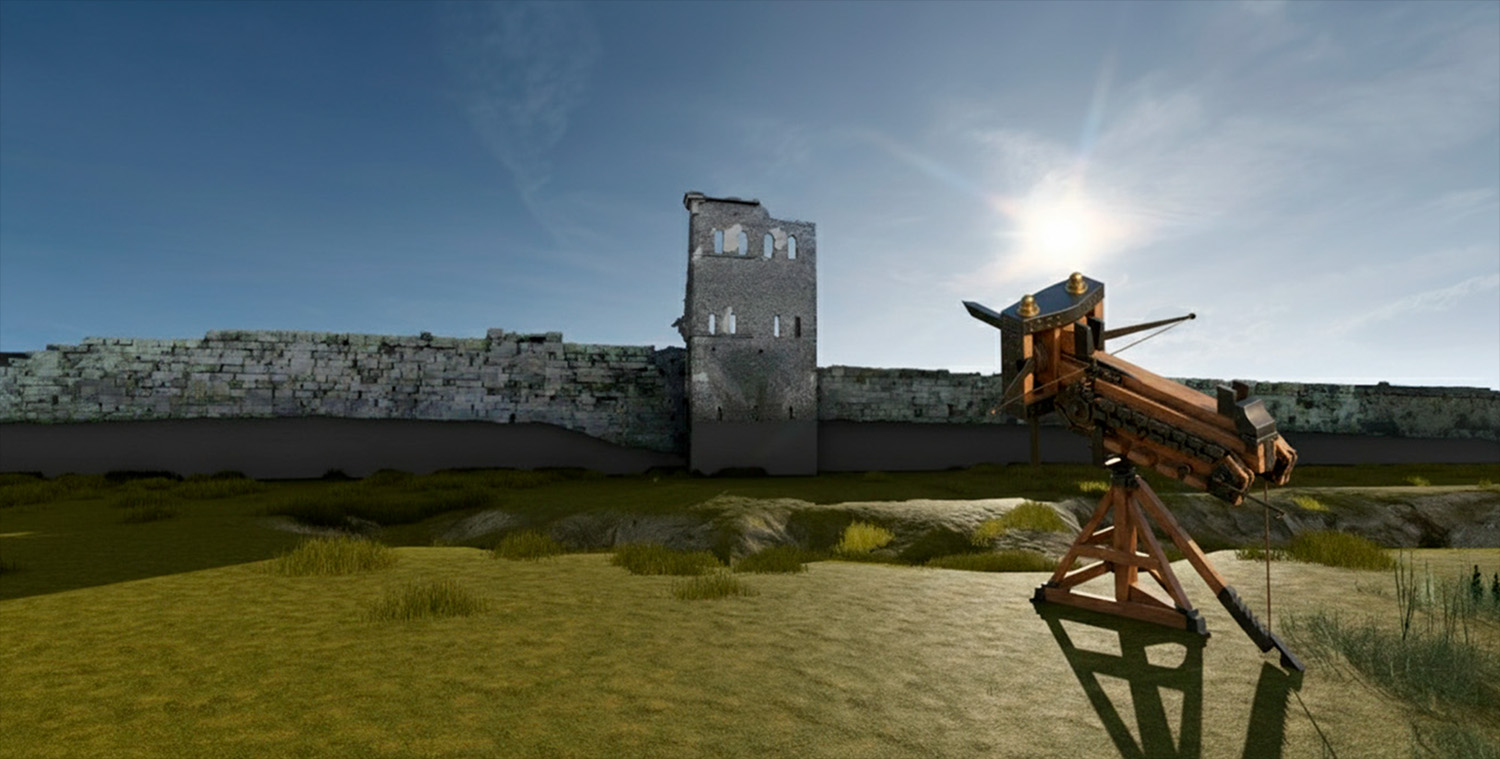
Digital survey and 3D model by Silvia Bertacchirendering by Veronica Casadei
Posted on 04/14/2026 8:35:44 PM PDT by SunkenCiv
The polybolos has long been a legendary weapon of Roman military might, both in the sense that it could inflict tremendous damage and that it may never have existed. But archaeologists and engineers from the University of Campania Luigi Vanvitelli and the University of Bologna have identified ancient artillery holes that they believe correspond to shots from the device, according to a Diario AS report.
The polybolos, literally "multiple thrower," was a chain-driven freestanding catapult that fired metal-tipped bolts from a magazine in quick-repeating succession, automatically, according to a description by Philo of Byzantium, a Greek engineer living in the third century b.c. He attributed its invention to Dionysius of Alexandria. But Philo's description was the only historical or archaeological evidence that this ancient machine gun–style weapon ever existed, and attempts to build one in the twentieth century met with mixed success.
Researchers led by University of Campania engineer Adriana Rossi may have found where a polybolos left its mark, however. Rossi identified several series of square ballistic impact holes, each following a curved path, in the walls of Pompeii... In 89 b.c., Lucius Cornelius Sulla besieged the town when it attempted to break away from Roman rule. His army's artillery rounds can be seen today in the tufa ashlar blocks around the city's Vesuvius and Herculaneum gates, the area where the newly scrutinized firing patterns appear...
Read the original scholarly article about this research in Heritage. To read about an extraordinary ensemble of newly discovered Pompeian frescoes, go to "Pompeii's House of Dionysian Delights."
(Excerpt) Read more at archaeology.org ...
Digital survey and 3D model by Silvia Bertacchirendering by Veronica Casadei
Need to mount that in the bed of a pickup truck.
maybe with a warning sign, “objects in truck may soon be closer than they appear.”
I had no idea Pompeii had tried seceding from the Roman Republic. I’ll definitely check out the site of this polybolos find next time I’m in southern Italy, hopefully next year when we visit Sicily.
I didn’t know there was a University of Bologna. I am guessing there is a university of Salami, and that, nowadays, many universities teach lots of baloney. The Italians recognized that fact a long time ago.
Brrrrrt!
Mostly it was a conquest. A number of cities in Italy (different ethnic groups; Pompeii was Oscan) were allied with Rome. There was an attempt to wrest control of Italy by a previously allied city, Rome’s response was to raise forces to fight back. Pompeii, uh, chose poorly. Rome settled the towns around the Bay of Naples with retired soldiers, and over generations they became more and more Latin. By the time of the eruption, around 150 years had passed and Italy was Roman, probably with some bilingual remnants.
If it hadn’t been for constant attacks (the Etruscans peaked around the time Rome conquered Ostia; a hundred years later the Gauls burned down most of Rome and probably degraded Etruscan capabilities; starting about 220 BC Hannibal spent over a decade trying to defeat and destroy the city, and was allied with and later worked for one of the rump successor states of the Alexandrian Empire) the Romans probably wouldn’t have developed standing armies and created an Empire.
https://en.wikipedia.org/wiki/Social_War_(91%E2%80%9387_BC)
If I recall correctly, I think MythBusters built something very similar…
The Romans were brilliant engineers.
“Bigga Bertha”
😁 and 👍
No one needs that much firepower!!
Yeah, that’s why those were banned by the catapault control crowd.
roman artillery vespasian
https://search.brave.com/search?q=roman+artillery+vespasian&summary=1
Vespasian effectively utilized Roman artillery during the AD 43 invasion of Britain and the Jewish War (AD 66–73), employing coordinated barrages to clear enemy fortifications before infantry assaults. At the siege of Jotapata (Yodfat) in AD 69, he deployed 160 siege engines, including bolt-shooters and stone-throwers, to suppress defenders on the walls and disrupt water-drawing efforts.
His artillery tactics were particularly evident in Britain, where he commanded the Second Legion against heavily defended hillforts like Maiden Castle and Hod Hill.
Archaeological evidence, such as iron bolt heads embedded in chalk and a bolt lodged in a Briton’s spine at Maiden Castle, confirms the use of bolt-shooting catapults (likely scorpiones or early manuballistae) to intimidate defenders and force capitulation.
Key aspects of Vespasian’s artillery deployment include:
Coordinated Fire: Using a mix of catapults (firing long bolts), stone-throwers (firing one-talent stones), fire, and arrows to create an impenetrable barrage.
Tactical Innovation: Employing artillery to cover the advance of legionaries under the “tortoise” formation or to target specific strategic points like gates and huts.
Psychological Impact: Demonstrating the devastating accuracy and power of Roman machines to induce surrender without immediate close-quarters combat.
AI-generated answer. Please verify critical facts.
The people of Mayonnaise showed them how to make Po Boys
Uh ... no.
It makes for a flashy headline but the author doesn't understand (or maybe doesn't care) what an "automatic" weapon is.
Ancestrally, this has more in common with a mechanical timepiece (the escapement) than with any 'true' "machine" gun.
Ha! Good one.
Added to the banglist. There is no restriction in the Constitution for automatic weapons, and certainly not for a weapon used in 89 B.C.
The last sentence tells it all. All AI is is an automated internet search engine. It does searches faster than a human then tries to present the info in a cogent manner. Trade speed for accuracy? Forget it. Good for starting point, but not worth staking livelihood or life on
Disclaimer: Opinions posted on Free Republic are those of the individual posters and do not necessarily represent the opinion of Free Republic or its management. All materials posted herein are protected by copyright law and the exemption for fair use of copyrighted works.