Posted on 01/04/2026 9:57:16 PM PST by SunkenCiv
Mission Success. Haven Demo, our Haven-1 space station technologies test bed is now on orbit and healthy. Watch footage from our onboard cameras in full duration 4K. More to come.
Haven Demo On Orbit | 4K Mission Footage | 2:31
Vast | 18.5K subscribers | 10,566 views | November 4, 2025
Haven Demo @ Vast
SpaceX launches private space station pathfinder 'Haven Demo,' 17 other satellites to orbit (video) | Mike Wall | November 2, 2025
SpaceX rockets the 'Haven Demo' pathfinder module and 17 other satellites into space:
Falcon 9 marks its 140th launch with SpaceX's Bandwagon-4 | posted by Raina Saha | Sunday 11/2/2025 at 10:39AM EST
(Excerpt) Read more at youtube.com ...
Jed McCaleb made billions of dollars on cryptocurrency. Now he's prepared to lose a big chunk of that on a cosmic gamble. One of the original people behind the failed Mt. Gox Bitcoin exchange as well as the cryptocurrency XRP, he's the sole financial backer of an ambitious effort to build the world's first commercial space station and send it into orbit.
If he succeeds, his startup, Vast Space, may be well-positioned to win a lucrative contract from NASA next year -- potentially worth billions of dollars -- to replace the International Space Station. If it's a bust, McCaleb could lose half of his fortune.Meet The Man Betting His Fortune On a Private Space Station | 13:30
Bloomberg Originals | 4.91M subscribers | 186,797 views | April 1, 202500:00 Introduction
00:45 Vast's Mission
01:12 The ISS's Decomission
01:45 Vast's Founder
05:00 Vast's Race to Catch Up
05:47 That Machine Shop / Building a Space Station
09:04 The Speed of Private Industry
09:54 The NASA Contract
10:41 Vast's SpaceX Contracts
12:04 Haven - 1 Qualification Primary Structure
12:36 An Uncertain Future
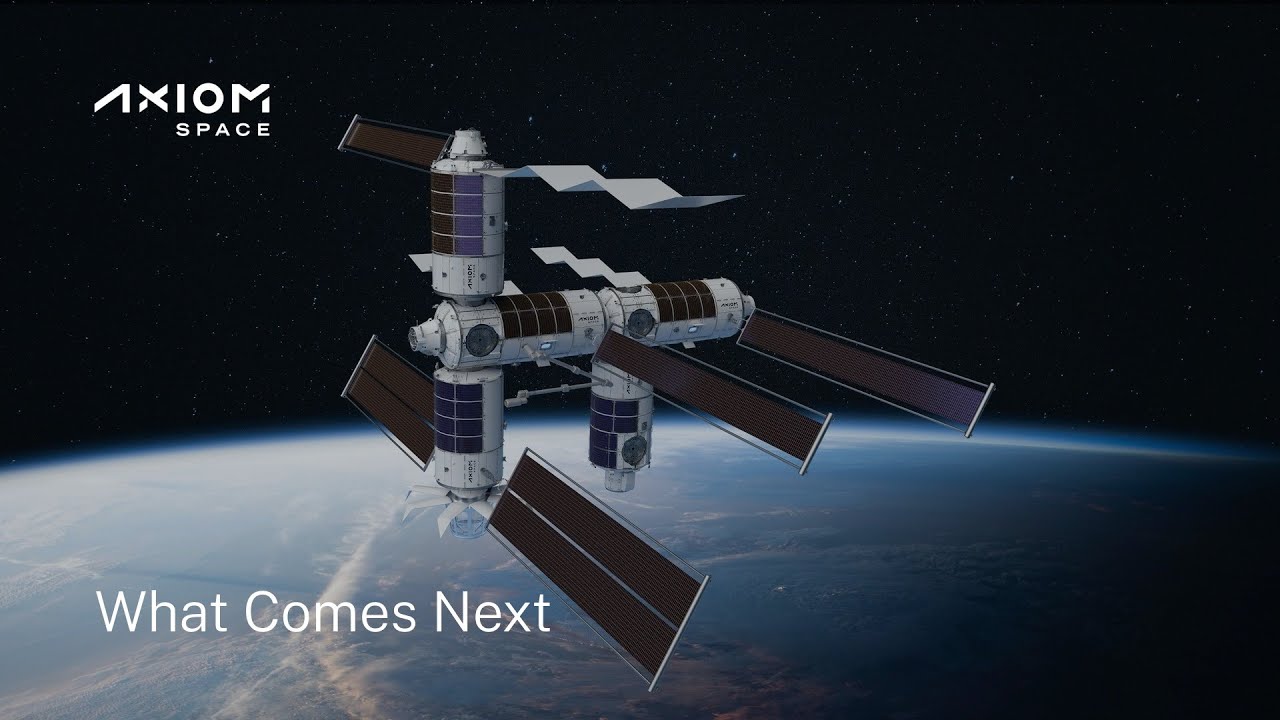
"What Comes Next" showcases Axiom Space's vision to transcend Earth by building era-defining space infrastructure that drives exploration and fuels a vibrant space economy for the benefit of every human everywhere. Tune in to watch our short film to learn more about how we are building what comes next for low-Earth orbit.What Comes Next? | 4:51
Axiom Space | 59.6K subscribers | 27,062 views | November 2, 2025YouTube transcript reformatted at textformatter.ai follows.
[Transcript]
Axiom Space: What Comes Next
There is a generation alive today that has never known a day where every human was on Earth. For them, space has never been a new frontier. For them, the question is not, “Can we live and work in space?” The question is, “What comes next?”
For nearly three decades, the International Space Station has been the home off planet for those in service of humanity — an orbiting laboratory sparking new discoveries, life-changing innovations, and historic breakthroughs. But what comes next?
What comes next matters because what is needed is not just to continue our presence in space, but to enable a new generation to unlock the potentials of microgravity; to invite industry to pose the questions that will give rise to the next age of humanity. How can we transcend the limitations of our planet so that our world becomes a better place to live?
The answer is to establish a platform for nations and researchers to conduct more pioneering investigations than ever before. The answer is to be an orbital forge to unprecedented industrial developments that can scale exponentially. The answer is to maintain a continuous heartbeat just outside Earth’s atmosphere from which humanity can venture ever further out. How do we know? Because we’re the ones already building what comes next.
With flight hardware in Turin, Italy, flight systems in Houston, Texas, and operational confidence in low Earth orbit, the next era of human spaceflight has already begun. Axiom Station is the world’s next space station sequenced to meet the needs of our nation and our customers around the globe.
We’re the only ones permitted to birth a commercial module to the International Space Station. This payload segment will attach to the International Space Station, offering not only cargo capacity, but a right-sized hatch to allow for the transfer of entire research racks. This is a critical solution for saving decades of flight hardware, science, and tech, ensuring the efforts of international partners continue to provide groundbreaking research.
And following closely behind the payload module will be our first crew quarters. On orbit, the two modules will meet and what follows builds out Axiom Station: an airlock for spacewalks and external science, a second habitation module to support four more crew, and then a segment wholly designed around the space strategies of industry, including earth-facing windows unlike anything ever attempted in the vacuum of space.
And yet, building out a station is an undertaking rivaled only by the task of operating it. Success up there requires a steady hand of unseen heroes down here. And ours were the hard-earned badges of space flight. Our people are revolutionizing new methods for success at every turn. From design to development to process, this is who we are. This unwavering confidence comes from those who’ve carried the torch time and time again, whose accolades and hands-on leadership are respected universally.
Microgravity will empower scientists to achieve results in a month that will take years on Earth. This is where levels of precision that have eluded terrestrial engineers will suddenly become the norm, where a network of orbital data centers will process information mass running on infinite power with infinite cooling untethered by the constraints of Earth. Ours is a platform upon which the needs of our tenants can be met at limitless scale.
And as these efforts directly benefit the planet and humanity at large over the next decade, Axiom Station will also serve as a catalyst for deep space exploration. There is a generation at work today preparing for humanity to transcend Earth. These are the ones who may very well live and work in space themselves.
And while some may ask, “Can we further human exploration of space? Can we cultivate a true economy in low Earth orbit? Can we maintain the leadership that’s been established over decades?” You bet we can, because we are Axiom Space. We are what comes next.
When are they gonna build one of those merry-go-round space stations?
Before we do that, I want dashboard CD players in cars again. 🎠💿 In a generation there will probably be one of those in orbit around the Earth, or the Moon, or at one of the Lagrange points. bTW, when people open the airlock of that latter example, a snip of the ZZ Top tune needs to play. Another good location would be in Mars orbit. Of course, anything that gets built will need to be economically viable, which means reusability. A Shuttle-style passenger-focused upper stage to move people to and from these stations will be a necessity.
SpaceX's Starship program is doing far more than preparing for the first Version 3 flight. SpaceX's Starship Is Creating Massive Value at Starbase and across the Rio Grande Valley. In this update, we take a deep look into Starship infrastructure, Version 3 vehicle testing, Gigabay construction, launch site expansion, and how workforce growth is transforming the local community. In fact expected to double to 8,000 workers this very year. SpaceX's presence at Starbase is reshaping the region in a way few industrial projects ever have. We also cover upgrades at Pad 2 and Massey's, COPV validation work, Starlink constellation changes, Falcon 9 updates, Dragon reboost operations for the ISS, and Axioms AxEMU space suit updates. There's a lot happening and in 2026, it is creating insane value!SpaceX's Starship Is Creating Massive Value 🤯 | 21:16
| 574K subscribers | 164,543 views | January 3, 2026
YouTube transcript reformatted at textformatter.ai follows.
[14:41] ...as we rang in the new year. In 2025, 165 Falcon launches along with the five Starship flight tests. As was shared here by Steve and reposted by Elon, SpaceX obviously set a new record for launches in a year, but at the same time launched more rockets in one year than the Space Shuttle, Apollo, and Gemini programs did in their combined history. Falcon alone placed more than 3,800 spacecraft into orbit. A lot of those are Starlink, of course, and what is amazing there is that they have just passed 9 million active users on the system. Along with that, the many rideshare payloads, lunar lander hardware, and national security missions that we know little about.
With the Starship's five flight tests, they pulled off the first-ever Super Heavy reuse and finally got the dummy Starlink satellites to deploy for the first time. Impressive, right!? Well, 2026 is going to be much, much bigger. Actually, a very intriguing update on the Starlink network dropped a few days ago. This is being reconfigured in a significant way this year for a few reasons. SpaceX will be lowering all satellites orbiting around 550 kilometers in altitude and bringing them all the way down to 480 kilometers. That means around 4,400 satellites will slowly shift through the year, which is a little under half of them up there. This is all incredibly complex, of course, and will take massive coordination with the operators involved.
Why are they doing this, though? Well, we are now approaching the next solar minimum in a cycle that lasts around 11 years. Less solar activity actually means that the density of our atmosphere slightly decreases, which results in less drag on all the satellites in low Earth orbit. Lowering the satellites will increase drag on them, which you may think is a bad thing, but each Starlink satellite has a planned lifespan anyway, so this simply re-corrects for the opposite effect caused by the solar minimum. There are some much bigger benefits, though. Lowering the satellites increases safety, and this is because at that altitude the number of debris objects and other planned satellite constellations are significantly lower, so this is a big reduction in the chances of collisions. With the altitude lowered by 70 kilometers, the latency is also slightly lower, which means faster connection speeds. In the entire constellation, there are only two dead satellites in orbit. Even still, if any do die, we want there to be good protection in place. At a lower altitude, if a satellite does fail for any reason, it should deorbit itself due to the increased drag much faster, which is a great thing.
In Elon's reply to me here on this, he mentioned the biggest advantage of all is a lower altitude means that the beam diameter can be smaller for a given antenna size, which essentially means that Starlink will be able to serve a higher density of customers on the ground.
Falcon 9 news for this week has been comparatively slim. The last Falcon 9 flight that was planned for 2025 may have been vertical at pad 4E in California to get ready for flight with the COSMO-SkyMed mission, but problems were soon announced with SpaceX standing down to look into a ground system problem. That was almost a week ago, and they had pushed the launch into Sunday. Well, no, Sunday came and went with another update saying that they needed more time to tinker around with the ground system problem and test it was all working as expected. That was then pushed again, taking us all the way to just last night with the launch finally heading off on Friday evening. Vandenberg lit up there as the CSG-3 mission roared off with Booster 1081 blasting out of the atmosphere for its 21st time. There is the first stage separation of the year for Falcon. No show of fairing separation for whatever reason, but a moment later there was the view of the satellite from the second stage. This was flown just after sunset, so this was also an opportunity to pick up the first space jellyfish of the year. Well, William did just that, and I suspect there are plenty more where that came from. This is only a small satellite, so the booster had plenty of margin to make a full return back to the launch site. Entry burn there and a timelapse of the landing itself coming in to touch down at Landing Zone 4. As always, making that look too easy, and back to the second stage engine cutoff a moment later. That meant that we were just left to watch the beautifully lit up deployment just after the 13-minute mark. This is an Earth observation satellite for the Italian Space Agency, which will form a part of a reconnaissance constellation using synthetic aperture radar.
I think it's also worth special mention of the Dragon cargo on the CRS-33 mission. Three days before the end of the year, it fired up those unique reboost thrusters for another 19 minutes to once again boost the International Space Station into a higher orbit. That, by the way, was actually Dragon's fifth reboost, so it is a success story that has kind of gone a little under the radar. They have just one more planned before Dragon returns to splash down this month. These are only subtle orbit raises, of course, given the size of the station, but this one in particular raised the orbit by about 2.5 km at the apogee and 3 km at the perigee, so raising both the lowest and highest points in the orbit. This is all great news because these successful boosts are paving the way to the big deorbit mission at the end of the station's life around 2030.
Axiom Space just dropped a few more slick behind-the-scenes views of their next-generation lunar spacesuit this week. The AxEMU, seen here right down to the stitching in the fabric, is of course the suit meant to take astronauts back to the Moon's surface, this time aiming for near the south pole on Artemis III. They've been sharing quite a bit on this lately. They've completed the first uncrewed thermal vacuum test of the spacesuit successfully, and in that, they were running it through tests that not only simulated the vacuum but also the harsh temperatures they would expect to see in a real mission. It's great to see the thermal performance holding up to all that scrutiny, and it's much more complex than it all seems. The layered construction of the materials, the way the joints are designed to move with all these pressure differences, it's hard to make something both flexible and durable enough to hold up with all the various forces applied to it over a long period of wear time.
So there you have it, my friends, the first video of 2026 all wrapped up. I hope you enjoyed this video! If you did, the subscribe button down there does not press itself. If you want to continue with more space goodness, do us a huge favor and smash this one. With the holidays going on, many of you have probably missed it. Thanks for watching all this way through, I hope you had a wonderful New Year! I will see you all in the next video!YouTube transcript reformatted at textformatter.ai follows.
Disclaimer: Opinions posted on Free Republic are those of the individual posters and do not necessarily represent the opinion of Free Republic or its management. All materials posted herein are protected by copyright law and the exemption for fair use of copyrighted works.