Posted on 12/07/2025 5:57:07 PM PST by Red Badger
A lost 16th-century ship buried deep in a Namibian desert has stunned archaeologists with a treasure haul that rewrites the story of early global trade.
In Namibia’s remote Sperrgebiet—a name that translates from German as “forbidden zone”—miners looking for diamonds stumbled upon something far more valuable: the buried wreck of a 16th-century Portuguese carrack, laden with gold, ivory, and copper.
Preserved beneath the hyper-arid sands of the Namib Desert, the ship, identified as the Bom Jesus, disappeared in 1533 while en route to India. Discovered in 2008 within a high-security mining concession near Oranjemund, the site quickly drew attention from marine archaeologists, climate scientists, and historians alike.
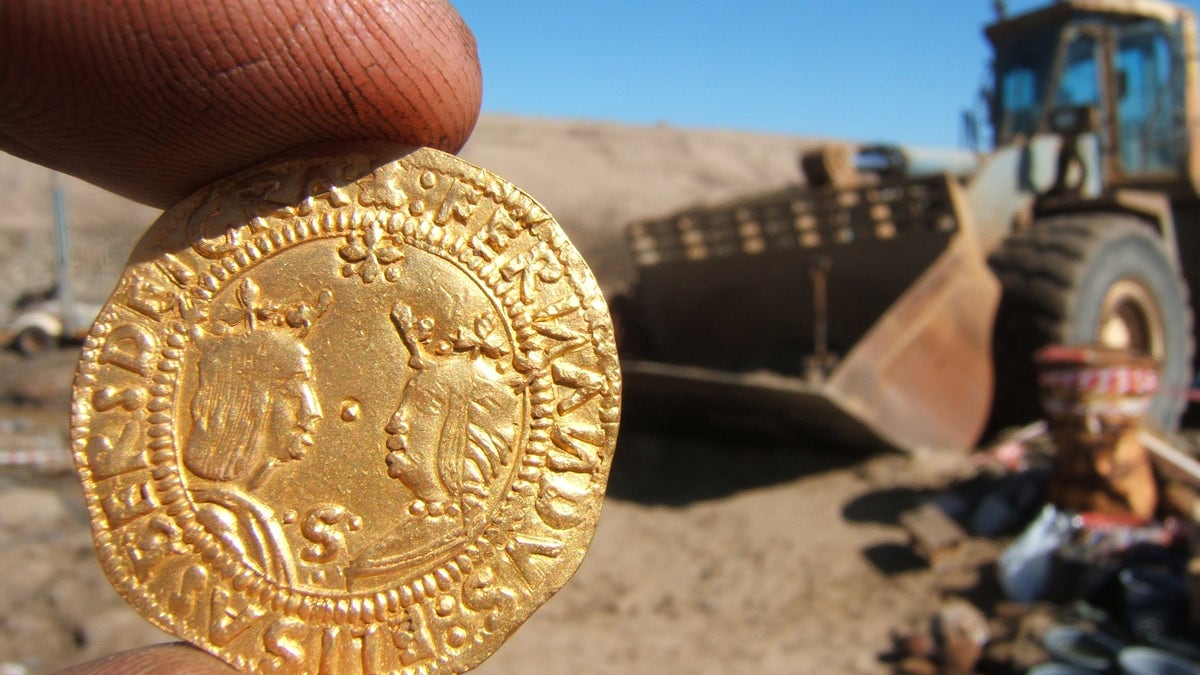
The Bom Jesus was carrying over 2,000 gold coins, 22 tons of copper ingots, and dozens of West African ivory tusks, revealing a near-intact cargo system spanning Europe, Africa, and Asia. The vessel, likely driven off course by a violent storm near the Cape of Good Hope, had been completely engulfed by sand over the centuries—shielded from scavengers, seawater, and even time.
Sealed by Sand, Not Sea
Unlike most historic shipwrecks discovered in deep ocean trenches or shallow bays, the Bom Jesus was located inland—several hundred feet from the Atlantic coast. Its exceptional state of preservation is thanks to the extreme aridity and sediment stability of the surrounding Namib Desert. A 2014 peer-reviewed study in Quaternary International confirmed that the region’s climate, combined with shifting coastal morphology, created a rare preservation chamber for the vessel’s timber, cargo, and even fabric fragments.
One of the gold coins discovered in the Namibian shipwreck. Credit: Dieter Noli
“This is not just an archaeological site; it’s a sealed economic time capsule from the Age of Discovery,” said Dr. Bruno Werz, director of the African Institute for Marine and Underwater Research, Exploration and Education (AIMURE), in an official research summary. “We’re dealing with a ship that tells the story of early globalization through physical evidence—not fragments, but full systems.”
The ship’s cargo includes copper ingots marked with the trident seal of the Fugger banking dynasty, confirming that German financiers were backing Portuguese voyages to the Indian Ocean—a little-documented detail in early colonial trade history. Additionally, a large volume of Spanish excelentes—coins rarely seen aboard Portuguese ships—suggests that Spanish investors may have had an unusually high stake in the 1533 fleet, a theory supported by a letter discovered in Lisbon’s royal archives, as cited by maritime historian Alexandre Monteiro in ResearchGate.
No Dispute, No Diplomacy Namibia’s ownership of the Bom Jesus was never contested. The vessel was found in a diamond mining concession operated by Namdeb, a joint enterprise between the Namibian government and De Beers Group. Within days of the discovery, mining was suspended, and an archaeological team was assembled. Unusually for such a high-value find, there was no legal battle over ownership.
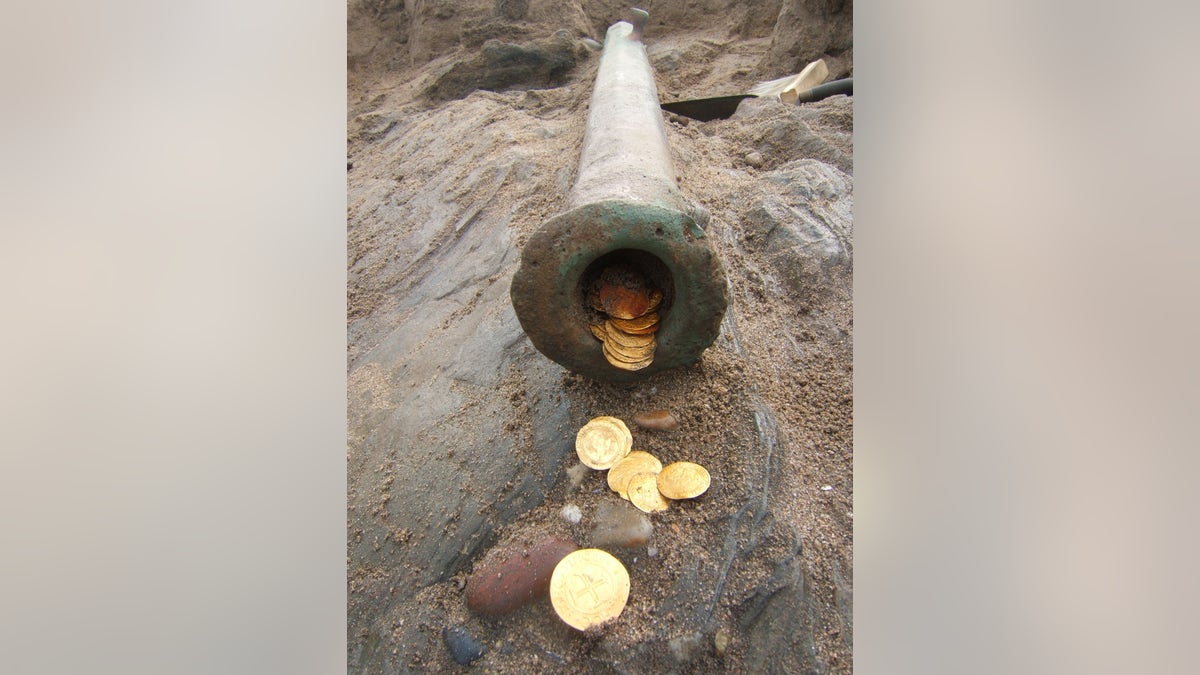
Gold coins and a cannon discovered in the Namibian shipwreck. Credit: Dieter Noli
Under the 2001 UNESCO Convention on the Protection of the Underwater Cultural Heritage, the wreck legally belongs to Namibia. Portugal, though a signatory and the ship’s origin state, declined to pursue any claim. This decision has been widely praised as a model for ethical maritime heritage policy.
“This is how international cooperation should function,” Monteiro told National Geographic in a 2022 interview. “There’s no question the wreck is Namibian. And the country has acted with professionalism and vision in managing it.”
A Human Story Beneath the Trade Networks
The Bom Jesus was part of a fleet that departed Lisbon in March 1533. Historical naval logs and visual documentation in Memória das Armadas—an illustrated chronicle of Portuguese fleets—mark the Bom Jesus as “perdido” (lost) near the Cape. Monteiro’s archival work uncovered investor letters confirming that over 20,000 Portuguese cruzados in gold had been transferred to Seville just weeks before the fleet sailed—further suggesting complex Iberian financial collaboration.
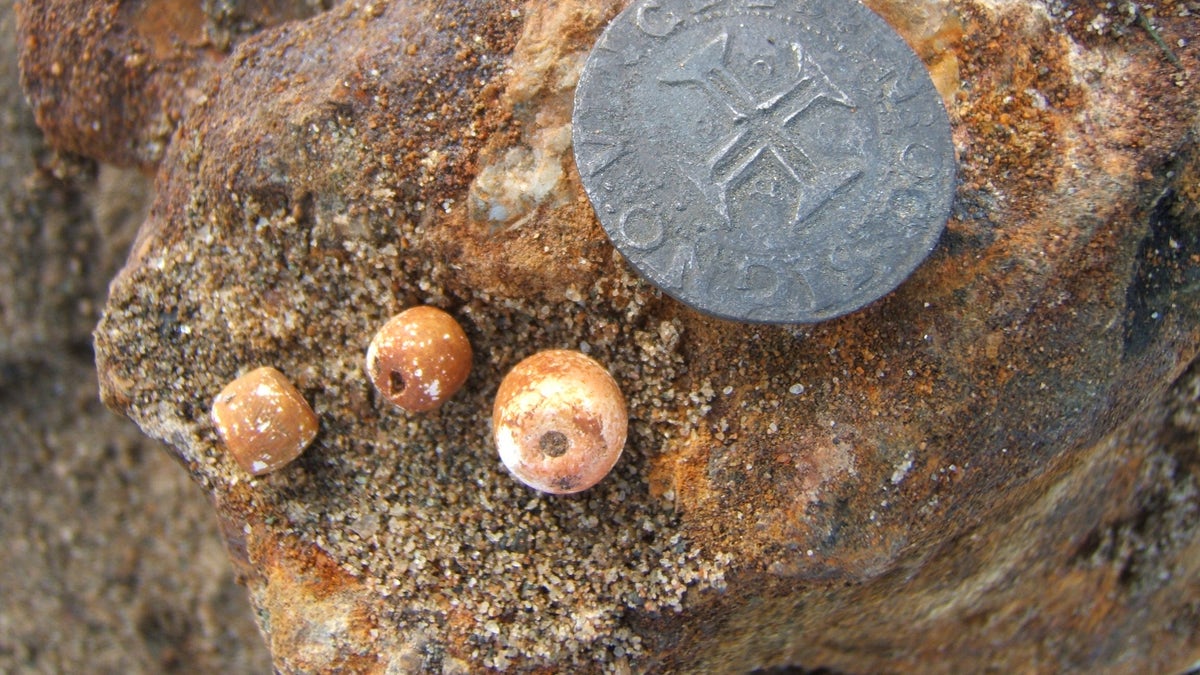
A coin and rosary beads discovered in the Namibian shipwreck. Credit: Dieter Noli
Though over 300 crew, clergy, and soldiers were likely aboard, only one human bone fragment, a toe found inside a decaying shoe, was recovered. This suggests many may have survived and reached land. Dr. Dieter Noli, the chief archaeologist on site and head of AIMURE’s excavation team, told Namibiana that access to the Orange River, just 25 km south, may have offered a lifeline.
“The desert looks lifeless, but for survivors in 1533, it may have offered food, water, and contact with local San communities,” Noli noted.
Reshaping the Maritime Narrative
The Bom Jesus challenges prevailing assumptions about early modern exploration. The ship is evidence that 16th-century European empires operated within deeply interconnected systems—drawing on multinational funding, complex trade commodities, and vast maritime knowledge long before the rise of corporate colonialism.
Namibia, meanwhile, is planning a maritime museum in Oranjemund to house the artefacts, positioning the country not just as a guardian of lost European heritage—but as an active narrator of African maritime history. According to Namdeb’s sustainability mission, heritage and economic development are now part of a unified agenda.
There are still unresolved puzzles: why did the ship veer so far north? What happened to the survivors? How many more such wrecks lie buried, not beneath oceans, but in unsearched deserts?
Exactly what I was thinking.
Sounds like a Clive Cussler novel...
Mark
Brings back memories of an old movie A TWIST OF SAND(1968) in which a diamonds hidden in an old ship on the Skeleton coast.
https://www.imdb.com/title/tt0063728/
Bkmk
I hadn’t heard about that one but doesn’t surprise me.
Disclaimer: Opinions posted on Free Republic are those of the individual posters and do not necessarily represent the opinion of Free Republic or its management. All materials posted herein are protected by copyright law and the exemption for fair use of copyrighted works.